








Is the 50-day "Shovel Season" coming to an end?
TechFlow Selected TechFlow Selected
Is the 50-day "Shovel Season" coming to an end?
After the hype fades, holders have two choices: wait for the project team's "vision" to drive progress and improve the project, or rush toward the next trend.
 Navigating Web3 tides with focused insights
Author: Joyce, BlockBeats
Editor: Jack, BlockBeats
In the final two months of 2023, the "shovel craze" emerging from the Bitcoin ecosystem delivered surprisingly strong wealth effects. MUBI and BSSB lifted AUCTION and TURT, followed by BAKE—each "shovel token" enjoyed a brief period of doubling within days. Within the crypto community, many began drawing parallels between this IDO boom and the ICO/IEO waves of 2018–2021, viewing it as a powerful catalyst for a new bull market.
However, from Bounce Brand’s MultiBit IDO and MUBI launch on November 12, 2023, to January 1, 2024, the "shovel market" appeared to have risen and fallen within just 50 days.
Turning Stones into Gold
In early November 2023, Binance's announcement of launching 1-50x U-margined perpetual contracts for ORDI pushed the Bitcoin ecosystem to new heights. A surge in BRC-20 tokens followed, with Bitcoin-related assets accumulating to a significant scale. With capital flowing in, infrastructure protocols serving these assets entered the spotlight—cross-chain protocol MultiBit and DeFi protocol BitStable quickly became focal points. Naturally, IDO platforms facilitating early participation in such projects also stepped into the limelight.
After Two IDOs, Bounce Takes Off
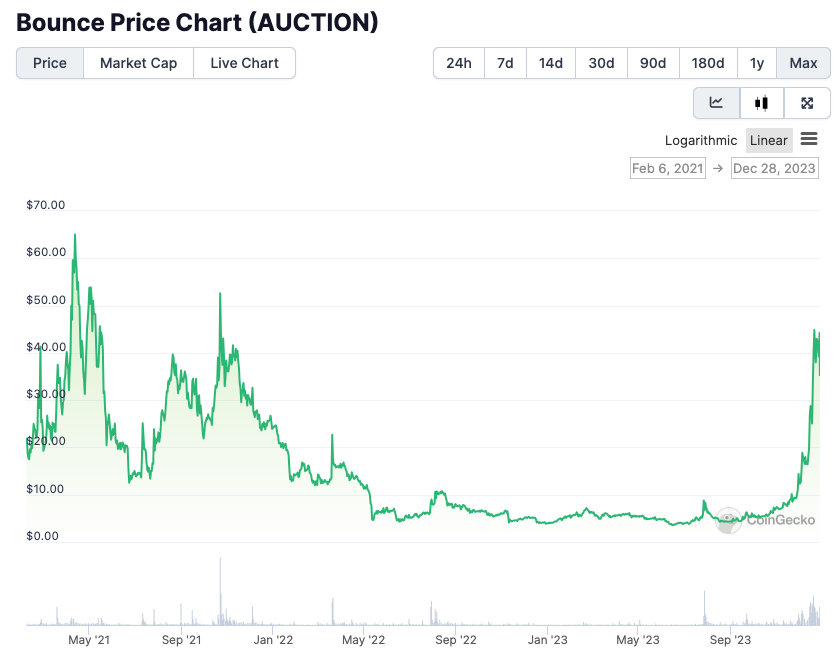
Leading the charge was Bounce Brand, a decentralized auction platform launched on Ethereum in 2020. In 2021, Bounce V2 introduced an initial IDO feature and rode the wave to push its native token AUCTION to $60 at peak. For much of 2023, however, AUCTION traded below $10, and Bounce’s TVL hovered around $2 million.
In mid-November, AUCTION suddenly surged, gaining over 500% in the following month and returning to its 2021 highs.
On November 12, the ERC20-to-BRC20 cross-chain protocol MultiBit completed its MUBI token auction on Bounce Brand at an IDO price of $0.00047, raising 88 ETH.
At that time, the Bitcoin ecosystem hype had just begun—ORDI had doubled from $5 to $21 in two weeks, and cumulative Ordinals inscription revenue had just surpassed $88 million. Capital had only recently started flowing in; Bitcoin ecosystem tokens were heating up, but limited liquidity remained a key barrier preventing broader investor participation.
As the first cross-chain bridge project in the Bitcoin ecosystem, MultiBit offered a path toward liquidity for funds locked in Bitcoin-native assets. With strong narrative appeal, MUBI naturally attracted investor attention. It surged fourfold within four days post-IDO.
During this period, Bounce quietly gained momentum—AUCTION rose approximately 17% over the next two weeks.
On November 27, seeing early success, Bounce announced that BitStable, a Bitcoin ecosystem DeFi protocol, would launch its native token BSSB via Bounce Launchpad two days later. Users could stake AUCTION or participate through auctions to secure BSSB allocations. Within two hours of the announcement, AUCTION jumped over 15%, and by the IDO day (November 29), it surged more than 35% in a single day.
By December, MUBI had grown nearly 50x from its IDO price over the prior month, while BSSB achieved a stunning 45x return in 20 days. Thus, Bounce’s next IDO became perceived as a “guaranteed wealth event.” On December 11, Bounce announced the upcoming launch of GoDID (BDID), a DID marketplace aggregator. From announcement to completion, AUCTION climbed over 200%.
Capitalizing on momentum, on December 19, Bounce Launchpad unveiled a “Two Birds, One Stone” token issuance strategy—two projects issuing a single token. Users could stake AUCTION or DAII, the stablecoin from BitStable Brand (BSSB). At the time, BSSB had hit a new high above $8.60. From announcement to completion, AUCTION rose another 90%, reaffirming its “gold content.”
Six-Month Wait, TURT Up 20x in a Month
TurtSat also benefited from the MUBI boom. Founded in May 2023, TurtSat positioned itself as a “donation platform focused on the Bitcoin Ordinals ecosystem,” launching shortly after the emergence of the Ordinals protocol when Bitcoin’s potential was just beginning to surface. Before MultiBit, TurtSat had conducted only one IDO—for Chamcha, a developer enabling programmable liquidity for Ordinals assets.
TurtSat conducted its MultiBit IDO on the same day as Bounce, raising 4.64 BTC. Afterward, TurtSat began attracting community attention due to its faster-than-average IDO pace and tight focus on Bitcoin-native projects.
On November 24, NxHub—an Ordinals aggregation marketplace—launched its NHUB token on TurtSat, which multiplied 20x in two weeks. Three days later, TurtSat revealed Dova Liquidity Protocol, a Bitcoin ecosystem LSD protocol integrated with the MultiBit bridge. Dova completed its IDO on December 1, and DOVA rose 15x in two weeks.
While core infrastructure was still far off, gaming concepts emerged in the Bitcoin ecosystem. On December 8, TurtSat IDO’d Rabbitgames, a “revolutionary Bitcoin ecosystem gaming platform.” Although RAIT dropped 50% shortly after listing, it recovered three days later with a fivefold gain over three days.
For investors, not every new project offered sustained upside like MUBI. Therefore, beyond simply holding platform tokens for appreciation, staking and participating in new launches became more attractive profit strategies. On December 6, TurtSat launched its TURT POOL staking system. By staking TURT, users earned “EGG,” a new asset issued by TurtSat. EGG could be used for voting on project listings, redeeming partner token gift packs, and more.
According to TurtSat’s official statement, this was a new way for users to participate in project launches—balancing fairness and efficiency while effectively preventing bots from hijacking large donation shares, ensuring fair rights distribution for TURT holders.
After lying dormant for half a year, TurtSat’s strategic positioning paid off, capturing market attention and capital. The most direct result? TURT’s price soared 20x in one month.
Amid the Bitcoin ecosystem frenzy, Bounce Brand and TurtSat stood out with unique positioning. The success of this “dual-shovel combo” showcased the potential of IDO platforms, bringing new narratives forward and injecting liquidity into emerging ecosystems. In the new bull cycle, shifting dynamics will spawn more new projects—and IDO platforms may prove the most efficient link between markets and project teams.
Everyone Seems to Win
In the constantly evolving narrative landscape of the Bitcoin ecosystem, people keep buying into new stories—even if they’re not yet grounded in reality. As TURT and AUCTION took off, more investors and projects turned their eyes to the “shovel track.” No one wanted to miss out amid the frenzy—it seemed the crypto market was entering an IDO Summer.
From Inscription Mania to “Solana Shovels”
Projects need funding; investors want early access to project tokens—thus IDO platforms emerged to help teams launch tokens, raise capital, and provide liquidity. Now, even inscriptions and memes without intrinsic value have dedicated launch platforms.
On December 13, Pland—an early Ordinals OG and Solana developer—launched Analysoor. According to Pland, he was inspired by Solana inscriptions (sols). Analysoor leverages Index Protocol’s off-chain indexer and Solana’s historical data to prevent bot manipulation, aiming for fairer meme coin distributions and better liquidity guidance.
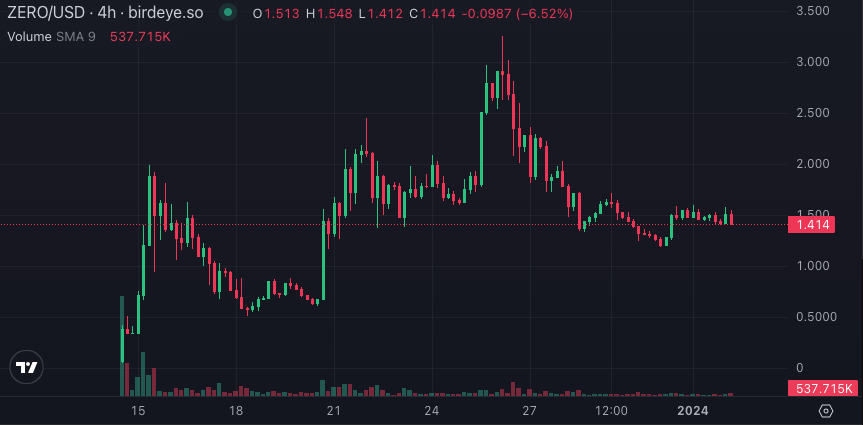
Analysoor’s first deployed inscription was ZERO, with a total supply of 21 million—10.5 million minted at 0.08 SOL each, raising over $600,000. However, delays and wallet address errors during the NFT series “ONE” launch raised community doubts about Analysoor’s capabilities. ZERO’s price fell steadily, seemingly destined for oblivion like so many other memes.
Then, on December 20, Pland announced in Analysoor’s Discord that the platform would launch a community-driven meme coin. Analysoor would only handle token creation and lock liquidity pools. Of the total supply, 48.5% would be minted via 0.05 SOL + 1 ZERO, with proceeds stored as ZERO liquidity. Additionally, 3% of the meme coin would be airdropped to holders of ONE.
Analysoor further announced it would continue deploying new projects, with ZERO participating in every deployment until its total supply reaches 5%—a move intended to enable listing on a top-three centralized exchange. Raised funds would then support ZERO’s liquidity post-listing.
At this point, ZERO ceased being an experimental project and gained “golden shovel” status. Its price began rising from December 20, breaking $2 by the 22nd. After a 60% drop over two days, it rebounded sharply with a 250%+ gain over the next two days.
From BRC20 to Bitcoin Gaming, IDO Oversubscribed by $100M
Another platform that rose to fame through Bitcoin ecosystem IDOs is BakerySwap, an AMM from the BSC ecosystem. Prior to December, BAKE hadn’t exceeded $0.30 throughout 2023. But from December 19 to 26, three IDO announcements propelled BAKE in a “triple jump,” gaining over 300% in a week.
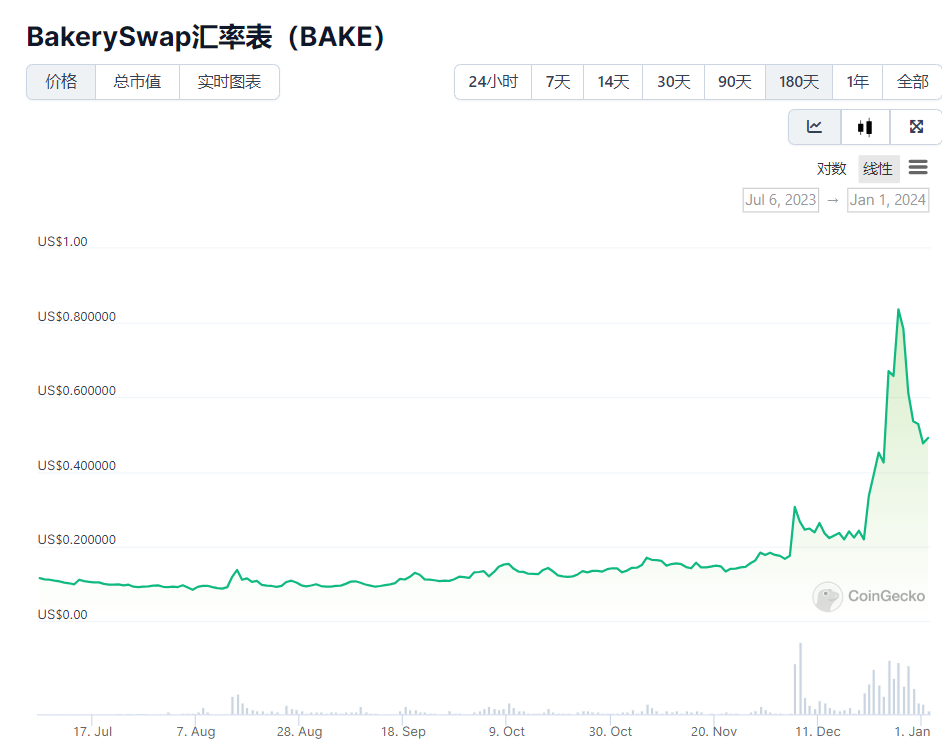
On December 19, BakerySwap launched its first Launchpad, featuring Bitcoin Cats—a Bitcoin-based game project. The initial release included 2 billion 1Cat tokens, with a cap of 2 ETH per participant and double allocation for whitelist members. The sale lasted two hours, attracting 37,383 ETH and 73 million BAKE—totaling $106 million in value and oversubscribed by 150x.
The next day, 1Cat listed on Uniswap, BakerySwap, and others, surging over 15x at open. Market attention immediately shifted to this new shovel, and BAKE responded with a 64% gain.
With Bounce and TurtSat setting precedents, investor sentiment had become highly responsive. On December 24, BakerySwap announced its next Launchpad project, BitLand (BLLB)—an AI-powered 3D metaverse built on the Bitcoin ecosystem—sending BAKE up 57% that day.
On December 26, BakerySwap announced a third Launchpad project was coming, though no details were shared—only that it was backed by Binance Labs with an FDV of $630,000. Upon news release, BAKE rose 28% that day.
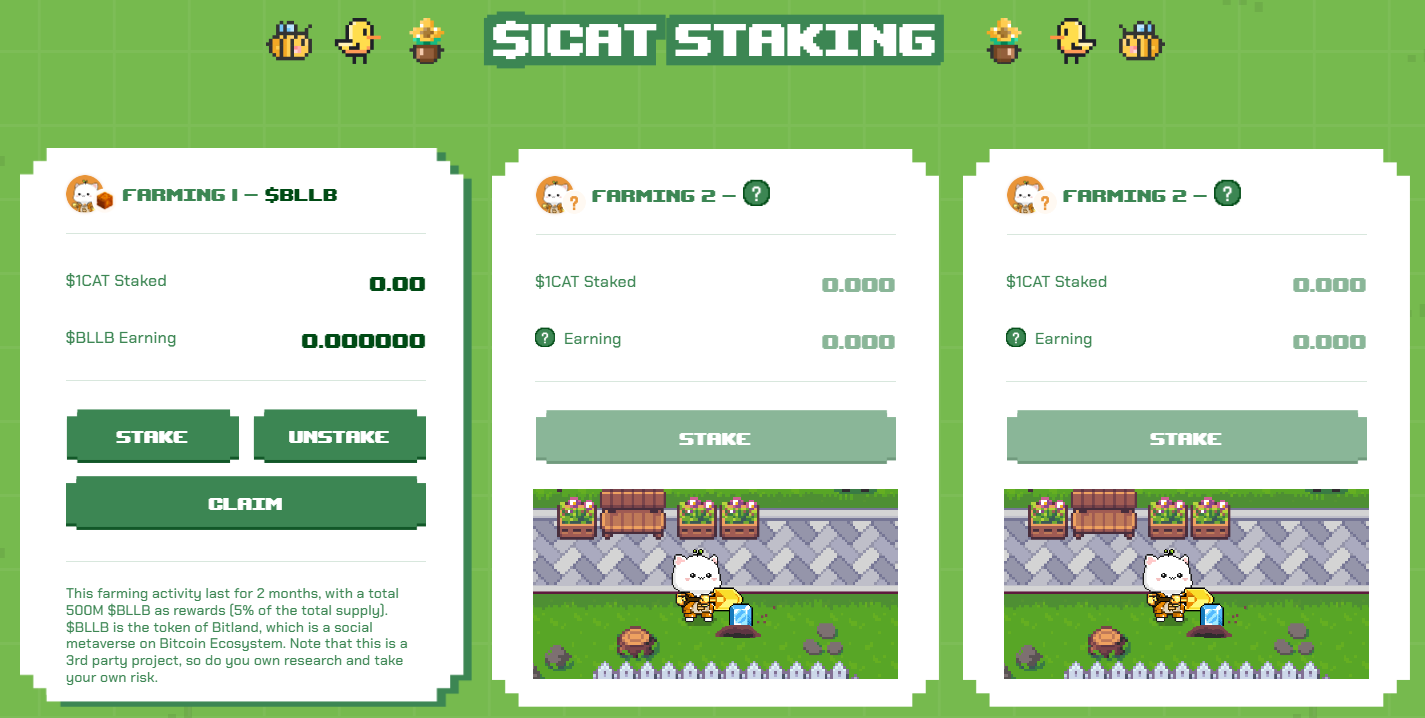
Shovel stacking began. On December 25, Bitcoin Cats announced its “1CAT Golden Shovel Program,” allowing users to stake 1CAT to earn partner ecosystem tokens. For the next two projects on BakerySwap’s Launchpad, both BAKE and 1CAT could be used for participation—making 1CAT not only the primary in-game asset of Bitcoin Cats but also a “golden shovel” to access a broader ecosystem.
DeFi protocols also began pivoting into the space. On December 25, NFT+DeFi aggregator Dego Finance announced completion of beta testing for its BRC20 Launchpad. Following the news, its native token DEGO surged past $4.20, up 64.1% in 24 hours.
On December 27, decentralized leverage trading platform LeverFi announced the launch of its BRC20 Launchpad, LeverPro. Upon announcement, LeverFi’s native token LEVER spiked to $0.0025, gaining over 50% in 24 hours.
The shovel wealth effect wasn't limited to the Bitcoin ecosystem.
TonUP, an asset issuance platform based on the TON blockchain, launched in August 2023 and completed its first IDO by month-end. On December 20, TonUP powered Bitget’s new Launchpad round—within one hour of opening, over 6,700 participants committed more than 17 million BGB tokens.
The shovel fever even spilled into the smartphone market. Solana Saga phone, released in 2022 and largely ignored for a year, gained breakout attention due to Bonk meme coin airdrops. It saw a 500% premium on eBay, selling for as high as $3,000—reviving a device once widely criticized.
Gold Mine or Red Ocean?
As new shovels emerge, can older ones retain appeal? For IDO platforms, competition demands constant demonstration of competitive advantages.
For projects waiting for IDO slots, positioning advantages in hot ecosystems are fleeting. After DeFi protocols like DEXs, stablecoins, and bridges captured attention, within less than two months, application-layer projects—from inscription management and trading tools to Bitcoin-based games and metaverses—began appearing, each vying for community attention under the banner of “first X on Bitcoin.”
Doubling Slows Down, Golden Shovels Lose Their Shine
The bubble quietly deflated. TurtSat holders may have been among the first to notice. While BAKE was making its triple jump, on December 21, TurtSat announced a partnership with DWF, briefly pushing TURT above $0.10. Soon after, TURT began falling, dropping over 40% from its peak within three days. At the time of writing, TURT traded at $0.04.
Some in the community believed that BakerySwap’s entry diluted TurtSat’s edge as a “Bitcoin-focused IDO platform,” causing it to lose investor interest. But reviewing the performance of TurtSat’s launched projects reveals earlier warning signs.
On December 14, TurtSat completed the Svarga IDO. Promoted as aiming to reshape the NFT world on Bitcoin by turning traditional PFP NFTs into dynamic, interactive Avatars, Svarga initially doubled in three days—then began declining.
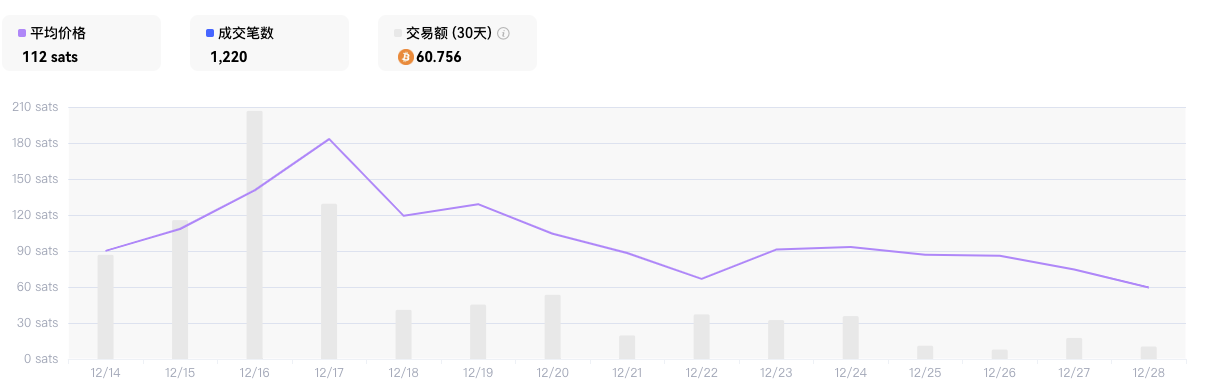
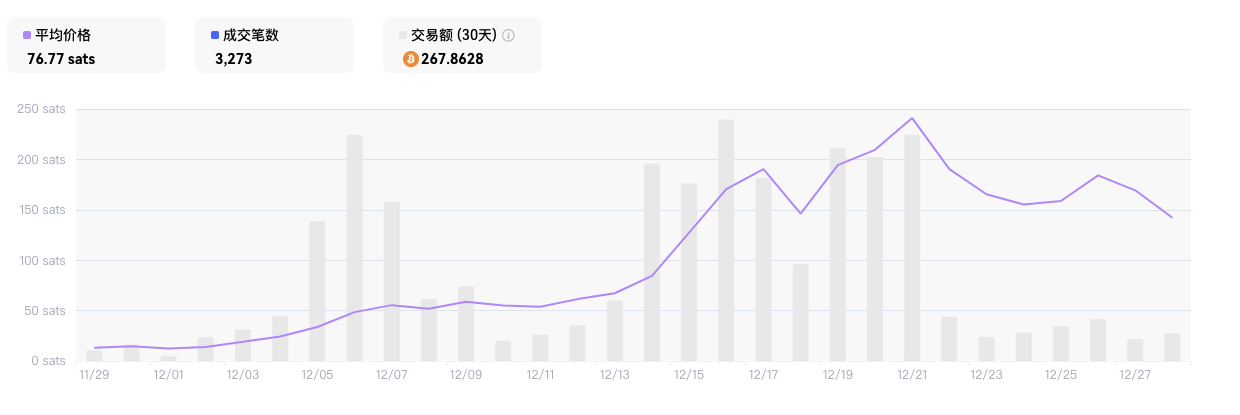
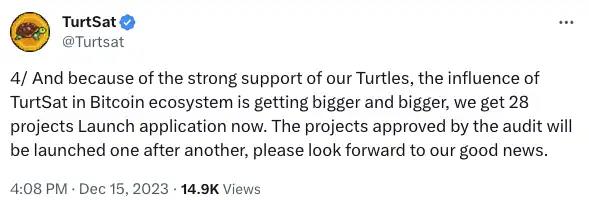
After launching Svarga, TurtSat announced on social media that it had received 28 IDO applications, all set to roll out gradually. At that point, TurtSat had hosted more Bitcoin ecosystem projects than Bounce Brand and BakerySwap combined. Yet subsequent project performances disappointed. ZOOA, launched on December 19, failed to double. QUIQ, launched on the 28th, followed a “peak-at-launch” trajectory—per OKX data, it saw 2.9 BTC in trading volume on launch day, but just 0.03 BTC three days later.
Struggling project momentum wasn’t unique to TurtSat. On the other side, although 1Cat opened strong, its follow-through was weak. It gained less than 20% in the three days post-launch. Only after the December 25 announcement of the “1CAT Golden Shovel Program”—allowing 1CAT to participate in BakerySwap’s next two IDOs—did its price climb again, gaining over 150% in two days. That may well have been its peak.
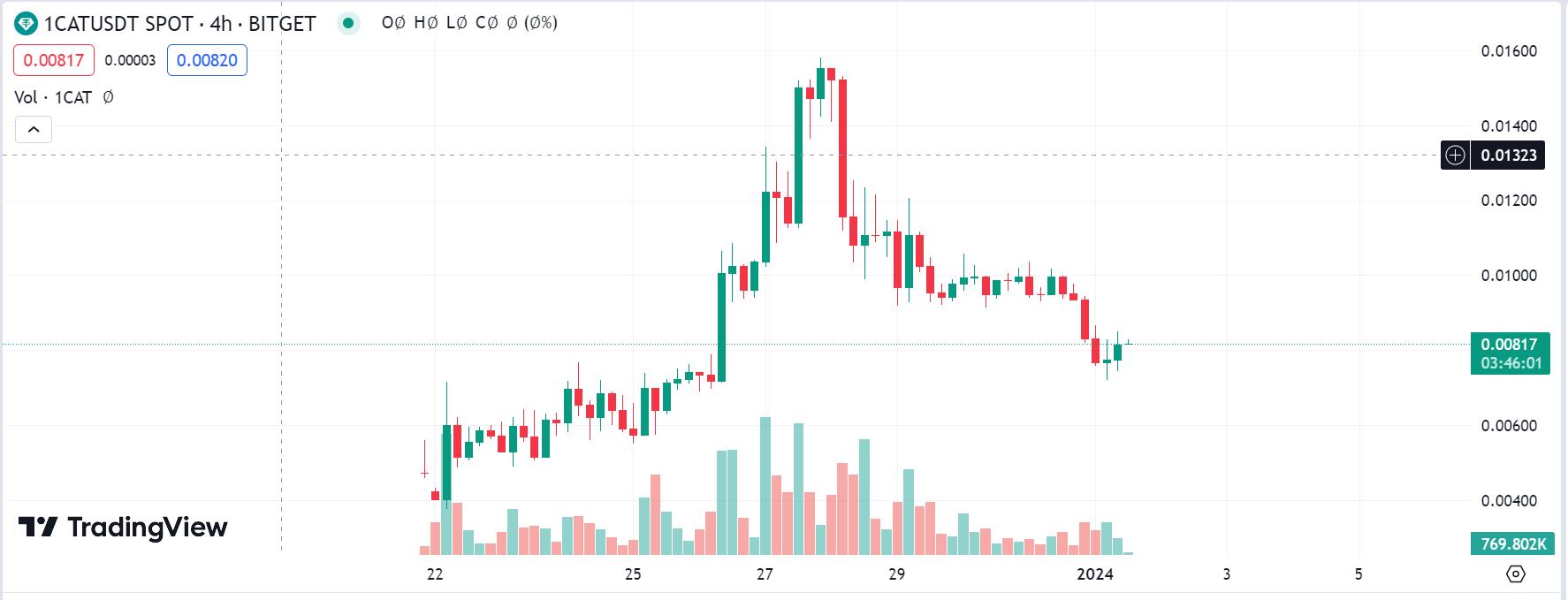
Token price gains are the most immediate signal—but not the only one. These projects are all less than a month old. Whether any can build lasting consensus and deliver ongoing returns requires deeper evaluation. So, what about the long-term potential of these platforms?
“Growth Flywheels” Are Just Pie-in-the-Sky Promises
IDO platforms must demonstrate growth potential in two areas: first, the post-launch performance of their projects. Token price appreciation is the clearest indicator—but not the sole proof. Project history, team background, and business execution also factor into user decisions. Yet issues are already visible—and not limited to one platform.
On December 15, Bounce Brand faced backlash over allegations that BDID, a project on its Launchpad, had used tokens meant for airdrops in private presales. AUCTION, previously rising, briefly pulled back over 20%.
On December 21, TurtSat announced Copycat Dex as its latest IDO. Described as an innovative P2P derivatives protocol based on PVPAMM, supporting the BRC20 ecosystem and Bitcat DEX, developed by BinanceLabs-backed Copycat Finance.
But the community quickly pointed out poor delivery records—the team’s 2021 project now trades below 3% of its launch price—raising concerns about TurtSat’s “curatorial standards.” Twelve hours later, TurtSat announced a delay in launching the BICA token.
BitcoinCats, the project that brought BakerySwap into the shovel game, was marketed as a GameFi platform for the Bitcoin ecosystem: “Mapping Bitcoin assets (BRC20, Ordinals NFTs, etc.) to Ethereum (and other Layer 2) networks to unlock new utilities including Play-to-Earn, staking, yield farming, and SocialFi.”
From the start, some community members noted BitcoinCats’ visual similarity to Worldwide Webb, a pixel-art MMORPG metaverse game familiar to NFT circles and backed by millions in funding. Others observed that BitcoinCats closely resembled BakerySwap’s earlier NFT collection Hello Pets—except styled in pixel art.
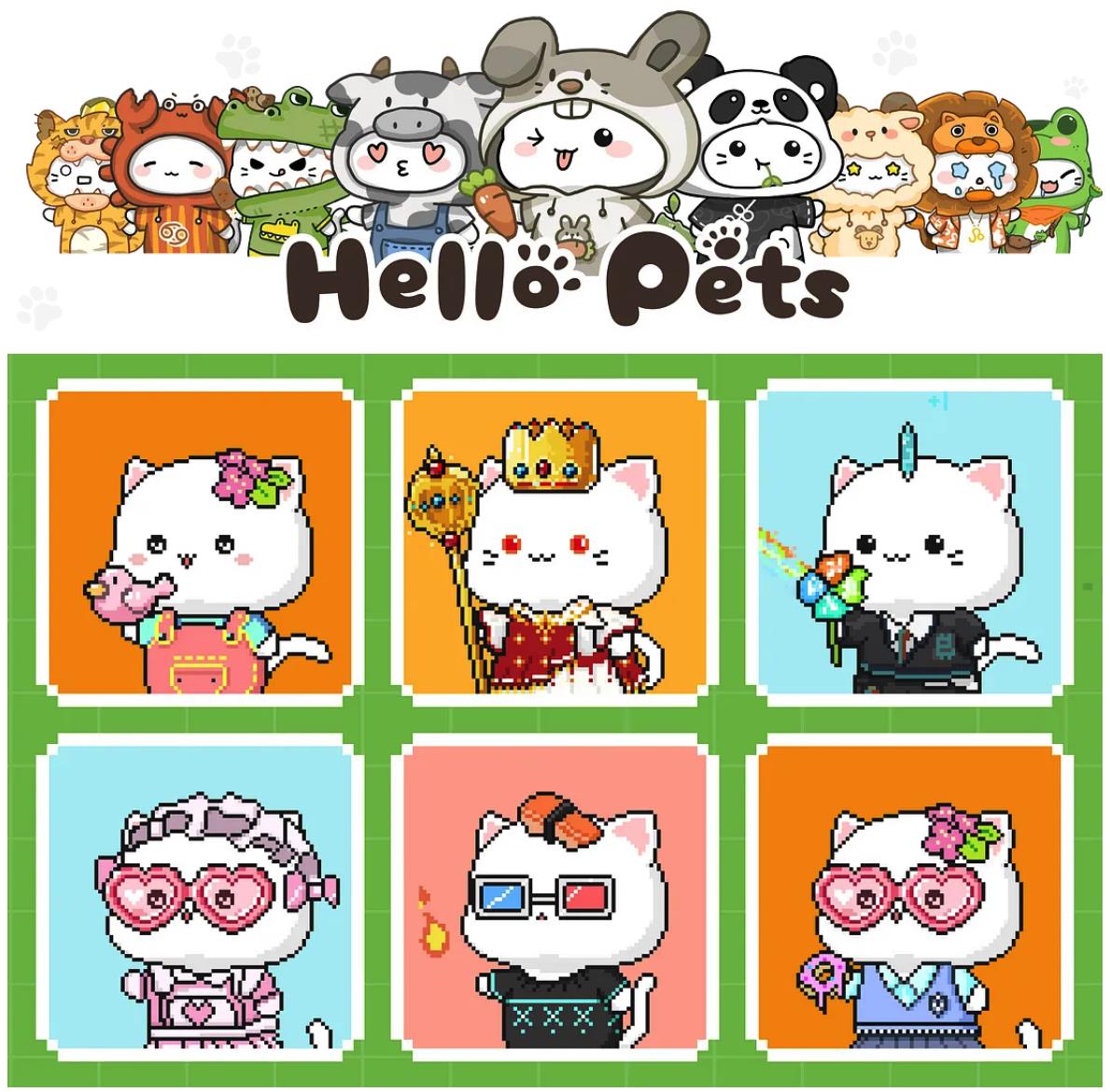
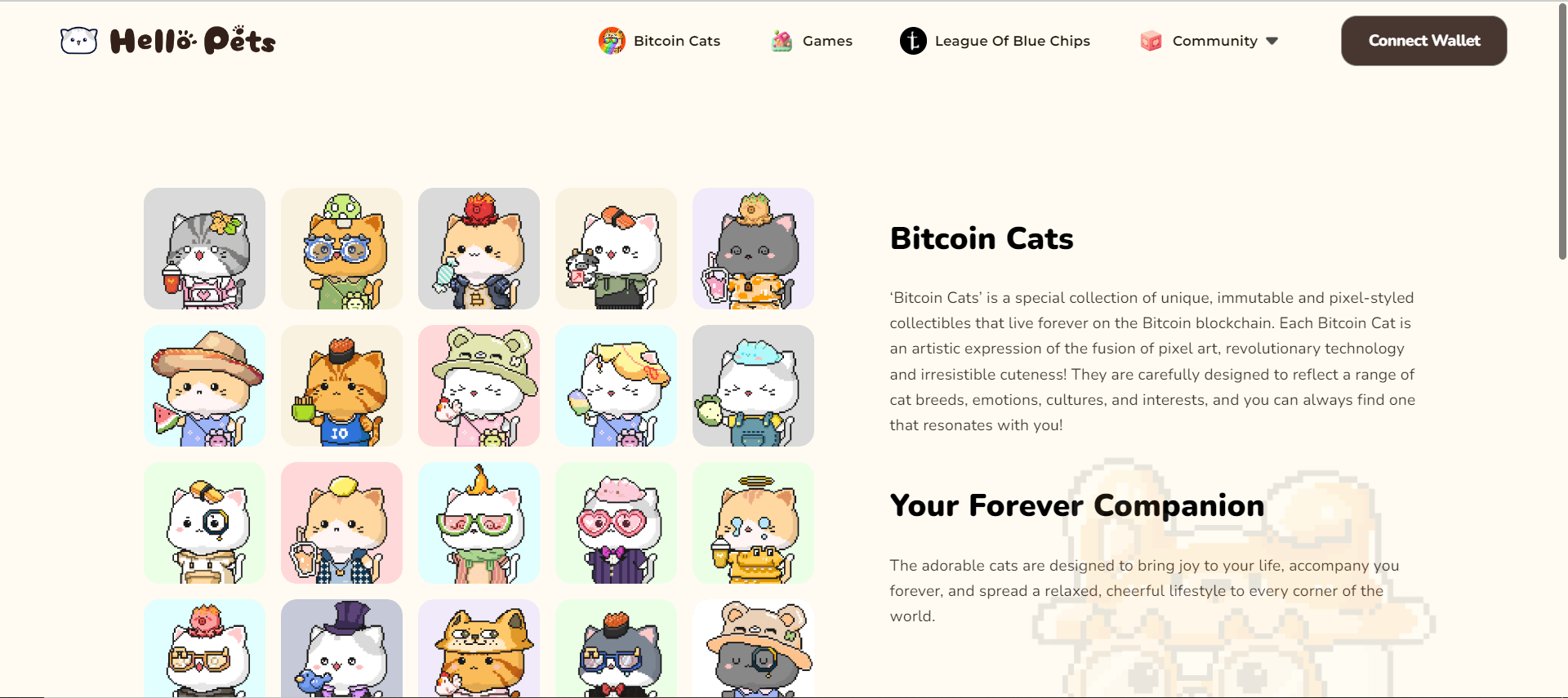
To date, BitcoinCats has not addressed its relationship with Hello Pets. However, the Hello Pets official website features a section titled “Bitcoin Cats” and provides navigation to the BitcoinCats homepage. According to BlockBeats, Hello Pets was formerly Battle Pets—a pet-battling game similar to Axie Infinity and inspired by CryptoKitties. Battle Pets rebranded to Hello Pets in January, repositioning itself as a “globally beloved brand bridging digital and real worlds.”
Project performance drives user interest in platforms, while platform participation mechanisms determine user retention.
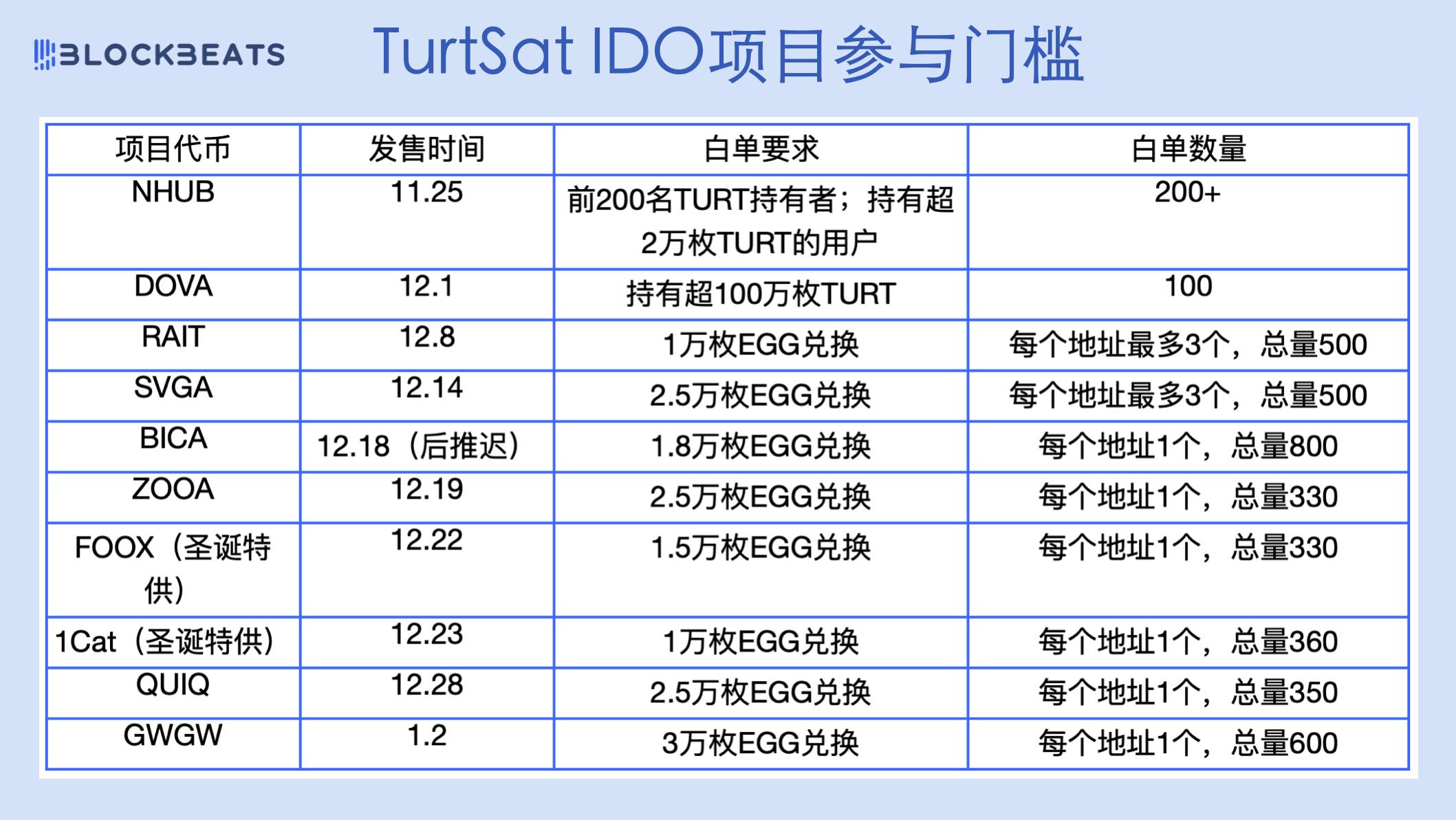
Unlike Bounce, TurtSat uses a whitelist model. Whitelist eligibility includes community contributors and TURT holders meeting certain thresholds. On December 7, TurtSat introduced a new staking mechanism: staking TURT earns EGG. A portion of future whitelist spots could be redeemed with EGG.
The “egg-laying mechanism” cost nothing to implement, allowing TurtSat to accumulate over 300 million TURT in staking. If whitelists are secured, staking TURT could yield substantial returns. Take QUIQ, IDO’d on December 28: per OKX data, its average launch-day trading price was 232 sats—meaning one whitelist allocation was worth nearly $2,000.
But EGG requirements vary per project. Excluding special holiday promotions, recent whitelist redemptions required at least 25,000 EGG—with GWGW on January 2 requiring 30,000.
According to community reports, staking 10,000 TURT yields about 80 EGG. Assuming a weekly requirement of 50,000 EGG, users would need to stake nearly 900,000 TURT to maintain eligibility across rounds. And eligibility doesn’t guarantee allocation. Even users who deposited TURT at $0.025 on December 8 needed $20,000 upfront. As TURT later rose to $0.08, the barrier to successful participation grew ever higher.
How did large players fare? TURT staking lasts one month; early unstaking incurs a 5,000 TURT fee. At the time of writing, TURT had fallen to $0.04—back to December 14 levels. Those who staked TURT after that date faced both missed whitelist draws and asset depreciation.
For BakerySwap, the challenge lies in proving it can meet soaring investor expectations. Its first Launchpad, Bitcoin Cats, drew 37,383 ETH and 73 million BAKE—$106 million total value—oversubscribed 150x. Its initial test succeeded; plenty were willing to pay.
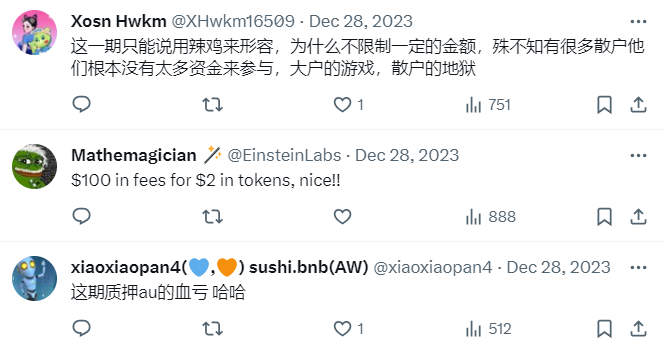
Once sufficient attention was captured, community focus shifted to Launchpad user experience. On December 28, BakerySwap announced the BitLand IDO success—receiving 116 million BAKE (~$80.5M) and 1.9 billion 1Cat (~$23M), totaling ~$103.5M in USDT equivalent. With 360x oversubscription, individual allocations were tiny. As expected, many participants reported minimal results.
When BitLand was announced, BAKE surged over 50%, but dropped 20% after the IDO concluded.
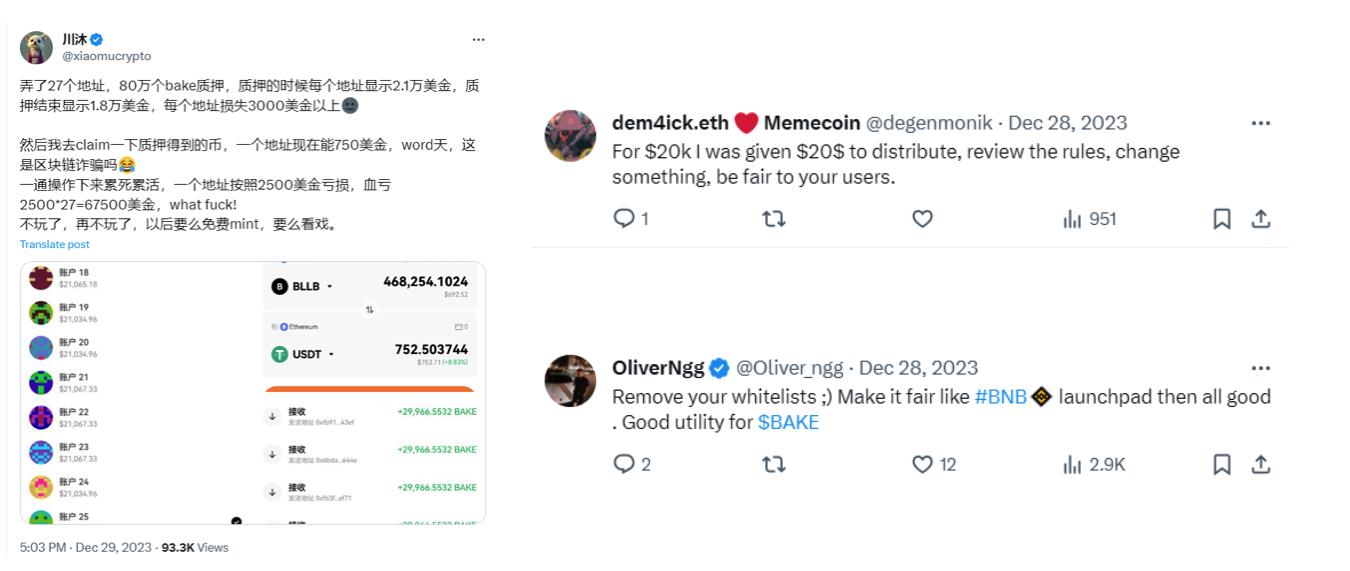
It’s understandable that staking-based launch models lead to criticism that only whales can participate. On December 21, Bounce announced Ladder Protocol (NFT AMM liquidity protocol) and Bitswap (BRC20 cross-chain trading platform) would jointly launch the “Two Birds, One Stone” token AMMX on Bounce Launchpad. As noted by community member @ai_9684xtpa, 15 whale addresses contributed 709,000 AUCTION to the pool, receiving 122 million AMMX—25.8% of total distributed tokens.
After the IDO, nine addresses deposited a total of 394,000 AUCTION tokens to Binance, worth $14.23 million, causing AUCTION to crash 32% briefly. Retail users who didn’t unstake promptly risked getting stuck holding the bag as whales dumped post-allocation.
Meanwhile, Analysoor, touted for its “fairness,” faced its own struggles. On December 27, Analysoor apologized to the community for technical issues during the WHEN meme coin mint. Challenges included Backpack malfunction halting receiving wallets (requiring 20-minute redeployment), RPC failures affecting transaction broadcasts, and Jupiter swap API failure during LP creation, disabling swap functions.
Prior to WHEN, both ZERO and ONE mints experienced delays. During ONE mint, funds meant for liquidity pools were mistakenly sent to minters—an incident that made WHEN’s “unexpected failures” feel inevitable to the community.
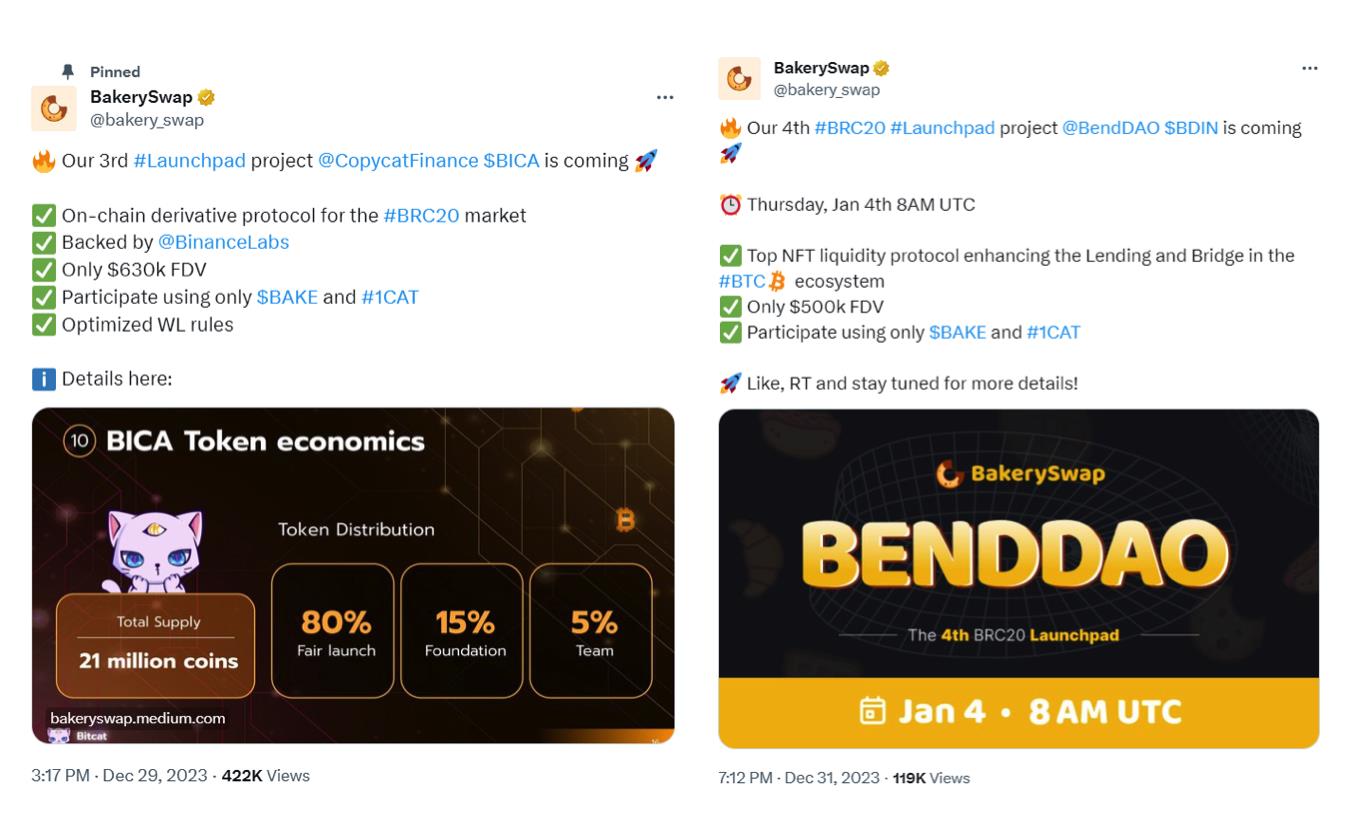
Despite growing skepticism, platforms continued launching new projects—each with its own quirks. On December 29, BakerySwap revealed its third Launchpad project: CopycatFinance, the same project delayed by TurtSat a week earlier. Close behind came BendDAO—an NFT lending liquidity protocol founded in 2022, once boasting over $300 million TVL, recently announcing expansion into the Bitcoin ecosystem.
Can New Shovels Still Get a Slice?
New platforms are still entering—but they no longer offer guaranteed returns. From December 25 to 27, three platforms announced new Launchpad plans. On December 25, NFT+DeFi aggregator Dego Brand announced completion of beta testing for its BRC20 Launchpad. Over the next week, DEGO initially surged over 100%, then rapidly collapsed. Despite revealing project details, Dego Brand couldn’t reverse the fading momentum.
Next, on December 27, LeverFi announced its BRC20 Launchpad LeverPro, planning three projects focusing on collateralized stablecoins, BRC20 asset lending, and AMM swaps and liquidity mining. LEVER, LeverFi’s native token, gained over 50% in 24 hours—then quickly retreated.
The shovel effect still brings short-term benefits—but now acts more like a “bubble generator” than a “launchpad booster.” Announcing a Launchpad means instant token lift, but days later, it’s as if nothing happened.
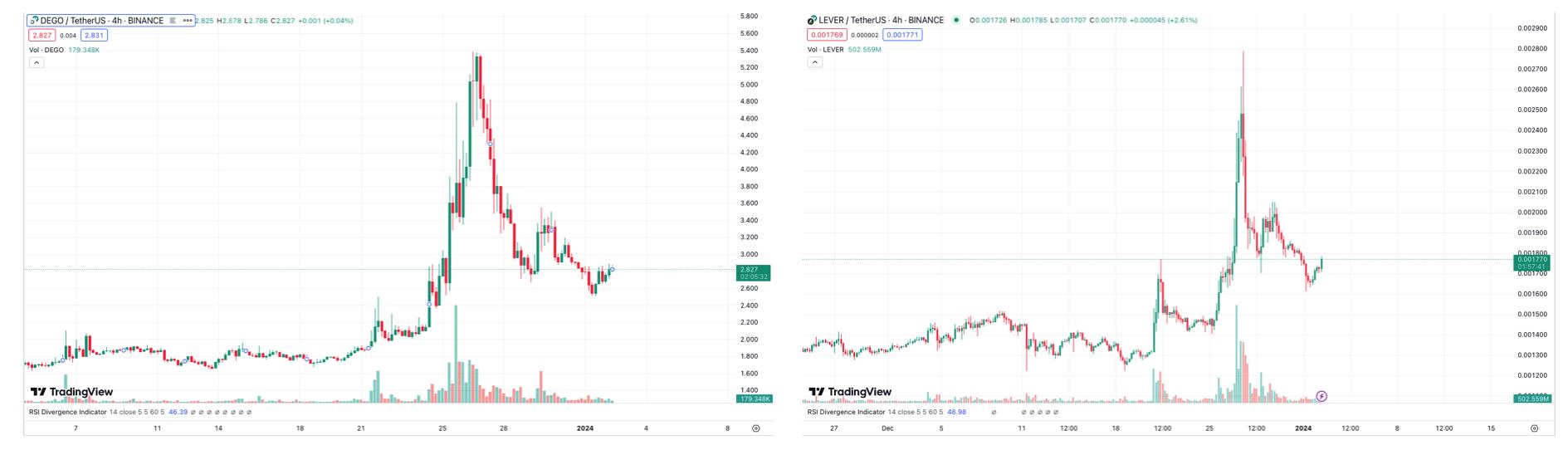
DEGO price chart; LEVER price chart
On the same day, Web3 gamified social education platform Hooked Protocol announced the first fair-launch project on its Hooked Education Launchpad: BRC20 project “TUNO.” Within five minutes of pool opening, HOOK lockups reached the cap of 4 million.
Can Shovels Be Saved?
This shovel boom echoes Binance’s IEO journey starting in 2019. Through its innovative IEO model, Binance stood out among exchanges, sparking a wave of competitors joining the “IEO club.” From 2019 to 2021, every Binance Launchpad launch boosted BNB’s price—up sixfold in five months. During the 2021 bull run, BNB surged past $675.
But compared to past performance, today’s Binance Launchpad faces widespread community criticism. Current projects are increasingly “hard to understand” compared to previous successes like MATIC, SAND, and AXIE. Returns are no longer compelling, and most Launchpad projects have become “whale games.” In this market cycle, BNB has barely moved, even losing market cap leadership to Solana.
The same story is unfolding now. For project teams, platforms, and investors alike, the rise of shovels tells a “win-win-win” tale.
Having missed ORDI and inscriptions—assets with little utility but massive wealth effects—the market urgently seeks the next big promise, regardless of project quality. The amount of capital pooling in the Bitcoin ecosystem can no longer be ignored. Everyone imagines how DeFi and GameFi narratives from Ethereum might replay in Bitcoin’s context. The market is happy to buy a ticket to that show.
Beyond early movers like TurtSat, for traditional platforms jumping into Bitcoin ecosystem IDOs, becoming a “shovel” is the fastest way to ride the hype wave and gain visibility. Staking mechanisms quickly boost token liquidity. Once attention is secured, platforms can pitch their long-term vision.
For the dizzying array of projects—many claiming “revolutionary significance”—there’s no need to refine products or even draft roadmaps. Simply create hype and the market follows. It’s a no-risk, guaranteed-profit business handed to them on a silver platter.
When the hype fades, these narratives will demand accountability—but it remains unclear who will deliver. Holders face two choices: wait for project teams to deliver on grand visions, or chase the next trend.
Join TechFlow official community to stay tuned
Telegram:https://t.me/TechFlowDaily
X (Twitter):https://x.com/TechFlowPost
X (Twitter) EN:https://x.com/BlockFlow_News
 BlockBeats











