Bing Ventures: Privacy Public Chains in the ZKP Era
TechFlow Selected TechFlow Selected
Bing Ventures: Privacy Public Chains in the ZKP Era
Aleo's ecosystem is still in a very early stage, and projects in the following sectors should be prioritized: privacy-preserving DeFi, privacy-preserving NFTs, privacy-preserving identity verification, and privacy-preserving data storage.
 Navigating Web3 tides with focused insights
Author: Kyle Liu, Investment Manager at Bing Ventures
Key Takeaways:
-
Aleo's success depends on the proliferation of infrastructure such as hardware and software for generating zkSNARK proofs, making zero-knowledge proofs ubiquitous. We believe Aleo’s combination of programmability and privacy protection makes it a promising ZKP project with strong potential to meet future demands.
-
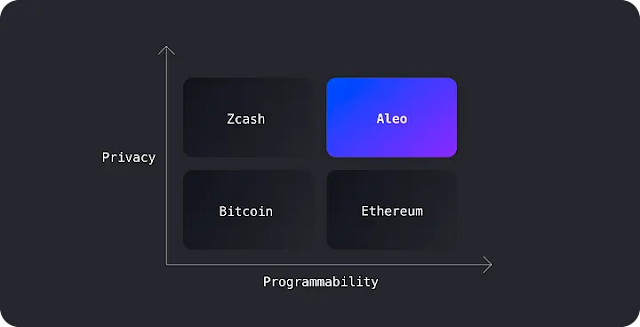
For users who value both privacy and programmability, Aleo is the best choice. It provides robust privacy through zero-knowledge proofs while offering a powerful smart contract language capable of building complex decentralized applications. Bitcoin and Ethereum each have their strengths, but Zcash’s limited programmability makes it less appealing to developers and users needing more advanced functionality.
-
Given that Aleo’s ecosystem is still in its very early stages, we recommend focusing on projects in the following sectors: privacy-preserving DeFi, privacy-preserving NFTs, privacy-preserving identity verification, and privacy-preserving data storage. Aleo represents a key direction for next-generation cryptocurrencies, with significant potential and room for future development.
ZKP (Zero-Knowledge Proof) is a method that allows you to prove knowledge of something without revealing the information itself. The application potential of ZKPs is vast—ranging from scaling networks and verifying votes to confirming credit ratings. Aleo leverages ZKP technology to create a private and secure internet, offering users a way to protect their privacy.
Aleo is a blockchain-based privacy platform. It uses zkSNARKs to achieve high scalability, enabling support for a large number of transactions without processing all data on-chain. The Aleo platform is programmable and employs Leo, a secure, private, and scalable smart contract programming language. Additionally, Aleo offers rich development tools that lower the barrier for developers. This article explores the potential of Aleo, a privacy-focused public chain in the ZKP era.
Mixed Consensus Algorithm
AleoBFT is a hybrid consensus algorithm combining Proof-of-Stake (PoS) and Succinct Proof-of-Work (PoSW). It aims to ensure a sufficient number of experienced validators capable of solving zkSNARK problems, while encouraging multiple participants to demonstrate network efficiency and cost-effectiveness. This consensus mechanism enables Aleo to achieve instant finality for every block, ensuring full decentralization and incentivizing provers to expand the provability of the Aleo ecosystem over time.
AleoBFT is designed to incentivize validators to maintain the network by producing blocks, and to motivate provers to extend proof capabilities across the Aleo ecosystem. Proving on Aleo requires deeper expertise in zkSNARKs compared to traditional PoW mining, creating more opportunities for skilled provers to gain substantial advantages. Aleo also accepts more valid solutions per block, distributing rewards among more provers rather than following a "winner-takes-all" model, which increases validation costs.
Aleo’s design allows applications to outsource proofs to third-party “proving services,” which use specialized hardware and software to perform computations faster, cheaper, and more efficiently than application developers could achieve on standard CPUs. Aleo’s success hinges on the widespread adoption of infrastructure like zkSNARK-proofing hardware and software, helping make zero-knowledge proofs commonplace.
Core Technical Features
Aleo is a comprehensive blockchain platform offering users strong privacy protection and decentralization, along with scalability and flexibility—creating an ideal environment for developers to build privacy-first decentralized applications. It uses the Zero-Knowledge Succinct Non-Interactive Argument of Knowledge (zk-SNARK) protocol to verify transaction validity without exposing any sensitive information. It can meet surging demand for ZKP computation, delivering the most affordable and efficient zkSNARK computing capability available. We believe Aleo’s strengths in programmability and privacy make it a promising ZKP project well-positioned to handle future needs.
snarkVM and snarkOS
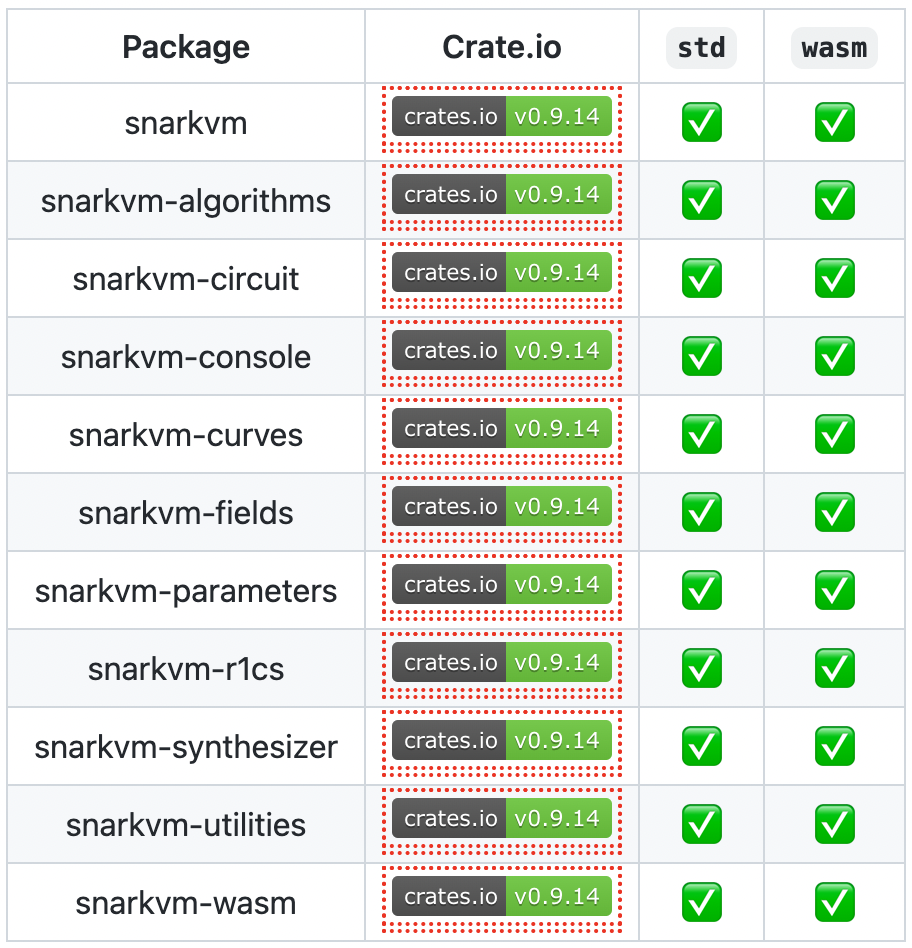
Aleo’s snarkVM and snarkOS are innovative technologies designed to deliver privacy, scalability, and security to the decentralized world. snarkVM (Snark Virtual Machine) is a virtual machine that uses zero-knowledge proofs to enable trusted transactions while preserving user privacy. snarkOS is an operating system built on top of snarkVM, providing dApps with a secure and scalable infrastructure.
The technical advantages of snarkVM in Aleo are primarily reflected in the following aspects:
-
snarkVM ensures confidentiality of data and transactions by enabling private execution of smart contracts, providing users on the Aleo network with a high level of privacy protection;
-
snarkVM allows offline computation with on-chain result verification, improving scalability and performance so Aleo can handle large volumes of transactions and data without compromising security or privacy;
-
snarkVM enables parties to verify computation results without accessing underlying data, enhancing transparency and trust in smart contract execution;
-
snarkVM provides a secure execution environment, reducing risks from hacking and other security threats, thereby strengthening the overall security of the Aleo network and protecting users’ assets and data;
-
snarkVM can also be used to build distributed applications interoperable with other platforms and protocols, allowing Aleo to seamlessly integrate with other distributed systems and expand its reach and influence.
Aleo’s snarkVM and snarkOS can handle large amounts of data and transactions, offering high scalability—an essential requirement for decentralized systems that must accommodate growing numbers of users and transactions. Moreover, both technologies support multiple programming languages, allowing developers to use familiar tools, significantly improving development speed and efficiency.
In terms of security, Aleo’s snarkVM and snarkOS employ cryptographic techniques to protect user data and transactions, designed as tamper-proof and attack-resistant systems. They are also engineered to prevent downtime and censorship, making them ideal for sensitive industries such as finance, healthcare, and government. In the future, Aleo’s snarkVM and snarkOS are expected to play a significant role in shaping the decentralized world.
Leo Language
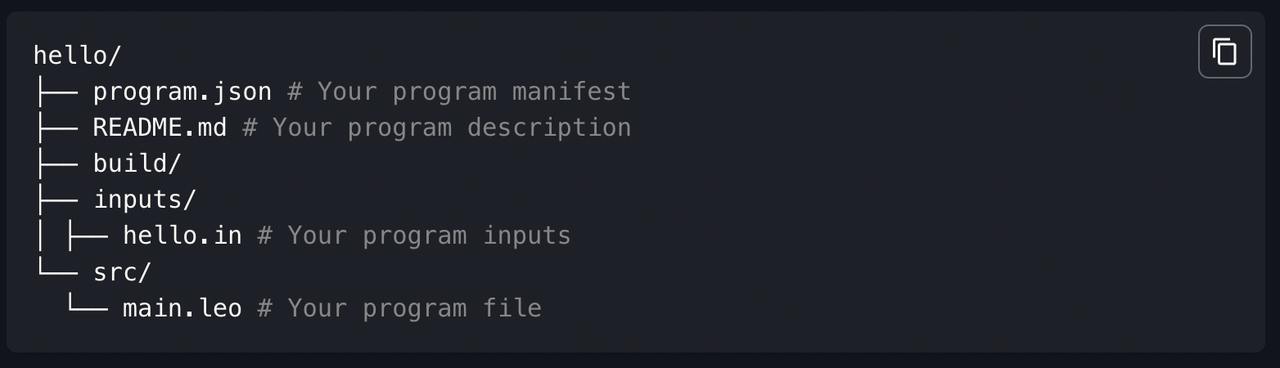
Aleo’s Leo language is a Rust-inspired, statically-typed programming language designed for building private applications. It enables developers to intuitively construct applications on the Aleo blockchain, laying the foundation for a private, decentralized ecosystem. Leo is the first programming language to introduce a testing framework, package registry, import system, and native support for zero-knowledge proofs.
Aleo developed Leo separately to offer an intuitive and easy-to-use programming language specifically tailored for building private applications on its blockchain. Off-the-shelf programming languages often fail to effectively abstract low-level cryptographic concepts or integrate smoothly into existing tech stacks.
Leo is a functional, statically-typed language with intuitive and user-friendly semantics. It allows developers to build decentralized applications on the Aleo blockchain and generate correct proofs for their offline compilation and execution. At the底层 level, Leo compiles high-level developer code into zero-knowledge circuits.
Aleo Studio
Aleo Studio is an interactive development environment for writing zero-knowledge applications in Leo. It is the first IDE dedicated to developing zero-knowledge apps. Aleo Studio uses zero-knowledge proofs to protect user data and transaction information. Compared to other tools, privacy protection is its biggest advantage—others may prioritize speed or scalability instead. Additionally, Aleo Studio features a simple, intuitive interface with drag-and-drop design, making it fast and accessible for developers of all skill levels.
Aleo Studio also includes a real-time preview feature, allowing developers to immediately see how their dApp looks and functions during development. Compared to other tools, this reduces compilation and deployment time, boosting development efficiency. Aleo Studio also integrates debugging tools, enabling developers to easily identify and fix issues within their dApps—a key competitive advantage in the development tool market.
In summary, Aleo Studio is a powerful and unique blockchain development tool. Its strengths in privacy protection, ease of use, real-time preview, and debugging make it a top choice for developers. Whether you're an experienced blockchain developer or just starting out, Aleo Studio is worth exploring and using.
Competitor Comparison
Aleo is a blockchain technology based on zero-knowledge cryptography, aiming to provide privacy and programmability. Its core technology, ZEXE (Zero-Knowledge EXEcution), generates proofs from offline state transitions and integrates them into on-chain transactions, updating system states via creation or use of on-chain records. This approach resembles Zcash and Ethereum, offering strong privacy protection while supporting smart contracts, enabling users to interact or transfer value in predefined ways.
Comprehensive Privacy Protection
Aleo employs zero-knowledge proofs to allow users to prove the validity of a statement without revealing sensitive information. By using complex mathematical algorithms to create verifiable proofs that do not expose underlying data, it ensures all transactions and smart contracts on the network remain private, enabling anonymous interactions without fear of exposing sensitive data.
Aleo is a privacy-focused blockchain platform using Zero-Knowledge Proofs (ZKPs) to enable private transactions and computations. This means users can transact on the platform without disclosing any sensitive information to third parties. Compared to other blockchain platforms, Aleo offers higher privacy because ZKPs can prove certain information exists without revealing the information itself.
In contrast, other platforms like Ethereum use zk-SNARKs that only offer limited privacy guarantees, whereas Aleo provides more comprehensive privacy protection. This makes Aleo an ideal platform for applications requiring high levels of privacy, such as those in finance and healthcare.
Aleo vs. Other Public Chains
To achieve high scalability and decentralization, Aleo adopts a unique consensus mechanism that enables high transaction throughput while maintaining the security and reliability of a decentralized network. Furthermore, Aleo supports interoperability with other blockchains and networks, allowing seamless integration with existing systems. This empowers developers to leverage the strengths of different blockchains and networks to build powerful decentralized applications.
Aleo’s decentralized private computation technology allows users to run smart contracts while protecting data privacy, without relying on public blockchains and avoiding the risk of transaction data leaks. This is a novel technology—by comparison, Zcash’s zk-SNARK technology is already widely used, but generating private transactions requires substantial computational resources, making it impractical for everyday use. Moreover, Aleo’s technology supports fully private applications, a capability Zcash lacks.
However, Aleo’s technology also has drawbacks. Its decentralized private computation relies on zero-knowledge proofs, which are relatively complex and require a learning curve. Additionally, Aleo is currently in the testnet phase and not yet fully mature, with relatively few application scenarios. In contrast, Zcash, as an established cryptocurrency, has a more mature ecosystem and broader use cases, though its privacy transactions consume heavy computational resources, affecting liquidity, and it carries some negative historical baggage.
Another public chain, Avalanche, focuses on creating subnets to provide scalable blockchain ecosystems for specific applications. While it can build strong, reliable, and secure permissioned or permissionless networks with custom implementations, it lacks the privacy guarantees offered by Aleo’s native zero-knowledge primitives. NEAR, on the other hand, is a sharded proof-of-stake blockchain designed to offer fast, affordable, and user-friendly platforms for decentralized applications. It uses a unique “fog computing” mechanism that distributes computation to nodes geographically close to users, reducing latency and improving performance. While NEAR improves scalability and performance through sharding and fog computing, it lacks built-in privacy features compared to Aleo.
Overall, Aleo’s architecture makes it a stronger and more comprehensive solution for privacy-centric applications compared to Avalanche and NEAR. Its default private, open-source web platform offers a unique answer to the shortcomings of current blockchain implementations.
Aleo’s Advantages
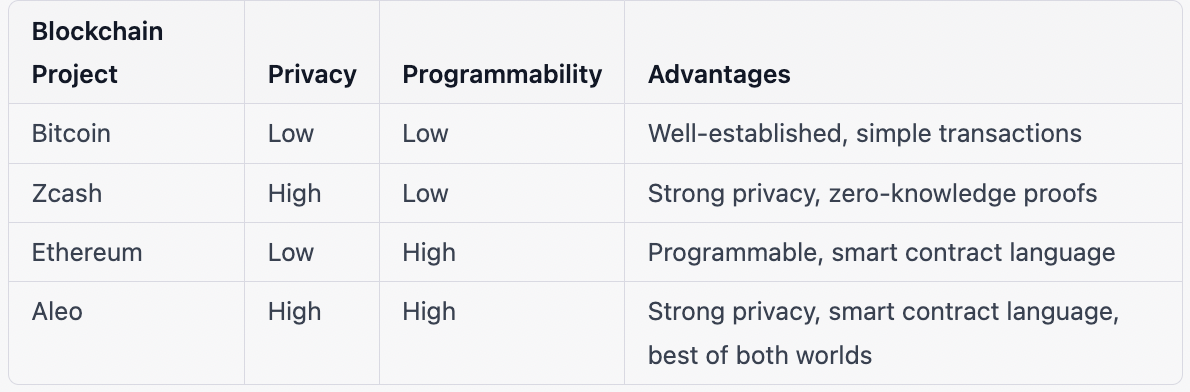
Aleo holds advantages over competitors in four key areas:
-
Aleo is a privacy-focused blockchain platform utilizing zero-knowledge proof technology to enable private transactions and user identity protection. In contrast, Ethereum and Bitcoin lack built-in privacy features, although privacy-enhancing technologies can be supported via smart contracts.
-
Aleo uses more advanced programming languages and supports multiple languages, including compatibility with the Ethereum Virtual Machine (EVM), while Bitcoin’s scripting language is quite limited. This gives developers greater flexibility when building decentralized applications (dApps) on Aleo.
-
Aleo features a decentralized governance model similar to Bitcoin and Ethereum, but differs in using token-holder voting to decide network changes and upgrades, further reinforcing decentralization principles.
-
Aleo employs a Proof-of-Stake-based consensus algorithm, granting it high scalability, while further enhancing performance through zero-knowledge proof technology.
Overall, for users who prioritize privacy and programmability, Aleo is the best choice. It delivers strong privacy protection via zero-knowledge proofs while providing a powerful smart contract language suitable for building complex decentralized applications. Bitcoin and Ethereum each have their strengths, but Zcash’s limited programmability makes it less attractive to developers and users seeking more functionality.
Application Landscape
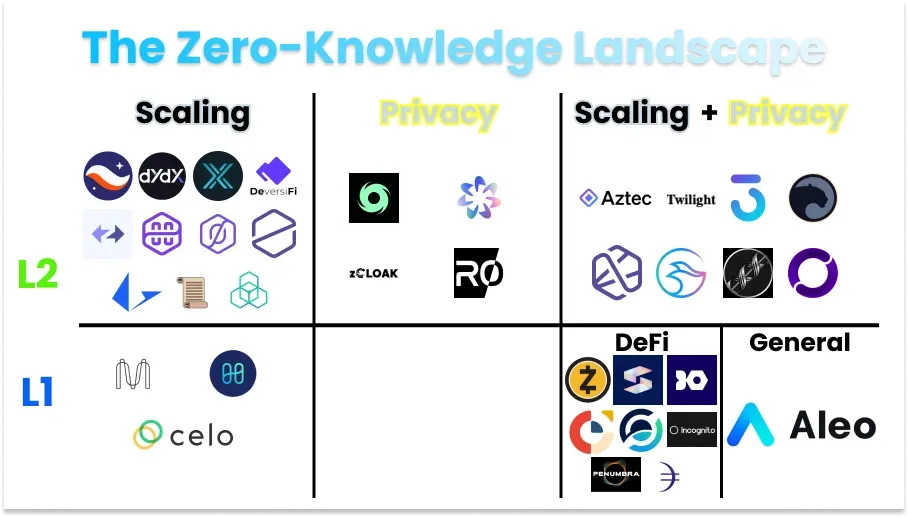
Aleo’s innovation lies in its focus on privacy protection, setting it apart from other blockchain platforms. The privacy guarantees it offers make it an ideal foundation for applications requiring high privacy, such as in finance and healthcare. Meanwhile, Aleo’s innovative Leo programming language establishes it as a powerful platform for developers to build privacy- and security-first applications.
Compared to similar projects in the privacy-focused public chain space, Aleo breaks new ground by being the first platform for fully private applications—delivering superior user experiences without sacrificing privacy. Aleo’s unique architecture makes it more scalable than traditional blockchains. By default, interactions between Aleo applications and users are private. On this foundation, developers can reimagine web applications that are both fully private and fully personalized.
Aleo’s open-source nature further enhances accessibility and fosters a large, vibrant community of developers and users who contribute to the platform’s growth and innovation. The platform also offers users a unique reward system—participants can earn rewards by holding Aleo tokens and providing liquidity, incentivizing engagement and helping secure the network’s stability.
Bing Ventures believes that given Aleo’s ecosystem is still in a very early stage, priority should be placed on projects in the following sectors: privacy-preserving DeFi, privacy-preserving NFTs, privacy-preserving identity verification, and privacy-preserving data storage. Aleo represents a crucial direction for next-generation cryptocurrencies, with immense potential and future growth prospects. Its multi-layered architecture enables high scalability, allowing simultaneous processing of large transaction volumes—ideal for high-throughput applications. Meanwhile, Aleo’s unique consensus algorithm achieves consensus in seconds rather than minutes or hours, giving it an edge in transaction speed and efficiency.
Join TechFlow official community to stay tuned
Telegram:https://t.me/TechFlowDaily
X (Twitter):https://x.com/TechFlowPost
X (Twitter) EN:https://x.com/BlockFlow_News
 Bing Ventures