








What may not sustain in the Bitcoin ecosystem is the hype around inscriptions, but what can endure is...
TechFlow Selected TechFlow Selected
What may not sustain in the Bitcoin ecosystem is the hype around inscriptions, but what can endure is...
When the get-rich-quick effect attracts capital from within the industry, a surge in projects related to Bitcoin concepts will inevitably follow.
 Navigating Web3 tides with focused insights
Author: Day, Baicai Blockchain
Recently, the Bitcoin ecosystem has gradually become FOMO-driven, fueling projects such as the Bitcoin-based game Bitcoin Cats, IDO platforms like BakerySwap and Bounce. At the same time, BRC20 tokens have remained extremely popular, causing Bitcoin transaction fees to surge continuously—reaching a peak of 600 satoshis per byte, making the cost of sending a single BRC20 transaction around $80.
In reality, most meme-centric BRC20 projects are likely short-lived phenomena whose popularity may not last. What will endure is the infrastructure being built around them, which holds more long-term value. Today, let’s take a brief look at some of the key infrastructure components already emerging in the Bitcoin ecosystem.
Bitcoin Ecosystem
The dominant theme during the last bull market was the Ethereum ecosystem. This cycle, however, increasing attention is shifting toward the Bitcoin ecosystem. While the recent explosion in Bitcoin's ecosystem began with meme tokens, it certainly won’t end there. Once wealth-generation effects attract capital from across the crypto space, an influx of Bitcoin-related projects becomes inevitable. Let’s review some of the currently trending Bitcoin-related concepts.
Launchpad: Bounce Brand
Bounce Brand (formerly Bounce Finance) is a decentralized auction protocol enabling users to create and participate in various types of auctions across multiple blockchain networks. It recently gained significant attention due to successful auctions for Bitcoin-themed projects such as MultiBit (MUBI) and Bitstable (BSSB), generating impressive returns.
On another front, in early December, Bounce Brand launched BounceBit—a DeFi solution designed specifically for the Bitcoin ecosystem—introducing BTCB, a Bitcoin-pegged token aimed at enhancing Bitcoin liquidity, thus positioning itself firmly within the Bitcoin ecosystem. The rising interest in Bitcoin-related narratives, combined with its status as one of the few Bitcoin ecosystem projects listed on Binance, has significantly boosted its visibility. However, recently, the price of its new launch project bDID plummeted after revelations of continuous selling by insiders, dragging down related tokens such as auction and MUBI.
Another similar platform is TurtSat, which offers functions comparable to Bounce Brand. However, such platforms heavily depend on the resources and capabilities of their founding teams. If they can consistently deliver high-quality projects, they may achieve sustained growth and platform empowerment.
DeFi Platform: Alex Lab
ALEX Labs is a DeFi protocol built on Stacks, aiming to provide a suite of services for Bitcoin applications—including token issuance, fixed-rate and fixed-term lending without liquidation risk, DEX functionality, and yield generation. Its goal is to build a broader financial ecosystem for Bitcoin, offering more opportunities and choices for both Bitcoin holders and DeFi users.
At the end of November, ALEX announced the launch of its cross-chain component, ALEX Bridge, designed to enable seamless bridging between Bitcoin and other assets such as BRC20 tokens, providing secure and reliable service. Additionally, it recently secured strategic investment from LK Venture, a subsidiary of Blue Harbor Interactive, further strengthening its position in the Bitcoin ecosystem.
Cross-chain Bridge: MultiBit
MultiBit is a cross-chain bridge protocol designed to connect liquidity between Bitcoin and EVM-compatible networks. It enables seamless transfer of tokens across different blockchains. Specifically, MultiBit focuses on bridging BRC20 tokens with EVM networks such as Ethereum and BSC.
MultiBit also features a staking mechanism where users can stake its native token MUBI to gain governance rights and earn rewards, which may be distributed in the form of ERC20 or BRC20 tokens. Within just over 40 days of launch, MultiBit’s bridge processed over $440 million in trading volume. Behind the scenes, DWF has played a key role in driving its development.
Layer 2: MAP Protocol
MAP Protocol is a Bitcoin Layer 2 network enabling peer-to-peer cross-chain interoperability. Leveraging Bitcoin’s security model, it allows assets and users from other public chains to interact seamlessly with the Bitcoin network, enhancing overall security while enabling BRC20 cross-chain transfers.
Stablecoin: BitStable
BitStable is a decentralized asset protocol built on Bitcoin. It aims to provide stablecoin solutions for the Bitcoin ecosystem, increasing liquidity and flexibility—similar in function to MakerDAO on Ethereum. Through BitStable, users can create, trade, and manage synthetic assets that mirror real-world assets and maintain a fixed value ratio. It introduces the stablecoin DAII and native token BSSB, analogous to DAI and MKR in MakerDAO, except issued on Bitcoin instead of Ethereum. However, given the relative immaturity of the Bitcoin ecosystem, practical use cases remain limited so far.
The above represents some of the most prominent Bitcoin ecosystem projects recently. Due to space limitations, smaller projects aren't included here. It's evident that many of these are direct replicas of Ethereum ecosystem models and are still in early stages. Many lack professionalism; some were previously focused on other sectors or chains but have now pivoted to Bitcoin due to its rising popularity. While this trend isn't necessarily negative—after all, early momentum often leads to sustained advantage—it’s inevitable that more and more projects will begin integrating into the Bitcoin ecosystem.
NFTs
In recent months, NFTs in the Bitcoin ecosystem have flourished. According to Cryptoslam data, Bitcoin accounted for 57.25% of all NFT trading volume last week, totaling $265.61 million. In the top 10 NFT trading volumes over the past 30 days, seven belong to the Bitcoin ecosystem. Now, let’s briefly explore some of the hottest Bitcoin-based NFTs.
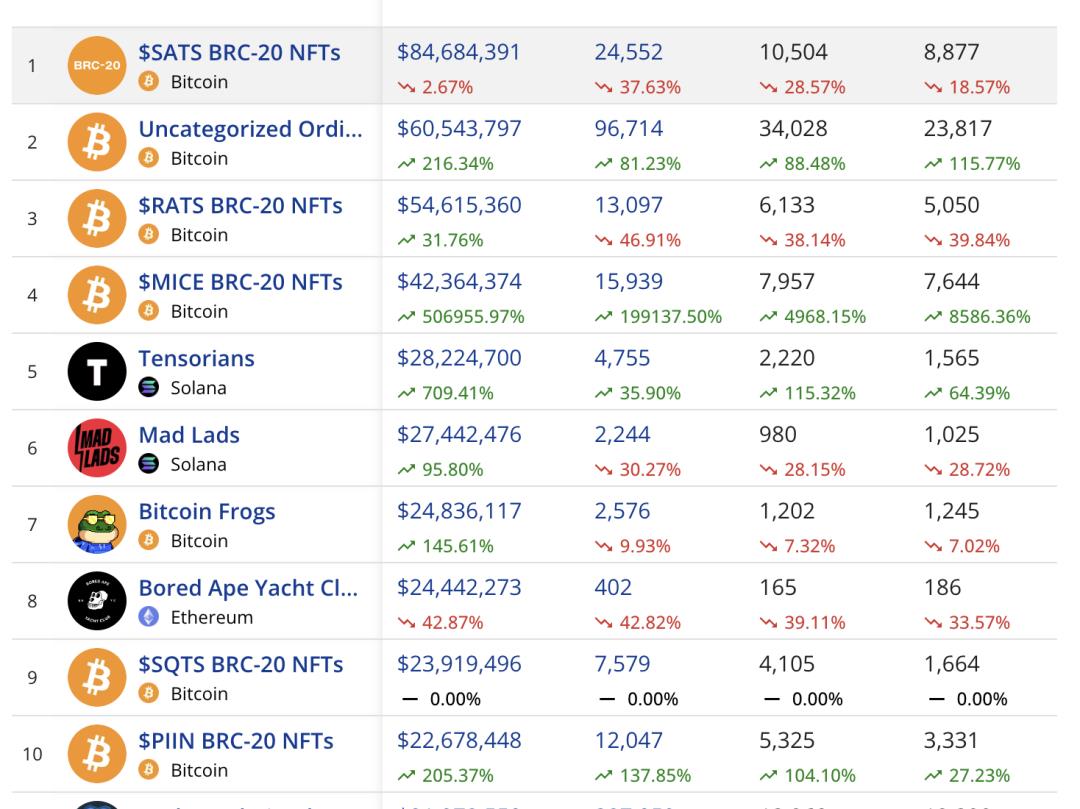
Bitcoin Frogs
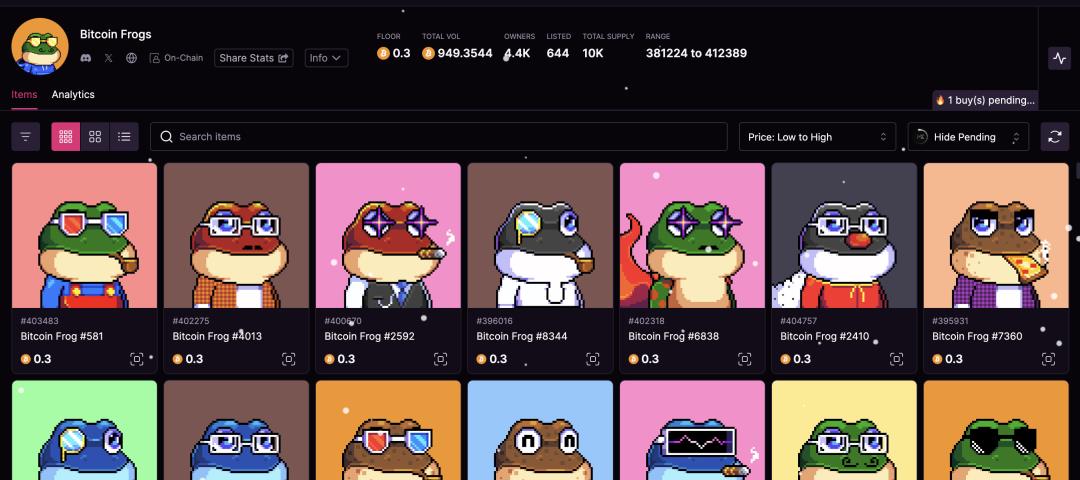
With a total supply of 10,000, Bitcoin Frogs is a Bitcoin Ordinals NFT launched on March 8, 2023, and currently the leading NFT project in the Bitcoin ecosystem.
Created through a collaboration between Vibegawd of Deezy Labs and anonymous artist Frogtoshi, the project was minted via Deezy Labs’ launch platform and supports Lightning Network payments. Initially, minting Bitcoin Frogs was free, requiring only a small network fee. However, a technical error during minting caused all frogs to appear without clothing—earning them the nickname “naked frogs.”
To fix this, the team used Replace-by-Fee (RBF) to cancel pending transactions for the naked frogs and re-minted corrected versions. Despite the incident causing losses to Deezy Labs, the Bitcoin Frogs community has continued to grow stronger.
Bitmap
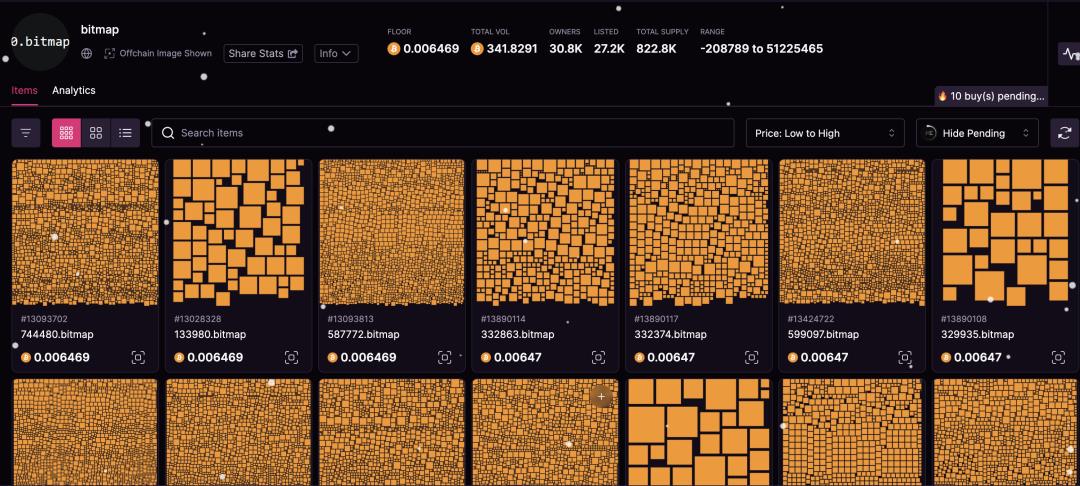
With a total supply of approximately 820,000, Bitmap is the first metaverse project in the Bitcoin ecosystem. Based on the Ordinals theory and Bitmap theory, it maps transaction inputs within Bitcoin blocks as plots of land, creating a digital landscape. The size of each plot corresponds to the size of the transaction input, forming blocks or districts. In phase two, the project introduced zoning, allowing users to subdivide their plots independently within a district.
Goosinals
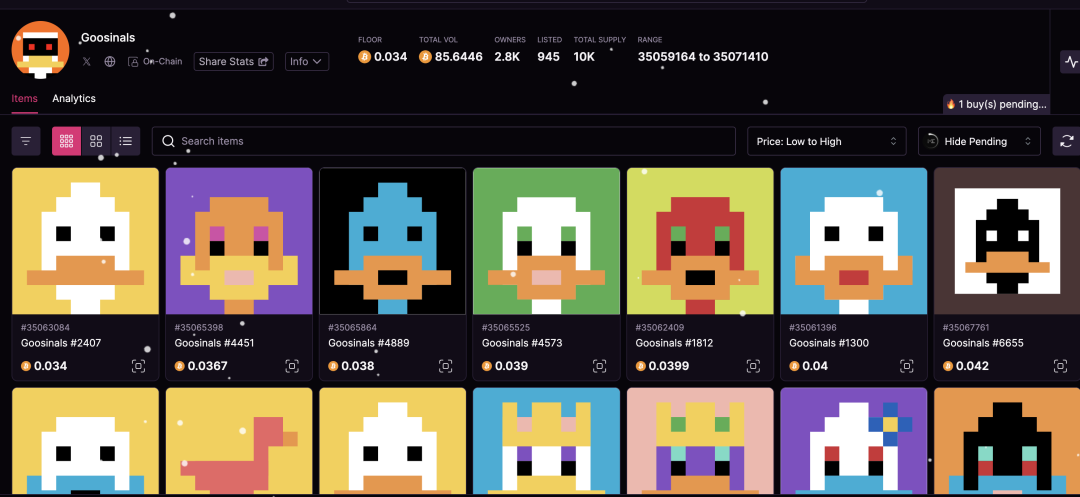
Goosinals has a total supply of 10,000 and was inspired by Ringers #879, a generative art piece. Ringers is a generative art project released in 2021 by artist Dmitri Cherniak, one piece of which visually resembles a goose and became humorously known as the “big goose.” A rare version, Ringers #879, was purchased for over $6.2 million by renowned NFT collector @Punk6529, becoming the second-highest-selling generative artwork ever.
TOOTHY
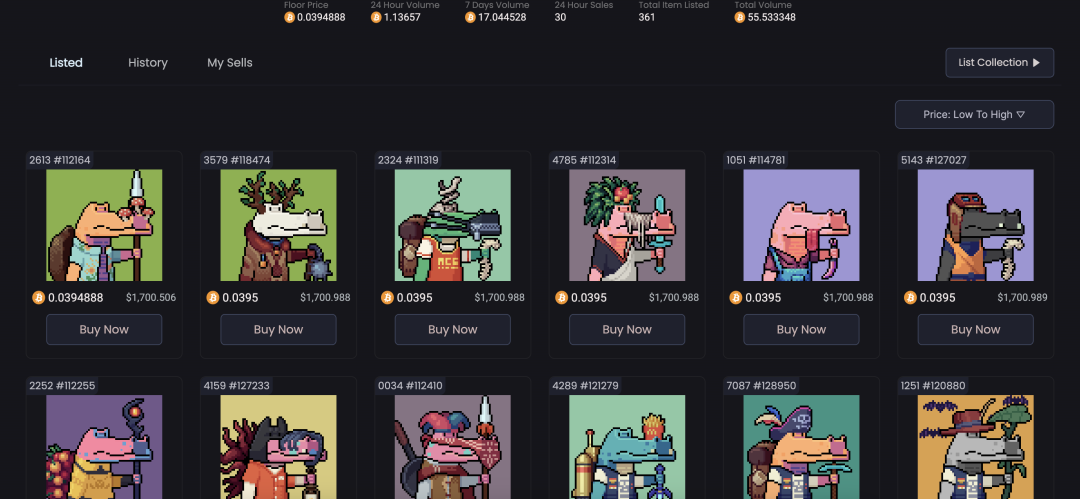
TOOTHY (Little Crocodile) is one of the first inscription NFT projects minted via the dmint update on the Atomicals protocol, with a total supply of 10,000. Due to variable gas fees, the minting cost reached up to $100 per NFT at peak times. Currently priced with a floor of $1,700, TOOTHY is the flagship NFT on the Atomicals protocol.
Basic Tools
Over the past year, with the explosion of inscriptions and gradual maturation of the Bitcoin ecosystem, certain foundational tools have become essential for investors. Here are several commonly used ones.
Wallets & Marketplaces
1) Unisat
As the first wallet extension supporting Ordinals inscriptions, Unisat supports both Ordinals and BRC20, helping users store, mint, and transfer BRC20 tokens, as well as buy/sell BTC, NFTs, domains, etc.
Unisat Marketplace is a dedicated trading platform under Unisat for BRC20 tokens, designed to work seamlessly with the Unisat wallet.
2) OKX Web3 Wallet
OKX Web3 Wallet exemplifies how exchanges can leapfrog ahead this year by being among the first to support trading and staking of BRC20 inscriptions and BTC NFTs, bringing massive traffic to its wallet product. OKX Web3 Wallet has become the largest marketplace for BRC20 inscriptions and BTC NFTs on Ordinals, recording a total trading volume of $870 million by December 24. Moreover, user experience on OKX Web3 Marketplace—especially listing and execution speed—is currently superior to that of Unisat Marketplace.
3) Magic Eden
Magic Eden, the leading NFT marketplace on Solana, provides NFT trading, minting, and management services. In March, Magic Eden launched its Bitcoin ecosystem NFT marketplace, allowing users to list, buy, and sell Ordinals. Most newly released Bitcoin NFTs tend to debut on Magic Eden.
On-chain Tools
1) Bitcoin explorer mempool
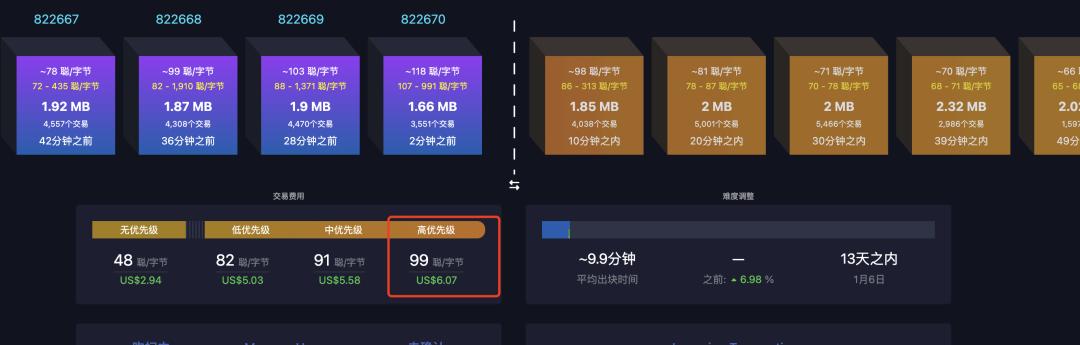
Mempool specializes in mempool monitoring and blockchain exploration for the Bitcoin community, providing real-time transaction status and data, allowing users to view pending transactions. Since Unisat embeds Mempool internally, it’s currently the most widely used tool. It helps check on-chain confirmation status and real-time gas fees. Given the intense competition on Bitcoin’s network, users typically need to set their priority fees 50–100 satoshis higher than Mempool’s recommended high-priority rate to ensure transaction success—otherwise, miners benefit at the user’s expense. With Bitcoin producing a block roughly every 10 minutes, this interval can help assess current block conditions, whether blocks are congested, and whether high gas fees stem from congestion or general network activity—guiding appropriate fee selection.
2) mct.xyz
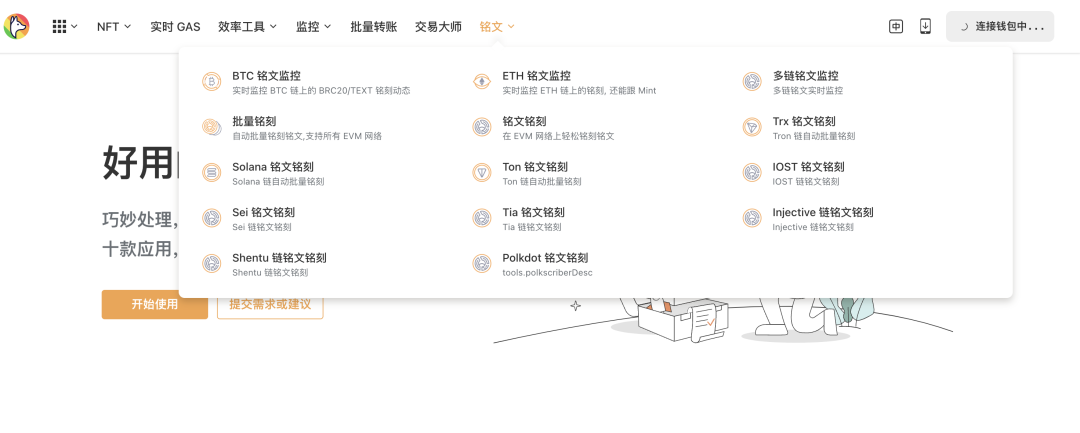
MCT offers a comprehensive toolbox allowing users to easily manage wallets, track monitored information, receive push notifications, and more. Recently, its inscription minting feature has been particularly popular, offering real-time monitoring of inscription projects across over 20 blockchains including Bitcoin, Ethereum, Solana, and Sui, along with batch inscription support. Most tools are free, though some require payment. Note that certain functions require importing private keys—an operation involving high risk; use with extreme caution.
3) GeniiData
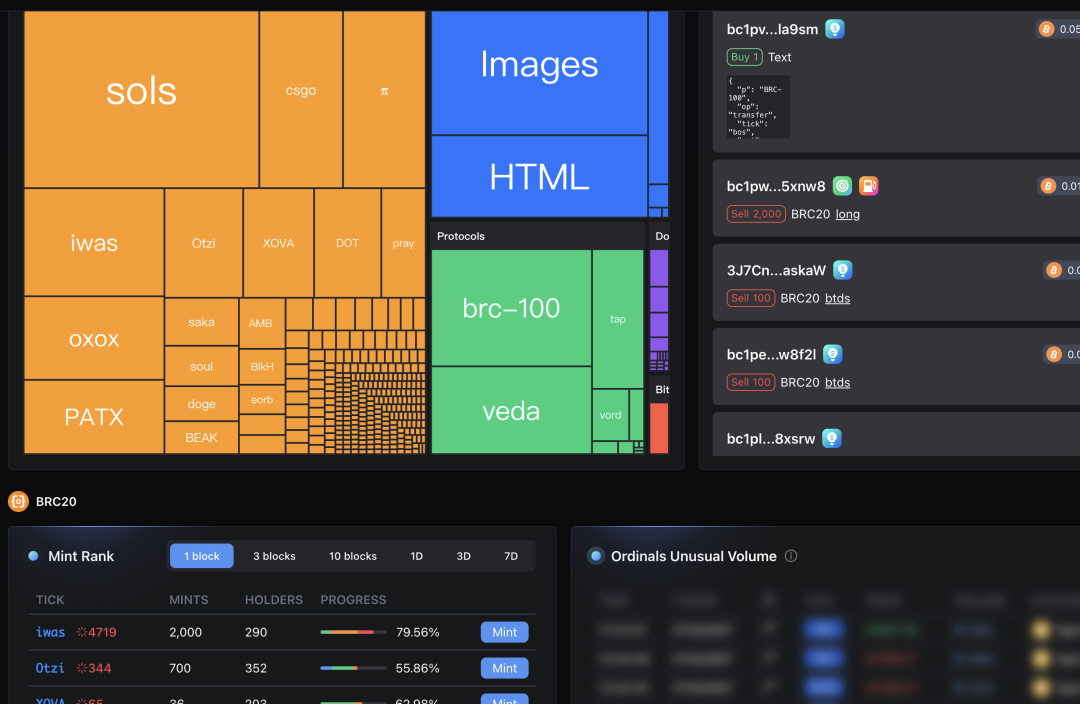
GeniiData is an analytics platform focused on the Ordinals ecosystem, providing data services for BRC20 and ORC-20 tokens, helping users access information on token popularity, rankings, deployment details, and transaction history, while supporting real-time transaction monitoring and verification. Its functionality overlaps with MCT, but whereas MCT is broad and somewhat cluttered, GeniiData offers a more streamlined experience specifically for BRC20 monitoring.
The upper half of the image below shows current activity levels on the Bitcoin chain—what kinds of transactions people are conducting—while the lower half displays what users are actively minting during a specific period, including frequency and progress. MCT and GeniiData can be used together effectively.
4) gasnow
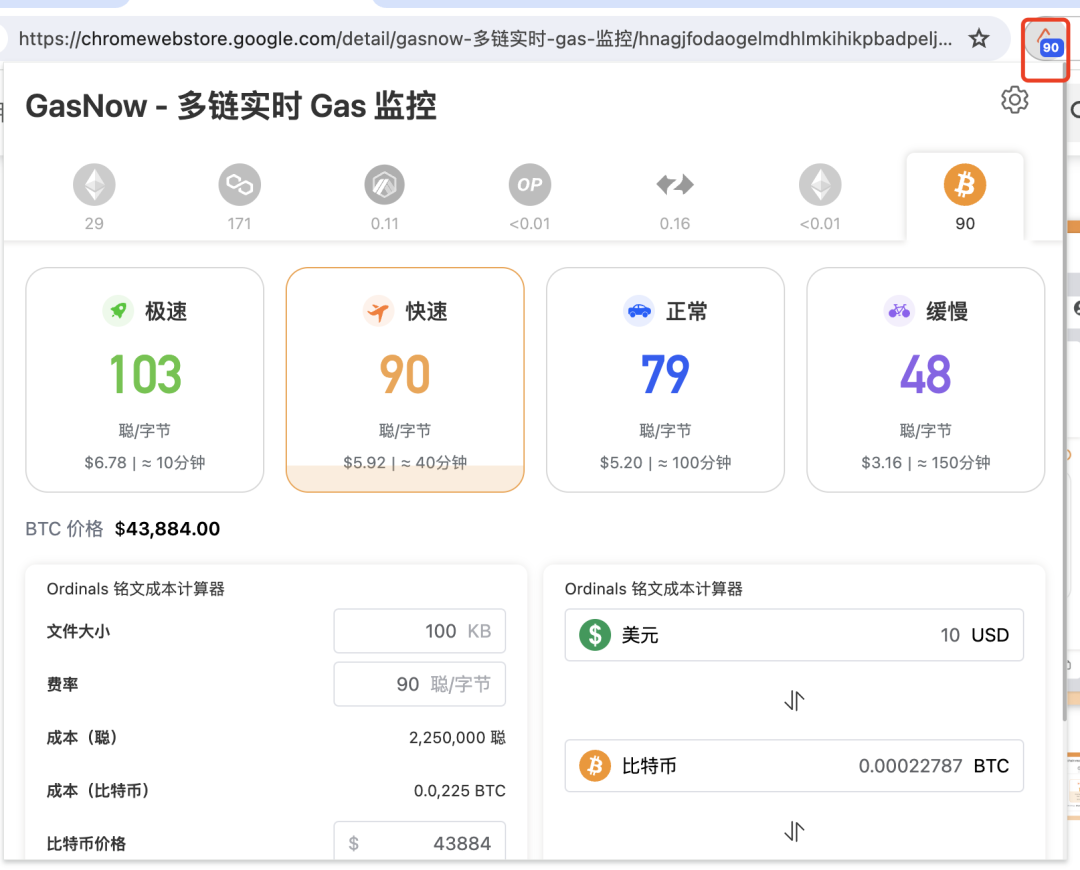
gasnow is a browser plugin that monitors gas usage across multiple chains in real time (highlighted in red at the top-right of the image). When gas spikes occur, users can refer to MCT or GeniiData to determine the underlying cause. It currently supports real-time gas data for Bitcoin, Ethereum, and several other chains.
5) Mining Pool Acceleration
If a Bitcoin transaction uses too low a fee, it may never confirm—rendering the wallet unusable and preventing new transactions. Unlike Ethereum wallets, Bitcoin wallets cannot directly increase gas fees using the same wallet interface to accelerate transactions. If gas remains high and urgent wallet access is needed, users can utilize BN mining pool’s acceleration service: enter the transaction hash, log into your BN account, and pay for acceleration, typically costing anywhere from dozens to over a hundred dollars.
The above covers some of the most frequently used on-chain tools today. Although the frenzy around BRC20 minting has cooled slightly, we hope these tools remain helpful. Feel free to share any others you find useful.
Summary
In recent months, the Bitcoin ecosystem has undergone transformative changes—from initial hype centered on BRC20 memes to the ongoing development of robust infrastructure. The Bitcoin ecosystem is poised to become a pivotal part of the entire industry.
Join TechFlow official community to stay tuned
Telegram:https://t.me/TechFlowDaily
X (Twitter):https://x.com/TechFlowPost
X (Twitter) EN:https://x.com/BlockFlow_News
 白话区块链
白话区块链











