









2023 Top 10 Events: Hong Kong, Binance, BlackRock...
TechFlow Selected TechFlow Selected
2023 Top 10 Events: Hong Kong, Binance, BlackRock...
The top ten events in the Web3 industry in 2023 focused on token airdrops, regulation, and new technologies.
 Navigating Web3 tides with focused insights
By angelilu, Foresight News
As 2023 draws to a close, the Web3 industry has shown remarkable resilience despite inheriting numerous blowups from 2022, giving rise to many innovations and trends throughout the year.
"History is a mirror." Reviewing the major events in the Web3 space this year not only defines its developmental trajectory but also hints at future directions. The year began quietly with airdrops from BLUR and ARB; in April, Ethereum successfully completed its Shanghai upgrade; mid-year brought continuous good news as Hong Kong officially implemented crypto-friendly policies, financial giants filed one after another for spot Bitcoin ETFs, and both Ripple and Grayscale scored victories against the U.S. Securities and Exchange Commission (SEC) in court. In October and November, the FTX trial and Binance's hefty fine put crypto exchanges under the spotlight, while interest shifted toward inscriptions and memes by year-end.
Below is a full recap of the top ten events of 2023:
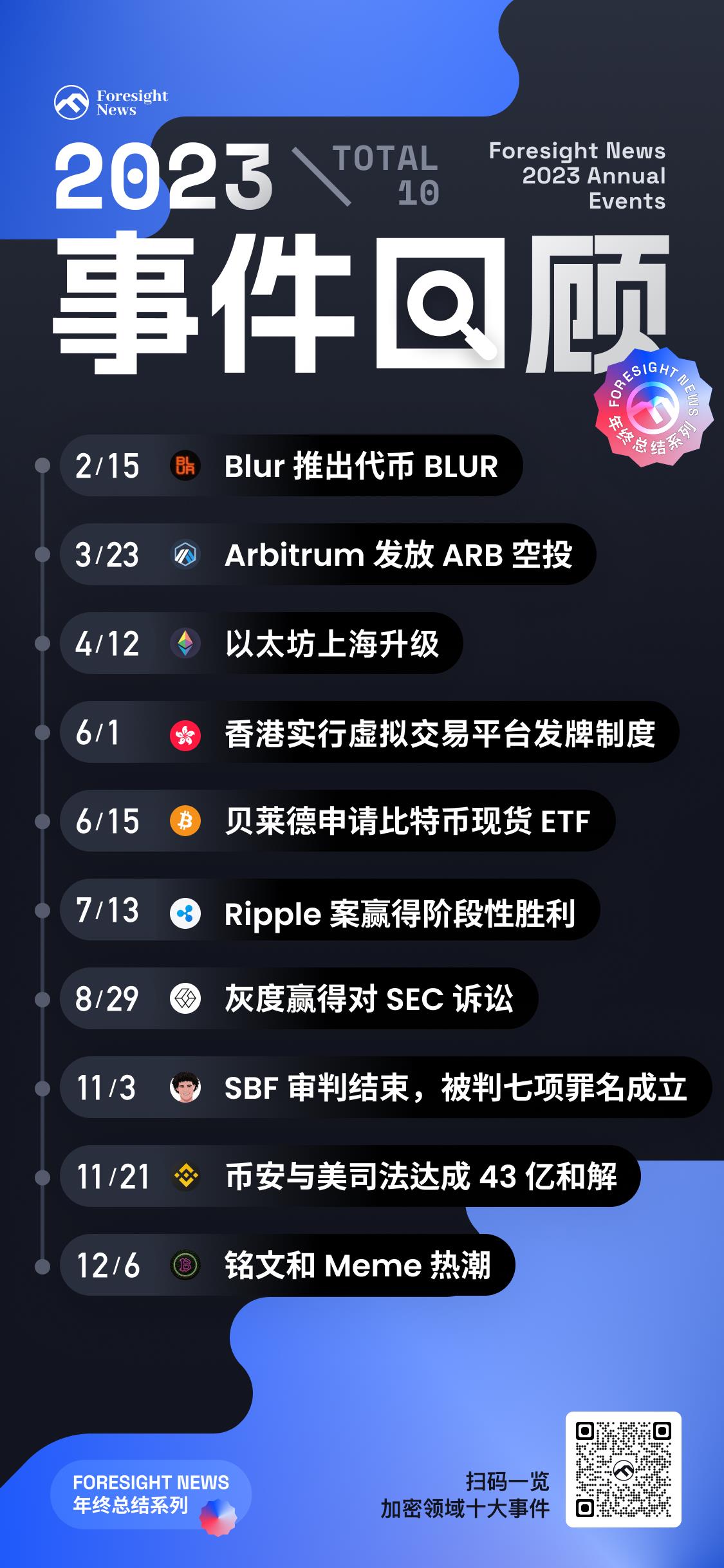
1. BLUR Sparks the First Airdrop Boom of 2023
The first major event in the cryptocurrency sector of 2023 occurred on February 15, when the Blur platform distributed its initial airdrop of 360 million BLUR tokens to community members. Due to overwhelming participation, Blur’s official website temporarily crashed during the claim process, leaving users unable to access or claim their tokens. It took over half an hour to resolve the issue. Meanwhile, Ethereum network gas fees surged to around 1,000 Gwei. According to data from ultrasound.money at the time, contract operations related to claiming the Blur airdrop led to the burning of more than 980 ETH—ranking first across the entire network. However, BLUR’s performance over its first 10 months fell short of expectations: it launched at $0.65 and was trading at $0.51 at the time of writing.
Emerging amid the NFT boom in mid-2022, the Blur platform quickly rose above other NFT marketplaces, even surpassing OpenSea, which had long dominated the market. As such, there is growing anticipation about whether a new leader will emerge in the NFT marketplace space in 2024. For instance, recently, fueled by the inscription craze, OKX NFT Marketplace briefly surpassed both OpenSea and Blur in trading volume.
2. ARB Airdrop Launch
Arbitrum distributed its token airdrop on March 23, marking one of the most notable events in the crypto industry that month. However, with only one-third of the total supply allocated for airdrops, the ARB distribution became known as one of the “most competitive airdrops.” As one of Ethereum’s leading Layer 2 solutions, Arbitrum drew comparisons between ARB and OP. ARB debuted at $1.35—similar to OP’s launch price of $1.40 last year—but at the time of writing, OP was trading at $3.52, significantly outperforming ARB, which stood at $1.38.
3. Ethereum Shanghai Upgrade
The Ethereum Shanghai upgrade on April 12 marked another milestone following the Ethereum Merge in September 2022. The Merge was a critical step in transitioning the network to a proof-of-stake (PoS) consensus mechanism, while the key feature of the Shanghai upgrade was enabling withdrawals of ETH staked in smart contracts on the Ethereum Beacon Chain—two years after staking first went live on the Beacon Chain.
Prior to the upgrade, markets widely feared a potential sell-off of ETH once unstaking became possible. Indeed, the first day post-upgrade saw the highest single-day outflow of staked ETH, with 14,249 validators initiating withdrawals. Within a month, 48,341 validators exited, withdrawing 1.55 million ETH (worth $2.93 billion at the time). Despite this, prices remained stable, and due to strong demand for staking, net inflows into staking pools remain positive to date.
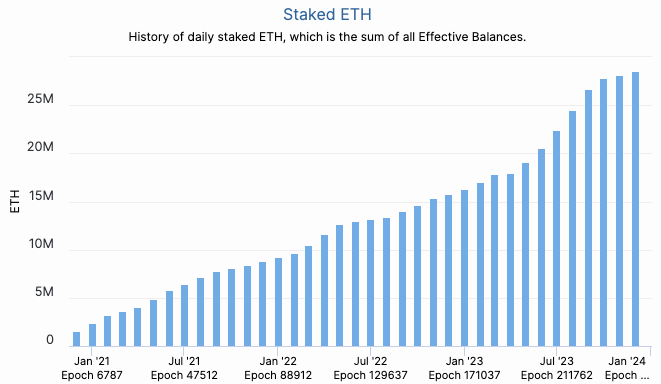
Next, Ethereum’s most anticipated technical advancement will be sharding.
4. Hong Kong Implements Virtual Trading Platform Licensing Regime
Since issuing its virtual asset policy declaration on October 31 of the previous year, the Hong Kong Special Administrative Region government has been actively promoting Web3.0 development. In December, it passed the Anti-Money Laundering and Counter-Terrorist Financing (Amendment) Bill 2022, establishing a licensing regime for virtual asset service providers effective June 1 of this year. This move formally brings virtual asset trading platforms under regulatory oversight, requiring any entity offering such services in Hong Kong to obtain a license.
To date, 13 virtual asset trading platforms have submitted applications to the Hong Kong Securities and Futures Commission (SFC), with two—HashKey Exchange and OSL Exchange—receiving licenses. One application was rejected, and 10 remain pending. Nonetheless, the unlicensed exchange JPEX sparked a fraud scandal involving over HK$1 billion.
Additionally, Hong Kong launched Asia’s first virtual currency futures ETF this year and is exploring the “digital Hong Kong dollar.” Tokenized assets are also part of Hong Kong’s potential development path. After the conclusion of Hong Kong FinTech Week in November, the city’s three key Web3.0 focus areas were identified as retail access, digital Hong Kong dollar and digital RMB, and stablecoins.
5. BlackRock Files for Spot Bitcoin ETF
U.S. financial institutions and regulators have debated spot Bitcoin ETF applications for years. But BlackRock—the world’s largest asset manager overseeing approximately $9 trillion in assets—filed its spot Bitcoin ETF application on June 15, signaling renewed institutional interest in the crypto market and helping push Bitcoin’s price from $25,000 to $30,000.
Following BlackRock’s lead, asset management firms including WisdomTree, Invesco, and Fidelity resubmitted their own spot Bitcoin ETF applications. The SEC, as before, repeatedly delayed decisions. However, following its losses in lawsuits involving Grayscale and shifting internal attitudes, the SEC has now held 24 meetings with the 13 applicant firms to discuss ETF details. January 5–10, 2024, marks the final deadline for the SEC to approve or reject these applications. Wall Street analysts predict that, to ensure market fairness, the SEC may approve multiple ETFs simultaneously.
6. Ripple Wins Key Victory Against SEC in Lawsuit
On July 13, Ripple secured a significant victory in its long-running legal battle with the U.S. Securities and Exchange Commission (SEC), a case dating back to December 2020. At stake was whether Ripple’s sale of $1.3 billion worth of XRP constituted an unregistered securities offering—a question of monumental importance to the broader crypto industry. After three years of litigation, a U.S. federal judge ruled that Ripple’s distribution of XRP did not violate federal securities laws, determining that XRP failed to meet the criteria for being classified as a security in many aspects. This marked the first time a U.S. judge ruled in favor of Ripple and could set a precedent for future token classification cases, sparking widespread excitement in the crypto community.
XRP’s price surged from $0.47 to $0.82, reaching its highest level since January 2018. The ruling also boosted several other tokens previously labeled as securities by the SEC in its lawsuit against Coinbase, including SOL, MATIC, ADA, and XLM—all of which saw double-digit percentage gains.
However, this ruling represents only a partial win for Ripple. Although the SEC’s appeal was dismissed, it may still attempt to appeal the entire case.
7. Grayscale Prevails in Lawsuit Against SEC
Less than two months after losing to Ripple, the SEC suffered another defeat—this time against Grayscale. Grayscale’s Bitcoin Trust (GBTC) has become the world’s largest Bitcoin investment trust, holding over 408,500 BTC—nearly 2% of the total Bitcoin supply—making Grayscale’s victory highly significant for the crypto industry.
On August 29, a U.S. federal court ruled in favor of Grayscale Investments LLC in its lawsuit challenging the SEC’s rejection of its application to convert GBTC into a spot Bitcoin ETF. The case originated in October 2021 when Grayscale first applied to transform its closed-end Bitcoin trust into a spot ETF, only to be denied by the SEC.
The judge determined that the SEC’s initial denial was “arbitrary and capricious,” emphasizing that regulatory agencies must apply consistent standards. If futures-based Bitcoin ETFs are approved on grounds of reduced manipulability, then spot Bitcoin ETFs should follow the same logic—otherwise, all futures ETF approvals should be revoked. The SEC had permitted Bitcoin futures ETFs in 2021, citing lower susceptibility to manipulation, yet continued to block spot ETFs. Given that Bitcoin is the only crypto asset explicitly recognized by the SEC as non-security, and ETFs are regulated financial products, there should be no barrier to approving a Bitcoin spot ETF.
If BlackRock’s application provided momentum for spot Bitcoin ETFs, Grayscale’s legal win accelerated the approval trend. Bitcoin responded immediately, breaking through the $27,000 and $28,000 thresholds. Prior to this rally, Bitcoin had repeatedly dipped below $26,000, with its market cap falling beneath $500 billion. However, the surge didn’t last long, as the SEC postponed rulings on several spot Bitcoin ETF applications within 48 hours of the verdict.
8. FTX Bankruptcy Case: SBF Convicted on Seven Charges
At the end of 2022, cryptocurrency exchange FTX filed for bankruptcy, triggering turmoil across the crypto market. Multiple crypto firms—including BlockFi and Genesis—followed suit, and overall market capitalization plummeted. As the trial unfolded, more internal details emerged. Before Sam Bankman-Fried’s (SBF) trial, other FTX executives pleaded guilty and agreed to cooperate with prosecutors.
During the high-profile trial, explosive testimony came from SBF’s former girlfriend, who claimed she was directed by SBF to commit crimes, including misappropriating approximately $14 billion in FTX customer funds; Alameda allegedly bribed Chinese officials to unlock accounts; and she admitted to falsifying Alameda’s balance sheets multiple times under SBF’s instructions. Gary Wang, co-founder of FTX, stated that Alameda owed FTX at least $8 billion, with most of Alameda’s investments funded by FTX user deposits. SBF himself acknowledged Alameda’s precarious situation and said he tried to shut it down two months before FTX collapsed.
This landmark trial concluded with SBF convicted on seven charges, facing up to 115 years in prison. However, this is not the final outcome—SBF’s second trial is scheduled for March 11, 2024, with sentencing set for March 28, 2024.
9. Binance Under Fire: Regulatory Hammer Falls, Industry Shakeout Accelerates
In June, the U.S. Securities and Exchange Commission targeted Binance and its founder Changpeng Zhao (CZ), filing 13 charges and placing Binance at the center of public scrutiny. However, data showed no significant change in Binance’s Bitcoin wallet balances over a seven-day period.
On November 22, the U.S. Department of Justice concluded its criminal investigation into Binance, resulting in a record-breaking $4.3 billion settlement—the largest in history. Concurrently, CZ stepped down as CEO of Binance. The crypto market reacted negatively, with Bitcoin briefly dropping below $36,000. Nevertheless, fund outflows from Binance were lower than expected. New CEO Richard Teng emphasized that Binance would now pursue a path of stability, growth, and compliance.
With FTX’s collapse followed by Binance’s regulatory troubles, the cryptocurrency industry faces new challenges and opportunities. Increased regulatory pressure will compel participants to strengthen compliance and internal governance. At the same time, industry consolidation will accelerate, creating fresh growth opportunities for leading players. Coinbase may stand to benefit the most—already serving as custodian for BlackRock’s crypto ETF—and stands to gain significantly if spot Bitcoin ETFs are approved next year.
10. Inscription and Meme Mania Take Off
By the end of 2023, inscriptions and meme coins swept across the entire cryptocurrency market.
Inscriptions refer to a technology that embeds arbitrary content onto the Bitcoin blockchain. First introduced in March 2023, developers built BRC-20 on top of Ordinals, mimicking ERC-20 standards and enabling fungible token issuance on Bitcoin. Initially, inscriptions gained little traction due to relatively high minting barriers. However, platforms like Unisat introduced automated tools that lowered entry costs, accelerating user adoption. By November, ORDI’s price surged dramatically, ushering in what some called the “Summer of Inscriptions.”
A turning point came on December 6, when Bitcoin Core developer Luke Dashjr announced that inscriptions were exploiting a vulnerability in the Bitcoin Core client to flood the blockchain with spam, promising to patch it in a future release. This implied that ORDI and similar inscriptions might cease to exist in newer versions, sparking fierce debate within the community—dividing supporters and opponents. Ironically, the controversy fueled another wave of interest, pushing ORDI to a new high above $68. In late December, daily transaction fees on the Bitcoin network briefly exceeded those of Ethereum due to massive Ordinals-related activity.
As Bitcoin inscriptions gained popularity, a wave of inscription activity spread across other public blockchains, driving up native token prices. Among them, SOL surged ahead, breaking past $110 with nearly a 100% gain over 30 days. Additionally, thanks to low gas fees and vibrant community engagement, Solana’s meme coin ecosystem exploded. Memes emerged as a crucial driver of market momentum at year-end, spawning countless animal-themed tokens such as WIF, LEIA, and SILLY, whose market caps rose nearly tenfold in short periods.
Conclusion
2023 was a year of recovery for Web3, marked by progress in regulation, technology, and applications. By year-end, major cryptocurrencies like Bitcoin and Ethereum saw substantial price increases, delivering a satisfying outcome for Web3 enthusiasts and laying the groundwork for further growth in 2024.
As Bill Gates said in his annual outlook: “The road ahead will reach a turning point in 2024.”
Join TechFlow official community to stay tuned
Telegram:https://t.me/TechFlowDaily
X (Twitter):https://x.com/TechFlowPost
X (Twitter) EN:https://x.com/BlockFlow_News
 Foresight News











