








DePIN Gains Significant Attention: Analyzing Its Development Potential, Ecosystem, and Potential Challenges
TechFlow Selected TechFlow Selected
DePIN Gains Significant Attention: Analyzing Its Development Potential, Ecosystem, and Potential Challenges
In addition to Helium Mobile, what are some other promising concept projects, and what security risks do they entail?
 Navigating Web3 tides with focused insights
Author: Beosin
Recently, Helium Mobile, a project within the Solana ecosystem, has gained significant popularity, with its token MOBILE soaring in market capitalization to a peak of $700 million. Subsequently, DePIN—the sector to which Helium Mobile belongs—has drawn widespread market attention, emerging as a major narrative following Bitcoin inscriptions and protocols.
What exactly is DePIN? Beyond Helium Mobile, what other promising concept projects exist? And what security risks do they entail? Today, the Beosin team will break it all down.
The Origin of DePIN
DePIN (Decentralized Physical Infrastructure Networks) refers to decentralized physical infrastructure networks that leverage blockchain technology and token incentives to motivate individuals and enterprises worldwide to build any form of physical-world infrastructure (such as WiFi, hard drive storage, batteries, etc.) in a decentralized manner, providing services to anyone.
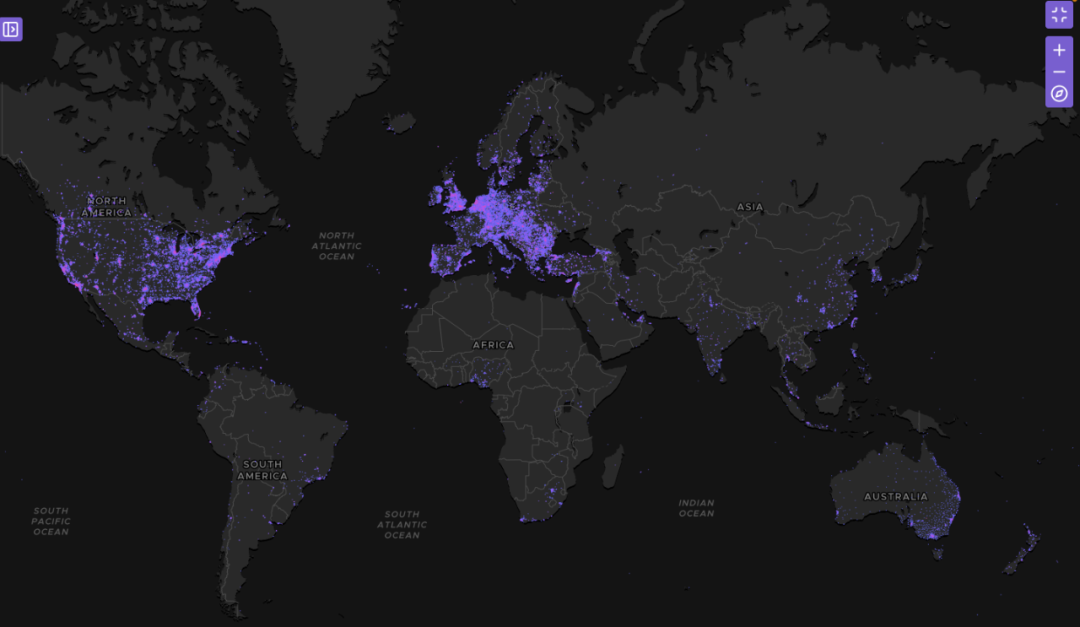
DePINscan: DePIN Device Distribution Map
Previously, there was no unified term for this emerging sector. In 2019, Kyle Samani, a partner at Multicoin Capital, referred to related decentralized physical infrastructure projects as the "Internet Infrastructure Stack." In 2021, IoTeX, a public blockchain focused on IoT, coined the term MachineFi for this space, followed by other names such as "Token-Incentivized Physical Network." In November 2022, Messari conducted a vote on naming the Web3 physical infrastructure sector and began using "DePIN" in its annual and thematic reports. Since then, DePIN has become the standardized name for this sector.
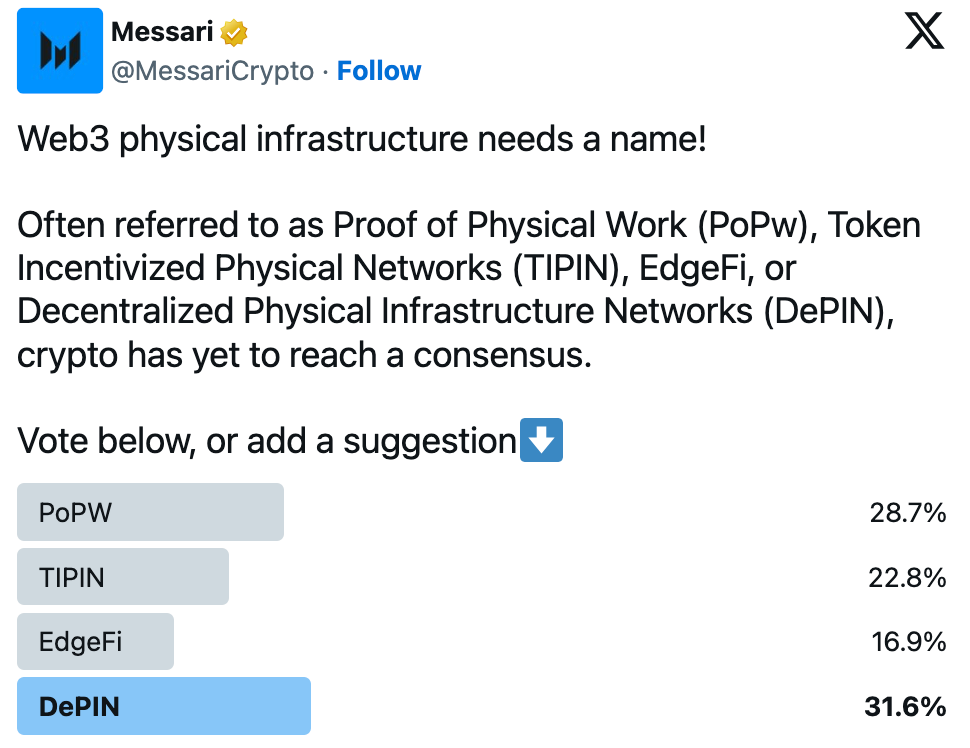
link: https://twitter.com/MessariCrypto/status/1588938954807869440
DePIN Concept Projects and Associated Risks
The industries covered by DePIN are extremely broad. According to Messari’s classification, they can be divided into two main categories: Physical Resource Networks and Digital Resource Networks, depending on the type of hardware, resources, goods, and services provided by the network.
Physical resource networks include wireless networks, mobile networks, and energy networks; digital resource networks include storage, bandwidth, and computing networks. Representative projects in each field are shown in the diagram below:
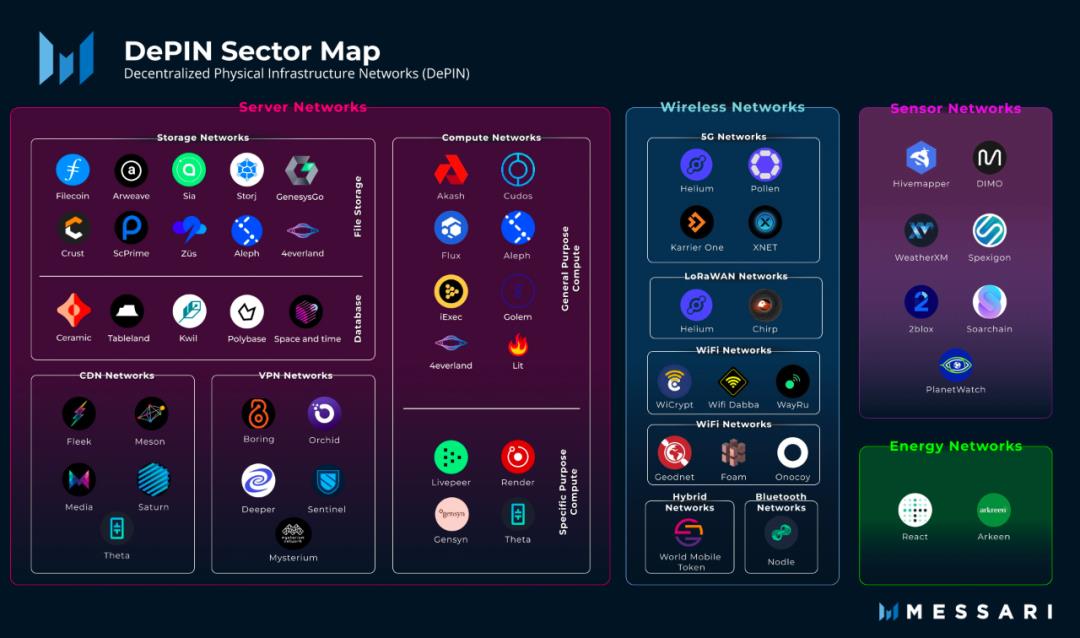
source: Messari
Given the large number of DePIN-related projects, only four key projects in the DePIN sector are analyzed below; the operations/narratives and risks of other projects are similar:
Note: The following content does not constitute investment advice.
1. Helium and Helium Mobile
Helium is a decentralized wireless network protocol. Since 2017, Helium has used blockchain technology and token incentives to encourage users to deploy wireless networks. Its decentralized network concept and the low barrier to entry of Helium hotspot devices attracted massive user participation. By the end of 2021, total sales of Helium hotspot devices exceeded $250 million.
In 2022, due to a low number of users on the Helium network and correspondingly low node rewards, the monthly income from a single Helium hotspot dropped to around $20. As a result, Helium decided to migrate to the Solana network to attract more users.
During the migration, Helium Mobile, a subsidiary service under Helium, began offering SIM cards and free trials to users via Saga smartphones developed by Solana Labs. On December 6, 2023, Helium Mobile launched a $20-per-month unlimited phone plan in the U.S., including data, text, and voice services. Users purchasing this plan receive an NFT and are eligible for MOBILE token airdrops.

Helium Mobile operates similarly to a telecom operator, offering competitively priced phone plans. Users can earn MOBILE tokens through eSIM activation. The business flywheel works as follows: Helium Mobile attracts users with low-cost services and token incentives; user growth drives up token prices, attracting even more users who pay for Helium Mobile’s services.
Currently, the MOBILE token serves solely as a governance token for Helium Mobile. Its current market cap exceeds $400 million, with a fully diluted valuation (FDV) over $1.1 billion. Users should be cautious of short-term speculation risks.
2. IoTeX
IoTeX is a decentralized public blockchain dedicated to the Internet of Things (IoT), aiming to integrate blockchain networks, trusted hardware, and edge computing to enable trustworthy interconnectivity of everything. IoTeX primarily builds products by connecting billions of real-world physical devices to Web3 infrastructure. Its ecosystem currently spans DeFi, NFTs, DAOs, Metaverse, and DePIN sectors.
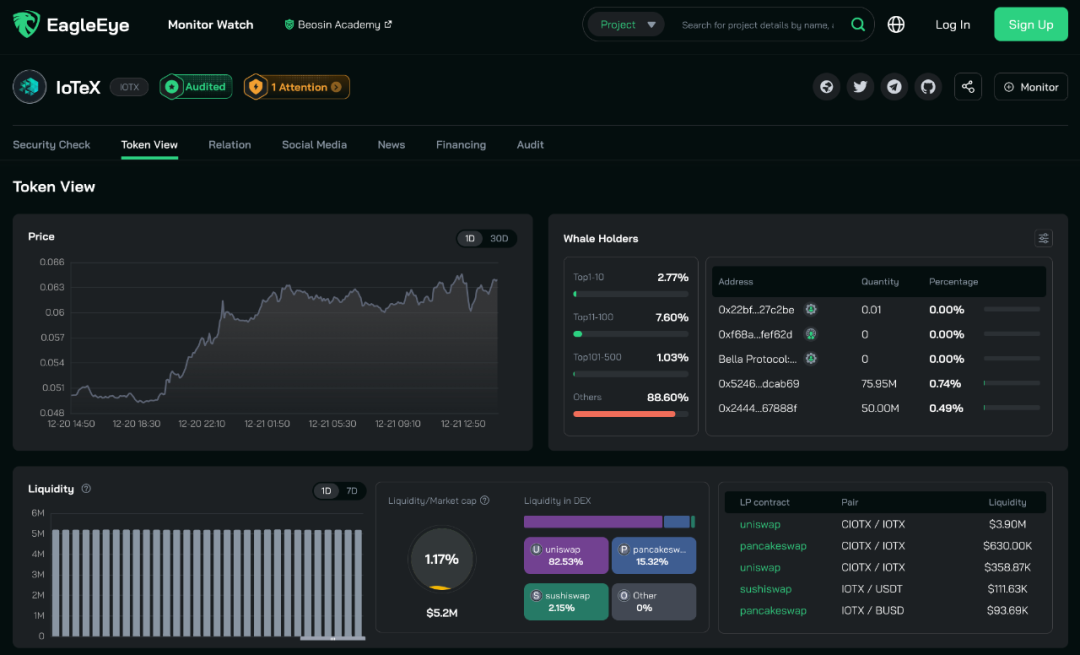
IoTeX: https://eagleeye.space/detail/iotex
According to EagleEye's on-chain data analysis, IoTeX’s liquidity is primarily concentrated in Uniswap pools and its native DEX Mimo, though most liquidity remains on centralized exchanges. Over 90% of its tokens are fully circulating, with a market cap of approximately $600 million.
3. DIMO Network
DIMO Network is an automotive IoT platform that allows drivers to collect and share their vehicle data in exchange for DIMO tokens. The team raised $9 million in funding in 2022 from institutions including CoinFund. According to the official DIMO website, the network currently connects over 28,000 vehicles. DIMO generates revenue from user-provided vehicle data and paid API data services.
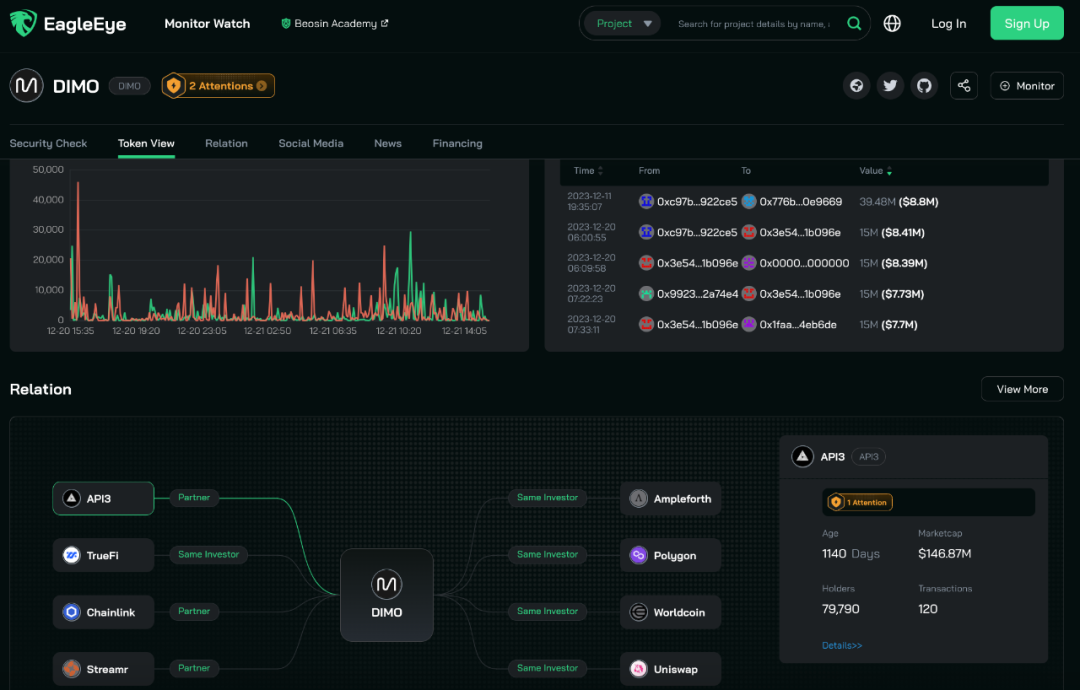
DIMO: https://eagleeye.space/detail/dimo
DIMO currently has a market cap exceeding $96 million. Its token, DIMO, is nearly fully circulating and experiencing high price volatility—users should exercise caution when trading.
4. Streamr Network
Streamr Network is a decentralized network designed to collect and distribute low-latency, real-time data streams from IoT sensors, machines, and other smart devices. According to EagleEye’s project relationship mapping, Streamr is currently collaborating with data platforms such as DIMO Network and Swash.
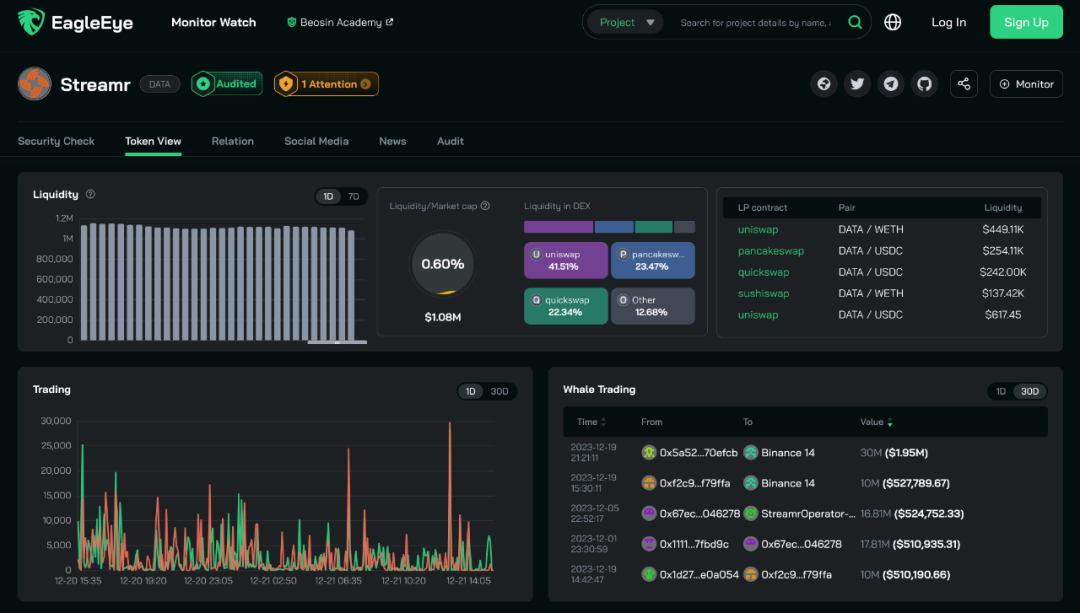
Streamr: https://eagleeye.space/detail/streamr
Streamr currently has a market cap exceeding $70 million. Its token, DATA, is nearly fully circulating and subject to significant price fluctuations. EagleEye detection indicates certain centralization risks in its token contract.
Impact and Significance of DePIN
Compared to traditional physical infrastructure networks, DePIN offers several advantages:
1. Rapid Launch: Operational and maintenance costs for DePIN projects are only a fraction of those for traditional hardware infrastructure companies. For example, while telecom operators may require billions in investment and large workforces to launch services, DePIN drastically reduces upfront capital needs through token incentives, enabling launches with just hundreds of thousands to millions of dollars—lowering industry entry barriers and accelerating time-to-market.
2. Community-First: In DePIN, the community owns all hardware comprising the network and provides the products and services it needs. Users are no longer dependent on corporations primarily focused on profits and financial statements. This alignment of stakeholder interests promotes adoption and growth of DePIN services.
3. Open Governance: Traditional infrastructure projects often end up governed by centralized entities that dictate terms and conditions. In contrast, DePIN is open, democratic, and accessible. Anyone, anywhere, can use DePIN services and participate in building physical infrastructure that benefits them directly.
Conclusion
Thanks to recovering market liquidity and sentiment, the DePIN sector and its associated concept projects have seen tremendous momentum and capital inflows over recent weeks. DePIN represents an application layer targeting real-world users, holding immense potential to onboard Web2 users and enterprises, potentially ushering Web3 into a phase of mass adoption.
However, users should note that for DePIN projects, narratives and flywheel effects are currently dominant, with adoption closely tied to market trends. Currently popular projects like Hivemapper, Render, Helium, and Helium Mobile are all part of the Solana ecosystem, and their rise is partly attributable to Solana’s resurgence. As markets mature and projects evolve, user evaluation will ultimately shift from narratives and hype toward sustainable profitability. Whether DePIN projects can establish viable business models, ensure smart contract security, and achieve stable, real-world implementation remains uncertain.
Join TechFlow official community to stay tuned
Telegram:https://t.me/TechFlowDaily
X (Twitter):https://x.com/TechFlowPost
X (Twitter) EN:https://x.com/BlockFlow_News
 @Beosin_com











