








Linking Agriculture and Investors with RWA: Understanding LandX's Products and Economic Model
TechFlow Selected TechFlow Selected
Linking Agriculture and Investors with RWA: Understanding LandX's Products and Economic Model
As a decentralized protocol, LandX connects farmland owners with crypto-native investors through blockchain-based perpetual commodity vaults.
 Navigating Web3 tides with focused insights
Author: Revelo Intel
Translation: TechFlow
LandX is currently live on Ethereum mainnet and Arbitrum, aiming to bring physical agricultural assets into the decentralized finance (DeFi) space, offering DeFi users exposure to the agricultural commodities sector. Deposited funds are used to finance real farmers, with returns paid back to users in the form of commodities.
Additionally, LNDX, LandX’s token, has recently launched. Within the context of the RWA narrative, is LNDX a project worth participating in?
Background of LandX
-
LandX Finance is a blockchain protocol designed to bring real-world assets (RWA) into the decentralized finance (DeFi) world through perpetual commodity vaults.
-
By introducing agricultural RWAs on-chain, the protocol offers investors yield opportunities and exposure to an asset class uncorrelated with DeFi and cryptocurrencies.
-
As a decentralized protocol, LandX connects farmland owners with crypto-native investors via blockchain-based perpetual commodity vaults, enabling fully on-chain generation of real yields from real-world output.
-
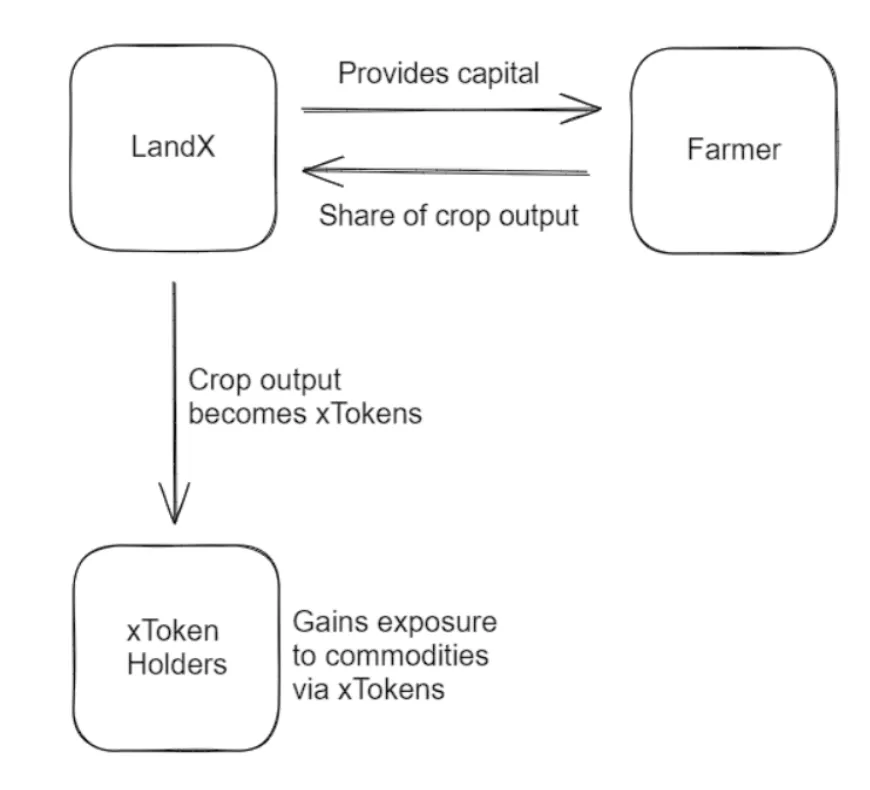
Farmers can raise capital from the DeFi ecosystem, repaying with periodic crop shares. These payment obligations are tokenized as ERC-20 tokens and represented on-chain as xTokens.
-
LandX's platform focuses on four crops: corn, wheat, rice, and soybeans.
-
$xBasket is an index token that allows holders to equally allocate investments across all four crops.
How LandX Works
-
LandX introduces a new method of utilizing farmland through tokens and NFTs.
-
On one hand, NFTs represent legal and economic contracts backed by farmland, ensuring a reliable and secure coordination system between parties.
-
On the other hand, after a rigorous qualification process, farmers commit via legal contracts (called liens) to deliver a portion of their annual harvest.
-
In return, they receive xTokens equivalent to the agreed crop share. These tokens are then sold to interested investors, providing farmers with upfront capital.
-
To hedge against potential uncertainties, LandX requires farmers to maintain 12 months of crop share payments and a 12-month margin on the platform.
-
Additionally, the protocol ensures independent legal agreements grant LandX ownership rights over collateral (farmland) in case loans are not repaid.
Perpetual Commodity Vaults
-
The LandX protocol facilitates agreements between borrowers (farmers) and investors through blockchain-based tokenized perpetual commodity vaults.
-
This enables investors to earn yields secured by legal contracts backed by underlying farmland.
-
Perpetual commodity vaults trade at a principal price determined by the market and provide token holders with permanent daily returns in base commodities.
-
These products are traded through an internal market that uses Chainlink Oracle data services to update product prices.
-
This means they can be exchanged 24/7 for stablecoins like $USDC with zero slippage.
xTokens and cTokens
-
An xToken is a perpetual commodity vault that pays an annual yield of 1 cToken, providing investors with a steady income source.
-
xTokens are tradable on public markets.
-
A key benefit of xTokens is their ability to hedge against inflation. This is achieved by providing exposure to farm crop outputs, which have historically been reliable inflation hedges.
-
cTokens are on-chain commodities representing 1 kilogram of the underlying product, granting tangible ownership of physical assets.
-
cTokens can be redeemed for $USDC within the LandX dApp. They are not tradable on public markets.
-
cTokens can be redeemed at the market value of the underlying commodity.
-
LandX Launch
-
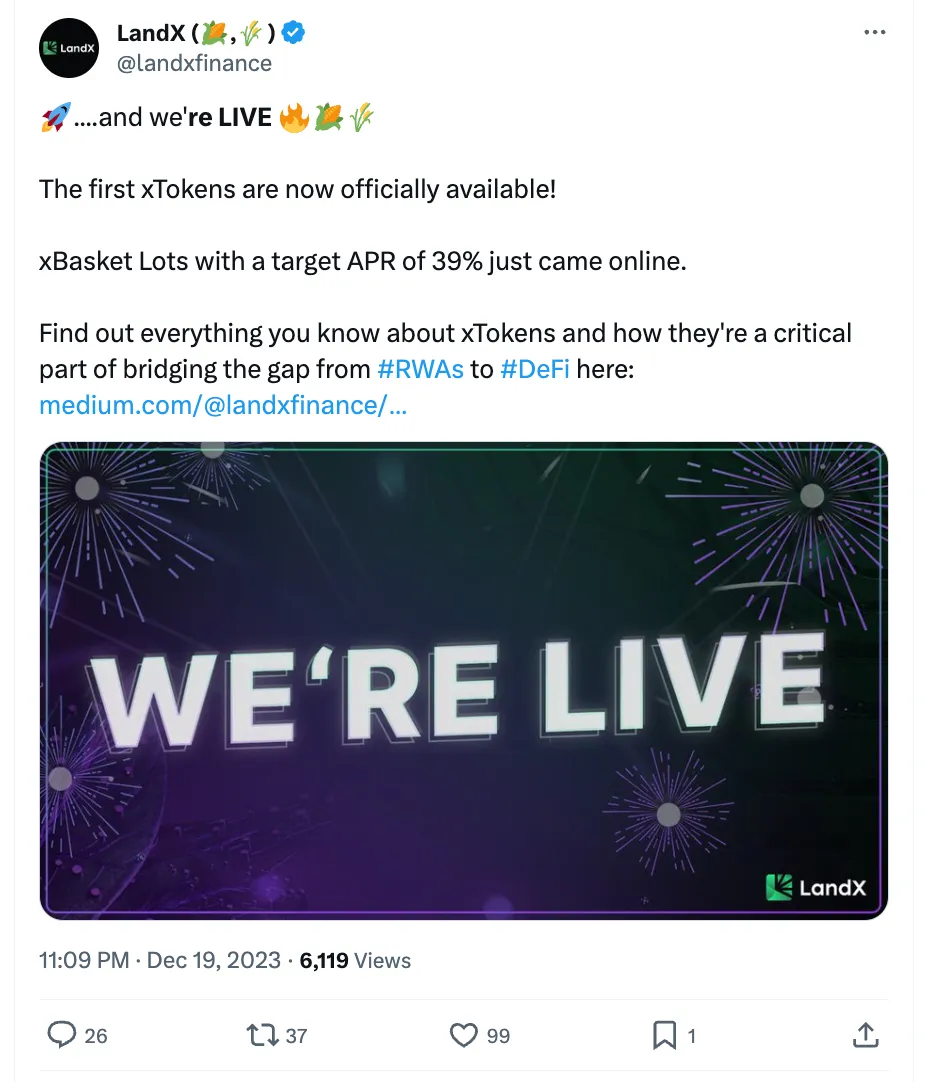
LandX launched yesterday and quickly attracted inflows. At launch, $2 million in xTokens/USDC liquidity was provided.
-
The project went live on both Ethereum mainnet and Arbitrum at launch, with $ETH constituting the majority of the protocol’s TVL.
-
xBasket is available on Ethereum mainnet, with a TVL of approximately $412,000.

LNDX Token Economics
-
LNDX is LandX’s native governance token.
-
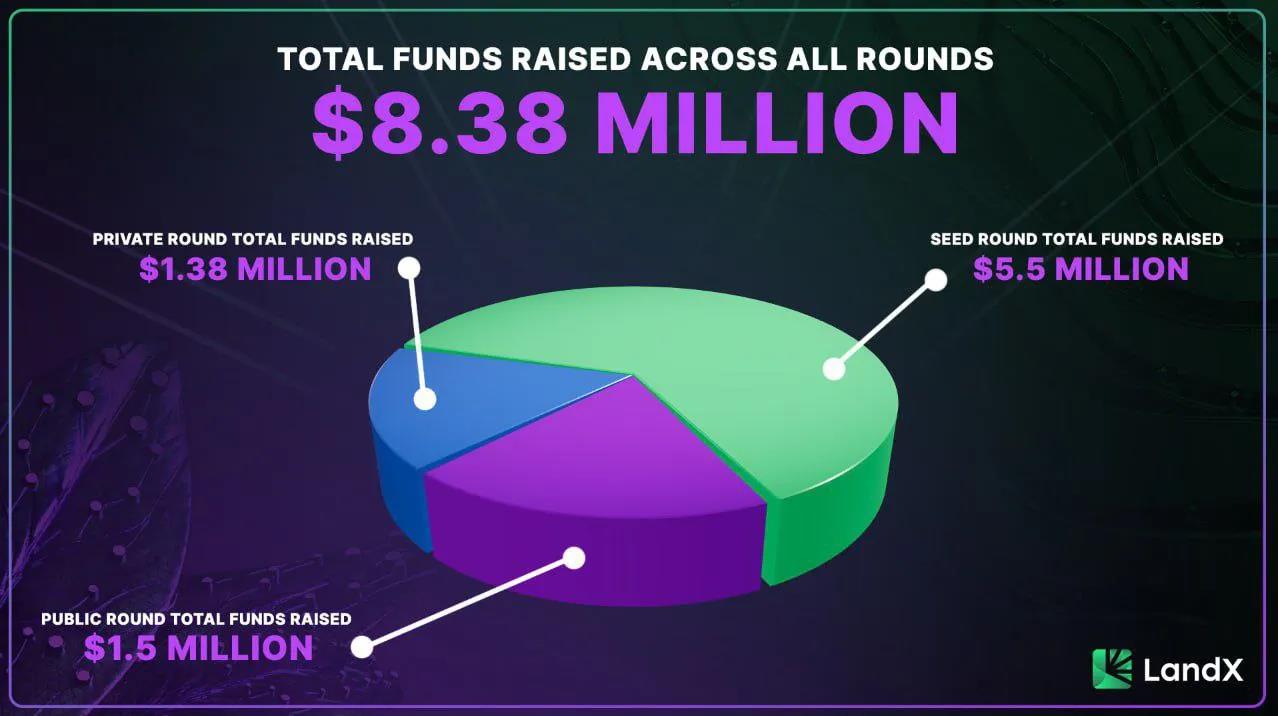
The project has raised approximately $8.3 million in total:
-
It allows users to receive veLNDX, a representative token that entitles holders to a portion of protocol revenues and enables participation in governance.
-
LandX charges a 3% fee on farmland financing and a 0.25% fee on regular crop share payments. These fees are allocated as follows:
-
60% to $LNDX holders
-
35% to LandX Labs operations
-
5% to the LandX Choice Fund, supporting regenerative agriculture programs, land operator education, and other initiatives
-
-
In addition to DAO voting rights, $LNDX holders may become validators on LandX. Validators are responsible for onboarding new farmers and ensuring smooth platform operations.
Future Plans
-
Currently, the core team executes plans and makes decisions. As TVL grows, the organization will incorporate and introduce a board, becoming more decentralized. Governance will grow increasingly important as the protocol evolves.
-
LandX will fly drones over its farmland, allowing users to view fields during harvest, providing assurance to xToken holders.
-
LandX founder 0xLandWalker stated that the hardest decision made was limiting the commodities offered on the platform to just wheat, rice, soybeans, and corn.
The team welcomes others to fork the protocol and expand the range of crops offered, but LandX will focus on its four core commodities and continue providing financing in these areas.
Join TechFlow official community to stay tuned
Telegram:https://t.me/TechFlowDaily
X (Twitter):https://x.com/TechFlowPost
X (Twitter) EN:https://x.com/BlockFlow_News
 Revelo Intel






