








The Singularity of Mass Adoption Approaching? This "Supporting" Sector is Key to the Web3 Boom
TechFlow Selected TechFlow Selected
The Singularity of Mass Adoption Approaching? This "Supporting" Sector is Key to the Web3 Boom
Behind blockchain data lies the vast ocean of Web3.
 Navigating Web3 tides with focused insights
Author: Jason Jiang
Data is the most valuable resource in today's world and the focal point of digital gold rushes. Despite ongoing controversies surrounding Web3, as on-chain ecosystems such as inscriptions, GameFi, and DeFi diversify, we are now immersed in a surge of Web3 application innovation—making the blockchain data sector increasingly prominent.
Against the backdrop of a relatively sluggish 2023 Web3 investment landscape, the blockchain data sector has seen "countercyclical" interest from investors: As of December 15, 2023, nearly 40 global blockchain data startups and projects have secured funding, attracting over $176.9 million into the Web3 market.
Why Is Capital Focusing on the Blockchain Data Sector?
Capital follows market signals. The blockchain data sector gained investor favor in 2023 primarily due to its certainty. The primary goal for Web3 today is increasing adoption—which must be built upon tangible, real-world use cases. Compared to other hyped crypto narratives, the blockchain data sector may appear less visionary, but its market demand is more grounded and genuine.
Beyond certainty, the long-term potential of the blockchain data sector cannot be overlooked. In 2022, the global big data and business analytics market was valued at nearly $280 billion, while financial data analysis alone generated annual revenues exceeding $38 billion. By comparison, the on-chain data market could conservatively reach a scale of tens of billions of dollars.
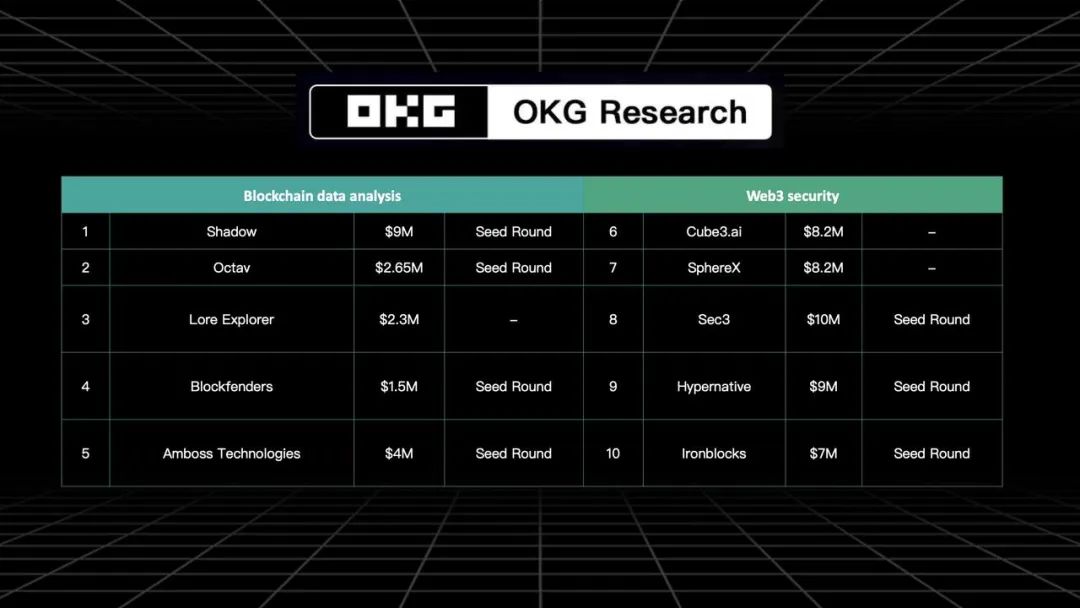
In terms of capital flows, on-chain data analytics and Web3 security are currently the most funded and closely watched sub-sectors within blockchain data. According to incomplete statistics from OKG Research, in 2023, 80% of funded blockchain data projects and over 90% of total investment amounts were concentrated in these two areas. As Web3 regulatory compliance accelerates, solutions for transaction monitoring, anti-fraud, and anti-money laundering based on on-chain data also received increased attention in 2023.
Source: OKG Research
Although the public and accessible nature of on-chain data might seem to eliminate competitive advantages in this sector, the high costs and sustained R&D required to build various products have created significant "invisible barriers": generating smart contract event logs requires substantial gas fees; real-time tracking and analysis demand massive computing resources; parsing and utilizing unstructured data necessitate continuous R&D investment...
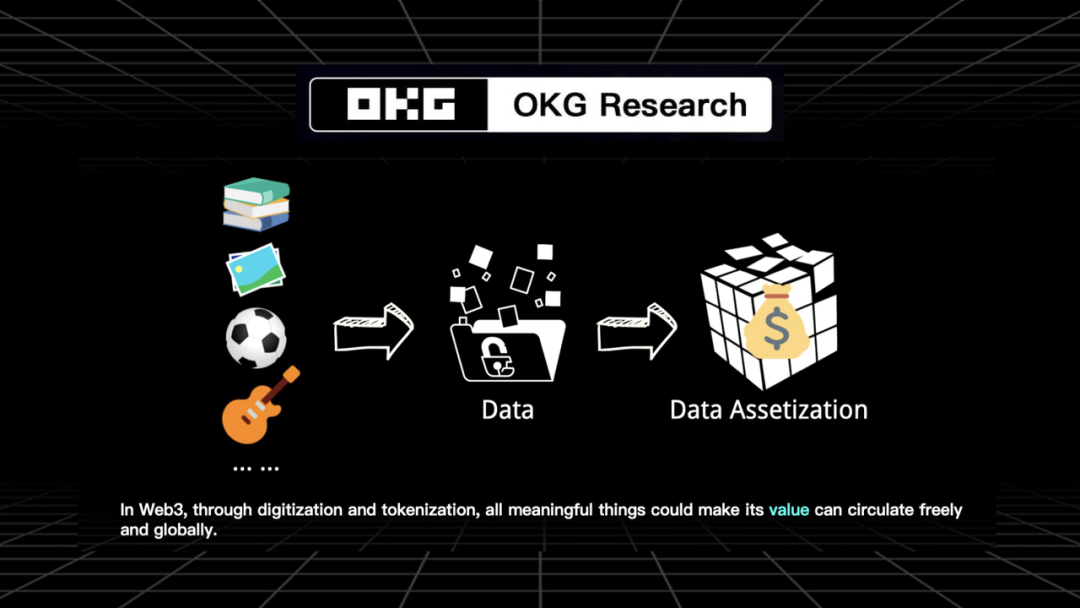
Compared to other popular narratives promising returns of dozens or even hundreds of times, the blockchain data sector is certainly not an ideal short-term investment. Yet capital continues to flow in, and Web3 tech firms like OKLink remain committed—because on-chain data forms the very foundation of the Web3 industry. Regardless of how one interprets Web3, data remains the most fundamental and core element. Whether capturing on-chain alpha, formulating development strategies, or building new security and compliance frameworks around Web3, virtually all Web3 activities rely on blockchain data.
Source: OKG Research
A previous article stated, “Don’t touch Web3 unless you’re all in.” Today, that sentiment seems even more fitting for the blockchain data space.
Four Trends for the Blockchain Data Sector in 2024
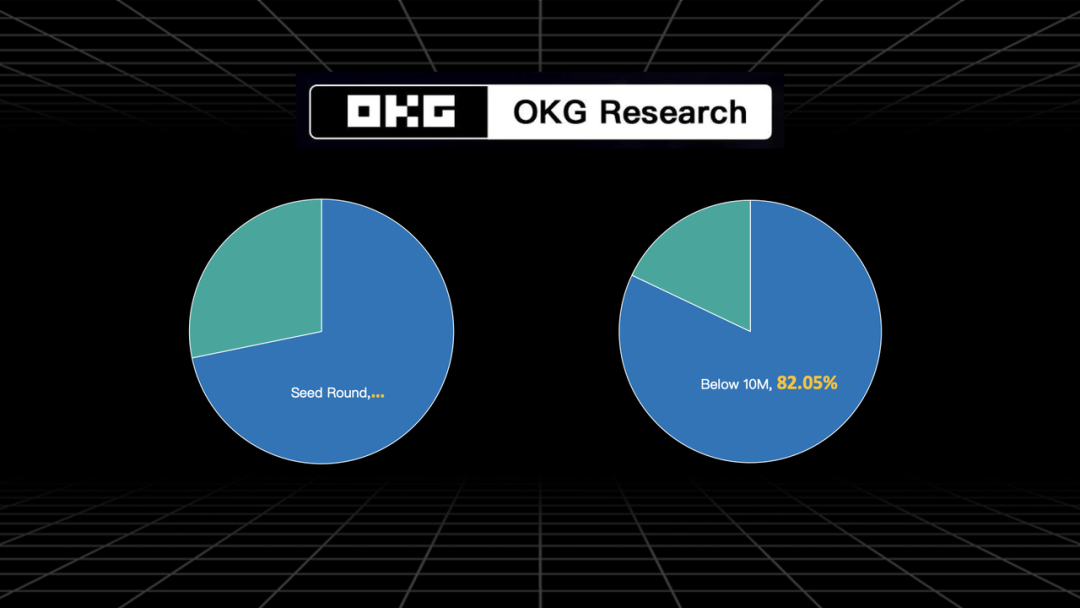
While the blockchain data sector has the potential to become a cornerstone of the Web3 ecosystem, it remains in its early exploratory phase. This is evident from 2023’s funding trends: Most blockchain data projects raised less than $10 million, with funding rounds predominantly at the seed stage.
Source: OKG Research
As mass adoption of Web3 approaches, the blockchain data sector will present more certain opportunities, inevitably attracting greater capital and institutional participation. In this context, OKG Research identifies four key trends expected to shape the blockchain data sector in 2024:
1. Deeper integration with AI will make it even more promising
AI technology is empowering the blockchain data sector across the board—not only enhancing data analysis and application capabilities through AI, but also enabling on-chain data systems to self-learn, becoming smarter and more efficient, thereby providing reliable data support for broader applications and users. At the same time, authentic and trustworthy blockchain data continuously improves AI explainability. The convergence of blockchain data and AI is already becoming common, with no fewer than five blockchain data + AI startups securing funding in 2023. In 2024, deeper integration between the blockchain data sector and AI will become even more anticipated.
2. Comprehensive platforms and niche specialists will complement each other
The blockchain data sector demands long-term commitment. From consumer-facing block explorers to B2B on-chain AML solutions and government-focused Chaintelligence, OKLink’s ability to offer diverse on-chain data products serving all user groups stems from over a decade of deep investment and experience—a result of incremental accumulation leading to qualitative transformation. This model is difficult for similar projects or new entrants to replicate. However, looking at 2023 funding data, specialized, niche blockchain data platforms have also grown rapidly and often capture user attention more easily. Examples include Mnemonic and NFTGo focused on the NFT space, and Octav targeting DeFi.
Compared to comprehensive platforms, niche players operate with lighter business models and greater flexibility, making them better suited for specific use cases and user needs. Meanwhile, large-scale, full-featured platforms can support a wider range of applications and commercial demands, serving as critical infrastructure for mainstream Web3 adoption. These two models are not mutually exclusive—in fact, they can coexist and reinforce each other, jointly building a more robust blockchain data service ecosystem.
3. Integration with off-chain data and real-world scenarios is an inevitable evolution
Web3 is evolving from purely on-chain operations toward a hybrid “on-chain + off-chain” model. Breakthrough applications like RWA and NFTs rely heavily on off-chain assets. Therefore, the blockchain data sector must break down silos and proactively integrate off-chain data in 2024, achieving organic integration between virtual and physical worlds to keep pace with crypto innovation and Web3 market growth. At the same time, blockchain data projects must go deeper into practical scenarios, aligning closely with social, sports, cultural, and other real-world contexts to fully unlock data value.
4. Centralization and decentralization are not mutually exclusive
Currently, the blockchain data sector follows two main paths. The first is the centralized model, similar to Web2 data companies, where firms leverage strong internal data analytics capabilities to deliver professional services—exemplified by Nansen and Glassnode. The second is the decentralized model, embodying the true spirit of Web3, where developer and community contributions drive a positive feedback loop in data product development and insights—such as Dune and Footprint.
However, considering broader Web3 trends, these two paths are converging. Companies are increasingly combining sustained R&D investment in blockchain data with stronger emphasis on developer and community engagement, using community input to enrich, refine, and ground their data offerings. This represents one of the most distinct differences between blockchain data platforms and traditional Web2 data companies. OKLink is actively exploring this path, leveraging UGC (user-generated content) and Open APIs to involve more users in on-chain data construction, collectively unlocking on-chain value. We believe that in 2024, more blockchain data platforms will intensify both data R&D and community-building efforts simultaneously.
Every address and every interaction together form the vast universe of the Web3 ecosystem, and blockchain data stands as one of the most crucial anchors in this digital world. From DeFi Summer to NFT Summer, from Layer2 Summer to today’s Inscription Summer—all Web3 innovations have been underpinned by blockchain data. In this data-native era of Web3, it’s hard not to anticipate even more transformative "alpha magic" emerging from blockchain data.
Join TechFlow official community to stay tuned
Telegram:https://t.me/TechFlowDaily
X (Twitter):https://x.com/TechFlowPost
X (Twitter) EN:https://x.com/BlockFlow_News
 @OKGResearch











