









BRCFi applications attract significant capital interest—how to seize the new opportunity in the Bitcoin ecosystem?
TechFlow Selected TechFlow Selected
BRCFi applications attract significant capital interest—how to seize the new opportunity in the Bitcoin ecosystem?
BRCFi assets surge across the board, signaling the emergence of a "picks and shovels" ecosystem along the Bitcoin inscription gold rush.
 Navigating Web3 tides with focused insights
By Xiyu, ChainCatcher
As BRC20 tokens such as ORDI, SATS, and RATS continue to rise, Bitcoin's ecosystem is gaining momentum, with a wave of applications and infrastructure projects centered around Ordinals inscriptions and BRC20 emerging rapidly.
According to data from crypto platform Rootdata, multiple projects within the Bitcoin ecosystem have announced funding rounds since December.
On December 20, ALEX Lab, a one-stop DeFi service platform built on Bitcoin Stack, received strategic investment from LK Venture, a subsidiary of Bluehole Interactive.
On December 18, Biis, a toolkit aggregating the Bitcoin BRC ecosystem, announced strategic investment from crypto investment firm CGV; GoDID, a DID marketplace aggregator, completed a new funding round at a $30 million valuation led by NGC, and days earlier, its sub-platform bdid.io launched the token BDID for the BTC ecosystem.
On December 16, Tap Protocol, a Bitcoin infrastructure project for building OrdFi applications, raised $4.2 million in a round led by Sora Ventures; on December 14, bitSmiley, a stablecoin lending protocol on Bitcoin, closed a funding round co-led by ABCDE and OKX Ventures; on December 11, Liquidium, a Bitcoin Ordinals-based lending solution, secured $1.25 million in a Pre-Seed round backed by Bitcoin Frontier Fund and Sora Ventures.
On December 7, cross-chain protocol MAP Protocol announced strategic investments from DWF Labs and Waterdrip Capital and achieved BRC20 cross-chain capabilities; Babylon, a Bitcoin staking project, announced an $18 million Series A round led by Polychain Capital and Hack VC.
Within less than two weeks, eight Bitcoin ecosystem-related projects received financial backing from crypto investors, spanning products in cross-chain, lending, and staking—all focused on financial applications built around new assets like Ordinals and BRC20.
With capital inflows, wealth effects in the Bitcoin ecosystem are intensifying—evolving from speculation on BRC20 inscriptions to infrastructure and application layers built upon these assets. For example, Bounce Finance’s token AUCTION (an IDO platform in the Bitcoin ecosystem), Multibit’s bridge token MUBI, and BitStable’s governance token BSSB all surged over 100% in the past week. Backed heavily by capital and driven by surging asset prices, a new sector—BRCFi—has emerged.
BRCFi refers to the DeFi ecosystem powered by BRC20 tokens, encompassing DeFi applications built around BRC20 and Ordinals assets. Currently, the BRCFi sector has launched various toolkits including cross-chain bridges, stablecoins, IDO platforms, and lending protocols. So, what are the representative BRCFi applications? How are they performing?
Bounce Finance’s BRCFi Suite: Cross-Chain Bridge, Stablecoin, IDO Platform
Bounce Finance (AUCTION): Centralized Auction Platform Rides Bitcoin Wave
Bounce Finance (AUCTION) originally started as a multi-chain decentralized auction platform offering services such as token launches and NFT auctions, simplifying the IDO process for new projects. Founded in September 2020 by Jack Lu and Ryan Fang—Jack Lu being a partner at NGC Ventures—the platform failed to stand out during the DeFi boom and gradually faded from users' attention amid the bear market.
However, in November, Bounce Finance gained sudden fame by launching Multibit’s cross-chain bridge token MUBI and stablecoin BitStable’s token BSSB on the Bitcoin ecosystem. After their IDOs on Bounce Finance, both MUBI and BSSB surged dozens of times in value. This wealth effect made Bounce Finance—the previously hidden asset launchpad—the biggest winner, now seen by users as “the birthplace of the next 10x coin.”
Over the past month, Bounce Finance has successfully launched three Bitcoin ecosystem project tokens. On November 12, it launched MultiBit’s asset MUBI at an IDO price of $0.00047, now trading at $0.39—a cumulative gain exceeding 1000x. On November 29, it conducted a public sale for BitStable’s token BSSB at approximately $0.27 per token, now priced at $9.50—an increase of about 40x. On December 15, it listed GoDID’s token BDID at a public sale price of $0.0029, currently quoted at $0.06, delivering returns over 20x.
Driven by consecutive success stories of high-return IDO projects, Bounce Finance has become a prosperity-generating IDO platform within the Bitcoin ecosystem. Following the successful launch of MUBI, Bounce Finance unveiled a series of moves to expand deeper into the Bitcoin ecosystem.
On November 25, Bounce Finance announced on social media its intention to broadly nurture the BTC ecosystem, emphasizing incubation and auction support for BTC-based projects.
On December 1, it announced the launch of Bounce Bit, a Bitcoin DeFi application chain built on Binance’s BTCB. BTCB is a wrapped asset issued by Binance, pegged 1:1 to real BTC. Users can obtain BTCB by locking BTC, allowing holders to participate in on-chain DeFi activities without giving up their Bitcoin positions, thereby generating additional yield. The Bounce Bit network will build a suite of DeFi applications around BTCB and its native token AUCTION.
On December 6, Bounce Finance announced a rebranding to Bounce Brand, which includes Bounce Bit (a Bitcoin-based application chain), Bounce Box (a one-stop gateway exploring Bitcoin DeFi apps), and Bounce Auction (a Bitcoin ecosystem asset auction platform).
On December 19, Bounce Brand revealed that future IDOs would adopt a “two birds, one stone” strategy—two independent teams jointly issuing one token, identity undisclosed, participation via AUCTION and BitStable’s stablecoin DAII, with two separate auction pools.
Riding the wave of the Bitcoin ecosystem, Bounce Finance transformed from a forgotten auction platform into a leading IDO application deeply rooted in Bitcoin. Its native token AUCTION rose approximately 108% in the last seven days, surged over 40% yesterday, and is currently trading at $40.78 with a market cap of $260 million.
Bitcoin Cross-Chain Bridging Protocol Multibit
Multibit Bridge (MUBI) is a cross-chain protocol within the Bitcoin ecosystem supporting seamless transfers between BRC20 and ERC20 assets, enabling asset bridging between Ethereum, BNB Chain, and other EVM networks with the Bitcoin network.
Multibit simplifies the transfer process of BRC20 tokens between Bitcoin and EVM networks. Specifically, users first deposit their BRC20 tokens into a designated BRC20 address provided by Multibit. Once confirmed by the protocol, equivalent tokens are minted and released on the target EVM chain. When users wish to bring BRC20 tokens back, Multibit burns the corresponding amount on the EVM chain and releases the original BRC20 tokens on the Bitcoin chain.
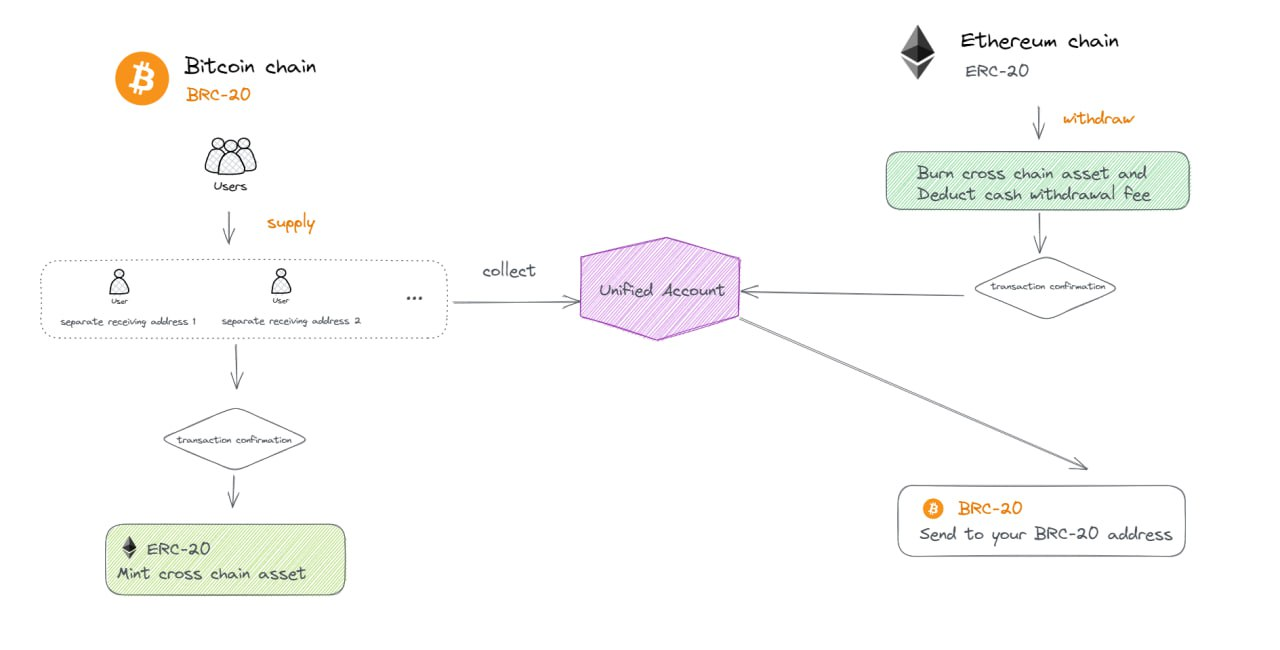
However, Multibit aims beyond just being a bridge—it plans to integrate OAMM trading, yield aggregators, stablecoin issuance, and more to form a comprehensive BRCFi application ecosystem.
OAMM trading refers to Multibit’s automated market maker (OAMM) decentralized exchange protocol designed specifically for trading Ordinals (ORDI) tokens, where all liquidity pools use ORDI pairs for price discovery. The yield aggregator optimizes returns on ORDI tokens across BRCFi applications, while the stablecoin will be minted using ORDI as collateral.
Multibit originated in May but remained unnoticed until November, when the launch of its MUBI token propelled it into the spotlight. On November 12, MUBI completed its IDO auction on Bounce Finance, opening with a 1140% surge.
The wealth effect from the IDO quickly turned Multibit into a star project in the Bitcoin ecosystem. MUBI has risen approximately 131% over the past seven days, currently priced around $0.30, with a total supply of 1 billion, 950 million in circulation, and a circulating market cap of $290 million.
Bitcoin Ecosystem Stablecoin BitStable
BitStable (BSSB & DAII) is a stablecoin protocol within the Bitcoin ecosystem utilizing a dual-token model: BSSB as the governance token and DAII as the stablecoin.
Currently, users can use assets approved under “BSSB Governance” as collateral to generate DAII. Only ORDI, MUBI, and BTCB are supported as collateral. Additionally, BitStable has bridged part of the DAII supply to Ethereum, enabling DAII holders to swap with USDT.
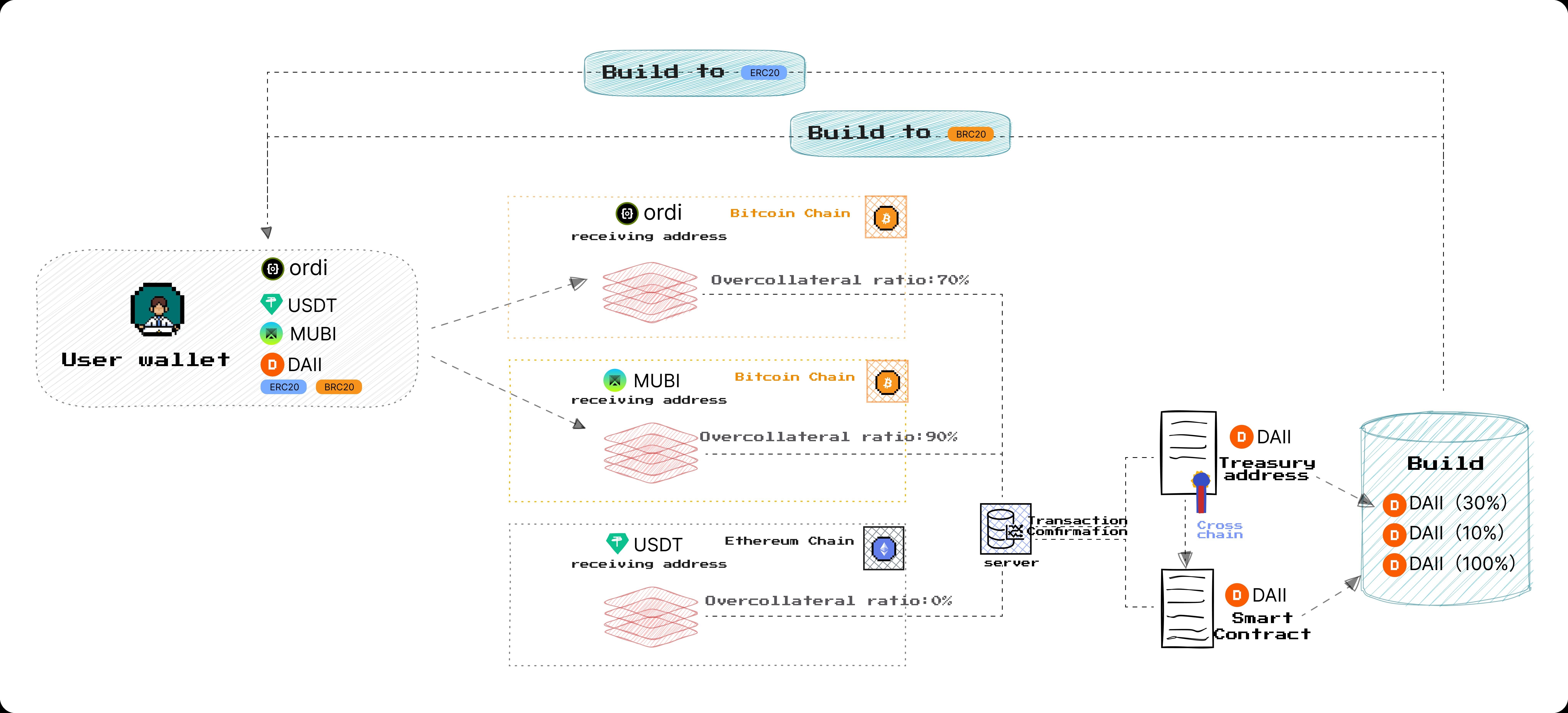
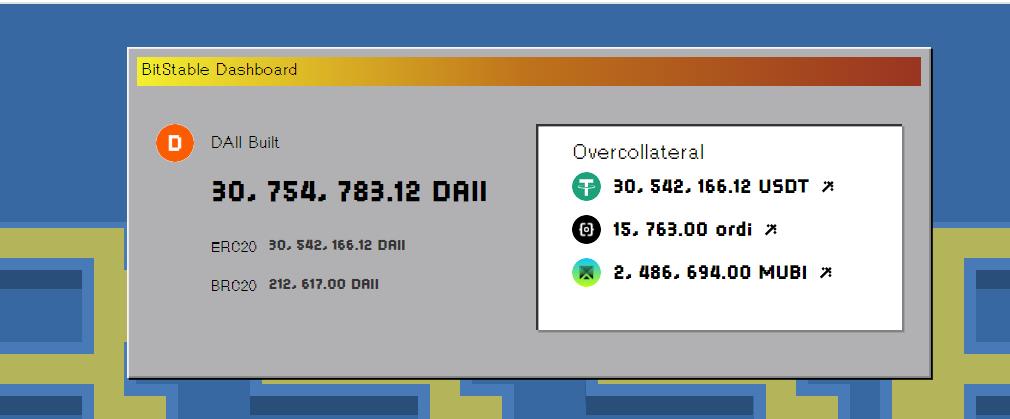
As of December 19, BitStable has minted 30.75 million DAII, of which 30.54 million are in ERC20 format and only 210,000 in BRC20 format.
BitStable first appeared publicly through the IDO of its BSSB token on Bounce Finance. BSSB has risen approximately 176% in the past seven days, currently priced at $7.50, with a total supply of 21 million and a market cap of $180 million.
However, it should be noted that BitStable has faced ongoing controversy since launch. During the BSSB public sale, the official website was inaccessible, leading some users to suspect a rug pull. The team later stated it suffered coordinated attacks involving miners and skilled developers, along with DDoS attacks, resulting in uneven token distribution and unauthorized wallets receiving most of the supply. The team ultimately burned 75% of the auctioned tokens. Notably, BitStable’s X account was only created two days before the auction, posting its first message on November 27.
Additionally, some users claim that Bounce Finance, Multibit, and BitStable originate from the same team, aiming to build an integrated Bitcoin ecosystem featuring IDO, cross-chain, and stablecoin functionalities. This theory isn't baseless—both Multibit and BitStable conducted their IDOs on Bounce Finance; future Bounce Finance IDOs allow participation using BitStable’s stablecoin DAII; and BitStable accepts MUBI as collateral to mint DAII—revealing deep interconnections among the three.
DID Marketplace Aggregator GoDID Launches Bitcoin Ecosystem DID Management Tool Bdid.io
Like Multibit and BitStable, DID aggregation tool GoDID also launched its BDID token on Bounce Finance and on December 18 announced a new funding round led by NGC Ventures at a $30 million valuation.
Interestingly, Jack Lu, founder of Bounce Finance, is also a partner at NGC Ventures. Some users have speculated whether all products launched on Bounce Finance are connected to NGC Ventures, suggesting NGC might be the true orchestrator behind Multibit and other Bitcoin ecosystem projects.
GoDID is a marketplace aggregator for decentralized identities (DID), offering core features including bulk search, query, registration, trading, and management of DIDs, currently serving ENS, Space ID, and Bitcoin Ordinals DIDs.
On December 15, GODID’s sub-platform Bdid.io launched the BDID token on Bounce Finance. Incubated by GODID, Bdid.io supports registration, trading, and management of major DID suffixes created via the Ordinals protocol, such as .sats, .bitmap, .btc, .unisat, and .bitter.
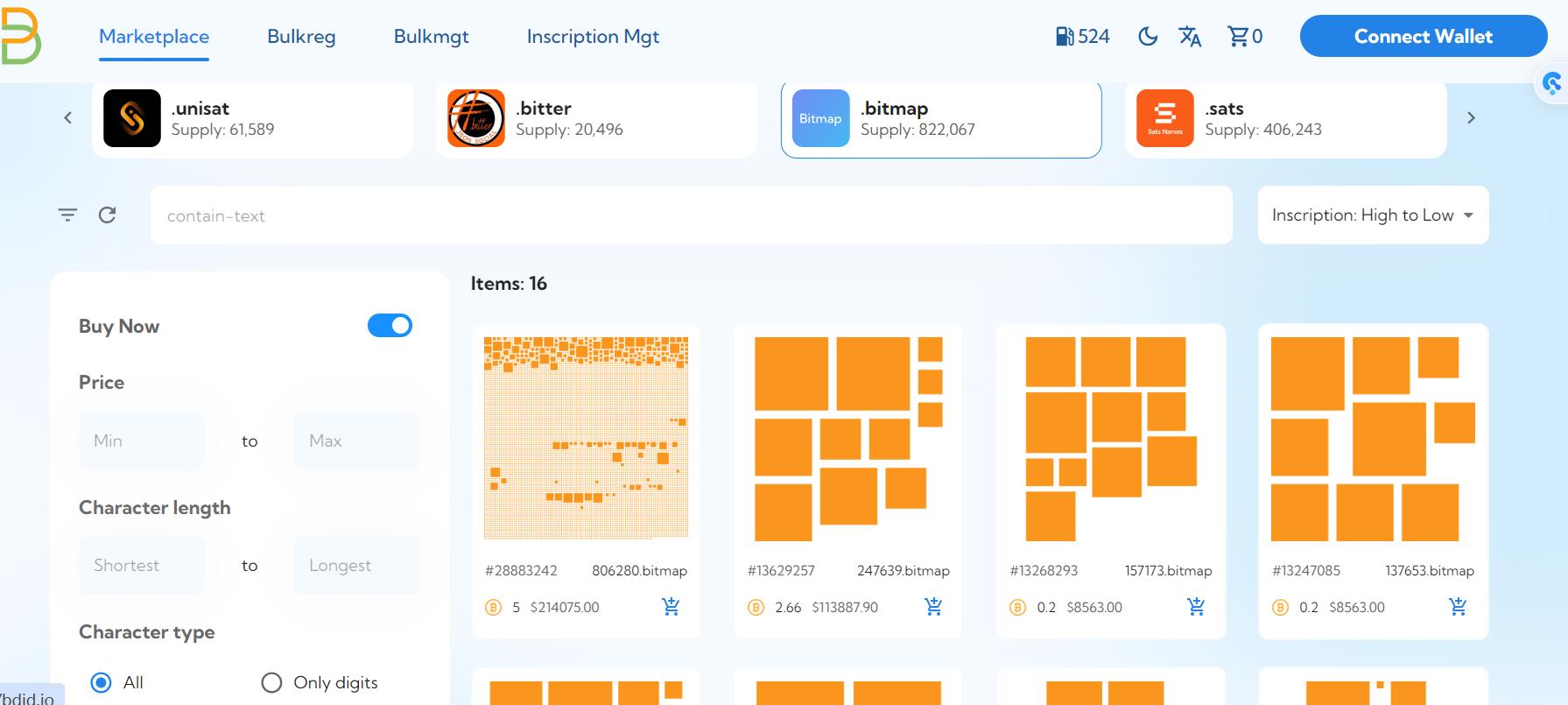
BDID has a total supply of 500 million, with an IDO price on Bounce Finance of about $0.00297, now quoted at $0.04—a return of roughly 20x.
Representative Lending Products: BitSmiley, Liquidium, Uplink Finance
Stablecoin Lending Protocol BitSmiley
BitSmiley is a stablecoin lending protocol in the Bitcoin ecosystem, dubbed “MakerDAO + Compound,” composed of a decentralized over-collateralized stablecoin protocol, lending protocol, and derivatives protocol. On December 14, bitSmiley announced a funding round led by ABCDE and OKX Ventures.
bitUSD is a stablecoin soft-pegged to the U.S. dollar, over-collateralized by BTC, operating similarly to MakerDAO—but using BTC as collateral. Any BTC holder can generate bitUSD by depositing Bitcoin into the “bitSmiley Treasury” smart contract, with each bitUSD in circulation backed by over-collateralization.
In the bitSmiley protocol, bitUSD can be used to settle debts such as stability fees or loan interest. Users deposit a certain amount of BTC into the bitSmiley Treasury to generate bitUSD. To retrieve the deposited BTC, users must repay the generated bitUSD plus a stability fee.
Centered on the stablecoin bitUSD, BitSmiley introduced bitLending, a peer-to-peer lending protocol based on BRC20.
Currently, bitSmiley’s products have not yet launched, and its official Twitter account was only established on December 4.
NFT and BRC20 Lending Protocol Liquidium
Liquidium is a P2P lending protocol built on the Ordinals protocol, enabling users to borrow and lend Bitcoin using ordinal inscriptions and BRC20 tokens as collateral. On December 11, it announced a $1.25 million Pre-Seed round with participation from Sora Ventures.
Currently, Liquidium only supports borrowing using Ordinals inscription NFTs as collateral. The BRC20 lending product is not yet open to the public and remains in a whitelist application phase.
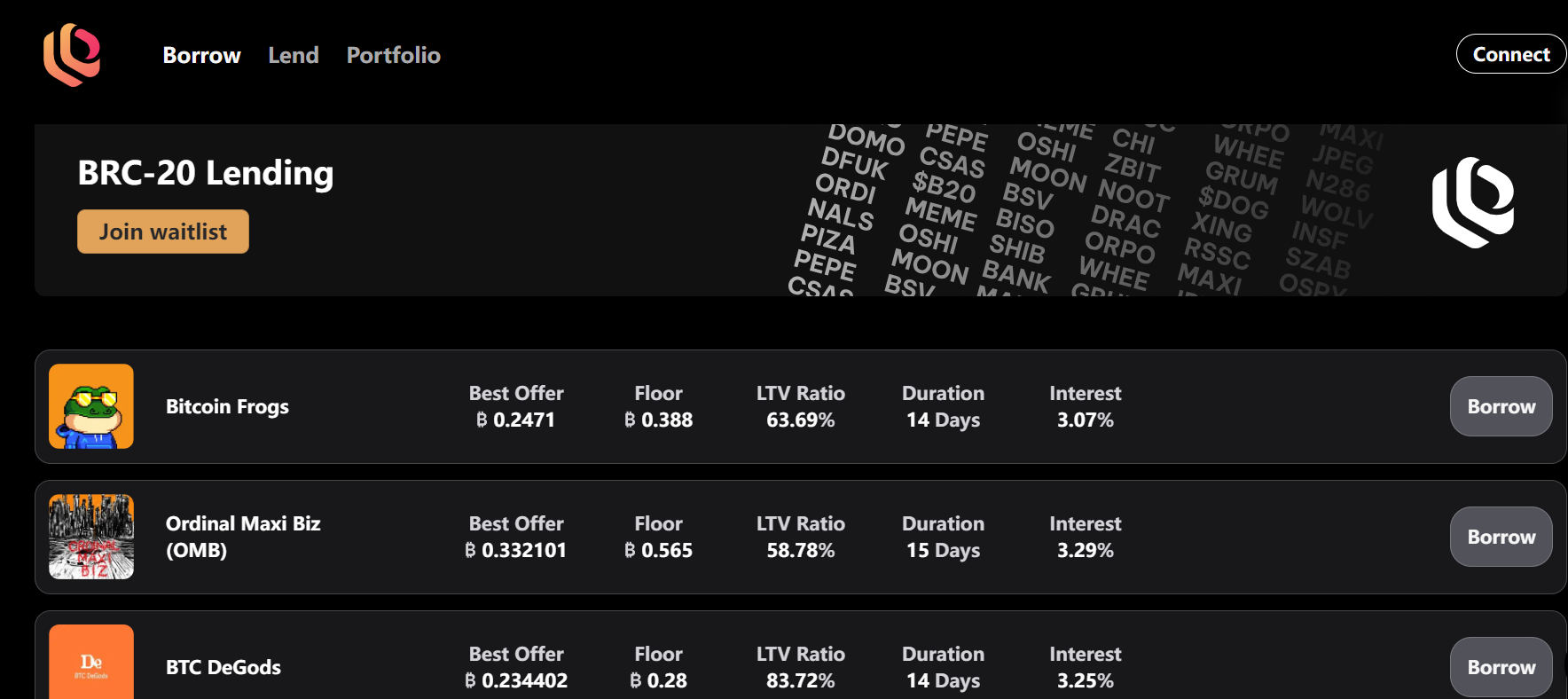
Liquidium does not use an LTV-based liquidation mechanism. Loan status depends solely on repayment within the set term. If unrepaid by maturity, the loan defaults and the collateral goes to the lender.
BRC20 Ecosystem Stablecoin Lending Protocol Uplink Finance
Uplink Finance (UPFI) is a stablecoin lending protocol designed for investors in BRC-20 assets like ORDI and SATS, positioning itself as the “MakerDAO of the BRC-20 ecosystem,” allowing holders to unlock liquidity value without selling their assets.
On Uplink Finance, users deposit BRC-20 assets such as BTC, ORDI, and SATS as over-collateralized deposits to borrow the platform’s stablecoin UPSD.
On December 12, Uplink Finance announced that SATS and ORDI would be the first collateral types for stablecoin minting and launched an airdrop of its governance token UPFI to eligible asset holders.
Currently, Uplink Finance’s collateralized lending interface has not officially launched.
Ordinals Ecosystem Infrastructure Tools: Donation Platform TurtSat and Tap Protocol for Building OrdFi Applications
TurtSat: Gitcoin of the Bitcoin Ecosystem
TurtSat (TURT) is a community-driven donation platform for Ordinals, aiming to become the “Gitcoin of the Ordinals world.” Featuring a donation protocol, it enables more open-source developers and communities to participate in and benefit from Ordinals ecosystem development—anyone can build or donate to Ordinals ecosystem protocols via TurtSat.
In short, projects can raise funds through TurtSat, while supporters earn rewards. Currently, TurtSat supports token launches for multiple Bitcoin ecosystem projects in a launchpad format, similar to Bounce Finance.
As of December 20, TurtSat has launched tokens including Chamcha (CHAX) for BRC20 protocol, Multibit (MUBI) for BRC20 bridge, NXHUB (NHUB) for Ordinals aggregator, Dova Protocol (DOVA) for Ordinals lending, Rabbit (RAIT) for Bitcoin gaming platform, and Svarga (SVGR) for Bitcoin metaverse game—all infrastructure platforms related to BRC20 and Ordinals in the Bitcoin ecosystem. Yesterday, TurtSat is set to list ZOOA, the token for Bitcoin staking platform Zooopia.
On December 7, TurtSat announced a staking pool for its native token TURT, allowing holders to participate in token launches on the platform for higher returns. Additionally, TurtSat will issue a new asset called EGGS, obtainable by staking TURT. EGGS can be exchanged for whitelist access to launch projects, and in the future will be used for voting on project listings, direct redemption of partner token packages, and more.
TURT has a maximum supply of 1 billion, currently priced at $0.078 with a market cap of $78.73 million. The total supply of EGGS has not been disclosed.
Platform for Building OrdFi Applications: Tap Protocol
Tap Protocol is a platform launched by Trac, an indexing protocol for Ordinals, aimed at building OrdFi applications. On December 16, it announced a $4.2 million funding round led by Sora Ventures.
Trac is an infrastructure project in the Ordinals ecosystem providing a decentralized system to track and access Ordinals-related protocols such as BRC20 and sats domains, offering standardized interfaces for creating, managing, and trading digital assets on the Ordinals platform.
Tap Protocol serves as a platform for building OrdFi applications, providing a suite of tools to help developers create DeFi products on Ordinals without needing complex Bitcoin Layer2 networks—such as enabling inscription splitting and DeFi functionality on inscriptions.
In the future, Tap Protocol plans to launch products including fractionalization of Ordinals, swap pools, lending, and staking.
Join TechFlow official community to stay tuned
Telegram:https://t.me/TechFlowDaily
X (Twitter):https://x.com/TechFlowPost
X (Twitter) EN:https://x.com/BlockFlow_News
 ChainCatcher 链捕手











