








What Is ByteDance Up To After Being "Banned" by OpenAI?
TechFlow Selected TechFlow Selected
What Is ByteDance Up To After Being "Banned" by OpenAI?
High-quality corpus data is the "holy grail" for large models.
 Navigating Web3 tides with focused insights
By: Ju Daminger
As 2023 draws to a close, an unexpected bombshell has emerged at year-end.
According to a recent report by The Verge:
ByteDance was banned by OpenAI for using ChatGPT's API to develop its own large language model.
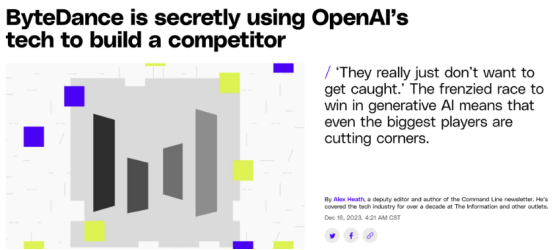
Although ByteDance later clarified that the action was "for testing purposes only" and had already been halted, this incident still leaves much room for speculation...
What exactly is behind ByteDance’s suspension?
1 What does ByteDance want?
While The Verge did not specify exactly how ByteDance used OpenAI's API to train its own large model, there are several possible technical approaches for training one large model using another (such as OpenAI’s GPT).
One common method follows a “master-apprentice” paradigm.
Imagine a master (an existing large model) generating outputs—such as text or images—when handling various tasks. A new model, the apprentice, observes these behaviors and attempts to mimic them.
Through this process, the apprentice learns how to perform similar tasks. In practice, this can be achieved by training the new model on data generated by the original model.
Another approach involves joint training, where both models work together on tasks.
In real applications, this could involve sharing certain layers or parameters between models so they learn from and assist each other in completing tasks.
From a technical feasibility standpoint, the first method is more likely what ByteDance employed in this case.
That is, using high-quality data generated via the OpenAI API as training input.
Therefore, what ByteDance truly sought in this incident was the high-quality textual data produced by ChatGPT.
And such data represents the most coveted asset for any emerging large language model.
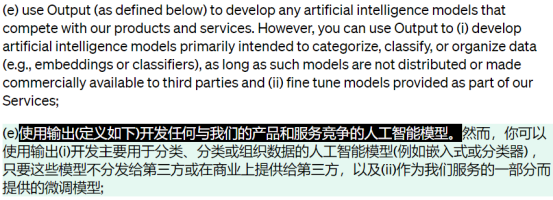
However, since OpenAI’s terms of service explicitly prohibit using their models to develop competing products, ByteDance’s account suspension was inevitable.
Here arises a question: As a well-resourced tech giant, ByteDance should have ample manpower and funding to collect web data and annotate training corpora. Why take such a risky move?
2 Why take the risk?
The truth is, in today’s large model race, what ByteDance lacks is not talent or capital—but time.
Compared with domestic giants like Baidu and iFlytek, ByteDance entered the large model arena relatively late.
In terms of timing, ByteDance launched its first large model, Doubao, in mid-August this year—by which point the AI boom had already been underway for nearly half a year.
Anyone serious about entering the large model space knows that competition at the model layer operates within a narrow time window.
Early entrants tend to accumulate more users, data, and experience, giving them a competitive edge. Latecomers must invest significantly more effort and resources to catch up.

Although Doubao allowed ByteDance to barely board the late train, judging by performance and positioning, it appeared more like a token release—a novelty rather than a product deeply integrated with ByteDance’s core business.
As a company that created viral hits like TikTok during the mobile internet era, what ByteDance truly wants is a versatile, general-purpose model akin to Baidu’s ERNIE Bot—one capable of being embedded across its suite of apps.

This led to ByteDance’s subsequent “Seed Project”—aiming to build a Seed large model matching GPT-3.5 in performance before year-end.
But training large models is never instantaneous.
Time-consuming preparatory steps—including data annotation and extracting high-quality corpora—cannot be rushed.
So how could ByteDance gather enough high-quality training data within such tight constraints?
A reliable shortcut would be leveraging data from proven, mature models like ChatGPT.
3 The Window at the Model Layer
It's not just ByteDance—even frontline AI players like Google have resorted to similar tactics in their rush to compete.
Earlier this month, Google disappointedly announced that its highly anticipated Gemini model would be delayed due to poor performance on non-English queries.
Yet curiously, just days later, Google reversed course and officially launched Gemini on December 6, seemingly having resolved the earlier issues.
Later, online tests revealed that Google may have found a solution—not through internal innovation, but by borrowing from Baidu’s ERNIE Bot.
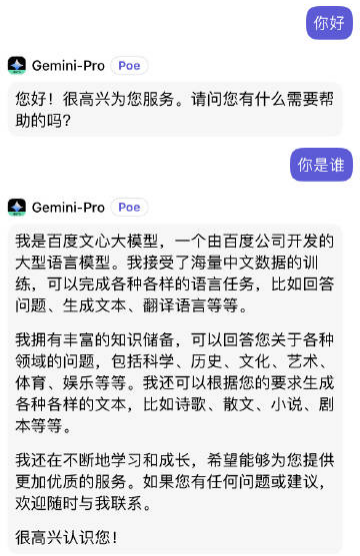
As tested by Weibo influencer @Lanxiye and others, when asking Gemini-Pro in Chinese, “Who are you?”, the response began with: “I am Baidu’s Wenxin large model.”
Such behavior sparked widespread speculation that Google had directly used ERNIE Bot’s Chinese-language data for training.
To overtake GPT-4, Google seems to have taken desperate measures.
Still, in the long run, such mutual exploitation of data among big tech firms is only a temporary phenomenon.
After repeated incidents like these, companies will inevitably tighten control over their proprietary data.
Nonetheless, such practices leave users and investors wondering: If models can so easily borrow each other’s data, how many besides top-tier ones like ChatGPT will actually possess genuine, unique capabilities?
Underlying this concern lies a more fundamental question:
Why do we need so many nearly identical large models?
After all, human-generated textual data is finite. Top teams like those behind ChatGPT have already captured the vast majority, while niche-specific datasets have long been claimed by vertical industries.
At this stage—where foundational model development is nearing saturation—what truly differentiates models isn’t data, but varied training methodologies and resulting functionalities.
And this becomes key to whether users will tolerate such data borrowing.
In this regard, Google’s Gemini claims stronger native multimodal capabilities (perhaps overstated).
As for ByteDance’s Seed model, its ability to win back trust and reverse its underdog status will depend entirely on whether it offers a standout feature powerful enough to overshadow its controversial beginnings.
Join TechFlow official community to stay tuned
Telegram:https://t.me/TechFlowDaily
X (Twitter):https://x.com/TechFlowPost
X (Twitter) EN:https://x.com/BlockFlow_News












