








How to understand the user experience re-architecture that a16z is focusing on?
TechFlow Selected TechFlow Selected
How to understand the user experience re-architecture that a16z is focusing on?
Simplifying user experience is the cornerstone for Web3 to achieve mass adoption.
 Navigating Web3 tides with focused insights
Written by: Heimi, Baize Research Institute
a16z crypto has long been one of the most prominent and well-known top-tier investment firms at the forefront of the crypto industry, managing over $7 billion in capital dedicated to investing in crypto projects and technologies. As of this writing, a16z crypto has invested in 26 projects across various sectors this year alone, including DeFi, infrastructure, gaming, L3s, interoperability, and more.
Recently, a16z crypto released a blog post titled "A Few Things We’re Excited About in Crypto (2024)," outlining nine key narratives that will shape the crypto landscape in 2024.
Entering a New Era of Decentralization → DAO governance will advance significantly
Redefining Future User Experience → Move beyond clunky interfaces; simplify UX so everyone can easily access dApps
The Rise of Modular Tech Stacks → Developers will gain unprecedented flexibility to build custom applications using interoperable components
AI + Blockchain → Artificial intelligence and blockchain technologies will further converge, unlocking new waves of innovation
"Play-to-Earn" Becomes "Play-While-Earning" → Web3 gaming will shift focus from earning rewards to simply enjoying gameplay
When AI Becomes the Game Creator, Cryptocurrency Provides Security → Crypto will ensure security and transparency for AI-driven games
Formal Verification Becomes Less Formal → New tools and techniques will make verifying smart contract security much easier
NFTs Become Ubiquitous Brand Assets → Brands will increasingly leverage NFTs to engage customers and foster loyalty
SNARKs Go Mainstream → Zero-knowledge proofs will become widespread, enabling private and secure transactions
Upon closer examination, two of these narratives specifically highlight the convergence of AI with blockchain and cryptocurrency. The rest revolve around a shared goal: capturing mainstream users during what may already be an ongoing bull market cycle, thereby achieving Mass Adoption in Web3. Just as NFTs broke into the mainstream in 2021, the next bull run will hinge on adoption by new users—whether through modular blockchains, zero-knowledge proofs, and other innovative infrastructures that enhance scalability and performance, or through concrete measures like UX redesign, brand adoption of NFTs, and redefining the core mechanics of Web3 gaming. Among these, improving user experience stands out as the fastest path to reaching mainstream audiences.
Simplifying User Experience is the Foundation for Web3 Mass Adoption
For native crypto users, connecting a wallet to Uniswap to swap tokens, then transferring those tokens to a dApp for staking or yield farming, is straightforward. But for mainstream users stepping into Web3 for the first time, the process is entirely different.
What is Gas? Where do I buy native tokens to pay for it? What does transaction approval mean? And how long until final confirmation?
If they want to use different dApps across multiple chains, new questions arise: What is Polygon? How do I bridge my assets from Ethereum to it?
To interact with on-chain dApps, new users must confront these obscure and highly technical concepts and terms. They need to learn them before doing anything meaningful.
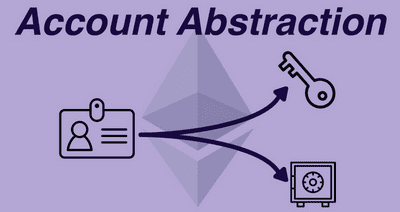
Smart contract wallets enabled by account abstraction now offer services such as social media logins and social recovery—providing a Web2-like product experience. These features free users from the burden of managing private keys and seed phrases while also enhancing security. Additional capabilities like batch transactions and gas sponsorship further lower the barrier to entry for using dApps.
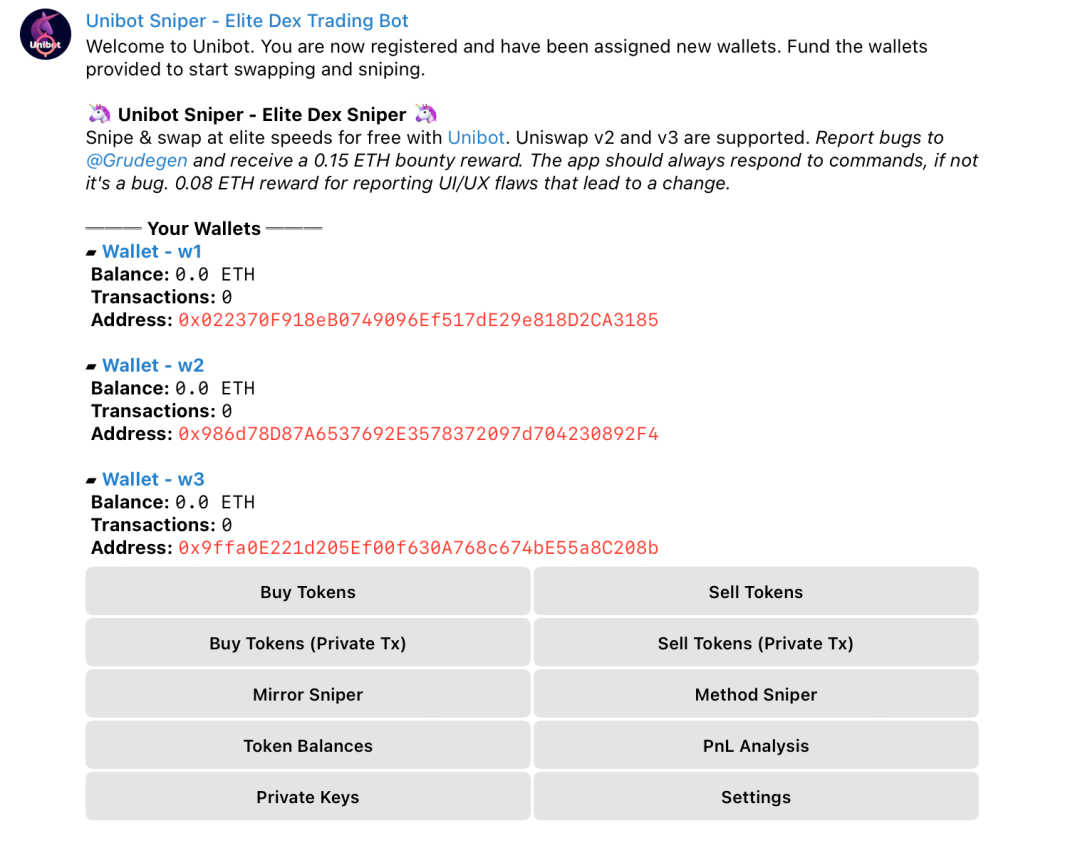
This year, Telegram trading bots have gained massive popularity, offering a novel way to interact with Web3. They are widely seen as a crucial gateway to onboard Telegram’s 800 million users into Web3. With Telegram trading bots, users no longer need to switch between various dApps—they can access trading, analytics, automated airdrop farming, cross-chain asset transfers, and more—all in one place, sometimes even with a single click. Born out of the need to simplify trading experiences, these bots deliver a core advantage: Intent. Users only need to state what they want to trade; the bot automatically handles how to execute it.
Thus, Telegram trading bots can be considered the first wave of real-world Intent-Centric products.
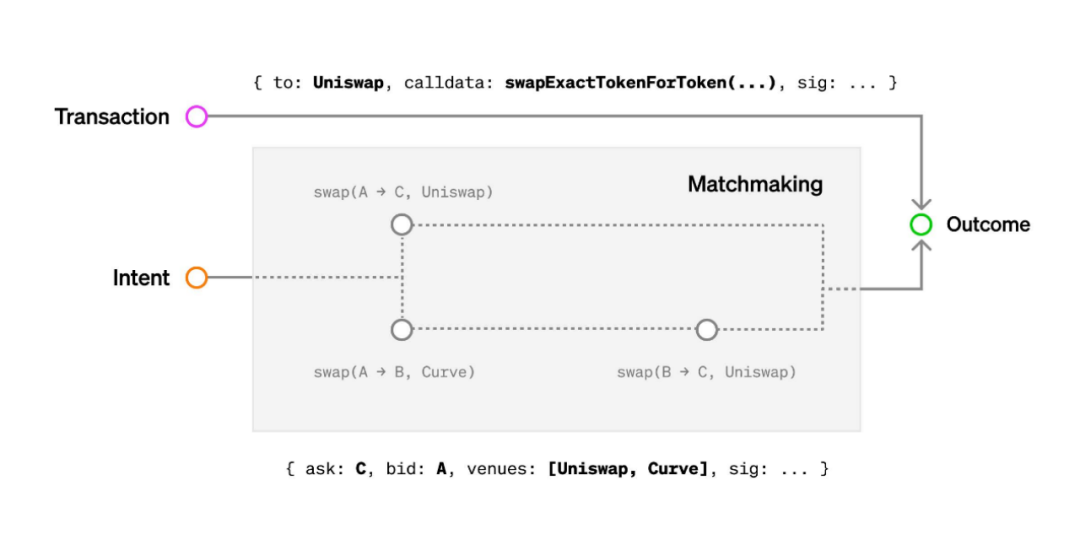
In July, Paradigm introduced the concept of Intent-Centric computing, which quickly went viral, sparking a surge of related projects across L1s, DeFi, and infrastructure. Intent-Centric design emphasizes user intent—users only express the desired outcome, without needing to understand the underlying execution process. If we imagine an Intent-Centric product as a black box, users submit their “requests” into it. Solvers then match these requests, determine optimal transaction routes for each, and return the results. The outcomes remain the same, but the processes behind them differ entirely.
If account abstraction removes the concept of “accounts,” then Intent-Centric represents a higher-order abstraction—one that eliminates the primary obstacles users face when interacting with blockchains and Web3. Below, we’ll take dappOS as a case study to better understand how simplifying user experience enhances convenience and accessibility for new Web3 users.
dappOS: Rethinking Web3 Operational Experience
dappOS is an intent-centric operating protocol. By acting as an “intent layer” between users and blockchain infrastructure such as public chains and cross-chain bridges, it delivers a seamless, one-click interaction experience.
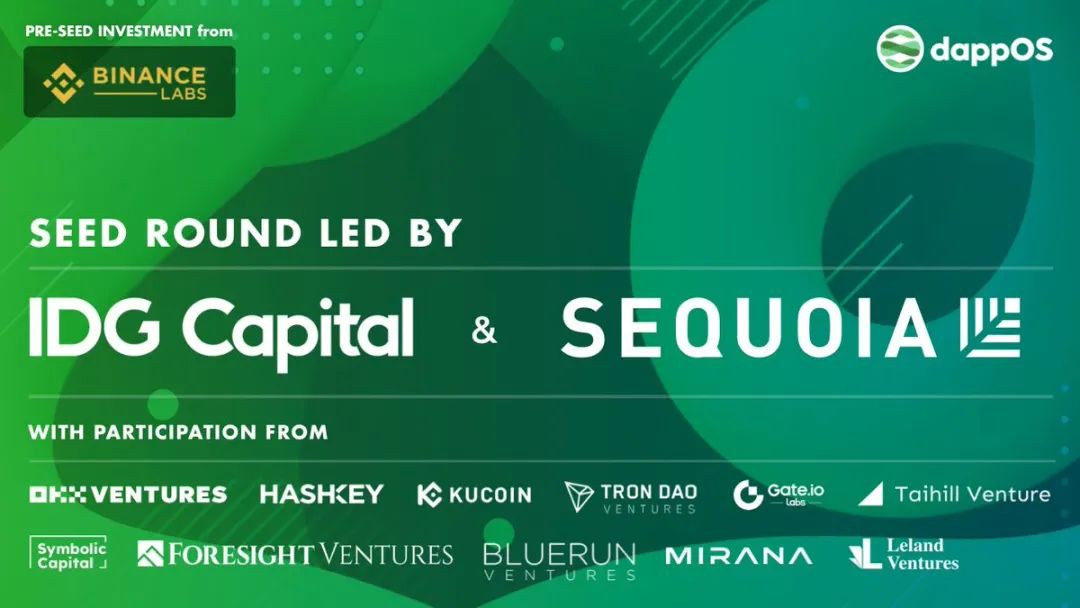
Following the surge in interest around Intent-Centric concepts, dappOS rapidly became one of the hottest projects in the Chinese crypto community after securing pre-seed funding from Binance Labs, followed by a seed round led by Sequoia China and IDG Capital. Other investors include OKX Ventures, HashKey Capital, KuCoin Ventures, and others.
The author believes dappOS’s Intent-Centric narrative can be understood through two lenses:
-
An intent-centric operating protocol that achieves chain abstraction, allowing users to interact seamlessly with popular dApps across chains without switching wallets or networks, effortlessly riding the wave of trending public chains
-
A new on-chain traffic distribution platform that helps emerging public chains rapidly build ecosystems by lowering user entry barriers
An Intent-Centric Operating Protocol
Today, newer public chains offering superior service capabilities and faster response times are multiplying—chains tailored for specific use cases, such as Avalanche for flexible scaling, Manta Network for privacy protection, or Oasys, a gaming-dedicated chain already hosting nearly 50 games. To use each of these chains, users often end up creating separate wallets, leading to fragmented assets. Instead of constantly bridging assets from Chain A to Chain B, many users choose to keep portions of their assets on multiple chains.
Taking inspiration from operating systems, dappOS aims to become a Web3 operating protocol—or a dApp Store—that fully abstracts away complex and cumbersome concepts like public chains and cross-chain bridges. From this “central hub,” users can effortlessly access dApps across multiple chains and use assets from any chain within dApps on another chain. For example, assets from Chain A can be directly used in a dApp on Chain B.
In its current V2 version, dappOS has integrated popular projects including Perpetual, BENQI, QuickSwap, and Stader. According to its roadmap, upcoming integrations include SyncSwap, Curve, DeFi Kingdom, Frax Finance, GMX, and Lido.
dappOS relies on the dappOS Account—a unified smart contract wallet. This unified account allows users to manage their total assets across all chains from a single interface. Common tokens like ETH, USDT, USDC, and DAI become universally usable across any dApp on any chain—for instance, using USDT on BNB Chain to trade perpetual contracts on Optimism’s Perpetual with just one click.
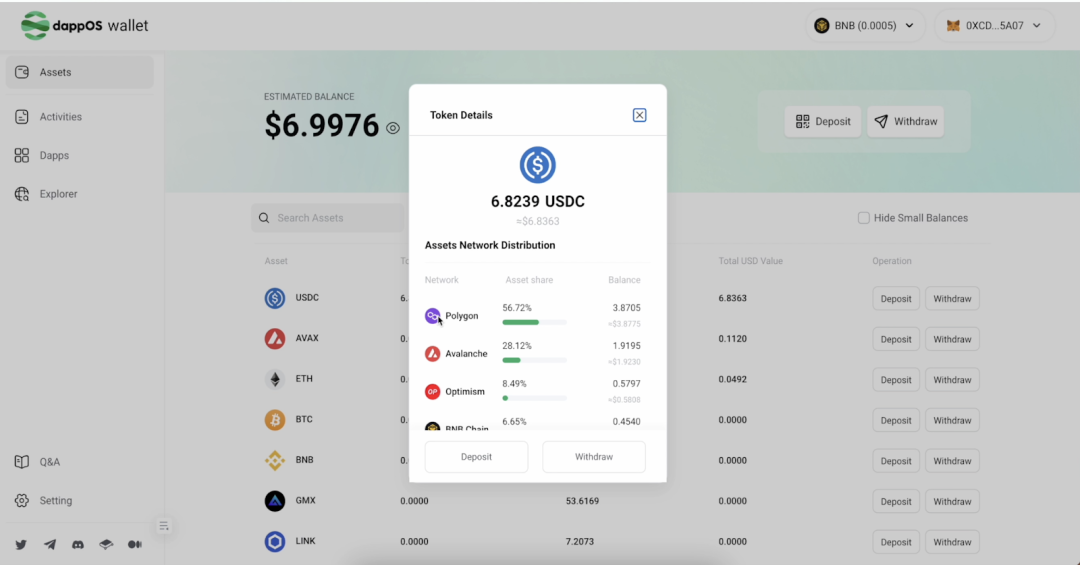
Let’s take Perpetual, one of dappOS’s earliest integrations—a perpetual DEX built on Optimism—as an example.
First, let’s compare the experience of using Perpetual directly on Optimism versus using it via dappOS:
On Optimism:
1. Swap $ETH for $USDT on Uniswap
2. Bridge $USDT from Ethereum to Optimism
3. Bridge a small amount of $ETH to Optimism to cover gas fees
4. Deposit $USDT or $USDC into Perpetual to begin trading
This entire process can take nearly half an hour, causing many new users to abandon it midway.
On dappOS:
Deposit $USDT or $USDC directly from Ethereum, BNB Chain, Avalanche, Polygon, or other chains into Perpetual and start trading
One action, completed in just five minutes.
In summary, dappOS leverages unified accounts and the dappOS Network to achieve Intent-Centric functionality, dramatically simplifying the user experience.
A New On-Chain Traffic Distribution Platform
Over the past few weeks, dappOS has consistently ranked among the top three dApps on Manta Network by transaction volume, bringing over 100,000 weekly transactions. Readers likely recognize Manta—it's a high-profile ZK modular blockchain backed by top-tier investors like PolyChain Capital and Spartan Group. The author believes the official collaboration between Manta Network and dappOS played a significant role, as users coming from other chains via dappOS represent a powerful growth vector.
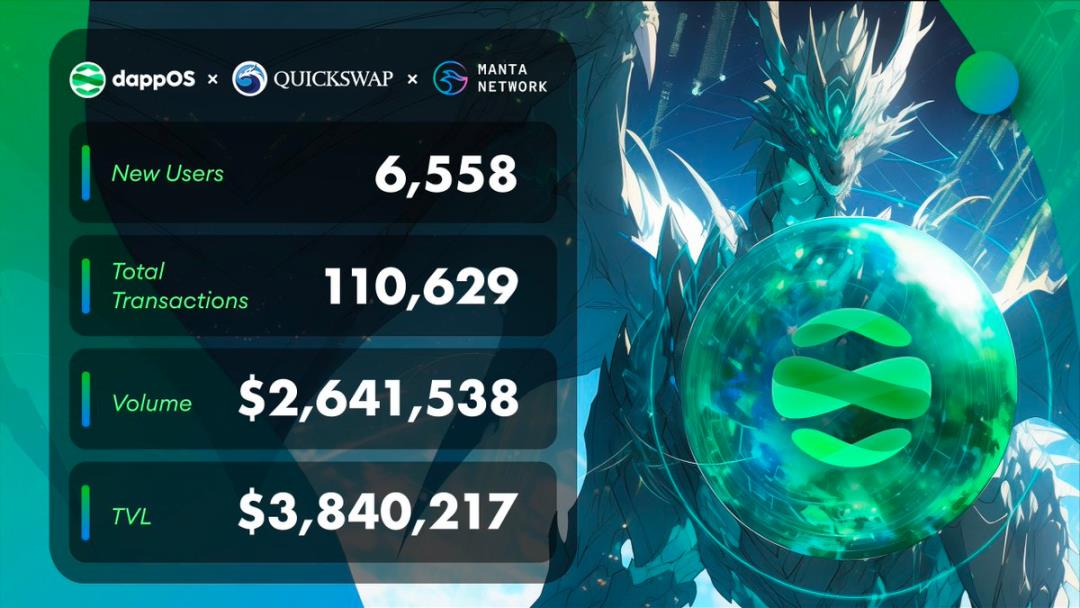
Additionally, after integrating dappOS V2, QuickSwap saw its TVL grow by over $3.84 million within two weeks, with transaction count increasing by 110,629 and 6,558 new users added. Moreover, liquidity provided by dappOS users on QuickSwap totaled $3,840,217—accounting for 41.02% of QuickSwap’s TVL on Manta—with trading volume reaching $2,641,538.
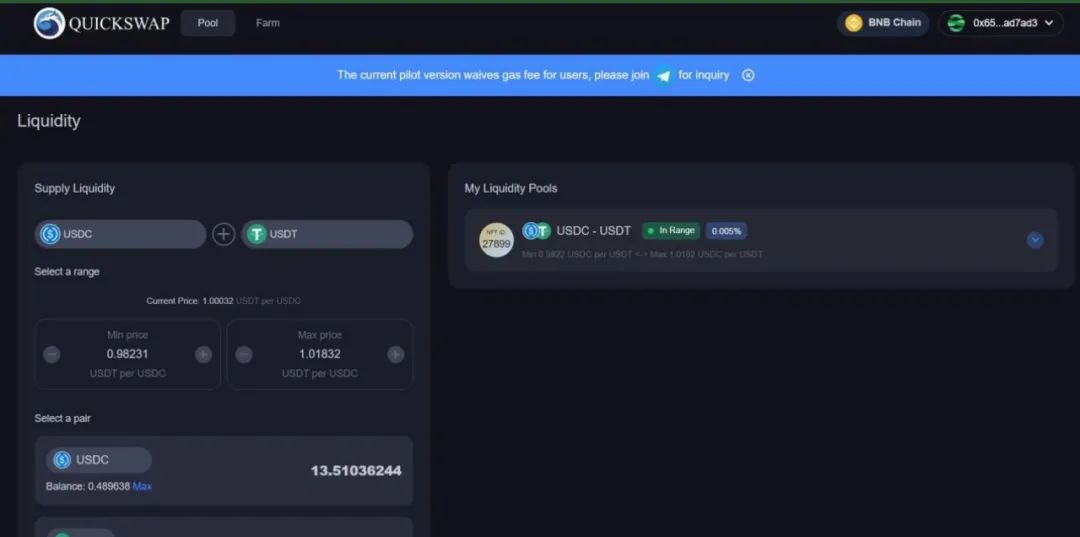
The author personally tested QuickSwap on dappOS and found gas costs to be extremely low—less than $1 throughout multiple swaps and LP setups. dappOS enables seamless interaction between Ethereum, Arbitrum, Avalanche, and other chains with QuickSwap on Manta Network, reducing overall fees by up to 85%. Even new users can participate in airdrop-related activities with ease, thanks to Intent-Centric’s ability to simplify complex transactions—requiring only basic understanding of swapping and liquidity mining.
In today’s multi-chain reality, a dApp struggles to distribute its existing user base and traffic to newly deployed public chains due to the aforementioned issue of asset fragmentation. Take QuickSwap: dappOS allows users from Polygon to instantly use their existing assets to interact with Manta Network—even if they hold zero assets there—extending support to any compatible public chain. By resolving asset fragmentation, dappOS effectively enables traffic distribution for QuickSwap.
Likewise, when a new public chain seeks rapid user acquisition and aims to claim a share in the competitive blockchain landscape, it typically relies on economic incentives—be it enticing token airdrops or generous ecosystem engagement funds. Prime examples include zkSync, which boasts 2.3 million unique users, and Blast, which attracted $7 billion in TVL within just ten days. Why? Again, asset fragmentation: unless users bridge their assets, they cannot use the new chain. In the case of Manta Network, dappOS enables users from any chain to interact with QuickSwap using their existing assets—thanks to its Intent-Centric architecture.
According to the joint announcement from dappOS and Manta, both parties will jointly contribute $10 million to support the development of Manta’s dApp ecosystem. Soon, more applications within the Manta ecosystem are expected to integrate dappOS. As Manta’s ecosystem flourishes, more users will quickly join through dappOS and potentially become long-term participants.
From this perspective, dappOS emerges as a powerful new on-chain traffic distribution channel, capable of helping both dApps and public chains rapidly attract users.
Triple Airdrop Opportunities with dappOS—Worth a Strategic Position
Simply put, interacting with dApps in the Manta Network ecosystem via dappOS (currently only QuickSwap) offers a strong chance of qualifying for a Manta Network airdrop. Since actual deposits and trades occur on-chain (handled by solvers), your activity is valid. Beyond that, two additional airdrop opportunities tied to dappOS are worth noting.
First, dappOS’s official Twitter account hinted at launching a new round of Rewards airdrops in December. Rewards function like “earn-by-trading,” offering USDT incentives to users who consistently interact with specific dApps on dappOS. The previous campaign featured Perpetual and lasted one month. Based on observations on Twitter, users performing several transactions typically received 80 USDT, with active users earning up to 1,000 USDT.
Second is the potential launch of dappOS’s native token. While there has been no explicit mention or hint, the project’s prestigious investor lineup makes it worthwhile to accumulate exposure early. There’s no need to aggressively farm interactions—simply follow official campaigns or Reward programs. This way, you earn USDT airdrops while staying eligible regardless of when snapshots occur.
For guidance on using dappOS, the author created a simple tutorial using the currently popular QuickSwap on Manta Network:
https://docs.google.com/document/d/1hBu1bsTWrCE2Fs3FzTL1bjDNqG8gQ_VbPZV_IlVDacM/edit?usp=sharing
Conclusion
Web3 represents a paradigm shift in application trust models—transferring power from centralized intermediaries to user communities. Yet, like any transformative technology, Web3 must overcome numerous hurdles before achieving global mass adoption. Simplifying user experience remains the most critical challenge.
Take dappOS, for example—it solves a problem many of us joke about: “How do I teach my parents to quickly get started with Web3?” Open dappOS, create a “unified account,” deposit some USDT, and start trading through a dApp interface that feels like WeChat mini-programs. With seamless cross-chain asset compatibility and smooth operations akin to centralized exchanges, the experience is simple and intuitive.
Easy to use, then easy to adopt.
In 2021, NFTs brought Web3 into the global spotlight, yet back then, simplifying user experience remained theoretical. The influx of new users created demand for learning technical jargon, fueling a boom in crypto education blogs.
Now, with advancements in account abstraction and the rise of Intent-Centric frameworks—alongside growing attention from leaders like a16z—simplified user experience is back in the spotlight. Can new Web3 users now use dApps without learning complex terminology? Can they complete an interaction in under five minutes without consulting external guides? When global attention turns once again toward Web3, will the industry be ready to welcome the next billion users with lower barriers to entry? We shall see.
Join TechFlow official community to stay tuned
Telegram:https://t.me/TechFlowDaily
X (Twitter):https://x.com/TechFlowPost
X (Twitter) EN:https://x.com/BlockFlow_News
 Baize Research


