Iran Conflict Becomes Prediction Market War: Over $1 Billion Wagered in Real Time on Polymarket to Forecast the Course of the War
TechFlow Selected TechFlow Selected
Iran Conflict Becomes Prediction Market War: Over $1 Billion Wagered in Real Time on Polymarket to Forecast the Course of the War
Prediction markets have turned warfare into a real-time scoring game; the Iran conflict is the first war to be traded on prediction markets.
 Navigating Web3 tides with focused insights
Author: Shreyas Hariharan
Translated by TechFlow
TechFlow Intro: There are already 246 active Iran-related markets on Polymarket, with cumulative trading volume exceeding $1 billion—down to granular questions like the number of ships transiting the Strait of Hormuz, whether Iran will strike Saudi Arabia, or whether Prince Reza Pahlavi will return to Iran.
This article isn’t merely describing the growth of prediction markets—it probes a deeper question: What happens to the relationship among media, capital, and wartime information when war is decomposed into tradable micro-events, and when journalists become arbiters of contracts?
Full Text Below:
Prediction markets have assigned war a real-time score—and added sideline betting. Iran is the first “prediction market war.”
There are 246 active Iran-related markets on Polymarket, and total trading volume in Iran-related markets has surpassed $1 billion. The granularity of these markets is astonishing: not just “Will the U.S. strike Iran?” but the precise number of vessels passing through the Strait of Hormuz; whether Crown Prince Reza Pahlavi will return to Iran; whether a ceasefire will be reached before a specific date; whether Iran will strike Saudi Arabia and the UAE; and whether the nuclear option will be deployed (though this market was later delisted amid strong opposition).
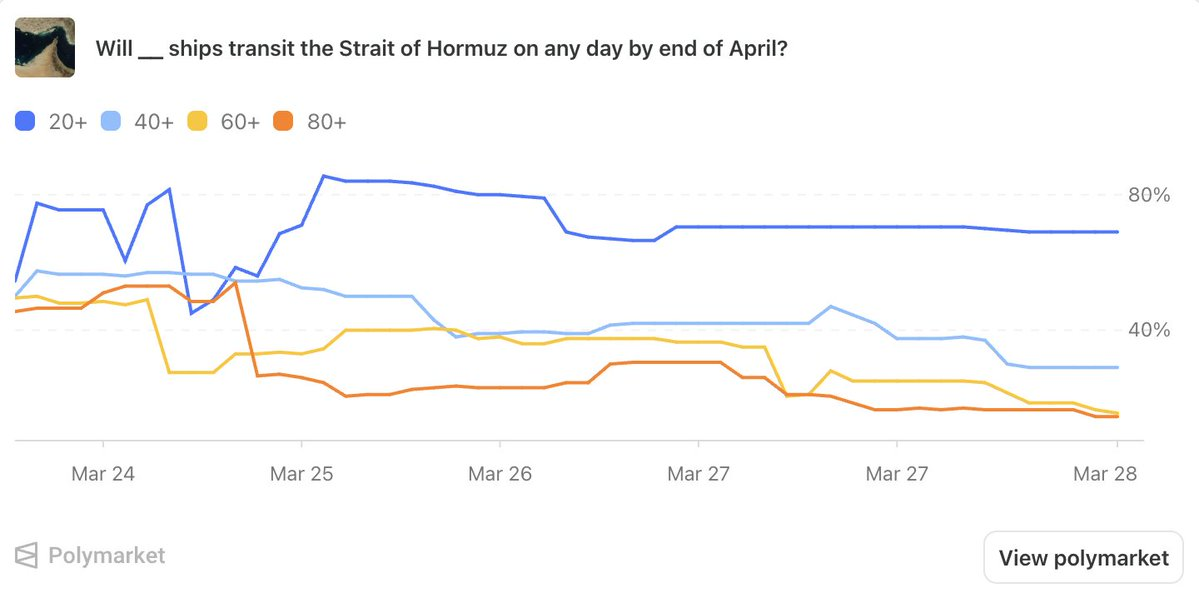
War is now being broken down into player prop bets.
The explosion of sports betting began when markets shifted from “Who wins the game?” to micro-markets: player props, in-game odds, and real-time odds for every single possession. The same decomposition is now happening with war—war is being disaggregated into tradable micro-events, just as an NBA game is broken down into “Will Jokić record a triple-double?”
When Journalists Become Contract Arbiters
Prediction markets settle based on consensus drawn from credible reporting. Journalists aren’t just covering war—they’re the adjudication mechanism for contracts backed by millions of dollars. In March, a Polymarket contract asked whether Iran had struck Israel by a specific date; over 90% of the trading volume occurred *after* the event itself, as traders debated whether a particular explosion qualified as a “strike” under the contract’s terms.
A military reporter for The Times of Israel reported that missiles landed near Jerusalem; his report was cited by The Economist and other outlets. Traders who needed the reporting to differ sent him death threats demanding he revise his account to state that the explosion resulted from an intercepted warhead—so it would not satisfy the contract’s settlement criteria. The more money flows into these markets, the stronger the economic incentive to influence reporting.
War Now Has Real-Time Odds
War has always affected prices. Oil prices spiked during Iraq’s invasion of Kuwait; defense stocks surged after 9/11; and gold has risen with every Middle Eastern escalation over the past fifty years. But those were indirect signals requiring interpretation: you had to deduce what a $5-per-barrel rise in crude meant for the probability of broader conflict; what shipping companies’ stock sell-offs implied about the Strait of Hormuz; what the VIX actually signaled—not what cable news claimed it signaled. You had to read between the lines—and between those lines, politicians could exaggerate, media organizations could inject bias, and intelligence agencies could plant reporting serving their own interests.
Prediction markets skip interpretation entirely. On Polymarket, one contract asks which countries Iran will retaliate against, with separate yes/no odds for Israel, the UAE, and Saudi Arabia. You don’t need to reverse-engineer the probability of military strikes from Brent crude—you get a real-time, updated number directly.
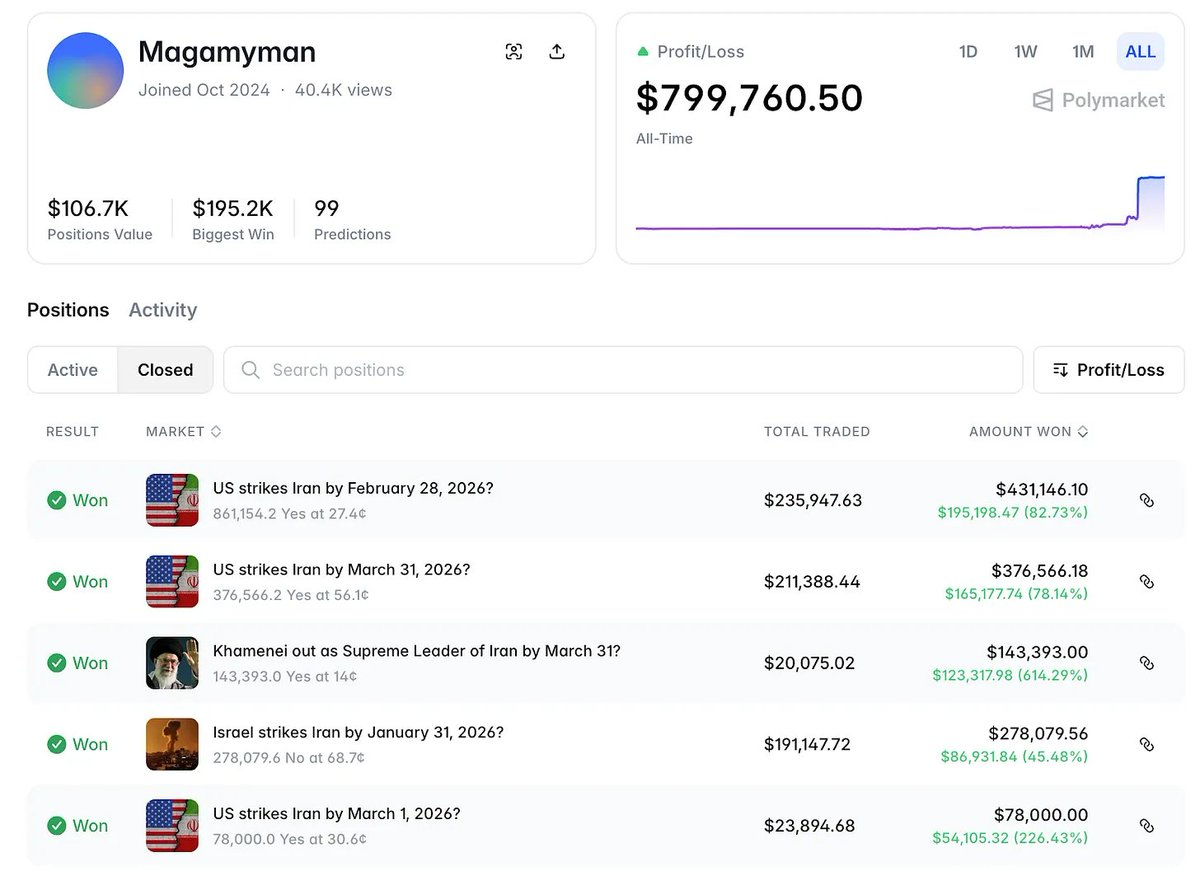
One trader earned nearly $800,000 by accurately predicting the timing of U.S.-Israeli strikes against Iran. For people, earning life-changing wealth by predicting truth creates powerful economic incentives.
The Evolution of War as Medium
Iran is the first war you can refresh every minute. Marshall McLuhan’s most famous insight was: “The medium is the message.” We obsess over content on screens or pages while ignoring how the screen or page itself reshapes the way we think, feel, and relate to one another. Content is distraction; form is what changes you. Television didn’t just let Americans *see* the Vietnam War—it turned a distant jungle conflict into the first “living-room war”: something that felt close and real, something you experienced bodily while sitting on your couch after dinner. McLuhan observed that the same war report might stir patriotic outrage in a newspaper but evoke sympathy for victims on television. Identical facts, delivered through different media, can provoke radically different emotional responses.
In the Iran war, the medium is money—and money is a medium fundamentally unlike photographs, radio broadcasts, or tweets. It doesn’t show you suffering; it shows you nothing at all. It gives you a number. When you look at Polymarket’s 24% probability of a ceasefire before March 31, you feel nothing for people living under bombardment—you’re processing a probability, assessing whether 24% is too high or too low, perhaps thinking about your next bet—or refreshing the page like checking playoff scores. Most people watching these odds aren’t betting; they’re spectating. Watching numbers shift is as gripping as tracking stock tickers or live sports scores—not as gripping as a photo of a bombed-out hospital.
Last week, Polymarket turned this experience into physical space: they opened a pop-up bar in Washington, D.C., called “The Intel Room.”
Eighty screens, a six-foot-tall globe, Bloomberg Terminals, flight radar, and prediction market odds scrolling live on the walls—they describe it as “a sports bar, but built for situational awareness.” War is now entertainment: watching odds shift when leaders announce military strikes feels increasingly indistinguishable from watching a wide receiver catch an unexpected touchdown pass.
Throughout the 1980s, Neil Postman warned that television would transform all serious public discourse into entertainment—a contest framed as Orwell versus Huxley: Orwell feared governments would ban books and suppress truth, while Huxley feared no bans would be necessary, because the public would drown in information and entertainment, rendering truth irrelevant—lost in a sea of noise. Postman believed Huxley was winning. He was right.
Television showed you what war looked like; Vietnam was the first televised war. Social media turned everyone into a frontline reporter; Ukraine was the first TikTok war. Prediction markets turn war into a game with real-time scores; Iran is the first prediction market war.
Join TechFlow official community to stay tuned
Telegram:https://t.me/TechFlowDaily
X (Twitter):https://x.com/TechFlowPost
X (Twitter) EN:https://x.com/BlockFlow_News
 @HelloShreyas