








FOCG: Igniting a Decentralized Revolution in the Gaming World
TechFlow Selected TechFlow Selected
FOCG: Igniting a Decentralized Revolution in the Gaming World
Compared to traditional games, fully on-chain games can achieve higher openness, decentralization, and persistence.
 Navigating Web3 tides with focused insights
Author: dt, DODOResearch
Fully on-chain games (FOCG) have long been anticipated by the crypto-native community as the next major blockchain application. Unlike the once-popular GameFi, which is primarily financial in nature and only puts in-game assets on-chain while keeping all other data off-chain, FOCG emphasizes gameplay with all core game logic and state deployed entirely on the blockchain—driven solely by decentralized consensus without any centralized servers. Compared to traditional games, fully on-chain games offer greater openness, decentralization, and persistence.
The ultimate goal of fully on-chain gaming is to create a completely autonomous and open game world, also known as an "Autonomous World." In such worlds, games can exist permanently without relying on any centralized operator; all rules, logic, and participation are conducted and verified via decentralized blockchains. Moreover, these autonomous game worlds can interoperate seamlessly, allowing characters and assets from one game to be used in another, thereby forming a truly open and interconnected "gaming metaverse."
This week, Dr. DODO will introduce several promising projects that have been deeply committed to the FOCG space and are worth your attention!
StarkNet Ecosystem
Recently, StarkNet—a Layer 2 blockchain that has sparked discussion due to rumors of an upcoming token launch—is technically and developmentally well-suited for deploying fully on-chain games. Its advantages can be summarized in three key aspects:
-
High Performance: Through recursive proofs, state transitions, and other techniques, StarkNet compresses vast amounts of computation and storage into constant-sized proofs, greatly optimizing efficiency. This enables millions or even higher transactions per second, fully meeting the high-performance demands of on-chain games.
-
Fairness: Fully on-chain games require fair randomness, which StarkNet natively supports through zero-knowledge proof technology. Many games rely on randomness—for example, card draws or dice rolls. With the Cairo V1 upgrade, StarkNet now implements Verifiable Random Functions (VRF), enabling provably verifiable random numbers and ensuring fairness in gameplay.
-
Coding Efficiency: Compared to Solidity—the most commonly used language on traditional EVM chains—StarkNet’s native language, Cairo, is better suited for building complex projects. It requires less code, executes more efficiently, reduces development complexity for on-chain games, and saves on expensive gas fees.
Now that we've explained why StarkNet is ideal for fully on-chain games, let's look at some notable projects being developed within its ecosystem:
-
Dojo: An open-source game engine and toolkit built for StarkNet. Using the Cairo language, Dojo implements an efficient Entity-Component-System (ECS) architecture that simplifies game development. It natively supports zero-knowledge proofs, ensuring fairness and data privacy. Several games have already launched using Dojo, including Influence, Loot Survivor, and Briq. The Dojo community continues to expand functionality, with future R&D focusing on L3 solutions, optimistic updates, and client-side proofs.
-
Loot Realm: Driven by the Loot NFT community DAO, Loot Realm aims to build an open, scalable, and eternal on-chain gaming universe. It includes multiple sub-games, such as the text-based adventure game Loot Survivor and the MMO on-chain game Realms: Eternum. Loot Realm exemplifies the potential of FOCG to achieve open sharing and autonomous operation.
-
Influence: A space-themed resource management and strategy game where players engage in infrastructure development and economic activities across asteroid belts. The game fully leverages StarkNet’s high performance to implement a fully on-chain economy and model complex commercial logic. Currently under active development, Influence plans to roll out multiple sub-games in phases.
-
Briq: An open on-chain creative space often described as “Lego for the blockchain.” Users collect and assemble different blocks to freely construct unique blockchain-based artworks. Briq demonstrates how on-chain games can empower user-generated content and metaspace creation.
MUD & Redstone - LATTICE Team
Next, we introduce MUD—the fully on-chain game engine—and Redstone, a Layer 2 blockchain specifically designed for on-chain gaming. Before diving in, it's essential to introduce the team behind them: Lattice. Lattice is the core team of the open-source developer community 0xPARC, which participated in developing the first fully on-chain game, Dark Forest, back in 2020. After Dark Forest, Lattice continued深耕 the FOCG space and, having developed multiple games, recognized numerous pain points in existing on-chain game development. To address these challenges, they created MUD, the fully on-chain game engine.
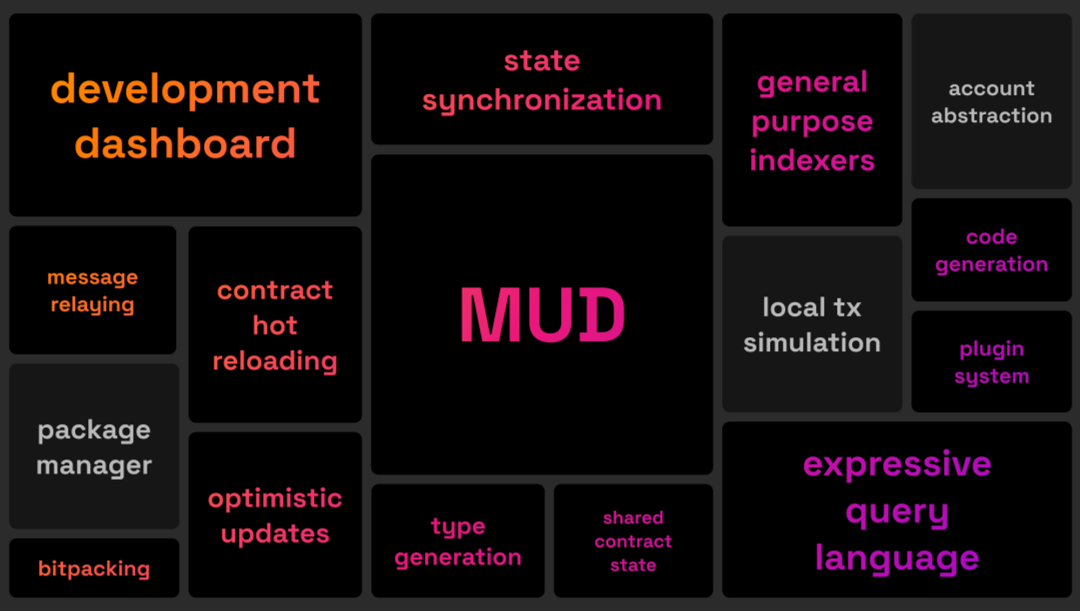
Lattice describes MUD as a game engine purpose-built for FOCG. The term “game engine” here consists of two main components: a smart contract application development framework + an on-chain relational database. It features a highly efficient EVM-native database, supports automatic synchronization between on-chain and off-chain states, and packages common game logic into reusable frameworks, significantly streamlining development. Developers define data structures via configuration, and MUD automatically generates corresponding Solidity libraries. Currently, over 90% of EVM-based fully on-chain games are built on MUD.
As the number of MUD-based games grew, Lattice realized that existing EVM blockchains couldn’t support large-scale on-chain applications. Thus, they developed their own rollup solution: Redstone. By submitting only data summaries to Layer 1, Redstone dramatically lowers costs and is specifically optimized for compatibility with MUD, making high-throughput on-chain games feasible.
Redstone represents a new generation of Layer 2 technology tailored for on-chain gaming. Its deep integration with MUD has significantly accelerated ecosystem growth. Redstone’s testnet is already live, supporting multiple games including Sky Strife, with the mainnet expected to launch in Q1 2024.
Argus & Paima
Beyond Dojo and the Lattice team, many other teams are actively developing on-chain game engines and dedicated blockchains. Two standout examples are Argus and Paima.
The Argus team, like Lattice, emerged from the Dark Forest developer community. Drawing from their experience, they identified infrastructure-level difficulties faced by FOCG developers today and founded Argus to build high-performance infrastructure for blockchain games. They’ve secured millions in funding from top-tier VCs such as 1kx, Polychain Capital, and Dragonfly Capital. Their two main products are:
-
World Engine: Argus’ proprietary Layer 2 solution designed specifically for blockchain games. It introduces an innovative sharding mechanism that horizontally scales to match real-time game load requirements. Custom Game Shards handle state transitions, significantly boosting execution performance.
-
Cardinal: A game-sharding solution built atop World Engine, developed in Go. Cardinal implements an efficient Entity-Component-System (ECS) architecture and integrates seamlessly with mainstream commercial game engines like Unity and Unreal.
Another leading project, Paima, differs from most teams by focusing not on Ethereum or its L2s but instead on Cardano and Milkomeda, and has received a million-dollar grant from the Cardano Foundation. Its flagship product, the Paima Engine, is a general-purpose development framework for blockchain games. It allows developers to directly deploy games within Paima’s rollup, reducing scalability hurdles. It also features built-in cross-chain mechanisms enabling the same game to run across different blockchains with synchronized states. Additionally, Paima incorporates the Shinkai AI layer to provide automated intelligent game agents, effectively functioning as an open game "operating system."
Author's Perspective
In my view, the concept of fully on-chain games is indeed compelling—the vision of Autonomous Worlds feels like a geek utopia. However, I remain skeptical about whether FOCG can become the next billion-dollar narrative in the blockchain space.
Due to their fully on-chain design, FOCGs inevitably sacrifice performance and visual fluidity—key metrics prioritized by today’s Web2 gaming giants—in exchange for deeper gameplay mechanics and balanced in-game economies. While I believe FOCGs will attract a dedicated user base, I don’t see them becoming a breakthrough for mass blockchain adoption.
A small-and-beautiful approach suits this category best. Therefore, community loyalty and engagement will be critical indicators when evaluating high-quality projects in the FOCG space. Overall, I’m not optimistic that FOCG will spark the next wave of widespread innovation and storytelling across the blockchain landscape.
Join TechFlow official community to stay tuned
Telegram:https://t.me/TechFlowDaily
X (Twitter):https://x.com/TechFlowPost
X (Twitter) EN:https://x.com/BlockFlow_News
 Dr.DODO


