








SEC Releases "New Appendix" to Pressure, Binance Says "Will Uphold Its Position"
TechFlow Selected TechFlow Selected
SEC Releases "New Appendix" to Pressure, Binance Says "Will Uphold Its Position"
Third-party auditor to oversee Binance—what impacts will this bring?
 Navigating Web3 tides with focused insights
Author: Weilin
Editor: Wendo
New developments have emerged in the U.S. Securities and Exchange Commission (SEC) lawsuit against Binance.
On December 8, three detailed settlement documents between Binance and U.S. regulatory agencies—including the Department of Justice (DOJ) and the Financial Crimes Enforcement Network (FinCEN)—were publicly released on CourtListener, a U.S. legal document website. Notably, the filer was listed as the SEC, even though the securities regulator is not among the agencies involved in Binance’s settlements with U.S. regulators.
In June, the SEC filed a civil lawsuit against Binance, accusing it of operating an unregistered exchange and illegally offering and selling securities to U.S. investors. These three documents have now been officially added by the SEC as newly disclosed exhibits. In the third document, the SEC requested that the judge make judicial findings on a series of "new evidentiary facts" included in the settlement agreements.
The SEC's pressure tactics are evident, as it has consistently rejected Binance’s requests to dismiss the lawsuit. In response, Binance’s new CEO, Richard Teng, stated during a Q&A session with the Chinese-speaking community on December 12 that Binance will firmly defend its position. Given that the case remains under investigation, he declined to comment further.
Beyond the previously known penalties and forfeitures, these three documents released by the SEC also provide detailed information about the much-discussed “monitor” provisions imposed on Binance.
According to the documents, multiple departments under the U.S. Department of Justice and regulators such as FinCEN will exercise oversight over Binance for the next three to five years through the appointment of a third-party compliance monitor hired by Binance. The monitor is not a government official but rather an independent third party selected and employed by Binance, primarily responsible for ensuring compliance with anti-money laundering (AML) and sanctions regulations.
Richard explained that the core responsibility of the monitor is focused on AML compliance and does not extend to specific business operations such as asset listings, nor will it compromise Binance’s principles regarding user data protection.
Third-Party Monitor Oversees AML Compliance, No Access to User Data
After Binance reached a settlement agreement with the U.S. Department of Justice, observers were stunned by the $4.3 billion fine. However, non-U.S. users are more concerned about whether the incoming compliance monitor will affect Binance’s listing of crypto assets or users’ trading activities—and whether user data might be exposed to regulators.
On December 12, Binance CEO Richard Teng responded during a community AMA session in Chinese, clarifying that the monitor’s primary role is strictly limited to anti-money laundering oversight. It will not impact asset listings, user trading, product innovation, or Binance’s commitment to protecting user information and data privacy.
Richard emphasized that the monitor is not a U.S. government official but rather a qualified third-party individual hired by Binance who must remain independent. “Their main duty is to assess whether our AML practices meet legal requirements and whether we are properly implementing every clause of the agreement,” he said.
He noted that Binance has invested heavily in AML efforts over the years—efforts he described as already ahead of industry standards. “But we can’t just claim that ourselves. With an independent monitor reviewing our work, they can objectively verify whether our efforts match our claims.”
Regarding data and privacy concerns, Richard stressed that Binance only cooperates with regulatory authorities when presented with legitimate legal requests or court orders. “This is a rule that all exchanges currently follow.”
Are Richard’s statements accurate? The three settlement agreements between Binance, the DOJ, and other regulators—publicly released by the SEC on December 8—provide clear answers.
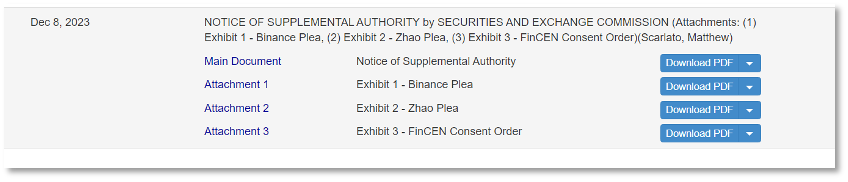
Three documents released on December 8
According to the agreement, Binance agrees to hire a third-party compliance monitor to fulfill obligations stipulated in the agreement term. Binance and prosecutors will use their best efforts to complete the selection process within 60 business days of signing the agreement.
Given this timeline, the monitor’s supervision of Binance will likely begin next year. The DOJ requires a three-year term for the monitor starting from the date of appointment, while FinCEN mandates a five-year term—possibly filled by the same individual.
The documents state that the monitor’s primary responsibility is to evaluate and oversee the company’s compliance with the terms of the agreement, including adherence to plans, policies, procedures, codes of conduct, systems, and internal controls, particularly those related to anti-money laundering (AML) and U.S. sanctions compliance, aiming to address and reduce the risk of recurrence of misconduct.
In certain cases, the monitor must report potential wrongdoing directly to the relevant office—not to Binance—especially if it involves risks to U.S. national security, public health or safety, environmental harm, involvement of senior management, obstruction of justice, or otherwise constitutes significant risk.
The monitor is also responsible for assessing and overseeing compliance with various agreements, including those with the Office of Foreign Assets Control (OFAC), the Commodity Futures Trading Commission (CFTC), and the DOJ.
Binance’s compliance commitments under the agreement include: policies, procedures, and internal controls; customer and third-party relationships; anti-evasion controls; periodic reviews; appropriate supervision and independence; training and guidance; comprehensive reporting and investigations; enforcement and discipline; and monitoring, testing, and auditing.
Under the agreement, Binance must use its best efforts to grant the monitor reasonable access to information upon request, including from former employees, agents, intermediaries, advisors, representatives, distributors, licensees, contractors, suppliers, and joint venture partners.
This indicates that the monitor’s review authority does not extend to ordinary user data. Additionally, the documents note that evidence provided by Binance during investigations conducted by the DOJ and FinCEN was submitted under the condition of complying with foreign data privacy laws.
These three documents, attached by the SEC to its ongoing litigation against Binance, contain more detail than prior disclosures made by the DOJ and FinCEN. The monitor-related content largely corroborates statements made by Binance CEO Richard. As a result of this strict oversight, Binance’s AML and compliance standards are likely to reach higher levels than most peers in the industry for at least the next three to five years.
Richard also shared feedback from some of Binance’s partners two weeks after the settlement: “They see this as positive. Some partners who were previously cautious are now more willing to collaborate with us. The benefits of compliance are becoming evident—not only enabling long-term sustainability but also driving broader adoption of crypto assets.”
SEC Applies Further Pressure; Binance Responds: “We Will Defend Our Position”
Beyond the content of the three documents themselves, in the third filing, the SEC requested that the judge make judicial findings on a series of “new evidentiary facts” contained in the settlement agreements.
Clearly, the SEC aims to strengthen its position in the case by asking the court to accept these facts as true without formal evidentiary submission. However, the outcome ultimately depends on how the court rules in this civil litigation.
On June 5, the SEC brought 13 charges against Binance, including the unregistered issuance of BNB and BUSD tokens, and its Simple Earn, BNB Vault, and staking products. The SEC also alleged that Binance failed to register its Binance.com platform as an exchange or broker-dealer.
At the heart of the allegations is whether Binance violated U.S. securities laws.
During Binance’s community AMA on December 12, Richard refrained from further comment due to the ongoing investigation but affirmed Binance’s stance: “Binance will firmly defend its position.”
Previously, Binance and its then-CEO Zhao Changpeng filed a motion in September with a U.S. district court seeking dismissal of the lawsuit, arguing that the SEC had exceeded its authority. They contended that the SEC had not provided clear regulatory guidance to the cryptocurrency industry before asserting jurisdiction and had distorted the interpretation of securities laws in doing so.
On November 7, the SEC countered Binance’s motion to dismiss, stating that no court has accepted Binance’s “misinterpretation of the law.” The SEC accused Binance of having “never complied” with federal securities laws and urged the court to deny Binance’s motion to uphold the integrity of the securities regulatory framework.
The legal battle between the SEC and Binance continues. In fact, beyond Binance, several companies in the crypto industry have faced lawsuits from the SEC over whether their tokens constitute securities. Past cases include Ethereum (ultimately not classified as a security), and more recent ones involving Ripple and TRON. Even U.S.-based exchanges like Coinbase are facing similar SEC litigation, which, like the case against Binance, remains unresolved.
Looking at concluded cases, most SEC actions have been civil matters ending in settlements and fines. Notably, however, the SEC was not part of the series of settlements Binance reached with U.S. regulators.
Regarding this point, He Yi, co-founder of Binance who participated in the same AMA, stated that Binance has dedicated legal teams and attorneys handling both the DOJ investigation and the SEC lawsuit. When assessing regulatory impact, she added, “Lawyers generally agree that the DOJ carries greater weight because it has criminal enforcement power, whereas the SEC’s case is purely civil liability.”
Both Richard and He Yi, Binance’s new leadership duo, appear optimistic about the SEC lawsuit. How the case will ultimately unfold, however, awaits a ruling from the U.S. district court.
Meanwhile, Binance, having already settled with U.S. regulators, is seeing further recovery in key metrics.
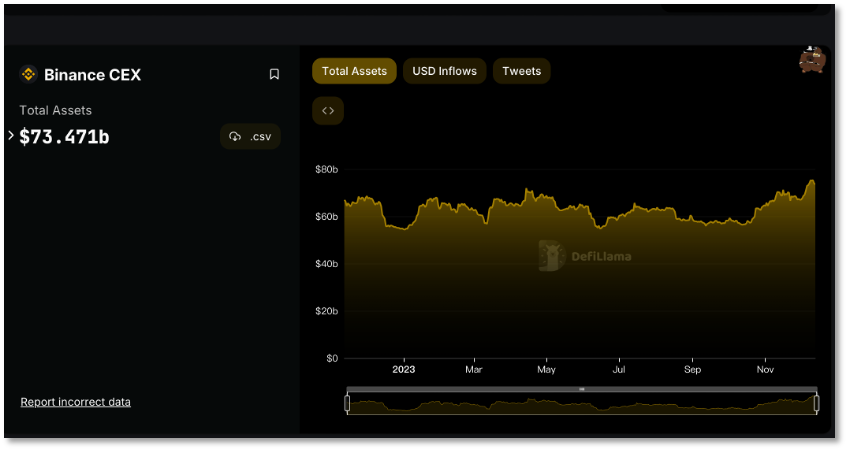
Binance’s on-chain wallet total assets have recovered to pre-incident levels
According to DefiLlama data, Binance’s total on-chain wallet assets stand at $73.471 billion, up 15% from $63.504 billion on November 21—the day the settlement was announced—and have returned to pre-crisis levels.
Join TechFlow official community to stay tuned
Telegram:https://t.me/TechFlowDaily
X (Twitter):https://x.com/TechFlowPost
X (Twitter) EN:https://x.com/BlockFlow_News












