Exclusive Interview with Joanna Zeng, Vice President of Aleo: After 4 Years and $300 Million, the "Dual Value" of ZK Will Emerge
TechFlow Selected TechFlow Selected
Exclusive Interview with Joanna Zeng, Vice President of Aleo: After 4 Years and $300 Million, the "Dual Value" of ZK Will Emerge
The four-year promise fulfilled, Aleo is set to launch its mainnet, aiming to make people realize that "ZK can be used not only for blockchain scalability but also for privacy."
 Navigating Web3 tides with focused insights
Interview, compiled by: Frank, Foresight News
Four years, $300 million in funding, and a ZK-based privacy-focused public blockchain—these are the three most visible labels of Aleo.
For Joanna Zeng, Vice President and Head of Business Development at Aleo, however, the keyword mentioned most frequently during the interview is "Technology."
Her decision to transition from over a decade on Wall Street into the crypto industry stemmed from a single “aha moment” centered around technology: Crypto isn't just an investment opportunity—it's fundamentally a disruptive technology.
This insight has guided her six-year journey through the crypto space—from Coinbase to Optimism, moving from Web3 companies closest to Web2 to emerging Rollup technologies. Through this path, Joanna Zeng has progressively advanced toward the technological frontier of the industry, gaining deep understanding of how relatively mature ecosystems grow and evolve.
And ZK represents the latest cutting edge. Working with Aleo made her realize that privacy protection shouldn’t only matter to users under constant surveillance—it’s a much broader issue, one that every individual encounters in daily life.
In terms of development timeline and fundraising scale, Aleo stands as a top-tier OG project in the crypto world. Yet since the Rollup wave began in 2022, ZK technology has primarily been associated with blockchain scalability, overshadowing its original purpose: privacy.
Now, after four years, with mainnet launch approaching, Aleo aims to remind everyone: ZK actually holds dual value—it can enhance both blockchain scalability and privacy.
Perhaps, as Joanna Zeng puts it, “from the perspective of mainnet launch, Aleo may become a beacon of hope.” Foresight News had the privilege of conducting an exclusive Chinese-language interview with Joanna Zeng on November 10, 2023. Below is the full transcript for our readers.
I. Joanna Zeng’s “Aha Moment”: From Wall Street to Bitcoin
Foresight News: After some research, we noticed your early career was in traditional finance—top institutions like Lehman Brothers and Citibank. What led you to discover the blockchain industry and eventually join it?
Joanna Zeng: Before joining Aleo, I’d already been involved in the crypto industry for nearly six years. My first job was at Lehman Brothers, where I worked in currency trading.
Later, I spent about ten years at Citibank. Around 2013, due to work-related exposure, I first encountered the concept of Bitcoin. At the time, many viewed it as a hedge against traditional currencies. As a forex trader, I made some personal investments in Bitcoin—but eventually sold my holdings.
In 2017, I had a sudden “aha moment”—realizing that crypto wasn’t merely an investment opportunity, but rather a truly disruptive technology. So even during that bear market, I spent time thinking about how to get involved technically.
I enrolled in a developer bootcamp to learn Solidity and co-founded a group called “Crypto NYC,” a developer community where fellow crypto enthusiasts and I discussed whitepapers. Many of those friends and colleagues later launched their own projects—I helped them write whitepapers, build their initiatives, and connect with investors.
Foresight News: How did you first learn about Aleo, and what prompted you to join? What role does joining Aleo play in your career trajectory?
Joanna Zeng: After entering crypto, I held roles at Coinbase and Optimism. My experience at Optimism taught me how a relatively mature ecosystem grows and scales.
Before joining Aleo, I’d long been interested in ZK. I first met Aleo’s founder Alex Pruden at a ZK summit where he gave a talk. That’s when I realized ZK would be pivotal in the future. If 2022 was the ‘Rollup Summer,’ then 2023 should be called ‘ZK Summer.’
I wanted to deepen my knowledge, so I paid out of pocket to take ZK courses. During that process, I reconnected with the Aleo team and maintained contact—eventually receiving an invitation to join.
II. Aleo Has a Unique “Hybrid” Culture
Foresight News: What do you see as the biggest difference between this industry and traditional finance? And how does joining Aleo fit into your professional journey?
Joanna Zeng: Since entering crypto, friends from traditional finance often ask me, “Why did you make this choice?” or “Do you regret it?”
I always tell them: Don’t focus solely on short-term trade-offs. For me, this was a major life shift. Over the long term, staying in this space allows you to build reputation. Now I can confidently call anyone I know—and they’ll pick up.
The industry is still new. Though it’s hard to know everyone, it’s small enough that knowing everyone is possible.
If you prove through action that you won’t abandon the space when a bear market hits, people will trust you. There’s mutual support—I really appreciate this sense of camaraderie. It makes me feel like I’m constantly growing.
It’s a strong “community” feeling. Plus, there’s so much untapped potential. I’ve always tried to explore new frontiers—starting with Coinbase, which was the most Web2-like Web3 company, then moving to Optimism, a representative of new Rollup tech, and now ZK as the latest technical frontier.
So I’ve steadily moved closer to the leading edge of industry trends.
Foresight News: During your time at Aleo, what traits do your colleagues share? Any memorable experiences or individuals?
Joanna Zeng: I think Aleo has a fascinating ‘mix’ (hybrid culture).
Some team members have deep Web3 backgrounds, while others come from Web2 with significant leadership and operational experience.
From my past involvement in other Web3 projects, teams were either entirely Web2 professionals trying Web3, or pure Web3 natives—lacking balance. Aleo strikes that rare equilibrium.
From my perspective, why is this culture effective? Because we maintain a startup mindset—small team, every voice heard. In my department especially, we have both freedom and sufficient resources to execute effectively.
I deeply respect our CEO’s执行力 (execution ability)—he doesn’t just talk; he delivers on his promises.
III. Privacy Is Key to Web3 Going Mainstream
Foresight News: What specific products, services, or business areas does Aleo cover? What problems is it solving?
Joanna Zeng: Aleo is currently a Layer 1 blockchain project using ZKP technology to address privacy-related challenges.
Why emphasize privacy? Initially, I assumed privacy wasn’t important to everyone. But then I asked: If we want Web3 to go mainstream—if we want everyone beyond today’s crypto circles to participate—how do we get there?
We need our technology to mirror real-world privacy. For example, if I send you, Frank, money, only you and I should know the account details and amount—that’s normal. But in today’s Web3 world, everything is fully transparent.
Once your wallet address is linked to your real identity, everyone can see your entire transaction history. This clearly contradicts real-life norms. Privacy shouldn’t only concern users in countries under heavy government surveillance. It’s a much broader issue—something everyone needs in everyday life.
We’re making privacy a programmable Web3 feature. Users can choose full privacy, full transparency, or a “gray” middle ground—each person chooses freely.
Foresight News: Many compare Aleo to a programmable Zcash, or Ethereum with built-in privacy logic. How does Aleo differ architecturally from other ZK-based or privacy-focused protocols or blockchains?
Joanna Zeng: We see ourselves as the next major breakthrough in the blockchain technology revolution.
Let’s trace the evolution:
- Bitcoin came first—peer-to-peer public payments;
- Then Zcash—private payments;
- Then Ethereum—public application ecosystems.
Now comes Aleo—private application ecosystems. How is our privacy architecture different? The key difference is that we’ve invested heavily in rebuilding the Layer 1 architecture from the ground up, ensuring all components are designed specifically for privacy.
Aleo is quite an OG project—we’ve been building for three years. Why wait until now to launch mainnet? Because we kept exploring. We initially considered using Ethereum as a base model and building on top. But Ethereum’s account model wasn’t designed for privacy. So Aleo adopted a different accounting model—the Record model.
Ultimately, we built a ZK-SNARK-based virtual machine, layered with our custom operating system (ZK SNARK OS), and developed our own programming language, Leo (Foresight News note: a functional, statically-typed language based on Rust, built specifically for writing private applications).
After careful evaluation, we chose what we believe are the most advanced technical options. Three aspects set us apart:
- First, we deliver true privacy;
- Second, we enable programmability—meaning not just private transactions, but also building applications atop them;
- Third, we are permissionless.
Regarding “permissionless,” we use a unique dual consensus design combining PoW and PoS. We use PoS to validate transactions, and post-mainnet, anyone can join the network by staking sufficient tokens.
On the PoW side, we’ve fully decentralized participation, allowing traditional miners to contribute via ZK proof generation—similar to mining. We’ve also launched a new mining competition, “ZPrize,” bringing together top teams across research, engineering, hardware, and software to build better machines. We don’t intervene—developers are free to innovate.
Overall, validators, miners, and developers form a highly decentralized ecosystem.
Foresight News: For those interested in Aleo mining, how high is the hardware barrier to entry?
Joanna Zeng: Currently, the hardware barrier for mining participation is not high.
Experienced miners can quickly set up the necessary hardware. I’m not a miner myself, so I’m not deeply familiar with specifics—but from what I understand, transitioning from other mining platforms to Aleo doesn’t require extensive additional work.
IV. Aleo’s Mainnet Launch Plan
Foresight News: You mentioned plans to launch mainnet in January 2024. What’s the detailed timeline and rollout process?
Joanna Zeng: Our current plan is to launch mainnet in Q1 2024. However, the exact date will depend on testing progress, and we’ll announce it publicly once finalized.
Foresight News: Compared to testnet, what does mainnet launch mean for Aleo? What key directions will be prioritized?
Joanna Zeng: First, all applications on testnet will be directly migratable to mainnet.
Most importantly, up until now, technical decisions were made by the core team and protocol. After mainnet launch, we’ll shift to a permissionless, fully community-governed model—meaning all upgrades must pass community votes.
To achieve this, we’ll establish a formal proposal and governance process similar to Ethereum’s ERC framework—ours will be called ARC. Anyone can submit proposals, and implementation requires community approval via voting.
At mainnet launch, we’ll also establish a foundation. The company will continue product and service development, while the foundation focuses on ecosystem and community growth—offering grants and other resources to support developers building on Aleo.
Foresight News: Any updates on token economics? How will testnet participants redeem their Aleo points?
Joanna Zeng: Specifics on token distribution are still being finalized and will be disclosed before mainnet launch.
Testnet contributors will receive corresponding tokens upon mainnet launch—rewarding their contributions to Aleo’s development.
Foresight News: ZK development is known to be challenging—complex circuits, etc. Could this pose a barrier for developers choosing to build on Aleo?
Joanna Zeng: Lowering the development barrier is a top priority for us.
For instance, we’ve recently developed several compilers—including a Python compiler—that translate high-level code into low-level instructions. Developers can use familiar languages, and during compilation, their code converts into Leo, Aleo’s internal language. They can view the output without needing to understand Leo’s internals.
We’ve also built numerous tools to further reduce barriers—developers don’t need to master fundamental ZK concepts to build easily on Aleo.
Foresight News: Based on the services Aleo will offer post-mainnet, which types of applications are likely to adopt it, and what advantages would they gain?
Joanna Zeng: Currently, we identify seven core application categories: DeFi, Identity, Gaming, SocialFi, zkML, Infrastructure, and Voting/Governance. After mainnet, more teams will likely explore integrating Aleo’s tech with other chains to create novel use cases.
Aleo’s strength lies in privacy and security—unlike other chains focused on transaction volume or user count. We believe privacy and security are foundational. As adoption grows, so will our transaction volume and user base, driving progress in both areas.
We’ll continue collaborating with projects across chains to unlock new possibilities—such as fully on-chain games, age verification for children, or validating machine learning algorithm accuracy.
We believe Aleo’s unique strengths will play a vital role in advancing blockchain technology toward a more private, secure, and fair platform.
V. What Milestones Has the Aleo Ecosystem Achieved?
Foresight News: Though Aleo mainnet hasn’t launched yet, testnet testing is ongoing. What progress has the Aleo ecosystem made so far? Any data or metrics you can share?
Joanna Zeng: Let me highlight two metrics: monthly active developers and number of deployed programs (Foresight News note: in Aleo’s terminology, “programs” refer to smart contracts).
Monthly active developers are defined as those who submitted code in any language that was subsequently used by someone else. Deployed programs aren’t counted if simply forked without meaningful contribution.
After filtering out low-value code, we now have 14,000 deployed programs and 120 monthly active developers.
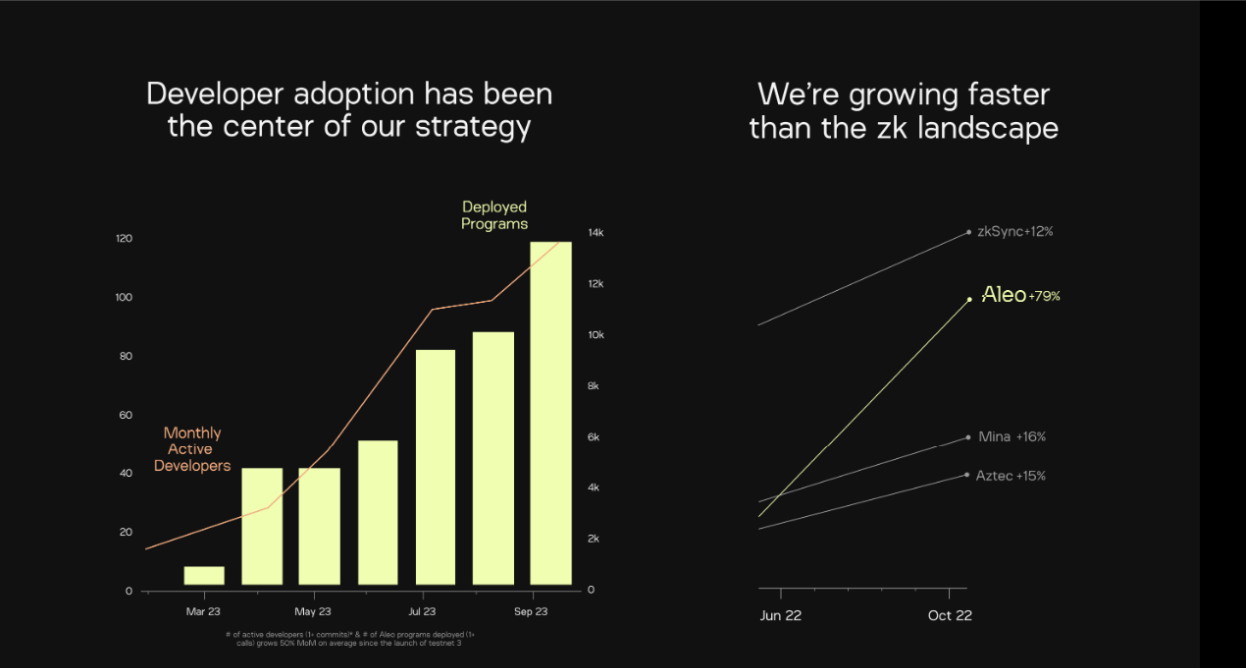
Compared to other popular blockchain platforms, these numbers represent strong performance. Despite no mainnet yet, our testnet’s monthly active developer count rivals that of many mainstream chains. Moreover, our monthly active developer growth rate is 79%.
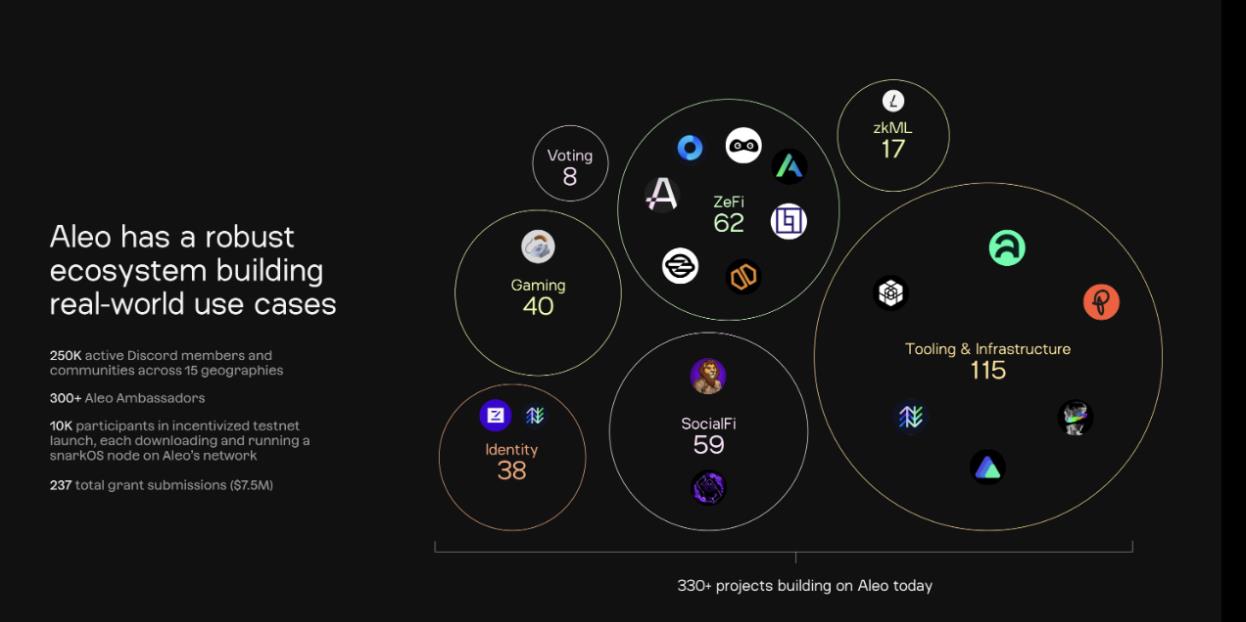
Currently, we focus on seven key use case areas: DeFi, Identity, Gaming, SocialFi, zkML, Infrastructure, and Voting/Governance.
Infrastructure (InfraFi) leads in project count with 330, largely because our ecosystem emphasizes decentralized infrastructure.
While ZK technology naturally supports privacy use cases, direct migration from Ethereum’s ecosystem remains challenging due to infrastructural gaps. Many projects are addressing this—building wallets, cross-chain bridges, RPCs, and other foundational tools.
An interesting use case is Gaming. Game developers aim to build fully on-chain games, but traditional models can’t hide game state. With ZK, developers can create asymmetric information environments—players can bluff without revealing strategies to opponents. This is a use case only possible on a privacy-focused public chain.
It’s fascinating—games span many genres and scenarios. Poker, for example, can leverage our tech to protect player privacy. Aleo enables endless gameplay innovations, including social features.
For SocialFi, third-party attestation becomes possible. For example, scanning an NFC chip could reveal identity information—but stored only on the two devices, never exposed publicly.
We’re partnering with an educational company serving children, helping them safely access the internet. They use our tech to verify age without disclosing personal data—applicable in scenarios like age-appropriate content filtering.
Lastly, zkML uses zero-knowledge proofs to verify machine learning model accuracy. It’s a decentralized method enabling data contribution without exposing personal information—useful in credit card fraud detection, for example.
Foresight News: Beyond purely on-chain apps, what off-chain applications could benefit from privacy enabled by Aleo?
Joanna Zeng: As discussed, Aleo goes beyond basic privacy transactions—we’re tackling real-world private applications.
From a user perspective, any scenario where you don’t want to broadcast information globally qualifies as a privacy application. For example, verifying student IDs at schools to determine age eligibility for certain online content.
In Aleo’s system, cutting-edge tech enables verifiable processing of one-time database queries, rapidly generating cryptographic proofs.
Foresight News: Privacy apps like Tornado Cash face regulatory scrutiny globally. As a privacy-focused public chain, could Aleo face similar regulatory concerns or risks?
Joanna Zeng: One key difference between Aleo and other privacy chains is that compliance has been a priority from day one.
Privacy-focused and compliant public chains may seem contradictory, but we believe they can coexist. We’re collaborating with a ZK tech provider to develop a validator mechanism allowing regulators to view on-chain data when necessary—but only with explicit project consent.
We’re also working with multiple government agencies to help them build privacy-preserving applications. By collaborating with regulators, we aim to provide user privacy while meeting compliance requirements.
Foresight News: Both development stacks and real-world use cases for ZK are still early. What efforts are needed for ZK to achieve mainstream adoption, and what is Aleo doing in this regard?
Joanna Zeng: ZK has mostly been seen as a scaling solution for blockchains. When people think of ZK, they think Rollups and Layer 2.
The most important thing Aleo does is remind everyone that ZK has dual value: it can serve both scalability and privacy.
We’re investing heavily in education—targeting policymakers down to end users. We run public initiatives like ZPrize, where Aleo gains no direct benefit, but aims to promote ZK technology and showcase its vast potential.
Foresight News: Aleo has raised several large funding rounds totaling nearly $300 million—rare in the industry. Given current market conditions, how do you view the current bull/bear cycle?
Joanna Zeng: Clearly, we’re still in a bear market—evident from all available data.
Under these conditions, Aleo must continue advancing R&D and community building. Especially launching mainnet—to fulfill our four-year promise to investors and the community. This is a critical milestone.
That’s exactly what the $300 million funding enables—focused tech development and commitment fulfillment.
From the perspective of mainnet launch, Aleo may become a beacon of hope. Those who truly understand us—our community supporters—know we’re a protocol capable of delivering on ambitious promises: privacy, permissionlessness, scalability, programmability, and Sybil resistance. These are exceptionally difficult challenges.
We’re confident Aleo’s mainnet launch can bring renewed hope to the industry.
Additionally, the Asia-Pacific (APAC) region is a key focus for Aleo’s next phase. Our core team recently visited major APAC hubs for research, and we’re highly optimistic about the region’s future potential.
Join TechFlow official community to stay tuned
Telegram:https://t.me/TechFlowDaily
X (Twitter):https://x.com/TechFlowPost
X (Twitter) EN:https://x.com/BlockFlow_News
 Foresight News