Exclusive Interview with Superscrypt's Founding Partner: Bull Markets Are Always Price-Driven; Infrastructure Only Matters for User Experience
TechFlow Selected TechFlow Selected
Exclusive Interview with Superscrypt's Founding Partner: Bull Markets Are Always Price-Driven; Infrastructure Only Matters for User Experience
About 70% of our focus is on infrastructure, but we are increasingly paying attention to application and gaming use cases.
 Navigating Web3 tides with focused insights
TechFlow: Sunny
Superscrypt: Jacob Ko
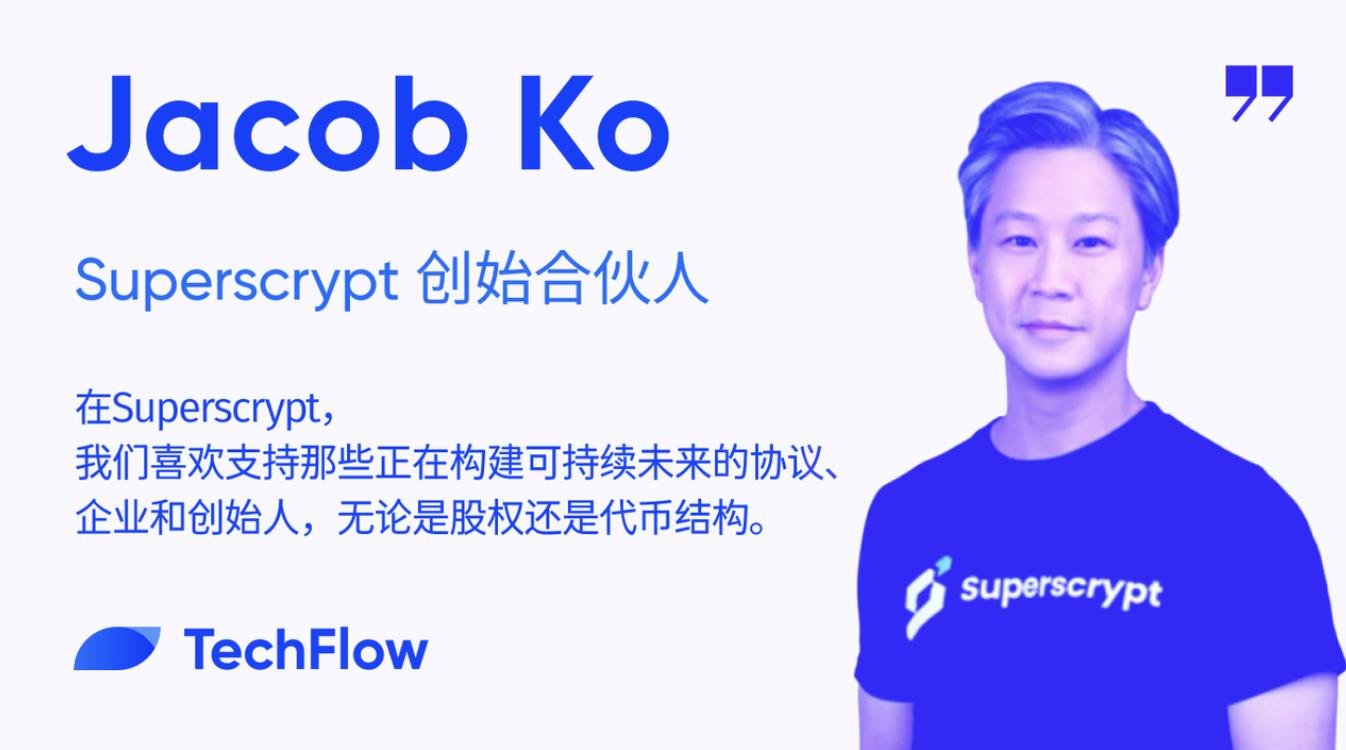
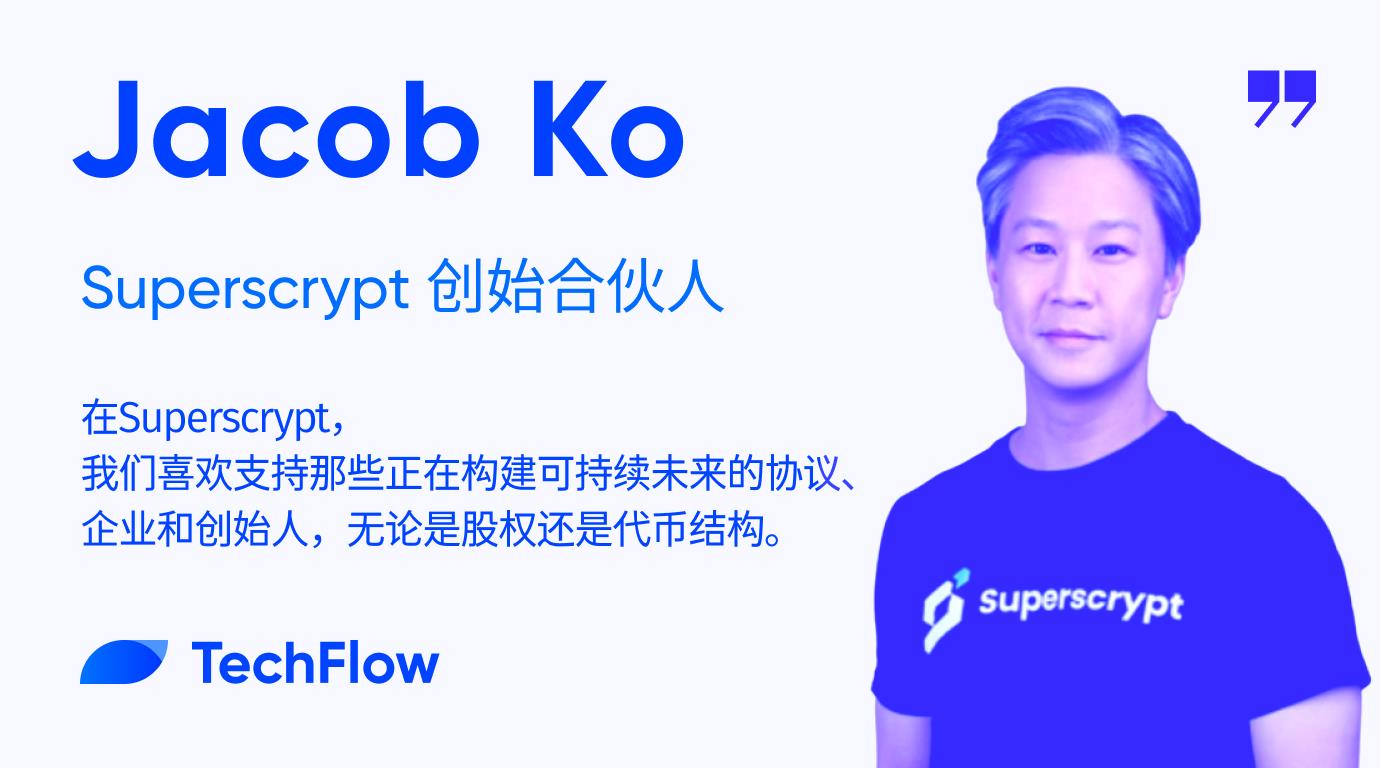
“About 70% of what we focus on is infrastructure, but we’re increasingly paying attention to applications and gaming use cases.”
---Jacob Ko
On Friday, I had a brief chat with Jacob at Superscrypt’s headquarters in Singapore—discussing the differences between Hong Kong and Singapore's crypto cultures. Jacob is the founder of Superscrypt, a crypto fund affiliated with Temasek. Based in Singapore, he naturally favors the local crypto atmosphere. Compared to Hong Kong, Singapore has a smaller land area and scarcer natural resources, so the country heavily invests in human capital to achieve economies of scale and innovation.
“We maintain a very open attitude toward all forms of innovation,” Jacob said. Understanding this may help explain why someone who spent nine years in technology investing at Temasek would transition into crypto investing in 2022. For advanced economies like Singapore, creating synthetic food, digital currencies, and the next-generation internet hold significant importance across these innovative verticals.
We interviewed Jacob Ko, one of the founding partners of Superscrypt. We discussed his journey and story, why he entered the Web3 industry, and the core benefits of building with blockchain technology. We also explored their investment methodology, which areas in Web3 excite them, and how early-stage teams should build amid challenging fundraising environments.
Key Takeaways
-
Web3 places stronger emphasis on community and users as stakeholders, sharing value.
-
Tokens often bring faster liquidity and higher valuations.
-
Protocols are adopted rapidly because they are permissionless and operate on an open internet.
-
I don’t believe blockchain will become the foundation for everything. First, we must ask: why do we need blockchain?
-
Ownership, coordination & incentives, and tracking & traceability are unique characteristics of blockchain.
-
When you think bull markets are price-driven, that’s why I mention two things: ETFs and the arrival of traditional investors. But what will keep people using blockchain and actually engaging with it will be better infrastructure improvements, such as wallet labels or identity verification.
-
We focus about 70% on infrastructure, but we’re increasingly interested in application and gaming use cases. In fact, we believe gaming will be huge. Gaming already is huge. Traditional gaming is larger than the music and entertainment industries combined.
The Origin of Superscrypt
TechFlow: Thank you for joining us today. Our goal is to dive deep into Web3 investing and your background. Let’s begin with Superscrypt’s founding story and its connection to Temasek.
Jacob:
Superscrypt was founded by Temasek in 2022. We are an early-stage Web3 firm operating independently to invest in and support innovators building in the Web3 space. Our operational model ensures we add value to our portfolio companies and accelerate their growth. We help all our founders develop go-to-market strategies, evaluate their tech stacks, recruit talent, and build communities.
Some members of our team are former builders and entrepreneurs—we combine that expertise with my investment background and Web3 insights to identify the best opportunities and support top builders developing products and protocols using blockchain technology.
Operating at the early stage gives us insight into the future evolution of the internet. The Web3 space evolves extremely quickly, so early-stage investing provides the best learning opportunity. You meet brilliant founders, and those experiences might apply to where the internet is headed—or could even disrupt existing models or spawn entirely new business paradigms.
Jacob’s Shift from AgriTech/Deep Tech Investing to Blockchain
TechFlow: Given your financial background at Temasek and experience investing in agri-tech, what inspired your shift from deep tech investing to Web3 in 2022?
Jacob:
Before founding Superscrypt, during my time at Temasek, I invested in late-stage deep tech and agri-tech. What Web3 shares with those fields is a focus on cutting-edge technologies, understanding new business models, and assessing their potential to disrupt traditional industries.
There are many similarities when evaluating new technologies—such as determining whether a team is the right one to build something transformative—and then taking an investment position. Early-stage venture capital involves high risk, but also high reward. Along the way, we hope to find people creating novel things, potentially sparking new primitives or even entire industries. Bitcoin gave rise to digital currency, DeFi emerged during the summer of 2020, and NFTs gained popularity in the last cycle. There’s constant experimentation with protocols and use cases in Web3.
As for why I shifted from agriculture to Web3—I’ve always been an internet participant. I grew up online and witnessed how the world changed when people started interacting via computers and sharing knowledge. I saw the promise and loved being part of it.
Over the past three years, I did extensive self-study on blockchain (thanks to plenty of free time during the pandemic lockdowns). I began learning about Bitcoin, then moved on to Ethereum and smart contracts. When I discovered smart contracts, I realized they felt very much like Web 1.0, when information was spreading freely. Anyone could build anything, write code, and deploy it. I feel Web2 became bigger and more structured, but we lost some of the early internet culture, where everything seemed possible.
When I began studying smart contracts and Web3, that sense of infinite possibility from Web1 returned to me. I became extremely excited by what I saw. It was still early, so I decided to leverage my investment background and get involved in Web3.
Beyond that, I started writing, tried building communities, and used blockchain itself (DeFi, social) to understand every aspect. This truly ignited my passion. From then on, I knew this was where my heart lay (agritech being a close second), and I began helping establish Superscrypt.
TechFlow: As someone with a biochemistry background, I see many similarities between agritech and Web3 in terms of complex terminology. Concepts in agritech like molecular farming or cultivated meat were initially seen as unconventional ways of producing food, similar to how most Web3 jargon feels unfamiliar to people today.
Jacob:
There are many interesting parallels.
Things you thought impossible in agritech are actually feasible—like producing protein without animal meat. Similarly, people can use blockchain technology and protocols to create new primitives—for example, a decentralized exchange; a lending platform; Web3 social, where you own your posts, or even tokenize intellectual property rights. Blockchain is essentially a distributed ledger that enables token-based allocation of digital ownership. With this mechanism, you can create entirely new paradigms and value models.
Previously, doing this was difficult, inefficient, and inconvenient.
Let me give you an example. Recently we’ve seen projects like friend.tech, where someone’s keys have value—those keys simply represent their social graph, knowledge, or intangible access rights. A person’s social connections, expertise, and knowledge are intangible assets, and assigning ownership to these intangibles via blockchain technology is something quite novel.
On previous Web2 platforms, you couldn’t derive value from these. Of course, questions remain about the sustainability of projects like friend.tech, but the fact is, new value has already been assigned to these intangible concepts.
Many breakthroughs stem from things once deemed impossible.
TechFlow: At the core of emerging technologies lies uncertainty and novel approaches. Given Web3’s nascent nature, from your perspective, how does Web3 investing differ from agritech/deep tech investing?
Jacob:
I believe the core of Web3 is community.
This word gets thrown around a lot, but it usually refers to users—the people using your protocol or product. They’re stakeholders because they support what you’re doing, spread the word, and the more they use your product, the more likely they are to love it. That’s your community—they’re incentivized or rewarded through ownership of the community, product, or protocol.
That’s what makes Web3 unique: you have a decentralized architecture and tokens that can coordinate and incentivize communities. The value created by a Web3 product or protocol doesn’t just belong to the protocol or app—as is mostly the case in Web2—but also to the users. So I see this as a major difference compared to traditional investing. Here, you genuinely place the community at the center. Of course, tokens as tools for coordination or stakeholder rewards aren’t common in traditional investing, especially due to securities regulations surrounding such mechanisms.
A final distinction between Web3 and traditional investing is speed and liquidity. Tokens typically become liquid much faster than traditional equity investments. Even when a protocol is in its early operational stages, Web3 investments often come with a premium because liquidity emerges earlier, whereas in Web2 venture capital, exits via acquisition or IPO might take 5 to 10 years. Web2 valuations tend to be lower, based on more “typical” observable metrics compared to Web3. That said, since Web3 is fundamentally an investment in the internet, adoption can be extremely rapid because anyone can connect to a protocol and start using it immediately.
To summarize, these are some key differences between Web3 and Web2 investing. In Web3, there’s greater emphasis on community and users as stakeholders, shared value, faster liquidity due to tokens, higher valuations—and also the potential for extremely rapid protocol adoption because they’re permissionless and operate on an open internet.
Full Blockchain Adoption?
TechFlow: I want to ask you this: Do you think one day blockchain will merge with traditional industries like agriculture? Right now we see many projects using blockchain for supply chain management, IoT devices, and other purposes. You also mentioned that traditional industries have regulations that create many barriers to innovation. But do you think blockchain will one day become the foundation for everything?
Jacob:
I think it will move in that direction. I don’t believe blockchain will become the foundation for everything. I say this because when evaluating projects, you must carefully consider: why do we need a blockchain in the first place?
We see many projects and teams where it’s obvious a blockchain isn’t needed.
Why might you need a blockchain? Usually for several reasons. First, when you need a system that can assign ownership to an asset, whether tangible (protocol tokens or real-world assets) or intangible (e.g., IP rights for content, social graphs).
Second, you need a coordination mechanism to incentivize users and stakeholders to perform certain actions, such as running nodes and securing a decentralized network.
Third, if your problem requires some form of tracking and traceability to prove authenticity or activity history—for example, in supply chains. If you need to verify whether a crop passed through the correct supply chain and confirm it went through all required stages, blockchain is useful. That’s where blockchain and tokens come into play.
Again: ownership, coordination & incentives, and tracking & traceability.
If what people are building requires these three attributes, then there’s no reason not to use blockchain. But if not, they shouldn’t use it—because it can distract from the core innovation. Maybe they’re attracted to the idea of tokens gaining liquidity and appreciating quickly in the early stages.
So I believe there will be genuine use cases requiring these features, and we’ll see more blockchain adoption. But many use cases won’t need it. And if not, they shouldn’t use it.
Investment Methodology
TechFlow: You highlighted blockchain’s effectiveness in three areas—breaking down data silos and enabling a true network—and its role in financialization, which is fascinating. The shift from Web2 to Web3 investing in this domain might happen faster. I’m curious: does Superscrypt have a specific investment decision-making framework? Building on our earlier interview with Yu Hu, founder of Kaito, and considering projects like Web3 large language models, could you elaborate on the approach Superscrypt and you personally take when evaluating such projects?
Jacob:
First, let’s talk about our DNA. I worked at Temasek for nine years, and we carry forward some of their core principles around sustainable investing and long-term vision.
At Superscrypt, we like supporting founders, protocols, and companies building sustainable futures. Of course, there’s a lot of experimentation in Web3—not everything will succeed—but we tend to focus on founders and companies that create value, whether through equity or tokens. What excites us is finding founders who can grow businesses over five, ten, or more years. The value they create compounds over time. That’s one area we emphasize—we actively seek sustainable, long-term opportunities.
The second pillar is relentless founders who find a way to deliver results. In early-stage investing, market feedback on product-market fit is critical. Founders pivoting and experimenting early on is common. So we look for founders who are relentless—those who will do whatever it takes to succeed. Whether it’s acquiring customers, building beloved products, solving critical problems, forming strong partnerships, or pivoting to something more sustainable when needed.
The third factor is their go-to-market strategy. We favor teams with thoughtful, strategic approaches to market entry and a deep understanding of their target users and how to serve them. They must be obsessed with serving their customers, users, and community. In Web3, either you have a product serving customers, or your customer is a community—especially if you’re building a protocol. How well you grow that community and ensure they’re motivated to support you—and capable of receiving value back—is crucial, because the community is what helps you scale rapidly. Go-to-market and community matter.
Fourth is team discipline. This means being mindful of key metrics: transaction volume, users, revenue (if applicable), burn rate management, and maintaining a lean team.
Finally, we also emphasize valuation discipline—thinking carefully about our entry valuation to achieve strong venture returns.
TechFlow: Is your team particularly interested in any specific trend or sector?
Jacob:
Roughly two-thirds of our time is spent researching Web3 infrastructure—an enormous and complex field. It includes Layer 1s, Layer 2 scaling solutions, MEV architectures, rollup sequencing, data indexing, identity, communication protocols, and blockchain interoperability.
Interoperability: We’ve done work in interoperability. We see many different blockchains emerging—both Layer 1s and Layer 2s helping scale Ethereum. We believe the future will be multi-chain and multi-layered. If that’s the case, interoperability solutions between Layer 1s and Layer 2s will be essential. This is technically challenging and risky—bridges sometimes get hacked—so any solution that solves or simplifies this is critical for better user and developer experience. We see interoperability as a major problem space and investment opportunity. We previously co-led LI.FI’s funding round with Coinfund; they aggregate bridges, creating liquidity pools across multiple channels to simplify cross-chain transactions. We love initiatives like that.
Identity, Reputation, and Credentials: We find the space of identity, reputation, and credentials in Web3 highly compelling. Today in Web2, we log in using WeChat, Facebook, Google, and other vertical-specific identities. It’s convenient and fast—we won’t replace them tomorrow—though we sacrifice some freedom and value, as these platforms benefit from our data and social graphs. But perhaps the next generation—or our children—will log in using wallets or decentralized IDs. They’ll control what information they share with enterprises, products, or protocols, and may directly benefit in ways impossible under Web2.
So we believe ID and reputation will unlock major improvements in future user experience. Wallets aren’t mature yet, but imagine what becomes possible when they are—you’ll unlock countless new use cases.
Decentralized ID and Interoperability
TechFlow: Why aren’t decentralized IDs (DIDs) mature today? Is it due to poor user adoption or a lack of builder talent in the space?
Jacob:
There’s plenty of talent building in this space. The challenge with DIDs, visible even in Web2, is that certain companies currently enjoy scale advantages—which they treat as competitive moats they don’t want to share. They don’t want to open access to their tech stack—it’s more profitable to control it. The hard part of building DIDs is getting people to adopt your verifiable credentials—people don’t want thousands of different login methods.
So DID teams must find ways to incentivize sign-ups and creation of verifiable credentials within their systems. For example, WorldCoin uses retinal scans and may later conduct airdrops—that could be their path to scale.
For verifiable credentials, it’s an uphill battle. You have to convince people to use your system. I think that’s hard. In the past, Google offered free search and services like Gmail and Slides—people signed up, and that became the gateway to Google ID. Facebook used social media as a wedge—more people joined, and eventually you could log in with Facebook. We haven’t seen much of that in decentralized systems yet, because convincing people to adopt new ID solutions is difficult. I believe multiple solutions will converge, and one or two dominant ones may emerge.
TechFlow: Shouldn’t these solutions be interoperable? After all, Web3 is supposed to break down data silos, yet now we see many similar DID projects competing—forcing users to pick one network to access its services. In this context, how is interoperability addressed?
Jacob:
For identity and verifiable credentials to be truly useful, they must be interoperable. But as I mentioned, the value created by verifiable credentials belongs to the silo that issued them, so they have little incentive to make them interoperable. So I think we need multiple attestations from different sources. We invested in a company called Intuition, building a reputation and attestation protocol where anyone can verify that a wallet belongs to person A or B. Then not just one person, but multiple parties can provide such attestations.
How does this solve identity? Well, someone might have a WeChat account, a Facebook account, a decentralized ID from disco.xyz, and multiple wallets. If enough people use Intuition’s service or reputation system to attest that all these accounts are linked, we can effectively know they belong to one individual—tying all these identities together.
Drivers of the Next Bull Market
TechFlow: Do you think decentralized ID and interoperability infrastructure will be the gravitational pull of the next bull run, or do you see ZK, AA, or AI as the drivers?
Jacob:
I don’t know if they’ll be the sole market drivers. What I do know is they’ll make blockchain easier and smoother for more people to use. The more features you have, the more seamless the experience becomes. Is it easier for someone to use a wallet or app? Identity and connecting your data come into play here. But will that trigger a bull market?
I think there are more direct catalysts. Recently, there’s been growing anticipation around the approval of a Bitcoin ETF in January 2024. This is positive because, if approved as expected, it offers non-crypto-native individuals an easy way to gain exposure to cryptocurrencies and Bitcoin trends. Remember, most people—about 90%—don’t know how to set up a wallet or manage private keys, but they might be interested in alternative assets. Products like ETFs could attract more external capital and interest into the space. That could drive a bull market.
We also hear increasing talk about institutions and traditional finance entering the space. I believe they’re very interested and recognize blockchain’s benefits—speed, lower costs compared to legacy systems, and capabilities for cross-border payments.
-
We’ve seen JPMorgan pilot projects on private blockchains with Axelar and LayerZero,
-
Citigroup piloting a foreign exchange market on Avalanche,
-
Franklin Templeton launching the OnChain U.S. Government Money Fund, an SEC-approved tokenized money market fund.
They recognize that Web3 infrastructure makes sense and is coming, but they also need to manage risks—which means it may take more time.
We shouldn’t be overly optimistic and expect everything to happen overnight. Traditional institutions will take years to arrive, and it will happen through small-scale experiments. I think once we see some capital onboard, then we may see renewed bullish momentum and greater institutional interest. So, a real bull market is price-driven, which is why I mention these two things: ETFs and traditional investors. But what keeps users engaged and actively using blockchain will be better infrastructure improvements—like wallet labels or identity. I don’t think infrastructure alone drives the whole market, but it enables smoother onboarding and gradually attracts more users over time.
Enterprise-Driven vs. Crypto-Native Projects
TechFlow: In Web3, an interesting phenomenon has emerged. I interviewed a Layer 1 chain backed by major Korean tech giants like KakaoTalk, which delivers excellent user experience and has a dedicated engineering team. In contrast, the native Web3 landscape is decentralized, driven by global contributors. Most native projects lack the centralized support seen in state-backed initiatives, making it harder to deliver user-friendly experiences.
What are your thoughts on the future of remote work, especially compared to the role played by major corporations supporting the blockchain movement?
Jacob:
Whenever something is enterprise-driven, Web3 natives tend to be skeptical. “Is it real?” “Does it have genuine community and organic adoption?” “Are we just rebuilding Google and Facebook?”
I’ve said community is everything—it means things should benefit users and the community, not just corporations. So overall, I believe native Web3 communities remain somewhat skeptical of corporate involvement in blockchain. Over time, as the technology finds more use cases and we see more value generated from intangibles and tokenized ownership, this attitude may shift.
Right now, I think we’re still early. When enterprises step in, there are valid questions. Corporate involvement isn’t necessarily bad—they can bring traffic and use cases. But we need more real-world examples to drive broader acceptance.
Another point: a successful product or app succeeds because it solves a daily problem or is fun to use. By definition, that doesn’t mean it succeeds because it uses blockchain, crypto, or tokens.
Our most-used daily apps don’t use blockchain. For a blockchain app to succeed, users must be able to use it seamlessly—even without realizing it runs on blockchain infrastructure in the background. That’s what I believe is needed for mass adoption.
I don’t think building things just to promote blockchain adoption always works. Solutions and use cases need some of the traits we discussed—perhaps you need to assign ownership and digital rights, track provenance, or incentivize and coordinate people. Unless you have those and many real use cases, enterprise-driven efforts may lack organic traction.
Gaming
TechFlow: You mentioned infrastructure, Web3 social, and AI. Then you seemed quite bearish on gaming. Why is that?
Jacob:
We focus about 70% on infrastructure, but we’re increasingly looking at applications and gaming use cases.
We’ve had this direction from the beginning. Early on, we chose not to focus on gaming—not because we think there’s no opportunity. In fact, we believe gaming will be massive. It already is massive. Traditional gaming is larger than the music and entertainment industries combined. Each new generation is increasingly made up of gaming natives. It’s more interactive, and people are deeply passionate. But our team doesn’t come primarily from gaming backgrounds—though some of us play games. Predicting what will succeed, what will go viral, what people will enjoy playing is often extremely difficult. When you get it right, the payoff is huge, but more often than not, it doesn’t work out. So our view was not to take that risk or make that bet.
That doesn’t mean we’ll never look at gaming—we’re deliberately focusing more on the underlying infrastructure needed to enable great games and products. I believe some excellent games will soon emerge on Web3. Not all will succeed, and they take a long time to build—you can never be sure they’ll work.
So while we consciously avoid over-indexing on gaming, we continuously observe user reactions to games, as it’s a highly popular medium. Our view mirrors our stance on applications: if you build an engaging game or solve real user problems, you’ll succeed. Unless truly necessary, blockchain functionality shouldn’t be forced in.
TechFlow: We’re currently experiencing a volatile shift in the market. And since you’re in the primary market, I imagine you feel the same pressures we do in the secondary market. What advice would you give to founders currently fundraising?
Jacob:
We’ve been in a bear market for a while. There are signs of life, but given the macro environment, it’s unclear how fast or strongly things will heat up, or whether fundamentals are solid.
One key point is that pure numbers and metrics are now more important than ever. This means demonstrating and tracking your data—your protocol or product’s monthly active users, or revenue generated.
You need to closely monitor these now. Taking a data-driven approach helps when raising capital. Many investors are hesitant now without solid metrics. Maybe in a bull market their views shift, but in tough markets, fundamentals matter. That’s point one.
Second, team discipline and cash management. Clearly, you need to be conservative and manage your cash position carefully. Balance building new features to grow data, users, and metrics against the cash burn required for hiring and development. Given more rational and lower valuations, you might raise less capital—but enough to sustain operations for at least a couple of years. Once your runway drops below 12 months, you’ll need to start fundraising again, which can be a lengthy process.
Finally, from a VC valuation standpoint, be realistic about your product and valuation. If what you’re building doesn’t need a token or blockchain, investors will treat you as an equity investment. That means longer holding periods, typical returns from acquisitions—which take time. So investors will naturally offer lower valuations, especially for minority equity stakes. That’s not bad—absolutely not. It reflects a long-term outlook. But don’t arbitrarily add a token just for the sake of it—investors will see through that.
Do We Need a Token?
TechFlow: How do we determine which projects need a token, and which should be equity-based?
Jacob:
I think going back to first principles—Bitcoin, Ethereum—the original purpose of tokens was to reward people for running nodes to secure the network. So whenever you need to protect something and have validators or nodes on the network, that’s a reason you might need a token.
Second, clearly, the coordination mechanism you mentioned earlier—whenever you need to incentivize people to act. Then there’s utility—what kind of function does it serve, what utility can the token provide. On the other hand, you don’t always need a token. When you look at SaaS businesses or developer tools, it’s harder to argue you need a token, because what network are you securing?
Research by Superscrypt: https://www.superscrypt.xyz/research/
Join TechFlow official community to stay tuned
Telegram:https://t.me/TechFlowDaily
X (Twitter):https://x.com/TechFlowPost
X (Twitter) EN:https://x.com/BlockFlow_News
 深潮TechFlow