









Crypto practitioners debate: Is $2,200 ETH just the beginning?
TechFlow Selected TechFlow Selected
Crypto practitioners debate: Is $2,200 ETH just the beginning?
"ETH has not yet entered a bull market, and the market's irrational sentiment is far from over."
 Navigating Web3 tides with focused insights
Article by: 0xAyA, Odaily Planet Daily
Is ETH at $2,200 expensive? At least not according to Bankless co-founder Ryan Sean Adams. On December 5, Ryan published a lengthy post on X, sarcastically pushing back against those FUD’ing ETH and arguing that “ETH hasn’t even entered a bull market yet—market irrationality has much further to go.”
Moreover, Ryan elaborated on Ethereum’s strong fundamentals from multiple angles—such as its high price-to-earnings ratio, deflationary supply, energy efficiency under PoS making it attractive to ESG investors—and even went so far as to claim ETH has become the so-called “digital gold.”
The post instantly ignited community sentiment, prompting developers, VCs, researchers, and others to join the debate. While BTC's ecosystem is booming due to inscriptions, ETH's ecosystem—aside from eths in the same inscription niche—appears relatively lukewarm. So how do observers view Ryan’s bullish take?
Developers: Cost Concerns, Mixed Reactions
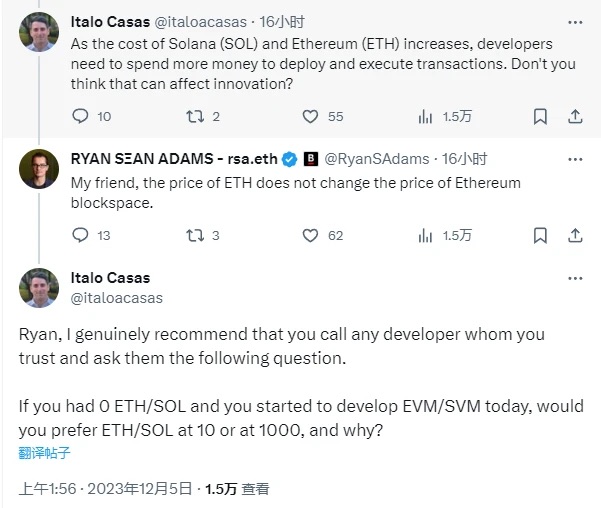
Topping the comment section was a question from Iron Forge Cloud CEO Italo Casas: “As the only profitable chain, Ethereum currently generates $2.7 billion in annual profit with a P/E ratio of 98—slightly higher than Amazon’s 75, but lower than Zoom’s 153. But what does that have to do with me as a developer?”
Ryan challenged Italo on why he would build on an expensive Layer 1, sparking a heated exchange over whether token cost impacts innovation.
Ryan argued that development can easily happen across various Layer 2s and stated, “ETH’s price doesn’t change the cost of Ethereum block space.” In response, Italo shot back: “You can go ask any developer which they’d prefer—$0 ETH/SOL or $1,000 ETH/SOL.”
Former Solana core developer @zen_llama offered his interpretation of Ryan’s argument: “Code on Ethereum (or more precisely, the functionality enabled by that code) is what makes its block space valuable. If deployment costs are higher, fewer applications will be deployed, reducing the value of that block space and widening the gap between price and intrinsic value. Personally, I disagree with Rollups as a scaling solution, but they make perfect sense as a value-capture mechanism for ETH assets—they bring revenue onto different networks. That’s why I believe Rollups are dangerous for ETH.”
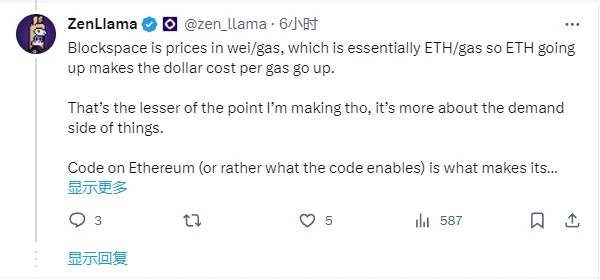
He also pointed out: “If it costs $20 to send $5, is building payment apps on Ethereum still attractive?”
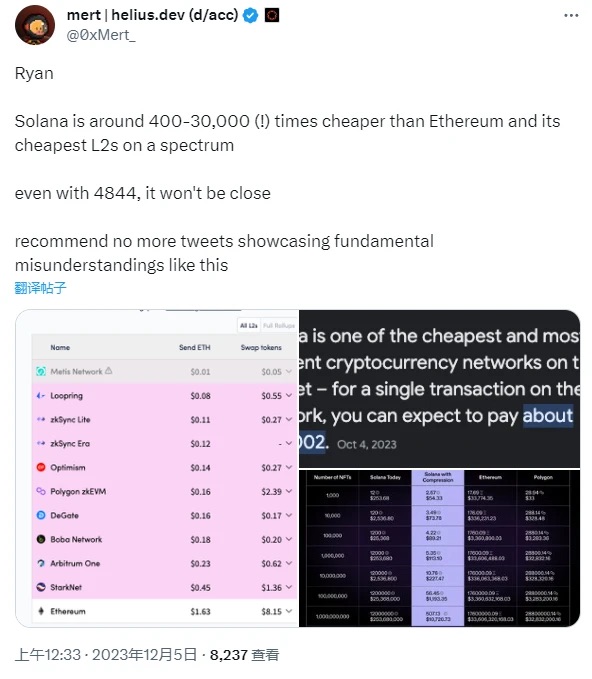
Former Coinbase engineer and Helius CEO @0xMert_ mocked: “Hey Ryan, Solana is 400–30,000x cheaper than Ethereum and its L2s. Suggest you avoid posting tweets fundamentally misunderstanding this next time.”
Supporters: Still Optimistic, Looking Ahead
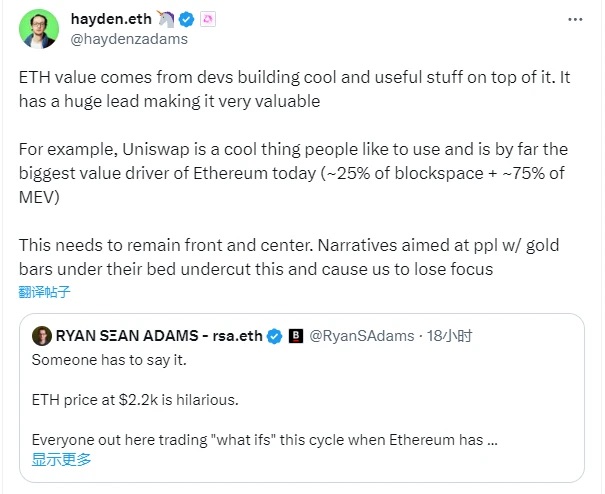
Uniswap founder Hayden Adams’ reply captures the sentiment of most Ryan supporters. He said ETH’s value comes from developers building cool and useful things on top of it. Its massive lead makes it highly valuable. Using Uniswap as an example, he noted: “Uniswap is a cool thing people love to use and has been Ethereum’s biggest value driver to date (~25% of block space + ~75% of MEV).”
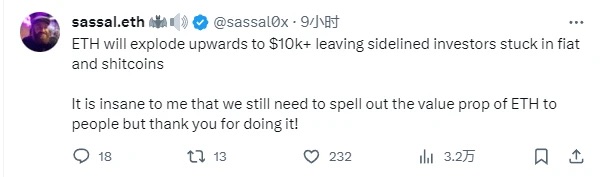
The Daily Gwei founder @sassal0x expressed great optimism: “ETH will surge past $10,000, leaving hesitant investors stuck in fiat and shitcoins. To me, we still need to better explain where ETH’s value backing lies. It’s insane—but thank you for doing this!”
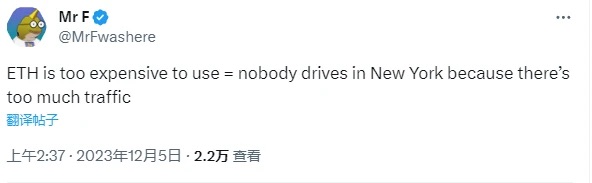
NFT developer @MrFwashere remarked: “Saying ETH is too expensive to use is as ridiculous as saying nobody drives in New York because traffic is too bad.”
User @YieldBouncer already popped the champagne: “Last time I remember Ryan writing something like this, ETH was at $400—and then the bull run started. Let’s go!”

Bitcoin Supporters Strike Back
Of course, Ryan’s comment section also featured pushback from diehard Bitcoin supporters. User @phyrooo commented: “Ethereum has now fully transitioned to PoS and no longer burns energy to produce block space... Well, looks like you don’t understand that burning energy is Bitcoin’s defense mechanism.”

User @danieleripoll countered Ryan’s point differently: “When BTC was $40K, ETH was $2,700. Now ETH is $2,200 while BTC is $41,500.”

Summary
In response to Ryan’s arguments, observers voiced diverse opinions, creating a lively discussion. Some support Ryan’s view, believing Ethereum’s fundamentals are indeed strong and its price isn’t excessive. They highlight Ethereum’s leadership in DeFi, NFTs, and blockchain applications, along with its growing developer community and ecosystem.
However, others remain skeptical. They express concerns about Ethereum’s scalability and transaction congestion, and worry rising prices could dampen developer innovation.
Regardless of stance, Ryan’s post has successfully drawn attention back to Ethereum. Whether Ethereum can continue leading innovation in this bull cycle and overcome its challenges as it has before? Only time will tell.
Join TechFlow official community to stay tuned
Telegram:https://t.me/TechFlowDaily
X (Twitter):https://x.com/TechFlowPost
X (Twitter) EN:https://x.com/BlockFlow_News
 Odaily






