









Eastern Solutions to the Cryptocurrency Regulation Puzzle: Binance, Geopolitical Compliance, and the World of Tomorrow
TechFlow Selected TechFlow Selected
Eastern Solutions to the Cryptocurrency Regulation Puzzle: Binance, Geopolitical Compliance, and the World of Tomorrow
In the blockchain space, compliance and censorship resistance are two important and challenging issues.
 Navigating Web3 tides with focused insights
Author: Uncommons
I. Regulatory Spotlight: The Policy Landscape Behind the Binance Case
1.1 Hidden Concerns Amid Heavy Penalties
In 2023, Binance and its founder Changpeng "CZ" Zhao seemed to spiral into an unavoidable vortex. A probe that began in 2018 reached a pivotal turning point this year.
At the beginning of the year, U.S. Congress turned its gaze toward the world's largest cryptocurrency exchange. Senators like Elizabeth Warren questioned not only Binance’s financial transparency but also deeper compliance issues. In March, the U.S. Commodity Futures Trading Commission (CFTC) filed a major lawsuit against Zhao and Binance over improper trading practices and market manipulation. Shortly after, the U.S. Securities and Exchange Commission (SEC) followed suit, filing 13 serious charges against Binance, including unregistered securities offerings and commingling of customer funds.
As investigations intensified, senior members of Binance.US began resigning—a sign of an approaching storm. By summer, Binance failed to obtain a license in the Netherlands, and France launched its own investigation. Binance’s image and reputation faced unprecedented challenges.
By autumn, the situation worsened. Binance was forced to halt new customer registrations in the UK, limiting its global reach and operations. In November, Zhao finally admitted guilt on U.S. anti-money laundering violations, agreeing to pay $4.3 billion in fines and asset forfeitures to settle long-standing probes by the U.S. Department of Justice and other federal agencies. He stepped down as CEO, succeeded by Richard Teng.
Perhaps this legal saga has temporarily concluded—but quiet concerns linger:
Who will be the next Binance?
1.2 The Cage and Mirror of Regulation
Hal Finney, an early Bitcoin contributor and cryptography pioneer, once said: “Bitcoin is the first uncensorable financial mechanism to appear in the world.” The revolutionary nature of cryptocurrencies in resisting censorship stands in stark contrast to the tensions seen in the Binance case—between compliance and the free flow of money.
Distrust of traditional finance following the 2008 global financial crisis fueled Bitcoin’s creation. As the first decentralized digital currency, Bitcoin was designed to provide a financial system outside central authority via blockchain technology. Ethereum’s launch in 2015 became another milestone, extending blockchain’s reach far beyond payments by enabling smart contracts and decentralized applications (DApps). New cryptocurrencies and technologies strengthened the sector’s resistance to censorship, offering users more options and making fund transfers and information exchanges harder for centralized institutions to control. Cryptocurrencies began gaining traction in cross-border payments and tax avoidance, drawing attention from global regulators.
As adoption grew, anti-money laundering (AML) and know-your-customer (KYC) requirements became regulatory focal points. For instance, the SEC and CFTC began scrutinizing crypto exchanges and ICOs to ensure compliance with existing financial laws. National approaches to crypto legislation have diverged significantly, increasing uncertainty and complexity in the market.
As the world’s largest economy, U.S. regulatory attitudes are seen as a bellwether for global trends. In the U.S., crypto regulation is managed at the federal level by multiple agencies: the SEC, CFTC, FTC, Treasury (via IRS), Office of the Comptroller of the Currency (OCC), and Financial Crimes Enforcement Network (FinCEN). Whether a crypto sale is regulated depends on whether it’s deemed a securities offering under federal or state law, or classified as money transmission under state rules—which would designate sellers as money services businesses (MSBs) federally. The CFTC also oversees market manipulation involving crypto assets categorized as commodities.
In emerging markets and developing countries across Asia, Africa, and Latin America, cryptocurrencies are viewed as catalysts for economic growth. In many parts of Africa and Asia, crypto offers a way to bypass traditional financial systems, enhancing financial inclusion. For example, numerous African nations use crypto for cross-border remittances to overcome weak banking infrastructure. Cryptocurrency is also seen as a tool for economic development and innovation, with young entrepreneurs in countries like Nigeria using it for international trade and investment. In nations such as Venezuela, crypto helps circumvent international sanctions and enables NGOs and dissidents to evade government financial controls.
In the distant East, China sees cryptocurrency as a challenge to state oversight. China has long maintained strict regulations. In 2017, it banned domestic initial coin offerings (ICOs) and shut down all crypto exchanges, citing financial risks and fraud prevention. This forced many China-based exchanges like Binance and Huobi to relocate overseas. China was once among the world’s top Bitcoin mining hubs, but due to environmental and energy concerns, it began cracking down on mining in 2021. This shifted the global mining landscape, pushing miners to regions like the U.S., Central Asia, and Eastern Europe.
Against the backdrop of global geopolitics, the Binance incident acts like a butterfly flapping its wings—the full ripple effects on the crypto world remain unclear. Within this transnational and multicultural narrative, the anti-censorship essence of cryptocurrencies stands under intense scrutiny. Each pulse sends subtle waves through political and economic currents. Resistance to censorship serves both as shield and sword—protecting individual privacy and freedom from central interference, yet raising concerns among regulators about financial stability. This dialectic between freedom and order, innovation and responsibility, acts like a mirror reflecting the deepest dilemmas and possibilities of the crypto era.
II. On-Chain Censorship: The Battleground of Technology and Politics
2.1 The Frontline of Regulation and Anti-Censorship
Unlike regulatory policies shaped by geopolitical, national economic, and civil society dynamics, “on-chain regulation” lies at the epicenter—the most direct zone where policy exerts influence and effect. It is also the core ground defended by open-source advocates and techno-idealists. There is no buffer zone on-chain.
What is on-chain censorship? In a Bankless podcast titled Ethereum Uncensored with Justin Drake, Justin Drake defined two types: weak censorship and strong censorship. Weak censorship occurs when some blocks choose not to include a transaction, allowing others to eventually include it—resulting in delays that degrade user experience. Strong censorship means a transaction is never included: the network is controlled by a majority that reviews every transaction, akin to a 51% attack. Following Drake’s definition, this article primarily discusses resistance to weak censorship.
Against this backdrop, on-chain regulatory history is one of balance and compromise. Consider direct examples: beyond centralized exchanges (CEXs), DeFi has long been a frontline for regulatory pressure (“When regulators come knocking, DeFi answers the door”). Uniswap’s response to regulatory scrutiny reflects typical community reactions within DeFi: on July 23, 2021, Uniswap announced delisting certain tokens, using cautious language—stressing these tokens represented only a small fraction of total volume; noting similar actions by other DeFi interfaces; and clarifying that front-end restrictions did not affect the underlying open-source code or alternative access points (e.g., local deployments).
Despite emphasizing these three points, Uniswap still faced community backlash. The most-liked reply under the tweet read: “This blog post does not adequately explain why these tokens were removed from the frontend. Regulation is mentioned, but knowing which regulations apply would help readers and the community. Many Synth tokens seem to have already been deleted (before the post went public).” (@LefterisJP)
This comment captures community concerns about Uniswap making such decisions without sufficient consultation with $UNI holders. It raised fears of setting a poor precedent for responding to SEC oversight. Crypto communities are highly sensitive to regulation, and frontends are the most vulnerable to regulatory compromise. Beyond Uniswap, Balancer once hid a $20 million liquidity pool; MetaMask and Infura have both blocked wallet addresses linked to Tornado Cash based on compliance directives.
2.2 Trust Equals Censorability
“Every trust vector is a censorship vector,” declared Vitalik at the censorship.wtf conference in Istanbul. His keynote, “Hardening Ethereum’s Ecosystem at Different Layers,” outlined potential “censorship attacks” across six layers: interface, centralized node providers, L2 sequencers, cross-L2 bridging, P2P, and social layers.
Following the chronological sequence of block and transaction generation, we can map out Ethereum’s exposure to regulatory censorship. First, users interact with wallets—this happens at the frontend. Next, transactions enter the mempool, where searchers scan for MEV opportunities. Then comes block construction: under the PBS framework, Builders package and order transactions; Proposers accept bids sight-unseen, sign, and finalize inclusion on-chain. At any stage, a point of regulatory capture may emerge.
2.3 Overview of On-Chain Censorship in Ethereum
The frontend—the most accessible and easily modified layer—has already seen cases like Uniswap and Balancer. Since frontends don’t directly alter contract interactions, solutions exist: decentralize the frontend; use aggregators like Zapper or 1inch; open-source frontend code (which Uniswap has done); host static content via IPFS, dynamic data via The Graph; adopt decentralized domain services (ENS instead of DNS).
Next comes the issue of centralized node providers like Infura. As one of the largest RPC providers, Infura serves as the primary gateway for most dApps to access real-time Ethereum data, reducing development costs and capturing over half the market share. In March 2022, Infura confirmed it restricted MetaMask access in Iran, North Korea, Cuba, Syria, Crimea, Donetsk, and Luhansk due to U.S. regulations. Competitors like Pocket Network and Ankr have clear roadmaps toward decentralization. Infura itself announced in September 2022 plans to release a decentralized version by the end of 2023. Given its critical role and single-point-of-failure risk, the potential impact of Infura being compromised is enormous. One solution is building light clients—essentially running a local Ethereum instance and querying full nodes directly. This bypasses Infura’s control, aligning better with blockchain’s non-custodial ethos. Promoting light clients remains a key goal for Ethereum’s long-term decentralization.
Then comes cloud hosting for nodes. According to Ethernodes.org, around 60% of Ethereum nodes run on cloud platforms like Amazon. German provider Hetzner posted in 2022 that it was “not suitable” for Ethereum node hosting, despite previously hosting nearly 15% of Ethereum nodes. While not outright banned, pressure from cloud providers looms. Theoretically, AWS, Hetzner, and Google Cloud could terminate services at will. However, node migration costs are low, preventing vendor lock-in. Post-Merge, setting up personal nodes has become easier via Raspberry Pi or plug-and-play solutions like Avado—making the process reversible.
On September 15, 2022, The Merge marked Ethereum’s transition from PoW to PoS. Miners became validators, ideally neutral participants securing the network. As of November 18, 2023, 55% of Ethereum’s one million staking validators belonged to just six entities: Lido, Coinbase, Kraken, Binance, Bitcoin Suisse, and Staked.us. Lido leads in share but operates only 29 nodes—far from the desired decentralization, sparking concerns over validator centralization.
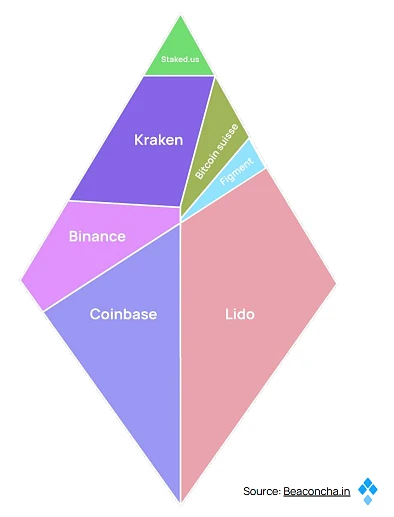
Image source: Alon Muroch’s presentation at censorship.wtf
In a discussion on preventing ETH2 validator failure, CarlBeek and adiasg introduced SSV (Secret Shared Validator), later evolving into DVT (Distributed Validator Technology)—a technical solution to validator centralization. The core idea: fragment private keys across multiple parties so a single node requires multi-party validation, reducing censorship risks from concentrated control. Today, the SSV Network, built on DVT, is becoming critical POS infrastructure. Lido conducted DVT tests starting in October 2022 and on November 15, 2023 passed a proposal to implement basic DVT modules, stating it “could significantly diversify Lido’s node operators and drive future innovation in Ethereum staking.”
After frontend, node services, and hosting, we arrive at the mempool—the heart of MEV-driven strategic games. Without mechanisms maintaining delicate balance, actors may abuse power and reap excessive profits, benefiting those with superior algorithms and centralized resources—an outcome undesirable for the ecosystem. The PBS (Proposer-Builder Separation) proposal emerged to address this, creating a dedicated Builder role by splitting responsibilities: ordering, bidding, and signing onto chain.
Due to PBS’s technical complexity, protocol-level implementation will take years. Until then, MEV-Boost—developed by Flashbots—provides a temporary yet effective fix by adding Relays. MEV-Boost allows Validators to extract high-value transactions efficiently through auctions, helping those lacking MEV extraction capabilities. It’s often credited with creating a fairer, more transparent profit landscape, reducing variance in captured MEV per validator. However, since the 2022 sanctions, many Ethereum relay blocks have complied with OFAC standards by censoring Tornado Cash transactions—most originating from Flashbots. Yet this isn’t irreversible strong censorship, but rather delayed “weak censorship,” where transactions likely still get included via non-censoring relays.
Even with PBS implemented, not all regulatory issues vanish. Other anti-censorship solutions are being explored, primarily aimed at limiting power during block production. One limits Builders’ authority: introducing censorship resistance lists (crlists), allowing Proposers to flag potentially censored transactions, and further, Forward Inclusion Lists, which require Builders to use available block space for specified transactions (not forcing direct inclusion, but mandating use of unused capacity when possible). This is known as “hybrid PBS.”
Another approach targets Proposers: MEV Smoothing. This ensures only the highest-bidding blocks are proposed. If a Proposer skips a profitable block, it likely indicates censorship rather than disinterest. MEV Smoothing “smooths” profits across all Proposers, eliminating incentives for censorship in a fully efficient market.
Other anti-censorship tactics in the MEV arena include encrypted mempools (encrypting transaction details and sender/receiver addresses before entering mempool, decrypting only on-chain) and appeals for altruism (self-building blocks instead of outsourcing). The former lacks mature solutions; the latter relies on ideology—how blockchain fundamentalism influences anti-censorship efforts. But Ethereum cannot thrive on ideology alone—it must persistently innovate at the mechanism level.
III. Censorship Beyond Ethereum: The Ever-Present Sword of Damocles
Looking beyond Ethereum, what challenges and answers arise regarding anti-censorship? Among competing blockchains, consider Bitcoin, with the longest anti-censorship legacy, and Solana, controversial in recent years.
On November 20, 2023, Bitcoin developer 0xB10C published a post titled Six OFAC-Sanctioned Transactions Missing: Are Asian Mining Pools the First to Yield to U.S. Sanctions?, reigniting debate over Bitcoin’s resistance to censorship. The post revealed that F2Pool, an Asia-based Bitcoin mining pool, filtered four U.S.-sanctioned transactions. F2Pool co-founder Chun responded on Twitter (later deleting it): “Why are you surprised I refuse to confirm transactions from criminals, dictators, and terrorists? I have the right to reject any transaction from Vladimir Putin and Xi Jinping, don’t I? Meanwhile, CZ sold his soul for money. He deserves it.” The statement referenced the recent Binance incident and revealed a strong pro-censorship stance.
F2Pool is currently the third-largest Bitcoin mining pool, responsible for about 14% of blocks mined in the past year, trailing Foundry USA (30%) and AntPool (22%). Mining pools represent collaborative hubs in the Bitcoin network, and their concentration—both in share and geographic distribution (see chart below)—reveals Bitcoin’s degree of centralization. High resource barriers and physical constraints make mining pools prone to monopolization and regulatory targeting.
Potential remedies include miners switching pools if one faces regulatory pressure, allowing uninterrupted mining elsewhere. Also, the decentralized mining pool protocol Stratum v2 aims to reduce centralization by letting miners select their own transaction sets (previously controlled by pools), enhancing decentralization.
Now consider Solana. From its debut as the “Ethereum killer” to later labels like “the outage chain” and “post-FTX recovery,” Solana emerged amid rising new blockchains but drew skepticism due to the FTX scandal and repeated downtime, fueling concerns over centralization and stability—and naturally, questions about censorship resistance.
Starting with the ever-present Sword of Damocles—validator centralization—we glimpse Solana’s operational reality. In October 2023, the Solana Foundation released a Validator Health Report. The chart below compares Solana with other chains in terms of validators, Nakamoto coefficient (a decentralization metric), and client diversity—where Solana leads in validator count and Nakamoto coefficient.
A risk lies in Solana’s requirement for high-performance hardware, prompting many individuals to rent third-party services—granting them significant node shares and potential attack vectors. For example, in November 2022, Hetzner blocked server access to Solana nodes. Solana responded by splitting data by autonomous system number (ASN) of major data centers and monitoring availability, encouraging users to stake across different centers to reduce single-entity control. Additionally, Solana validators are grouped, each with a leader determining transaction order, while group members vote on validity. Leaders rotate regularly, minimizing impact from any single malicious actor.
Despite these measures, the proportion of Solana staking nodes in the U.S. rose sharply from 23.5% to 29.2% between March and September 2023—showing decentralization remains a long journey.
IV. Crypto Anarchism: Tomorrow’s Third World
4.1 Ethereum’s “Exodus from America”
Geopolitics is the elephant in the room. From inception, cryptography has served as royal art, widely used in war intelligence. Blockchain, born from the anti-establishment hacker and internet open-source movements, stands as a banner against old-world hegemony and monopoly. Bitcoin originated in the “cypherpunk” movement—a late 1980s to early 1990s ideological and technical effort to use cryptography to protect privacy and personal freedom against state surveillance and corporate data collection. It was not merely a cryptographic breakthrough but a symbol of hacker and anarchist defiance. Participants remained largely anonymous, indifferent to identity, background, or geography—united by radical views on traditional political and economic systems.
Yet from its radical roots, blockchain has evolved—with talent infiltration and compliance pressures—into a tech sector dominated by Western entrepreneurs centered around the Ethereum ecosystem, reconciled with Silicon Valley capital, shedding its earlier rebellious edge, now focused on technological innovation. On one hand, industry maturation follows a natural arc from niche to mainstream. More projects now follow traditional VC funding models, fueling a vibrant startup scene. But since VCs concentrate in wealthier regions, resources increasingly flow to projects there. Internally, a split has emerged between “coin circles” and “chain circles.” Ethereum focuses on scalability and technical challenges, heavily investing in L2 and ZK technologies, attracting elite U.S.-based technologists, often PhDs or professors from top universities. Meanwhile, the more financially oriented DeFi space and altcoin markets cater to grassroots users seeking transformation.
“A so-called crypto elite,” said Vitalik Buterin in a recent interview with prominent African activist Magatte Wade, “is usually Americans with Chinese friends, or Chinese with American friends—rarely anyone with African friends.” This is an uncomfortable consensus people avoid discussing. Chinese players gained advantage in the Bitcoin and exchange era through financial intuition. The U.S. dominates the Ethereum era with top-tier technical talent shaping industry discourse. Blockchain, created to disrupt traditional paradigms, now shows signs of a Matthew effect—elite vs. grassroots. Thus, blockchain seems to follow the same rules as any other industry.
But we know this is not a shapeless industry—it has sharp edges. With global instability and power struggles intensifying, hidden currents stir beneath. Cryptocurrencies have become a third party in nation-state power plays, never truly absent. From its birth, Ethereum carried complex international ties: a North American leadership team, a founder with immigrant status, product developed in Europe, market expansion in Asia, facing U.S. scrutiny, supporting African communities. We revisit the past to foresee the future, peeling back layers to understand Ethereum’s current strategy of “entering Africa, Asia, and Latin America.”
4.2 Ethereum: Why Africa, Asia, and Latin America?
Ethereum was proposed by Vitalik Buterin, who in 2013 published a whitepaper describing a general-purpose blockchain platform capable of running smart contracts beyond simple transactions. Vitalik, a prodigy raised in Toronto and educated at the University of Waterloo, found support from professionals like Gavin Wood, a British computer scientist, and Joseph Lubin, an Ivy League graduate working in finance. The founding team consisted of eight white men, with core contributors primarily from Canada, the U.S., and the U.K. Aside from Vitalik, most were experienced, accomplished middle-aged professionals. In composition, Ethereum matched the archetype of First World elites.
Yet Vitalik was never just a Canadian child confined to developed-world perspectives. Born in 1994 in Kolomna, Russia, to Russian-Ukrainian computer scientist parents, he immigrated to Toronto at age six. His immigrant identity left deep marks. A math prodigy from youth, unlike geeks obsessed solely with technology, his life experiences gave him acute awareness of political economy. That’s why, after exploring various programming fields, he fell in love with Bitcoin in high school and made it his life’s mission: “I discovered Bitcoin halfway through high school. What fascinated me was how it combined all my interests: math, cryptography, computer science, open-source culture, and political economy.” Now a thought leader, Vitalik openly voices political opinions, using his influence to advocate for disadvantaged nations. After Russia invaded Ukraine in 2022, he condemned the aggression, supported Ukraine, and donated crypto to Ukrainian causes. On day one, he tweeted, “Ethereum is neutral, but I am not,” calling the invasion a crime against both Ukrainian and Russian peoples. When RT editor Margarita Simonyan claimed those ashamed of Russia’s actions aren’t truly Russian (“If you feel shame now because of Russia’s actions, don’t worry—you’re not Russian”), he replied, “Go f*ck yourself” (“иди на хуй”). Through “crypto philanthropy,” he supported initiatives like UkraineDAO. His father Dmitry, born in the USSR, publicly denounced Russian atrocities and signed UkraineDAO’s multisig wallet. As Ethereum’s spiritual leader, Vitalik embedded his beliefs in decentralization and anti-authoritarianism deeply into Ethereum’s technical architecture.
During Ethereum’s startup phase, the team lived as digital nomads. Vitalik insisted Ethereum should be a non-hierarchical, non-commercial nonprofit. They compared tax regimes and ultimately registered Ethereum as an NGO in Switzerland, renting a cabin nicknamed “Spaceship Earth,” where they lived together, coding day and night to define core products and team structure. Later, Gavin Wood’s C++ team worked from Berlin, Germany, while Jeff Wilcke’s Go team operated from Amsterdam, Netherlands—development remained European-centric. The first DevCon (developer conference) was held in Berlin, launching Ethereum’s global community summits. After successful crowdfunding and core development, Vitalik led efforts to build international communities. At the peak of Asian blockchain growth, markets like China, Singapore, South Korea, and Japan became key battlegrounds. Vitalik himself evolved, embracing commercialization. In October 2016, he registered a for-profit entity in Singapore, marking Ethereum’s new chapter. Looking back, Ethereum grew across Eurasia, deliberately avoiding establishing base in the U.S.
A major hurdle during Ethereum’s early days was the U.S. SEC. Just before their token sale, the SEC had ruled Erik Voorhees guilty of selling illegal securities—a warning shot. Their Swiss lawyers argued the decentralized nature of the fundraiser positioned ether as non-security, but the U.S. SEC remained a formidable threat. At a critical moment, legal advisor Steven Neraoff cleverly argued Ethereum functioned as a product, not a security, because users paid gas fees for computation. The strategy succeeded. Vitalik jubilantly wrote: “We didn’t give up on the U.S. market—great!” Ironically, years later, Neraoff himself released audio evidence accusing Ethereum of secretly colluding with the SEC to avoid compliance, muddying the narrative. Though incorporated in Europe and Asia, actively global, Ethereum is fundamentally not a U.S. company. Yet due to the U.S.’s notorious “long-arm jurisdiction”—where any business touching U.S. users falls under its reach—regulatory scrutiny is omnipresent. After FTX and Binance, it’s increasingly clear that this “world police” threatens the very foundation of the industry—U.S. regulation remains the Sword of Damocles over Ethereum. Any blockchain company risks U.S. capture—founders jailed, data and capital seized, decentralized networks reduced to U.S.-controlled consortia. Considering Ethereum’s origins, it carries North American thinking while fiercely adhering to anti-hegemonic ideals. In short, it understands U.S. strategies and thus maintains constant vigilance against censorship.
Therefore, Ethereum needs Africa, Asia, and Latin America—not just for real-world use cases, but to maintain geopolitical distance from the U.S. A true internationalist shouldn’t be captured by any single nation. Among blockchain projects, Ethereum sacrifices some performance to achieve highly decentralized validation nodes. Moreover, from its earliest days, it prioritized building a global Ethereum community. On its website, the events section boldly declares: “Every month, there are major Ethereum events around the world.” During college, Vitalik took a gap year to travel globally, visiting Bitcoin communities. He transformed this into Ethereum’s signature world-spanning community and monthly “sun never sets” summit model, widely emulated by later projects.
4.3 Africa, Asia, and Latin America: Why They Need Ethereum
As a tech ecosystem, Ethereum maintains political neutrality, but Vitalik personally holds stronger views. Since founding Ethereum, he has ceased settling in any city, migrating like a migratory bird across borders. In a September CNBC interview, he expressed growing caution: “Three years ago, I was eager to visit many countries. Now I’m more worried—even about places generally seen as stable.” As he matures and the industry evolves, Vitalik’s political instincts grow sharper.
For instance, Vitalik’s Zuzalu co-living experiment took place in Montenegro—a young nation independent for barely over a decade after breaking from Yugoslavia. Due to political instability and lack of monetary sovereignty (Montenegro uses the euro without EU membership), it seeks bold economic strategies. Local politicians contacted Vitalik, swiftly offering citizenship as goodwill, signaling deeper crypto policy ambitions. Vitalik reciprocated by hosting a two-month gathering of 200 people there. Judging from attendees’ responses during the opening session’s “Have you heard of Montenegro?” poll, most had never heard of the country before Zuzalu. Still, Vitalik passionately supported local crypto education, even organizing visits to the capital’s university to patiently teach students about the industry.
Also at Zuzalu, Vitalik showed enthusiastic support for African communities. He personally invited African leaders and attempted to resolve visa issues for African participants (which failed due to complexity, becoming his biggest stressor). As early as 2020, he voiced concern online: “Global inequality in travel accessibility remains severe. I look forward to the day Africans, Asians, and others can travel as freely as people from developed nations.” This February, he made high-profile visits to several African countries, physically supporting projects like Afropolitan and Borderless Africa that aim to unite African crypto consensus.
Using Montenegro and Africa as examples, we can analyze why these regions need Ethereum. Montenegro represents weaker states seeking leverage via crypto in geopolitical games. Similar nations include Latin American countries suffering hyperinflation under dollar hegemony—like Venezuela, which adopted Bitcoin as legal tender, or Honduras, creating crypto-friendly special economic zones. Others, like Japan, missed the web2.0 boom and seek to leapfrog in the web3/crypto era. Reuters reports Argentina’s inflation hit 124% this year. In its heated election, self-declared anarcho-capitalist Javier Milei won presidency. Grayscale stated his administration could pave the way for Bitcoin in Argentina, boosting optimism for crypto in this major South American nation. Here, politicians drive local crypto adoption, betting on future possibilities.
Africa represents another scenario. On its impoverished southern lands lie colonial legacies of dysfunctional governance and police brutality, with corruption rampant. Many depend on remittances from diaspora relatives abroad, where exchange rate gaps offer vital financial support. But backward financial systems and corrupt institutions push Africans toward decentralized payment methods—making crypto an ideal solution. In adoption rates, African nations rank high: according to Statista’s 2019–2023 data, Nigeria ranked first for multiple consecutive years. Contributing factors include rapidly depreciating local currencies and a young population (53.7% of Nigerians aged 15–65). Worried about capital flight, Nigeria’s central bank banned crypto in February 2021 and rushed to launch a central bank digital currency (CBDC) to replace cash. These moves sparked public outrage, triggering nationwide protests and unrest. Despite official bans, crypto use persists widely. Here, it is the people—not politicians—who drive adoption, driven by real survival needs for decentralized money.
V. Crypto’s Black Eyes: Dawn Breaks in the East
In blockchain, compliance and anti-censorship are two crucial and challenging themes. Gavin Wood, co-founder of Ethereum and founder of Polkadot, once said: “Blockchain technology offers immense potential in decentralization and transparency.”
Anti-censorship and decentralization form a foundational consensus—the top priority. They ensure all transactions are public and immutable—no one can alter or delete records. This transparency fosters an irreplaceable sense of “security” among users. In 2014, Google published the “BeyondCorp: A New Approach to Enterprise Security” whitepaper, detailing how it rebuilt its cybersecurity using the “Zero Trust” model—never assuming internal or external systems are trustworthy, always verifying identity and permissions. This project enhanced network transparency and gave users greater control over their data.
Openness, transparency, and absence of monopolistic authority are critically important in modern business.
With CZ stepping down and Binance undergoing leadership change, can users still feel “secure” in U.S.-regulated blockchain environments? When a state apparatus swings its arm, the once seemingly equal and solid barrier easily cracks.
Meanwhile, we observe Ethereum’s growing community strength in Africa, Asia, and Latin America, along with China’s unique position—hinting at new possibilities.
In Africa, Asia, and Latin America, complex geopolitical rivalries intertwine—among developing and underdeveloped nations, overlapping interests include political agendas, national economies, and people’s livelihoods. Former South African President Nelson Mandela emphasized education throughout his life—his famous quote, “Education is the most powerful weapon to change the world,” resonates widely. Blockchain, as a form of technological philosophy and social thought, functions as education—shaping individuals, then communities. In such complex environments, it could accelerate or even transform regional political-economic landscapes.
In China, despite cautious government attitudes toward Web3, the country’s massive internet user base, strong technical capabilities, and policy support in areas like Hong Kong offer vast imagination for uniquely Eastern Web3 development.
Amid seemingly endless regulatory webs, Africa, Asia, and Latin America remain relatively untouched lowlands. Under the dark sky of macroeconomic downturns, these regions are dim stars with latent thermal energy. Amid torrents of information, they’ve just begun carving nascent trails.
The broad path may not be bright; narrow trails might lead to hidden depths. New flames must find new frontiers. Time marches on. Crypto natives’ “black eyes” keep searching for the first glimmer of transparent dawn. Will the next dawn ignite in the East?
Join TechFlow official community to stay tuned
Telegram:https://t.me/TechFlowDaily
X (Twitter):https://x.com/TechFlowPost
X (Twitter) EN:https://x.com/BlockFlow_News
 @Un__commons











