Encrypted AI Agents: First-Class Citizens of the On-Chain Economy
TechFlow Selected TechFlow Selected
Encrypted AI Agents: First-Class Citizens of the On-Chain Economy
AI agents are emerging as an undeniable force in the crypto economy.
 Navigating Web3 tides with focused insights
Author: Mason Nystrom, Investment Partner at Variant Fund
Translation: Luffy, Foresight News
Robots are becoming first-class citizens in the crypto economy.
The trend is clear. Searchers deploy bots like Jaredfromsubway.eth to exploit human users' desire for convenience through frontrunning. Banana Gun and Maestro have consistently ranked among Ethereum's top gas consumers, enabling users to execute convenient trades via Telegram bots. Now, on social applications like Friend.tech, once an application gains initial traction with human users, bots quickly follow—unintentionally accelerating the speculative flywheel even further.
All of this indicates that bots—whether profit-driven (e.g., MEV bots) or consumer-driven (e.g., Telegram bots)—are increasingly becoming priority users on blockchains.
While bots in crypto have so far been relatively primitive, beyond crypto the rise of large language models (LLMs) has enabled bots to evolve into powerful AI agents whose ultimate goal is to autonomously handle complex tasks and make smarter decisions.
Building these AI agents within crypto offers several key enhancements:
Native payment flows: AI agents can exist outside of crypto, but if we want them to perform complex operations, they will need access to funds. Compared to granting AI agents access to bank accounts, payment processors (like Stripe), or dealing with the myriad inefficiencies present in the off-chain world, crypto’s ability to provide funding to AI agents represents a transformative improvement.
AI agent wallet ownership: AI agents connected to wallets can own assets (such as NFTs), granting them the same digital property rights inherent to all crypto assets. This is especially important for transactions between agents.
Verifiable, deterministic operations: AI agents operate most effectively when actions are provable (i.e., they can confirm that certain operations have been completed). On-chain transactions are inherently deterministic—either they happen or they don’t—meaning AI agents can complete on-chain tasks with greater accuracy.
Of course, on-chain AI agents also have limitations.
One limitation is that AI agents require off-chain logic to maintain high performance. This means on-chain AI agents will host their logic/computation off-chain to optimize efficiency, while agent decisions will be executed on-chain. Importantly, AI agents can also use zkML providers like Modulus to verify their off-chain data inputs.
Another major limitation of AI agents is that their usefulness depends entirely on the tools available to them. For example, if you ask an agent to summarize real-time news events, its toolkit must include a web crawler to scrape information from the internet to execute the task. If you need the agent to save responses as PDFs, it needs a file system in its toolkit. If you want the agent to copy-trade your favorite crypto Twitter KOL, it must have access to a wallet and signing permissions for that wallet’s private key.
Looking at the current landscape—from deterministic to non-deterministic—most crypto AI agents perform deterministic tasks. That is, humans program both the parameters of the task and how it should be completed (e.g., token swaps).
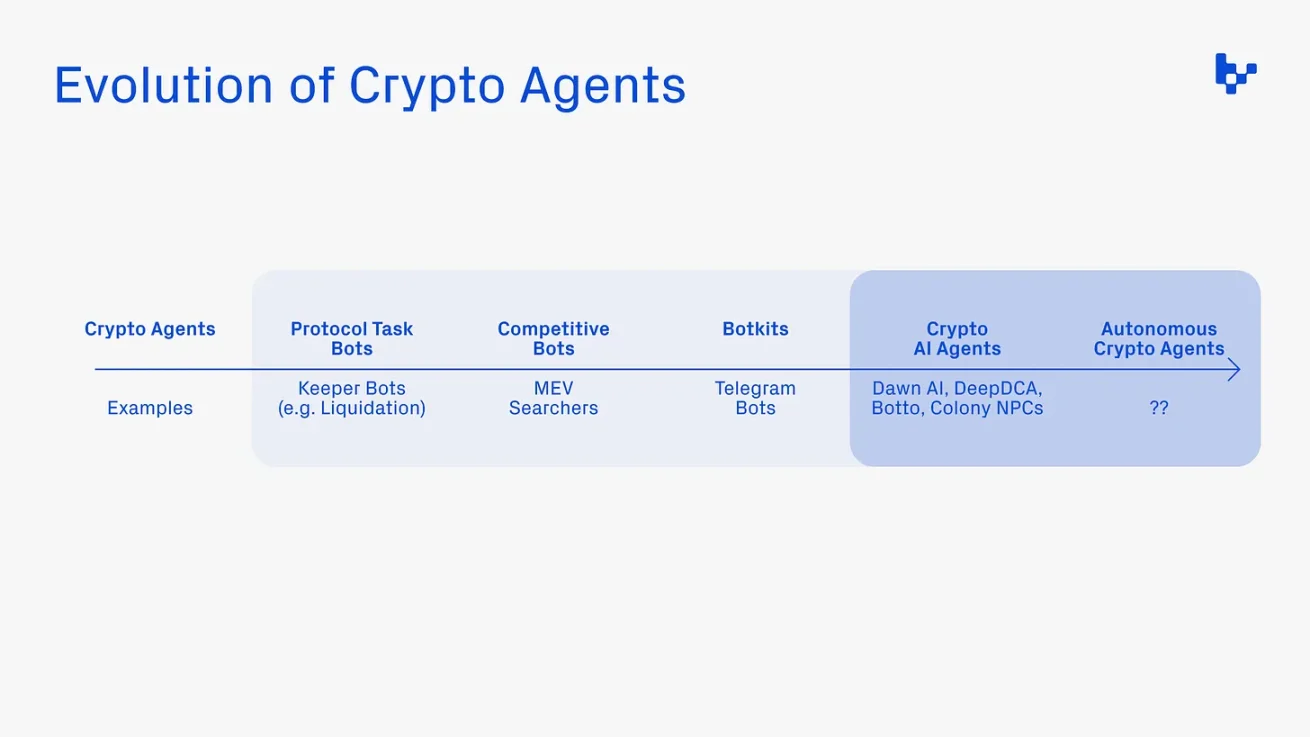
Crypto AI agents have evolved from early keeper bots—still used today in DeFi and oracle applications—to more sophisticated agents leveraging LLMs, such as Botto, an autonomous artist; AI agents using Syndicate’s Trading Cloud to self-bank; and early AI agent service markets like Autonolas.
A range of exciting frontier applications has already emerged:
AI-powered "smart wallets": Dawn leverages DawnAI to offer AI agents that help users send transactions, execute trades, and gain real-time on-chain insights.
Crypto gaming agents: Parallel Alpha’s latest game, Colony, aims to create AI characters that can own wallets and trade with each other.
Enhanced toolkits for AI agents: An AI agent’s capabilities depend on its toolkit, and interaction with blockchains is currently an emerging area. Crypto AI agents need wallets, fund access, permissioning features, integrated AI models, and the ability to interact with other agents. More specifically, Gnosis demonstrated an early infrastructure with its AI mechs, wrapping AI scripts in smart contracts so anyone—including other bots—can invoke the contract to execute agent actions (e.g., placing bets in prediction markets), while also enabling payments to the agent.
Advanced AI traders: DeFi superapps offering advanced trading functionality for traders and speculators, including: DCA position building when conditions are met; executing trades when gas prices drop below a threshold; monitoring new meme token contracts; optimizing order routing, and more.
The long tail of AI agents: While large applications like ChatGPT suit general conversational purposes, AI agents need specialization across numerous industries, topics, and niches. Bittensor incentivizes “miners” to train models for specific tasks (e.g., image generation, pre-training, predictive modeling) within targeted domains (e.g., cryptocurrency, biotechnology, academia). Though still in its infancy, developers are already using Bittensor to build long-tail applications atop open-source LLM foundations.
NPC consumer app agents: Non-player characters (NPCs) are common in MMORPGs but less so in multi-user consumer apps. However, the financialized nature of crypto consumer apps makes AI agents ideal participants for introducing novel gameplay mechanics. Open AI infrastructure company Ritual recently launched Frenrug, an LLM-based agent on Friend.tech that executes trades (buying or selling keys) based on user messages. Friend.tech users can try to persuade the agent to buy their key, sell someone else’s key, or spend funds in other ways.
As more applications and protocols incorporate AI agents, they will serve as gateways for humans to access the crypto economy. While AI agents may seem like toys today, in the future they will enhance everyday consumer experiences, become key stakeholders in protocols, and ultimately form entire crypto economies.
Join TechFlow official community to stay tuned
Telegram:https://t.me/TechFlowDaily
X (Twitter):https://x.com/TechFlowPost
X (Twitter) EN:https://x.com/BlockFlow_News
 @masonnystrom