MT Capital Research Report: On the Eve of Solana's Ecosystem Exploding
TechFlow Selected TechFlow Selected
MT Capital Research Report: On the Eve of Solana's Ecosystem Exploding
The Solana ecosystem has over one million users and more than 2,000 developers, continuously spawning new projects ranging from DeFi to NFTs.
 Navigating Web3 tides with focused insights
Authors: Xinwei, Ian Wu, MT Capital
TL;DR
-
The Solana ecosystem is on the verge of a full-scale breakout. Despite challenges like the FTX collapse, it has maintained strong growth. TVL has significantly increased, and DeFi Velocity shows exceptionally high liquidity utilization. Daily trading volume continues to rise steadily, far surpassing other blockchains.
-
The Solana Foundation is actively advancing: network stability and decentralization are progressing steadily, the Hyperdrive hackathon supports ecosystem projects, and strategic focus on the Asia-Pacific market is intensifying.
-
Ecosystem highlights abound: Visa launched USDC settlement on Solana, MakerDAO is considering integrating Solana SVM into its system, and Solana Pay has integrated with Shopify.
-
Diverse projects are flourishing across the ecosystem: the largest Solana airdrop season in history is about to begin, with standout projects emerging in DeFi, LSD, Meme, NFTs, inscriptions, and DePIN capturing market attention.
Introduction
After Ethereum’s transition from PoW to PoS, centralization issues have come under scrutiny. Competition among Layer 2 solutions is intensifying, further fragmenting liquidity, while innovation at the application layer remains limited.
In the Bitcoin ecosystem, BRC20 and various inscription protocols triggered community-wide FOMO, peaking when ORDI was listed on Binance. However, criticism over “no apps, just memes” has led to a gradual pullback.
Following the FTX bankruptcy, Solana’s SOL token plummeted to as low as $8, a decline exceeding 95%. Yet, despite this severe setback, the Solana ecosystem and community have continued healthy development over the past two years. The user base exceeds one million, developer count surpasses 2,000, and new projects continue to emerge across DeFi and NFTs. Jump Crypto’s second validator client for Solana, Firedancer, has officially launched on testnet.
As BTC prices rebound, SOL’s price surged more than 200% within two months. Currently, the Grayscale Solana Trust (GSOL) trades at a premium of approximately 800%, reflecting institutional investor confidence in Solana.
The breakout effect of Stepn during the last bull market remains fresh in memory. With negative catalysts now priced in, the next viral application on Solana is poised to ignite the market.
I. Overview
Since early 2023, Solana’s Total Value Locked (TVL) has shown significant growth, reaching $650M—an increase of over 200%.
Ian Wu stated: “With the recent launch of new assets on the platform, SOL plays a central role. SOL serves not only as the staking token within the entire ecosystem but also as margin and underlying asset in transactions, making it the key native crypto asset underpinning the entire platform.”
Moreover, as SOL is used to purchase NFTs and participate in on-chain activities—being locked up in the process—significant amounts of SOL are being removed from circulation. This locking effect on SOL is expected to drive price appreciation, creating a positive growth spiral. As new assets are issued and listed on Solana, the amount of SOL locked will gradually increase. This will not only dilute previous profit-taking pressure but also incentivize more holders to stake their SOL due to the positive impact of new assets. Therefore, in the future, the number of SOL staked through Solana nodes and the total market value of TVL will become critical metrics closely watched by analysts and investors for SOL valuation.

https://defillama.com/chain/Solana
DeFi Velocity (TVL Utilization):
-
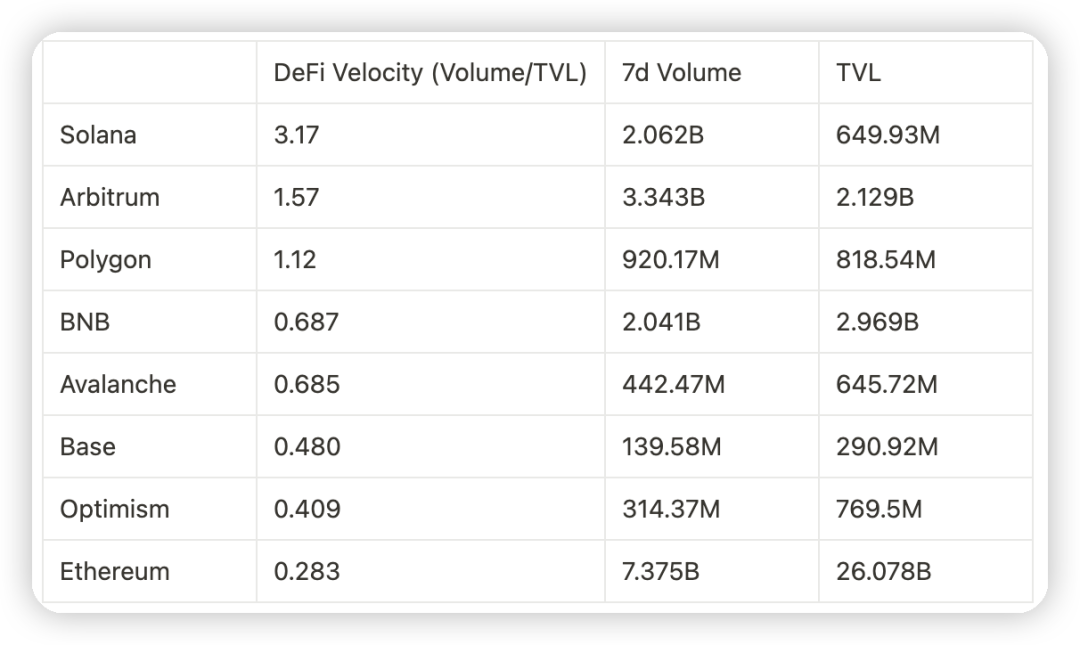
DeFi Velocity, defined as trading volume divided by TVL, is a key metric for measuring blockchain activity and adoption—more insightful than TVL alone.
-
Over the past week, Solana’s 7-day DeFi Velocity ratio reached 3.17. This means each dollar of liquidity generated approximately $3.17 in weekly trading volume. Compared to Arbitrum, Binance, Base, Optimism, and Ethereum, Solana demonstrated the highest TVL utilization over the past seven days.
Daily Trading Volume:
-
From 2023 to date, Solana’s daily trading volume has shown a stable trend, particularly with an increase in vote transactions.
-
Transactions are mainly categorized into voting and non-voting types, with voting transactions primarily involving validators’ voting accounts.
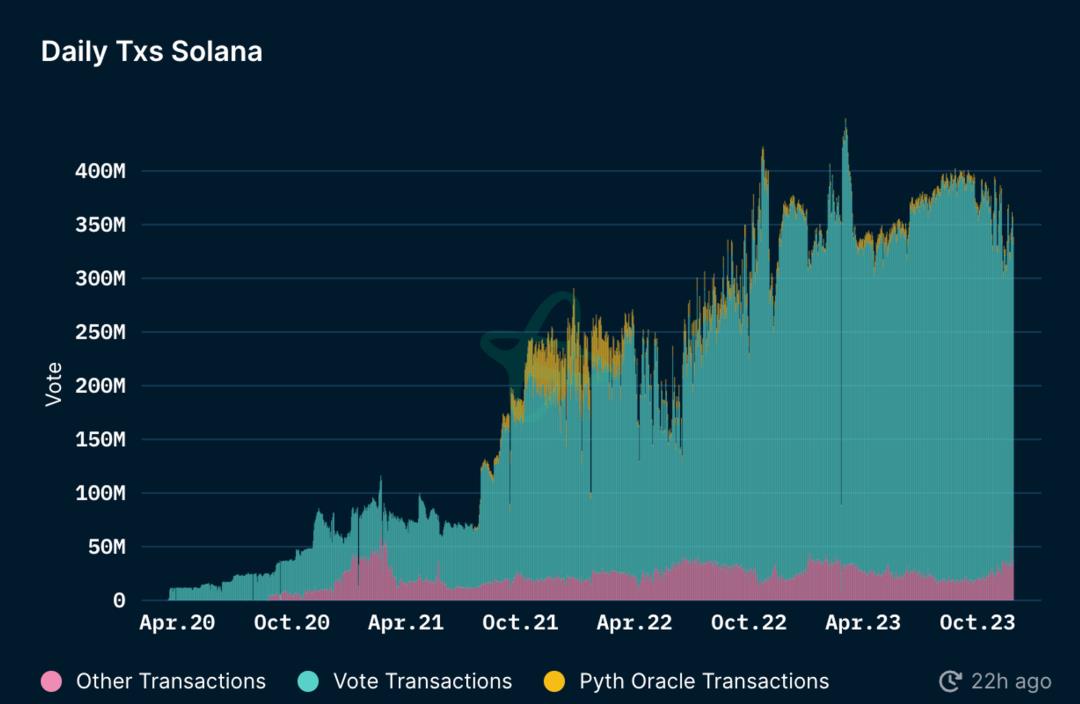
Comparison of average daily trading volume over the past six months across ecosystems

Despite challenges such as network outages and the FTX/Alameda collapse, Solana has remained operational, demonstrating its ability to improve and adapt.
Solana’s growing TVL, robust DeFi development, and stable transaction data collectively indicate its potential to become a vibrant hub for economic activity.
Ecosystem Highlights:
-
In September 2023, Visa chose Solana to launch USDC settlement functionality, marking a significant milestone for payment infrastructure and broader applications between public blockchains and financial institutions.
-
Also in September, MakerDAO’s founder considered incorporating Solana SVM into Maker’s new native chains as part of its “Endgame” upgrade plan, expected to span 2–3 years across five phases.
-
In August 2023, Solana Pay integrated with Shopify.
Foundation
Leadership Changes
On April 19, 2022, the Solana Foundation announced leadership changes to its five-member council. First, Anatoly Yakovenko, co-founder of Solana Labs, stepped down as Chair of the Solana Foundation Council effective December 2021 to focus on launching new applications at Solana Labs. Second, to ensure high-quality leadership continuity and usher in the next chapter for the Foundation, Leopold Schabel was appointed to the council. Schabel is a leader at Jump Crypto and co-founder of Certus One, a blockchain advisory firm providing validation services for the Solana ecosystem and other proof-of-stake networks.
New Financial Strategy
The Solana Foundation announced a new funding strategy including convertible grants and investments. These flexible funding options aim to meet the diverse needs of projects within the Solana ecosystem—from early-stage development to established ventures seeking financial support. The Foundation’s convertible grant program provides financial assistance to early-stage projects focused on development, research, and innovation. Grants will be distributed to projects with the potential to make significant impacts on the Solana ecosystem. For mature projects or startups that have demonstrated a path to success, the Solana Foundation offers investment support to scale operations and bring innovations to market.
Retrospective Public Goods Funding (RPGF) Program
The Solana Foundation and OpenBlock Labs innovatively introduced a retroactive funding model to support public goods and open-source projects within the Solana ecosystem. RPGF aims to provide sustainable income for creators behind widely-used public resources. Unlike traditional forward-looking grants, RPGF rewards past contributions that benefit the broader ecosystem. The first round of RPGF received an enthusiastic response, attracting over 100 project applications, with about 36 receiving funding. This process not only rewarded past efforts but also set a precedent for community-led support of public goods.
Hackathons
The Solana Foundation recently hosted its eighth hackathon, “Solana Hyperdrive,” an online competition focused on attracting high-impact projects to the Solana ecosystem. The event brought together founders and developers worldwide, with over 7,000 participants submitting 907 projects—the largest scale in Solana hackathon history. Covering areas such as infrastructure, mobile consumer apps, payments, DAOs, and AI, the event received support from major companies including AWS, Ironforge, UXD, and Magic Eden. Dan Albert, Executive Director of the Solana Foundation, stated that nearly 1,000 teams formed during these events will play crucial roles across AI, finance and payments, physical infrastructure networks, gaming and entertainment, mobile consumer apps, crypto infrastructure, DAOs, and network states, shaping future trends.
Future Plans
Technically, the Solana Foundation is focusing on several key innovations expected to yield results by year-end or early next year.
1. FireDancer Mainnet Launch: FireDancer is an independent Solana validator designed to enhance network robustness and performance. During internal testing, it achieved speeds of up to 1 million TPS, though real-world operation may reach around 100,000 TPS—still sufficient for high-frequency trading applications. Its goal is to maintain an independent tech stack, diversify the blockchain’s supply chain, and reduce exposure to single points of failure. FireDancer employs a defense-in-depth strategy, isolating components into separate processes and enforcing strict communication protocols to minimize vulnerability impacts. The development team integrates rigorous security practices throughout its lifecycle, using continuous collaboration between security and engineering teams, fuzz testing, and code reviews to identify and mitigate vulnerabilities. The objective is to launch FireDancer on the Solana mainnet and upgrade security measures, including external audits and bug bounty programs.
2. Asynchronous Execution / Leaderless Banking: In Solana’s leaderless banking model, leaders perform minimal work necessary to produce valid blocks. This design reduces memory operations required before bank execution by threefold. Leaders are responsible for verifying transaction signatures, ensuring fee accounts have sufficient balances, and managing balance caches.
3. Quorum Subcommittee: Solana’s quorum structure is vital to its security and performance. The network uses quadratic message overhead to ensure classical Byzantine fault-tolerant consensus. Solana’s design enables high throughput and low fees while maintaining strong security. The size of the quorum and how votes are implemented are key aspects of Solana’s architecture, balancing security and performance.
4. Dynamic Storage Pricing and State Compression: Solana introduced a state compression solution that drastically lowers on-chain storage costs. This technology relies on Merkle trees to compress verifiability of data trees into a single hash. This compression-friendly structure allows developers to store small amounts of data on-chain and update them directly within the Solana ledger, significantly reducing data storage costs while preserving Solana’s foundational security and decentralization.
5. Dynamic Base Fees: On Solana, transaction fees currently do not depend on resources consumed. Instead, fees are determined by the number of signatures requiring verification. Rates (e.g., lamports per signature) may vary from block to block. However, transaction fees can still be deterministically calculated before signing.
Strategic Focus
Currently, the Solana Foundation is prioritizing strengthening and expanding its presence in the Asia-Pacific region. Especially after last year’s FTX incident, the Foundation decided to increase investment in Chinese-speaking regions and the broader APAC market. Recognizing the importance of APAC in both labor (developer) and capital markets, the Foundation is working toward more balanced and comprehensive regional development.
The Solana Breakpoint event is scheduled for September 19–21, 2024, in Singapore. Choosing Singapore underscores the strategic significance of the Asia-Pacific region for Solana.
Additionally, the Foundation is expanding its footprint in India, Europe (especially Germany and the UK).
II. Recent Hot Projects
Mad Lads & Backpack
Mad Lads is an NFT project created by Coral, the company behind the Solana framework, launched by Armani Ferrante and Tristan Yver. This project marks a major innovation by Coral in blockchain technology and NFTs. Mad Lads were exclusively minted initially through Backpack, Coral’s all-in-one wallet application. This choice not only demonstrates Coral’s confidence in its own product but also highlights Backpack’s advanced technology and market potential.
Backpack’s defining feature is its foundation on “executable NFTs” (xNFTs). These xNFTs are essentially non-fungible tokens embedded with executable scripts—effectively operable Web3 application platforms. This technological innovation transforms Mad Lads from mere digital collectibles into platforms capable of running code and enabling complex interactions, greatly enhancing NFT functionality and appeal. The xNFT series opens entirely new avenues for software distribution. Game developers can mint entire games as limited-edition xNFTs. A DeFi protocol could distribute early access to a new frontend based on wallet addresses. A two-factor authentication token could be generated as an NFT and automatically rotated. As explained on Solana’s website, these represent possibilities available to xNFT users, adding that artists can create beautiful, immersive 3D experiences that cannot be copied and run directly within wallets. The possibilities are nearly endless.
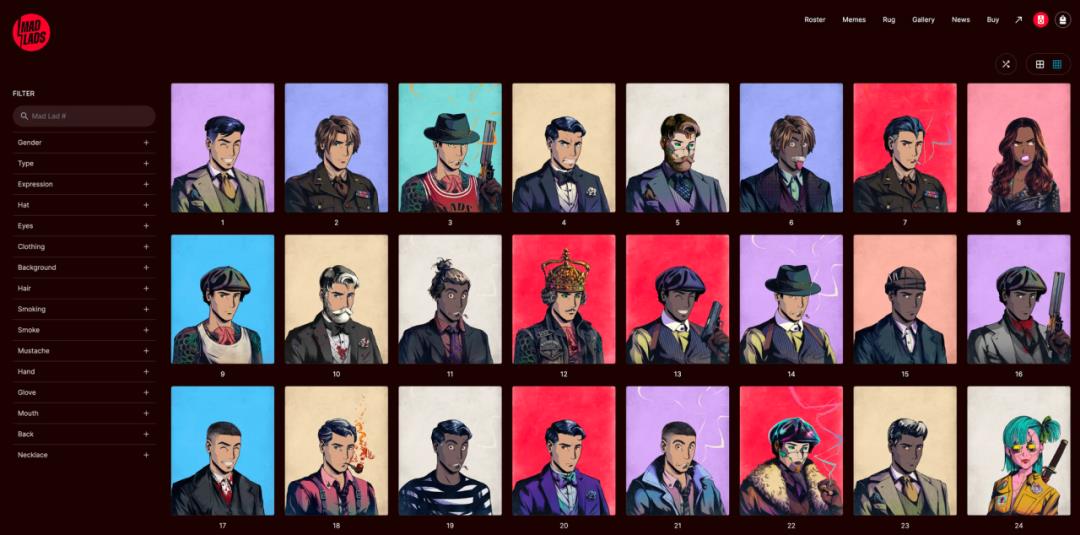
Mad Lads’ success stems from several key factors. First, its innovative xNFT concept injected new energy into the NFT market. These new NFTs aren’t just digital assets—they can execute built-in code, offering users greater interactivity and utility. Second, Mad Lads performed exceptionally well in the market. It achieved over $8.16 million in sales within 24 hours, outperforming the Bored Ape Yacht Club during the same period. This remarkable sales performance largely resulted from its uniqueness and high market expectations. Additionally, Mad Lads’ floor price surged 200% within two weeks, reaching 160 SOL, making it one of the most valuable NFT collections on Solana and earning widespread market recognition.
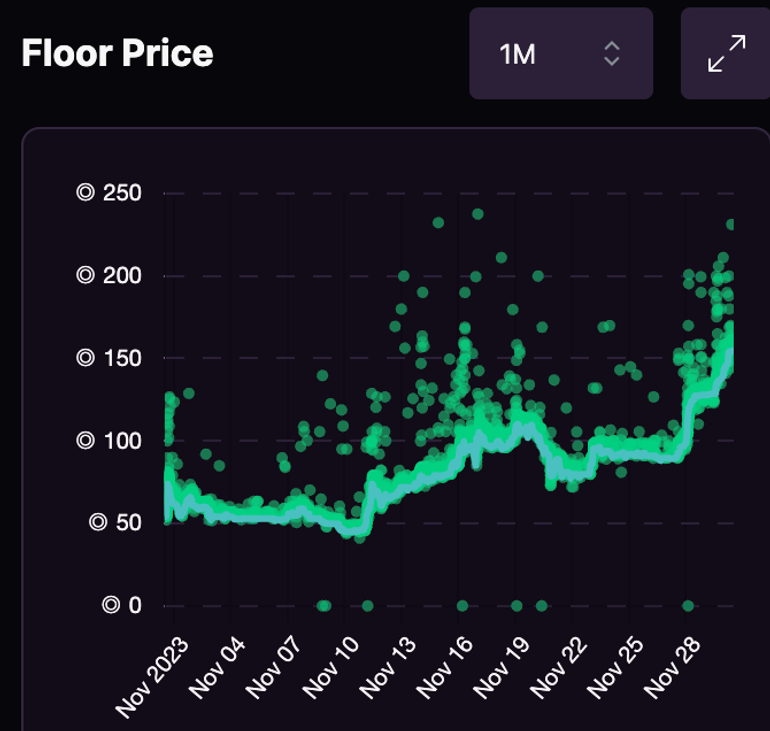
In terms of technical and market strategy, the Backpack team also demonstrated creativity and resilience. During Mad Lads’ re-minting phase, the team created two minting portals to effectively distinguish real users from bots, preventing bot manipulation. This strategy not only prevented malicious behavior but also sparked broad interest and discussion among legitimate users, boosting community engagement.
After Solana lost prominent NFT projects DeGods and y00ts—both migrated to Ethereum and Polygon respectively—a void emerged in the community. Mad Lads launched shortly after these departures, positioning itself perfectly for success. We believe Mad Lads has the potential to become Solana’s equivalent of BAYC.
Nonetheless, following FTX’s collapse, the entire Solana ecosystem faced severe challenges, with part of Backpack’s funds trapped within FTX. Under these circumstances, the Backpack team not only sustained operations but also began exploring new directions. Mad Lads’ success is seen as a rebirth for the Solana community, helping to heal damage caused by FTX associations and related narratives. Backpack is currently in public beta, with long-term goals of opening the platform to the community, allowing anyone to build upon it.
In September 2022, Coral raised $20 million in funding led by FTX Ventures and Jump Crypto, with strategic participation from Multicoin Capital and others.
In October 2023, Backpack announced plans to launch a “regulated” exchange named Backpack Exchange, showcasing the team’s ongoing commitment to innovation and market adaptation.
Mad Lads and Backpack tell a story of innovation, market adaptability, and seizing opportunities amid adversity. This case fully exemplifies the resilience and innovative capacity of the Solana ecosystem.
Jupiter
Jupiter is the largest aggregator DEX on Solana. Since its founding in 2021, it has become a key protocol within the Solana ecosystem. As Solana’s first trade aggregator, Jupiter aims to provide users with the best exchange rates by integrating all major liquidity markets on the blockchain. To enhance user experience, Jupiter continuously optimizes and updates its platform, integrating more mainstream Solana DEXs such as Orca, Raydium, and Serum.
Jupiter has also made extensive improvements to user experience. Beyond integrating major liquidity pools, it offers real-time exchange rate updates and direct links to integrated DEX project websites. For example, when swapping SOL for USDC, Jupiter matches multiple trading routes and selects the optimal path and price, saving users time and fees. Additionally, every transaction detail is transparent—including speed, price impact, and minimum amount users will receive—helping users with financial planning.
In terms of fundraising and token plans, Jupiter has made significant progress. It is preparing to launch its native token JUP and announced at the Solana Breakpoint conference that 40% of JUP tokens will be distributed via airdrop to the Jupiter Exchange community, with approximately 955,000 users qualifying. Another 20% will be distributed through token sales, with the remaining 40% reserved for insiders and strategic reserves. As a community-centric initiative, Jupiter announced a retroactive token airdrop plan distributing 400 million of its 1 billion JUP tokens (40%).
Pyth Network
Pyth Network is hailed as a game-changer in the DeFi oracle space, aggregating and distributing price data to smart contract applications by leveraging top-tier exchanges, market makers, and financial service providers. As an innovative decentralized oracle, Pyth pulls financial market data from over 90 sources—including major exchanges and market makers like CBOE, Binance, OKX, and Bybit—and distributes it across more than 40 blockchains.
Pyth consists of three core components: data providers (primarily exchanges), the Pyth protocol (which aggregates data from different providers to create unified prices and confidence intervals every 400ms), and data consumers (end-users such as applications on Pyth-supported blockchains that read aggregated price feeds and seamlessly integrate data into their smart contract logic).
Pyth Network raised funds through three rounds, with the latest completed on January 7, 2022. The token debuted with a $468 million market cap, with 90,000 wallets receiving airdrops. PYTH initially traded around $0.32, with a circulating supply of 1.5 billion tokens and the remaining 85% of total supply locked for 6 to 42 months.
Additionally, Pyth Network supports over 230 applications, including DEXs, lending protocols, and derivatives platforms. Its infrastructure enables over 65 million updates per day, enhancing the precision and security of smart contract operations.
Jito
Jito launched a referral program at the end of August and introduced a points system in mid-September. Similar to Blaze, Jito boosts user attraction by rewarding JitoSOL holders and increasing their DeFi points. Jito’s SOL locked value grew 320% year-over-quarter, reaching 6.67 million SOL. By quarter-end, about 35% of JitoSOL was locked in the protocol, up from just 13% at the start of the quarter.
What sets Jito apart is that users can earn MEV rewards. Jito’s staking pool delegates users’ SOL to validators supporting MEV, distributing MEV rewards as additional APY to stakers. Anatoly Yakovenko, CEO of Solana Labs, has also given Jito positive recognition.
Jito Labs has raised $12 million across two funding rounds. The latest round occurred on August 11, 2022, as a Series A led by Multicoin Capital and Framework Ventures.
As of November 30, 2023, Jito reached a new TVL high of $400M, with 6.67M SOL staked—a consistent upward trend since launch. Jito is the first staking product on Solana to include MEV rewards.
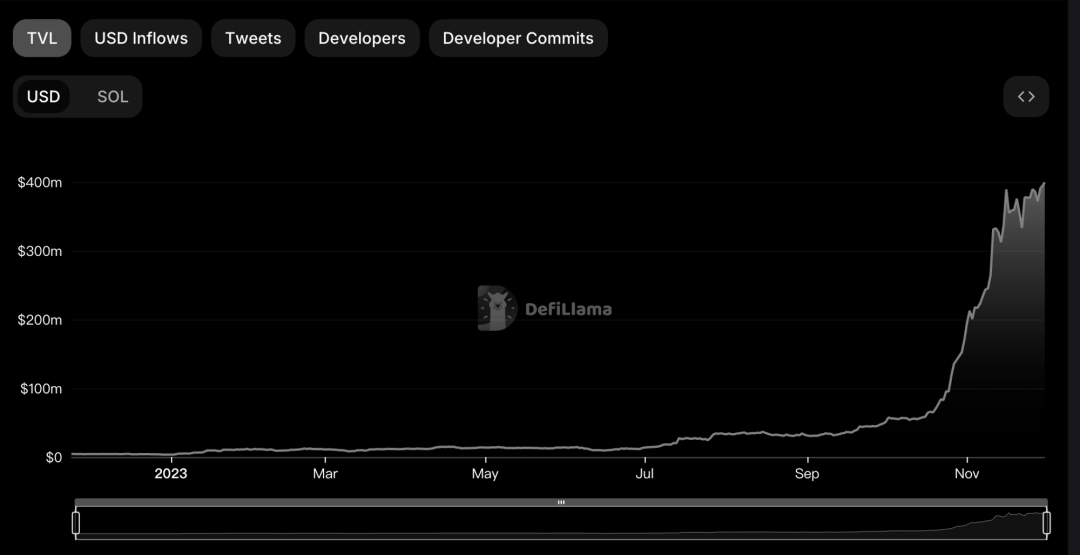
On November 28, the Jito Foundation announced the upcoming launch of the JTO governance token, a significant step forward for the Jito network.
In governance, JTO will empower token holders to make key decisions shaping Jito’s future, ensuring it evolves according to user needs and the broader Solana ecosystem. These decisions may include:
-
Setting fees for the JitoSOL staking pool
-
Updating delegation strategies by controlling parameters of StakeNet projects
-
Managing fees generated from JTO and JitoSOL held by the DAO
-
Contributing to the ongoing development and improvement of Jito protocols and products
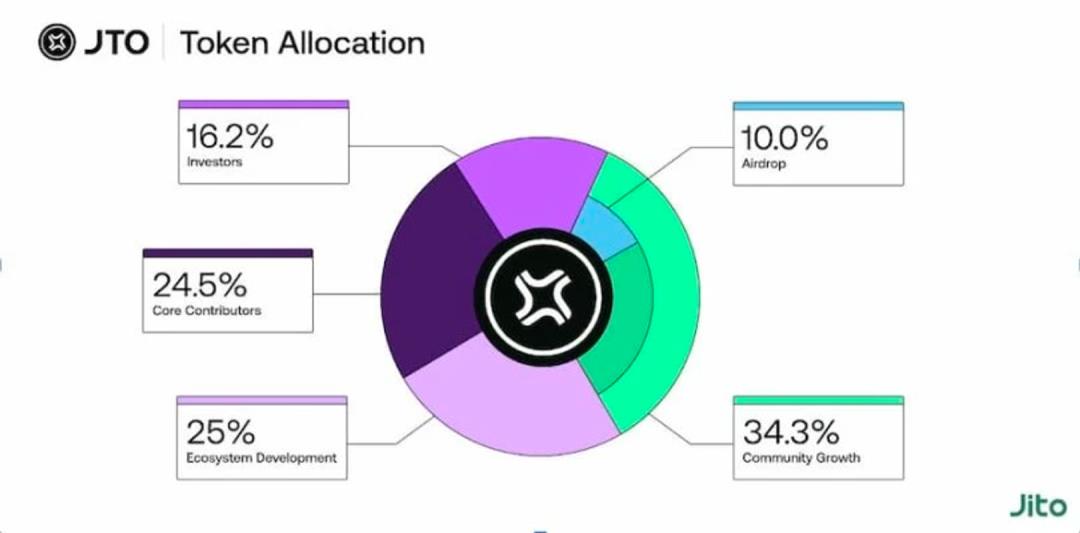
Regarding tokenomics, JTO has a total supply of 1 billion tokens: 10% for airdrops, 24.3% directly controlled by token holders via DAO governance on Realms, 25% for ecosystem development, 16.2% allocated to investors (fully locked for 1 year, fully unlocked over 3 years), and 24.5% to core contributors—founders and early ecosystem contributors (fully locked for 1 year, fully unlocked over 3 years).
The airdrop totals 10%, or 100 million JTO tokens. Of this, 90 million JTO tokens will be immediately distributed by the Foundation, with the remaining 10 million unlocking over the next year—all sourced from the 342.857 million tokens allocated to community growth.
Airdrop eligibility is determined by users’ contributions to Jito network growth, including long-term JitoSOL holders, users employing JitoSOL across various DeFi protocols, Solana validators running Jito-Solana MEV clients, and searchers actively utilizing Jito’s MEV products.
This airdrop is based on past behavior, with snapshot data taken on November 25, 2023. As part of this airdrop, the previously announced points program has concluded and points will no longer be updated.
BONK
BONK, the first meme token in Solana’s ecosystem, has recently gained notable market traction. It initially drew attention through a large-scale Christmas 2022 airdrop to the Solana community. The token was created to oppose the “Alameda-style” tokenomics post-FTX collapse and to restore confidence in the Solana ecosystem and SOL holders. Now approaching its one-year anniversary, BONK has regained momentum, sparking comparisons with SHIB and speculation about potential listings on major exchanges.
On November 22, Binance launched 1–50x USD-margined perpetual contracts for BONK, signaling strong support for this meme coin. Built on the Solana chain, BONK resembles the well-known Shib and targets mass adoption as a new meme coin. Half of the project’s total token supply was airdropped to Solana degens and DeFi traders, NFT artists, and developers—a broad distribution that injected significant liquidity into the Solana ecosystem.
The BONK team began planning the project on December 9, 2022, actively encouraging interaction with other projects in the Solana ecosystem. Ahead of Christmas, they executed a massive airdrop across the Solana community. As its anniversary approaches and Solana rebounds, BONK and related ecosystem tokens have experienced valuation recovery. Although BONK surged over 12x in the past month, its meme coin market cap is already relatively high.
Orca
Orca is a key decentralized exchange (DEX) in the Solana ecosystem, recognized for its user-friendly interface and efficient trading experience. As the only DEX on Solana with pure Automated Market Maker (AMM) functionality and its own liquidity pools, Orca offers simple and composable trading—making it an ideal candidate for next-generation DeFi applications.
Described as the most user-friendly DEX on Solana, Orca combines pure AMM functionality with an intuitive trading interface, enabling users to efficiently swap assets, provide liquidity, and earn returns. Orca emphasizes delivering the best swap experience—minimal fees, low latency, and fair pricing.
In terms of technical innovation, Orca continues advancing along its roadmap. For instance, Orca began testing Whirlpools—an active AMM with concentrated liquidity similar to Uniswap V3—which officially launched on April 25, 2021, marking a key step in improving capital efficiency.
Additionally, Orca raised $18 million in its Series A round led by Polychain, Placeholder, and Three Arrows Capital. Sino Global, Collab+Currency, Coinbase Ventures, and Solana Capital also participated. These funds strengthened Orca as a capital-efficient and user-friendly DEX, helping it further develop its platform and remain competitive and innovative in the fast-evolving DeFi landscape.
Regarding token valuation, ORCA’s current price is $3.27, with a market cap of approximately $143.8 million, a fully diluted valuation of around $326.8 million, a TVL of $85.12 million, and a circulating supply of about 43.99 million ORCA tokens. Orca stands as a key player in the Solana ecosystem due to its technical sophistication, focus on user experience, and strong financial backing.
Drift Protocol
As a derivatives exchange on Solana, Drift Protocol has surpassed $1 billion in total trading volume. Its TVL grew to $17.3 million by quarter-end, representing an 87% year-over-year increase and a 976% increase year-to-date.
Drift Protocol has emerged as a disruptor in Solana’s decentralized derivatives market. Drift chose Solana for its low-latency block times and high bandwidth, enabling minimal fees and rapid settlements. In November 2021, Drift launched Version 1, introducing the Dynamic Automated Market Maker (DAMM) concept, which provided guaranteed liquidity and superior trading experience, achieving nearly $1 billion in volume within six months. V1 introduced limit orders and maker orders, allowing users to act as market makers. In December 2022, Drift launched V2, enhancing liquidity through a “three-in-one liquidity” model, becoming a full-service decentralized exchange. V2 introduced robust security measures and achieved success with over $100 million in trading volume and a $10 million TVL. As of September 2023, Drift had accumulated $1 billion in trading volume and a TVL of $19 million. Drift integrates Pyth price feed oracles, offering diverse markets such as SOL, BTC, and ETH, ensuring high data quality and low-latency user experience. Pyth’s confidence interval feature also helps Drift detect market volatility and unusual price distributions promptly, protecting users and funds.
On October 26, 2021, Drift raised $3.8 million in seed funding from Multicoin Capital, Jump Capital, Not3Lau Capital, and others.
Zeta Markets
Zeta Markets is a comprehensive cross-margin derivatives protocol built on the Solana blockchain. It specializes in multiple trading options, including options trading, futures, and perpetual futures starting November 4, 2022—all integrated into a single platform.
As a low-collateral derivatives platform, Zeta Markets features a fully on-chain risk engine and a Central Limit Order Book (CLOB), making it a user-friendly platform offering all necessary tools for traders interested in leveraged trading within a decentralized environment.
On October 27, Zeta Markets announced the launch of Z-Score—the first step toward a token launch—allowing users to earn Z-Score based on their trading activity on Zeta, with one point earned per dollar traded. Additionally, a 24-hour PnL leaderboard determines reward multipliers. The first season of Z-Score will run until December 20.
Zeta Markets announced in December 2021 that it had completed an $8.5 million funding round led by Jump Capital, with participation from Race Capital, Electric Capital, DACM, Airtree Ventures, Amber Group, Wintermute, Sino Global Capital, Genesis Block Ventures, QCP Capital, Alameda Research, Solana Capital, MGNR, 3kVC, Orthogonal Trading, LedgerPrime, and SkyVision Capital.
Hivemapper
Hivemapper is a blockchain-based mapping network that launched its global network in 2022, collecting and creating map coverage via specialized dashcams, storing data on a Solana-based blockchain. Drivers can now use Hivemapper dashcams to contribute street-level images and expand decentralized maps of locations they visit, earning the company’s cryptocurrency HONEY as rewards.
Join TechFlow official community to stay tuned
Telegram:https://t.me/TechFlowDaily
X (Twitter):https://x.com/TechFlowPost
X (Twitter) EN:https://x.com/BlockFlow_News
 @mtcap_crypto