








Bitcoin NFT Craze: Bitfrog and His Friends
TechFlow Selected TechFlow Selected
Bitcoin NFT Craze: Bitfrog and His Friends
An increasing number of users are flooding into BRC-20, driving Bitcoin NFT market trading volume and fees to new highs.
 Navigating Web3 tides with focused insights
Written by: defioasis, WuShuo Blockchain
*Note: This article was written on November 19; some data has since changed. This article is for informational purposes only and does not endorse any mentioned projects or provide investment advice.
With Binance listing ORDI and OKX Web3 Wallet delivering a strong on-chain experience for Ordinals, more users are flocking to BRC-20 and the broader Bitcoin ecosystem. As a result, Bitcoin network transaction volume and fee capture have been rising steadily. On November 17, Bitcoin NFT/Inscription trading volume surpassed $30 million for the first time in history, climbing further to $35 million on the 18th—setting new records for multiple consecutive days. Amid this sustained growth, the inscriptions craze has gradually spread from BRC-20 to BTC NFTs, radiating across multiple chains and Layer 2 networks. On November 17, Bitcoin Frogs recorded a trading volume of $3.444 million, hitting an all-time high. Its floor price surged from 0.06 BTC to 0.15 BTC within a week—an increase of 150%—solidifying its position as the undisputed leader among current BTC NFTs.
The Story of Bitcoin Frogs
Bitcoin Frogs has a total supply of 10,000, with approximately 4.3k holders. Trading volume exceeds 626 BTC, and market capitalization stands at around 1,500 BTC (approximately $55 million).
As one of the earliest Bitcoin Ordinals NFT projects, Bitcoin Frogs originated from an accidental connection between Deezy Labs’ Vibegawd and anonymous artist Frogtoshi, who created the 10k artwork collection. Deezy Labs, then one of the few platforms on the Bitcoin network supporting lightning payments, provided the technical infrastructure for launching Frogs. The platform had previously successfully launched Astral Babes—a 3k NFT project—and earned revenue by profiting from the difference in inscription fees.
Based on the Astral Babes experience and Frogtoshi’s input, it was decided that Frogs would be minted for free via Deezy Labs’ launchpad—users only needed to pay the transaction fee to inscribe the 5kb Frogs PFP image. Deezy Labs would profit 0.5 BTC from the inscription fee differential without claiming any allocation of the Frogs themselves. At the time, however, no one had attempted a 10k NFT mint on Bitcoin in this manner. (Later, Deezy Labs founder danny revealed that they didn’t request a Frog allocation due to skepticism about new projects.)
Nonetheless, an accident occurred during the minting process. Due to a layering error in the image files, all minted Frogs ended up “naked”—their clothing appeared behind them instead of on them. Community members humorously dubbed these “Only Frogs” (now known as “Misprint Frogs”). Around 2,000 such misprinted Frogs had already been minted, with another 3,000 pending in the mempool. Ultimately, the team decided to use Replace-by-Fee (RBF) to cancel the pending transactions in the mempool and paused the minting process. RBF is a Bitcoin network feature allowing senders to replace unconfirmed transactions before blockchain confirmation.
To cancel the pending Frogs, Deezy Labs paid nearly 1 BTC in fees to replace the transactions. After fixing the layering issue and re-minting, they redistributed the corrected Frogs to original minter addresses, incurring an additional 1 BTC in inscription costs. In total, all 10,000 Frogs were eventually minted, but 3,400 Misprint Frogs remained in circulation. Deducting the 0.5 BTC profit from inscription fees, Deezy Labs incurred a net loss of approximately 1.5 BTC from the incident.
After successful completion of the mint, Frogtoshi gifted one Frog to Deezy Labs as a token of appreciation. Despite the inscription mishap, the Bitcoin Frogs community continued to grow unaffected. Later, Deezy Labs founder danny expressed amazement at the rapid development of the Frogs community and purchased several Frogs on the secondary market.
Other Notable BTC NFTs
Casey introduced the Ordinals protocol last December, assigning serial numbers to individual satoshis. Any user can attach data—such as text, images, or videos—to sats via Ordinals. Early adopters primarily used Ordinals to inscribe images, effectively creating NFTs. Casey's original vision leaned more toward using Bitcoin to store immutable, permanent content rather than enabling "tokenized" speculation—aligning more closely with the core NFT storage ethos.
In fact, BRC-20 differs fundamentally from how fungible tokens like ERC-20 operate within smart contracts. Technically, BRC-20 tokens are transacted as JSON files, each bearing a unique ordinal number. Each JSON file corresponds to a specific BRC-20 token, making them function more like non-fungible NFTs than traditional FTs. This is why data platforms like CryptoSlam still classify BRC-20 inscriptions under the NFT category.
Whether BRC-20, BTC NFTs, or others, they are all integral parts of the Bitcoin ecosystem. When a narrative gains traction and drives capital inflows, it shifts user attention—including those who missed early opportunities—toward other emerging narratives, turning them into early adopters and spreading capital across broader branches. Currently, Ordinals and BRC-20 remain niche markets within crypto, valued at just over a billion dollars. BTC NFTs are even earlier in their development stage, suggesting significant potential for future opportunities.
Goosinals
On the same day Bitcoin Frogs hit peak trading volume, Goosinals reached a record $500,000 in daily volume, with cumulative volume nearing 50 BTC. Its floor price rose 187% over the past week to 0.034 BTC.
Why geese? This traces back to Dmitri Cherniak’s renowned generative art piece, Ringers—currently priced at over 40 ETH. Among them, Ringers #879 gained fame for resembling a “goose” within its abstract stacked shapes, earning the nickname “Goose.” It was originally acquired by bankrupt hedge fund 3AC for 1,800 ETH but later auctioned off during liquidation for $6 million.
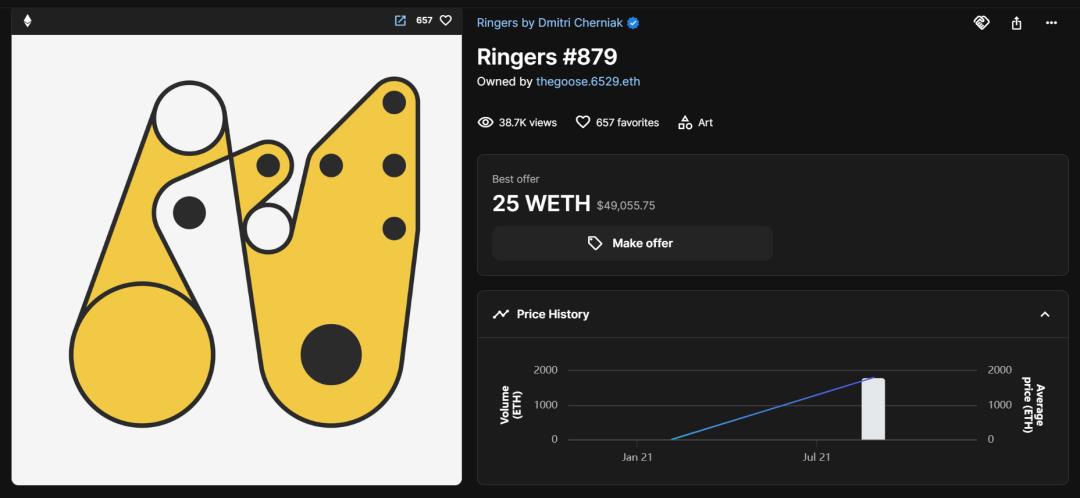
From the artistic “goose,” to the community-given nickname, to the media-covered auction sensation, the “goose” has transcended the Ringers artwork itself, acquiring deeper cultural significance. Dmitri Cherniak further developed this culture by releasing a cc0 Goose art generator, allowing any artist or user to freely create their own goose-themed artworks. This sparked numerous derivative works and ultimately led to the emergence of Goosinals—the BTC NFT collection and community we know today on Ordinals.
MNCHRMS
Launched in August, MNCHRMS was created by Beyond Rockets, a creative studio specializing in voxel-based art. The team previously released city-inspired voxel artworks on Cardano in 2021, including music albums and avatar collections. MNCHRMS features only black-and-white imagery—a monochrome scheme reminiscent of binary code, the foundation of cryptocurrencies like Bitcoin. The project uses this classic color palette to emphasize “simple complexity,” imbuing MNCHRMS with timeless, bold, and infinitely imaginative connotations aligned with Bitcoin’s philosophy of simplicity and permanence.
MNCHRMS has attracted overflow capital, recently achieving record-high trading volumes exceeding 8 BTC cumulatively. Its floor price surged over 15x from November 17 to reach nearly 0.006 BTC, though it later dropped close to half due to profit-taking by early holders.
Misprint Frogs ᵛ¹
Misprint Frogs are essentially abandoned NFTs resulting from the initial layering error during the Bitcoin Frogs mint. However, because their ordinal numbers precede those of standard Frogs, and given their lower total supply amid high Frogs floor prices, they’ve drawn interest from investors who missed the initial wave, creating speculative momentum. Recently, Misprint Frogs’ floor price has risen sharply, increasing over 260% in the past week. Still, a useful comparison is CryptoPunks and V1 Punks—V1 Punks emerged from a bug-induced fork and developed a distinct fork culture, yet despite having lower supply, their floor price remains far below that of original CryptoPunks.
OrdiRats
OrdiRats is a collection of 2,000 randomly generated 29×29 pixel rat NFTs on the Bitcoin chain, tapping into the recent animal-themed BRC-20 market trend. Its floor price briefly increased more than tenfold over the past week.
Van Gogh's painting
A project inscribing Van Gogh’s paintings onto Bitcoin for preservation. Over the past two weeks, this narrative has proven highly successful, generating over 105 BTC in trading volume in the last seven days, with a current floor price of 0.11 BTC.
Join TechFlow official community to stay tuned
Telegram:https://t.me/TechFlowDaily
X (Twitter):https://x.com/TechFlowPost
X (Twitter) EN:https://x.com/BlockFlow_News
 吴说区块链
吴说区块链






