








Gala Games: The Revival of Blockchain Gaming, How Does GALA Stand Out?
TechFlow Selected TechFlow Selected
Gala Games: The Revival of Blockchain Gaming, How Does GALA Stand Out?
After a long period of dormancy, the blockchain gaming sector is experiencing a revival. Can $GALA become a value investment in GameFi?
 Navigating Web3 tides with focused insights
Introduction
The strong post-launch performance of Bigtime tokens has drawn market attention, stirring excitement across various blockchain gaming projects and triggering a small surge in the GameFi sector. After a long period of dormancy, GameFi is back in the spotlight. Among these, Gala Games has emerged as a leading performer. From its recent low of $0.012 on October 19, $GALA reached $0.025 at the time of writing—an over 100% increase. What's driving this strength in $GALA? With the broader market stabilizing and altcoin bottoms forming, could $GALA become a valuable investment opportunity within GameFi as the blockchain gaming space revives? This article will explore that possibility.
1. Project Overview
1.1 Introduction to Gala Games
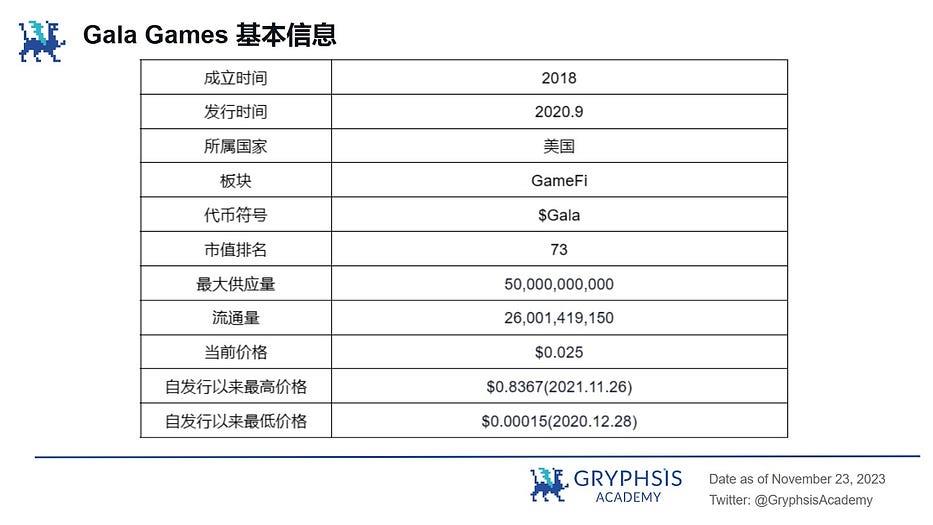
Gala Games is a blockchain game development company founded in 2018, aiming to build a decentralized gaming ecosystem. Gala Games functions both as a game development platform and an aggregator for multiple games.
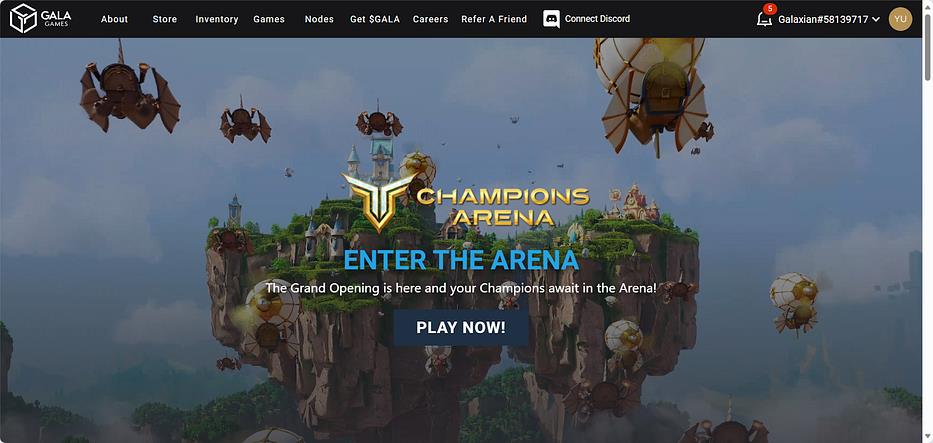
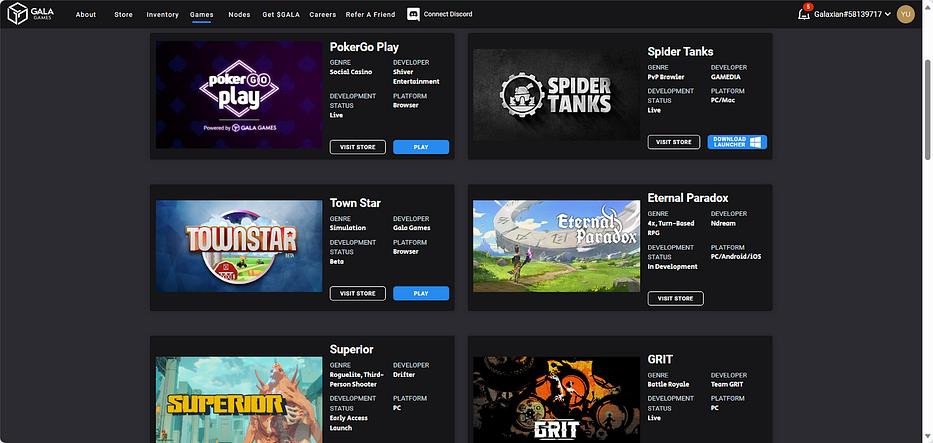
To date, although some games are still under development, Gala Games’ official website lists 18 confirmed titles across genres such as RPG, simulation, card games, tower defense, and shooters. In addition to Spider Tanks—a blockchain hit released this year—Gala has partnered with traditional gaming giant Epic to launch GRIT, a PUBG-style battle royale game.
1.2 How Gala Games Operates: Node System Explained
Gala has established its own dedicated network of nodes responsible for maintaining system security. The node system provides distributed computing power, transaction validation, and storage services for the gaming ecosystem. The entire game environment runs on a decentralized peer-to-peer node network rather than centralized servers controlled by a single entity. Founder Nodes serve as the backbone powering the Gala ecosystem. Within Gala’s decentralized node network, node operators participate in consensus voting to determine which games get listed on the platform, and all major community decisions are made through node voting.
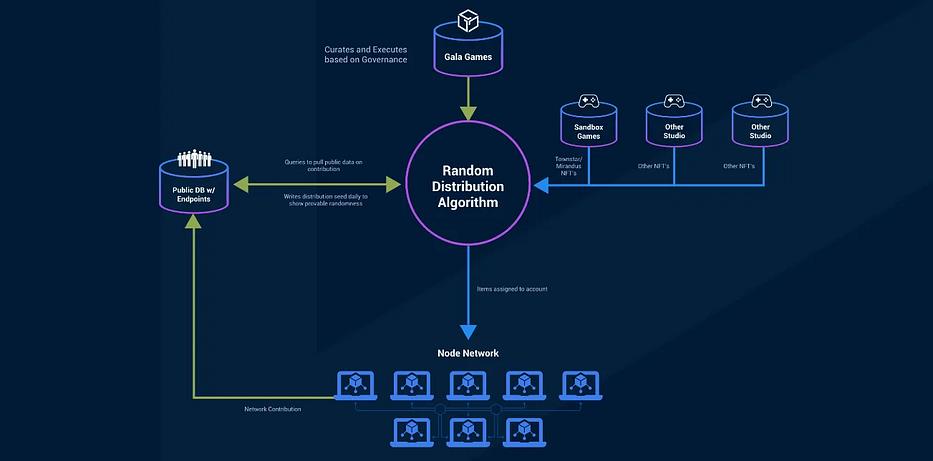
Gala Node Operation Diagram
2. Project Deep Dive
2.1 Team
Gala Games' co-founder and CEO Eric Schiermeyer, along with Game Chair John Osvald, both hail from Zynga. Eric previously served as CEO of Intermix Media (the company behind Myspace) and was also a co-founder and creative director at Zynga. Similarly, John spent much of his career in the gaming industry at Zynga. Founded in 2007, Zynga is a global leader in interactive entertainment, operating in over 175 countries with a diverse portfolio of popular franchises. It has surpassed 2.007 billion downloads across mobile devices. Titles like FarmVille and Zynga Poker have gained widespread recognition beyond niche audiences.
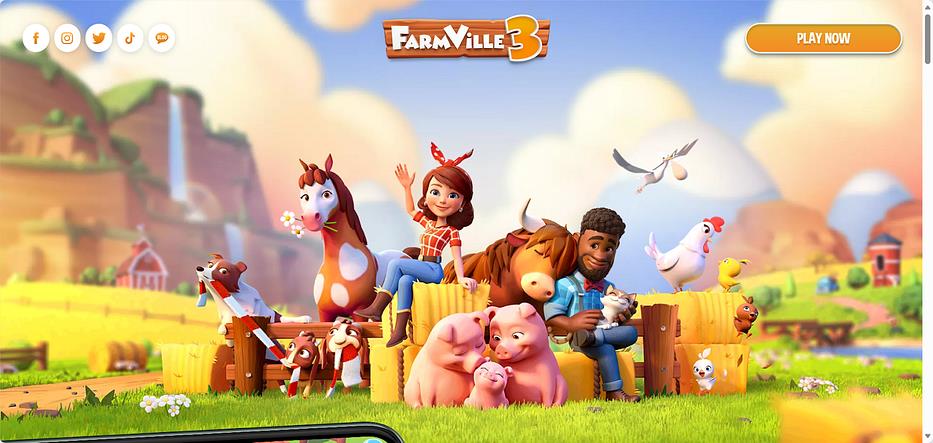
FarmVille Series
Warren Marshall and Craig Matchett work on 3D design for games. Warren, Gala’s co-founder and art director, previously worked at Epic Games and contributed to the development of Fortnite. As for Craig, given his exceptional expertise in 3D design, Gala even published a standalone announcement celebrating his arrival. Many may recognize titles like Dead Space and Battlefield—Craig played key roles in designing those acclaimed series. His creations reflect a natural sensitivity to form and color combined with an obsessive drive for research and innovation, making him a true artist in the 3D domain.
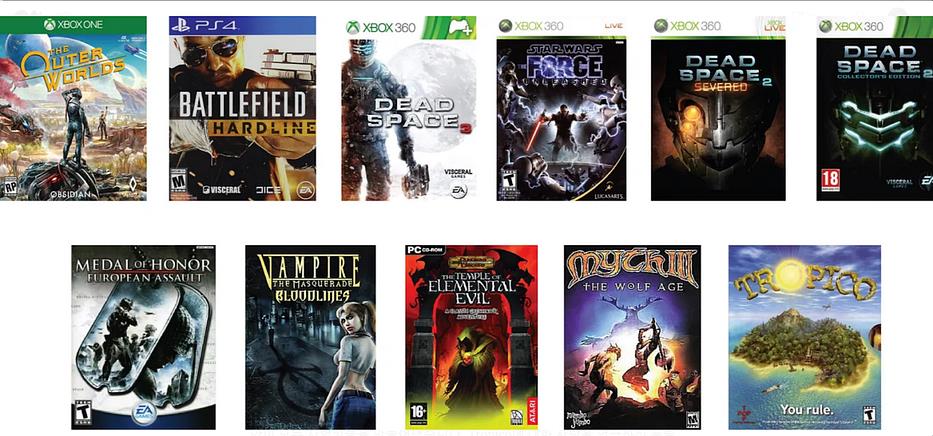
Craig's Masterpieces
Jason Brinks, Gala’s blockchain director, acts as the project’s spokesperson and de facto public relations representative on social media platforms like Twitter. He regularly engages with the community, discussing everything related to Gala. Most AMAs hosted by Gala are led by Jason himself. Previously employed at the United Nations, Jason joined GALA primarily because he believes play-to-earn gaming holds the potential to lift people in developing nations out of poverty. Having witnessed corruption within international institutions, he hopes decentralized autonomous protocols can eventually replace them.
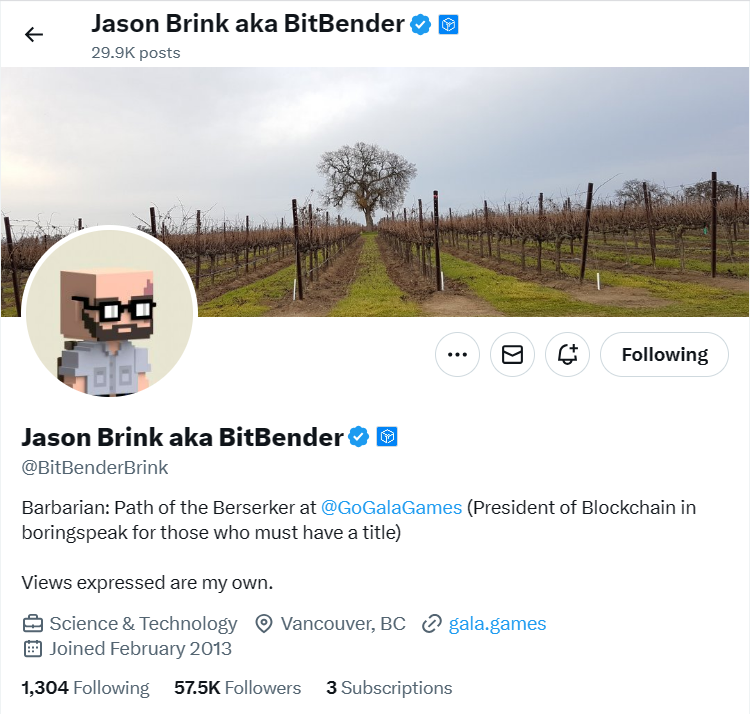
Jason's Twitter Profile
2.2 Funding Situation
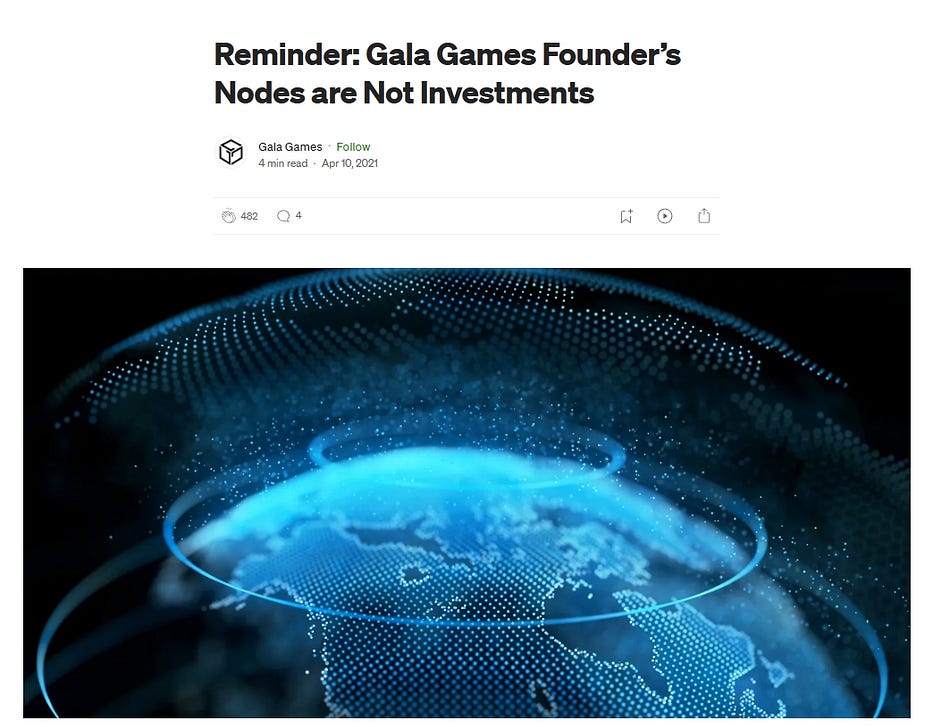
Gala did not conduct an ICO or any formal fundraising rounds—all initial capital came directly from the founders. This suggests strong early backing, possibly linked to Zynga. Additionally, the author personally believes that selling founder nodes effectively serves as an indirect form of fundraising. Gala explicitly stated in official communications that “Founder Nodes are not investments, and there should be no expectation of profit or return,” likely a precautionary move due to strict U.S. regulatory scrutiny.
2.3 Overview of the Gala Ecosystem
Gala is an open platform. Beyond gaming, it has expanded into Gala Film and Gala Music. In the future, all components of the Gala ecosystem will integrate onto Gala’s proprietary blockchain, Project GYRI. Moreover, Gala has partnered with Unity to create VOXverse, a metaverse initiative. Below are highlights of several prominent games currently live on the Gala platform.
1. Town Star
Town Star is a farming simulation game developed internally by the Gala team and marks Gala Games’ first release. Its gameplay closely follows in the footsteps of Zynga’s iconic FarmVille series. Players invest funds to plant crops and construct factories, balancing resource consumption and economic output. By climbing leaderboards, players earn rewards. Additionally, players can purchase NFTs to accelerate farm production—similar to in-app purchases.

2. Spider Tanks
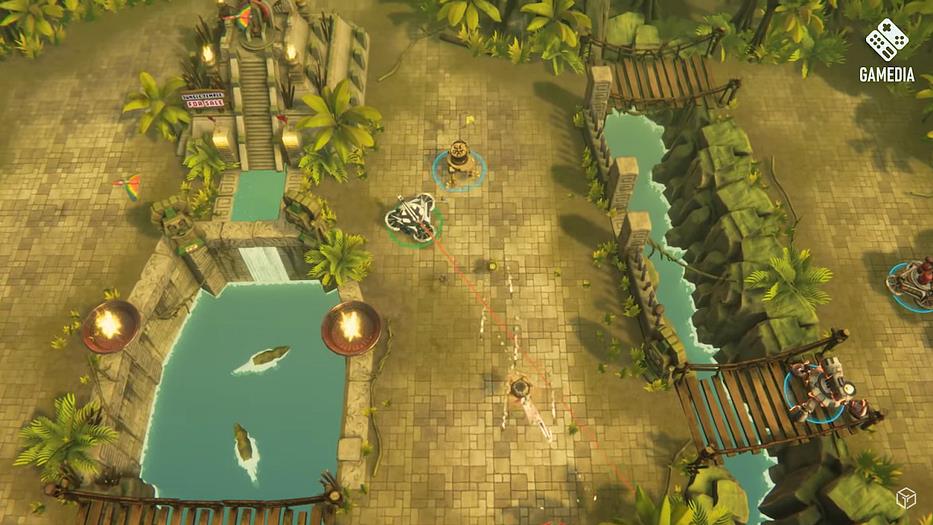
Spider Tanks is a PvP competitive game playable on PC. Players must acquire NFT-based equipment and compete against others in team-based combat across maps to gather resources. Developed by Dutch studio Gamedia, it was the first title launched on the GYRI project.
3. Mirandus
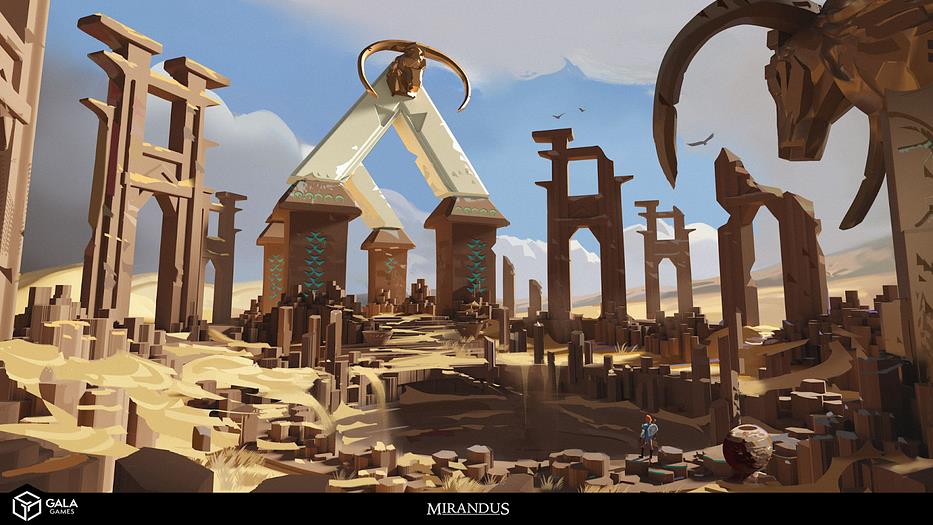
Mirandus is a fantasy role-playing (RPG) game offering full player autonomy. Within the game world, players enjoy absolute freedom—they may venture alone into wilderness areas, battle monsters deep in forests or dungeons, join one of several nations and serve as knights in royal courts, or establish shops in one of five great cities. Full ownership of in-game assets forms a core mechanic. Although the game hasn’t officially launched yet, anticipation among players remains high.
4. GRIT
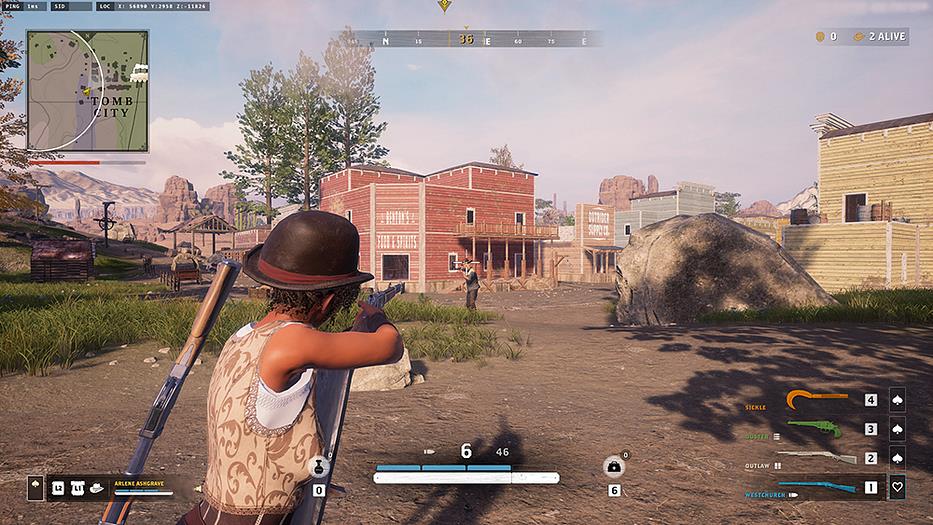
GRIT launched on the Epic Games Store on June 6, 2022, becoming the first Web3 game available on a mainstream gaming platform. Featuring a battle royale format similar to PUBG but set in a Wild West theme, GRIT boasts high-quality production values and meticulous detail. Players can buy firearms and weapons as NFTs via the in-game marketplace.
5. Gala Music & Gala Film
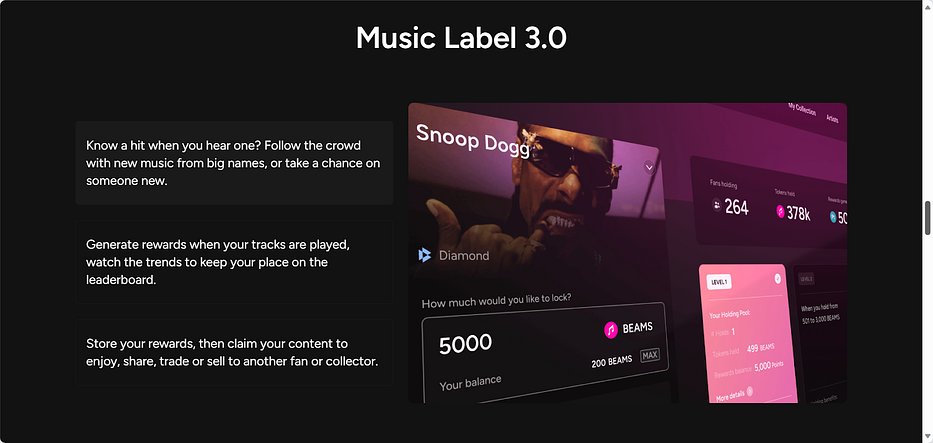
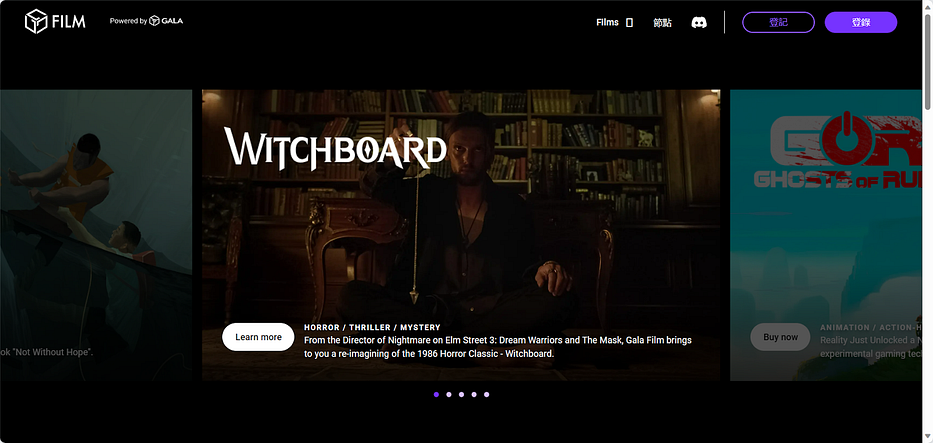
Gala has brought both film and music onto the blockchain, signing notable artists such as Dwayne "The Rock" Johnson for Gala Film and Snoop Dogg for Gala Music. Users can purchase movie or music album NFTs and earn rewards while watching films or listening to songs—“Watch to Earn” or “Listen to Earn.”
6. VOXverse
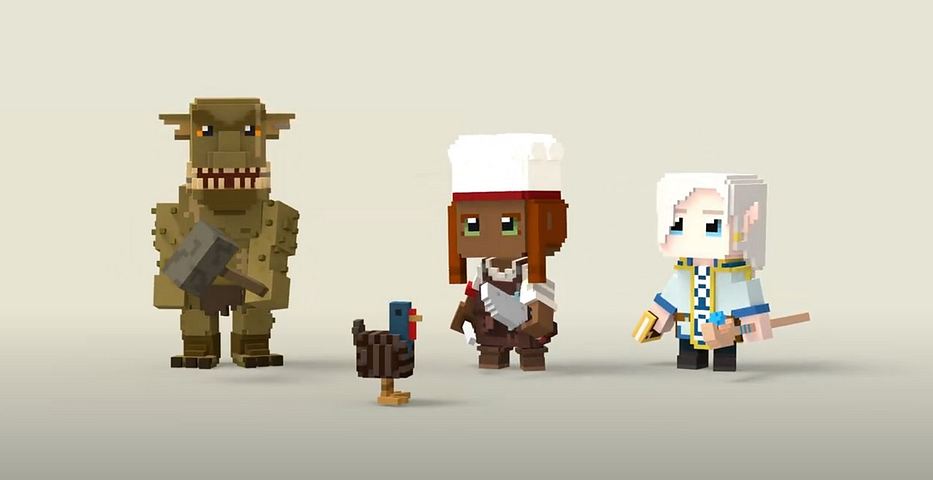
In June last year, Gala Games collaborated with Unity Technologies to develop “VOXverse,” a 3D metaverse project. VOXverse will integrate all premium offerings within the Gala ecosystem—including games, music, and film—centered around NFT-linked digital avatars known as the “VOX Collectible Series.” Each player in-game will own a VOX collectible avatar used as their virtual identity.
3. Gala Operational Status
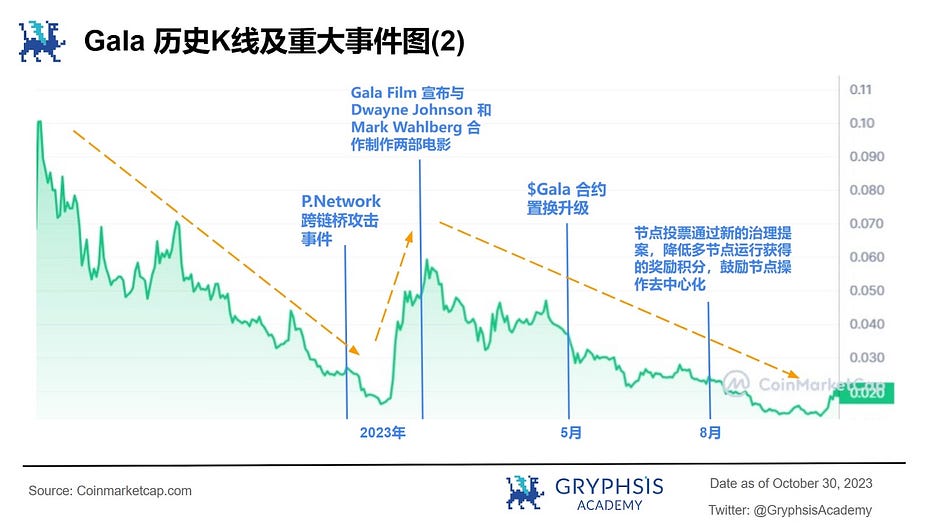
3.1 Key Historical Events & Price Chart
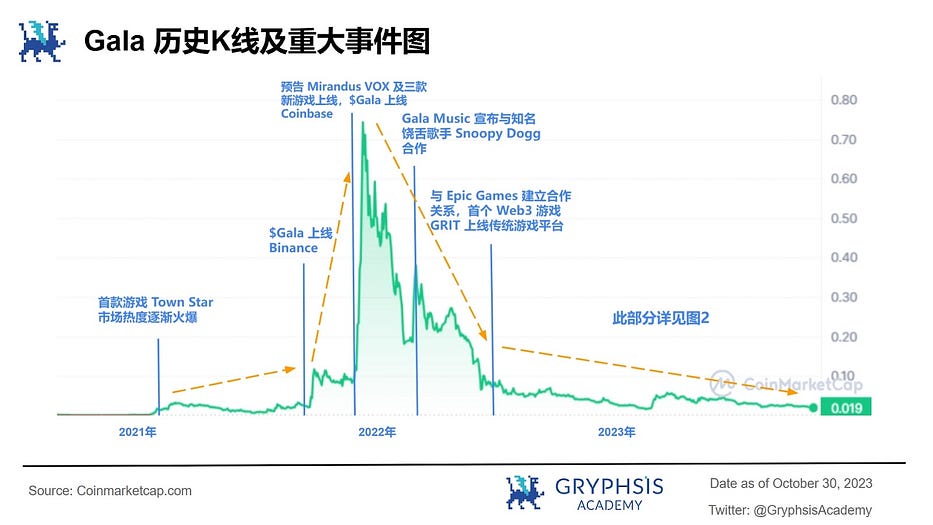
Let’s first review major milestones since Gala’s inception.
-
2019–2020: Early project planning completed by the Gala team, including development and publishing plans for breakout titles Town Star and Mirandus
-
2020.9: GALA token begins trading
-
2021.3.22: The Wall Street Journal publishes an article about Gala Games
-
2021.3.22: Gala Games announces sponsorship of Mazer Gaming
-
2021.3.27: Strategic partnership formed with PAC Global—a blockchain network using PoS and deterministic masternodes. This collaboration laid a solid foundation for secure and efficient node operations at Gala
-
2021.3.31: Partnership established with Polygon
-
2021.7.10: Node vote passes, officially welcoming Spider Tanks to Gala Games
-
2021.8.5: GALA token successfully bridged to BSC via cross-chain bridge P.Network
-
2021.8.10: VOX NFT sale launched
-
2021.9.4: Closed beta testing begins for Spider Tanks
-
2021.9.13: GALA token listed on Binance
-
2021.9.18: Launch of Town Coin—the P2E reward token for Town Star—marking the beginning of Gala’s play-to-earn era
-
2021.10.7: Announces collaboration with Wemade Tree to jointly promote global blockchain game development (MIR series games on Wemix are Wemade’s flagship titles)
-
2021.11.6: Town Star Nodes go live, functioning similarly to Founder Nodes
-
2021.11.12: Officially announces Mirandus VOX launch on December 6
-
2021.12.12: Three new games launch on Gala: Legacy (business simulation), The Walking Dead: Empires (multiplayer survival), and LAST EXPEDITION (AAA FPS)
-
2022.2: Gala Music officially launches, expanding the Gala ecosystem beyond games into broader digital worlds. Collaboration with renowned rapper Snoop Dogg announced—his latest album B.O.D.R. deployed on blockchain with tracks sold as NFTs
-
2022.5: Preview of Gala’s own blockchain, Project GYRI, announced. Future Gala ecosystem components will migrate onto this chain
-
2022.6.6: Gala announces partnership with Epic Games. Epic Store officially launches GRIT—a Web3 battle royale game. A historic milestone marking Web3 games entering the mainstream and reshaping the global gaming landscape
-
2022.6.6: Gala Film officially launches
-
2022.11.4: Hackers exploit misconfiguration in P.Network cross-chain bridge, minting unlimited pGALA on BSC and depositing into exchanges for profit. The incident caused GALA’s price to drop up to 30% that day. While affected users were later compensated, significant FUD spread throughout the community
-
2023.1.9: Gala announces via social media collaboration with celebrities Dwayne Johnson and Mark Wahlberg on two upcoming films via Gala Film. Tweet later deleted without explanation
-
2023.3.31: Strategic partnership formed with Huobi, collaborating on Web3 ecosystem and community building
-
2023.5.15: GALA token undergoes contract upgrade to Gala (V2)
-
2023.8.17: Node vote approves new governance proposal reducing multi-node operation reward points, encouraging greater decentralization among node operators
-
2023.9.4: Internal conflict erupts within Gala Games leadership. Co-founder and CEO Eric Schiermeyer and co-founder Wright Thurston file lawsuits against each other, accusing one another of “stealing coins and dumping” and “misusing funds,” involving approximately $730 million worth of $GALA assets.
3.2 Business Operations Data Analysis
Gala’s main revenue streams consist of two parts: sales of Founder Nodes and sales of game NFTs. Notably, Gala’s official website operates in a relatively centralized manner—store data isn’t recorded on-chain—so we rely on official site figures for analysis. First, let’s examine node sales.
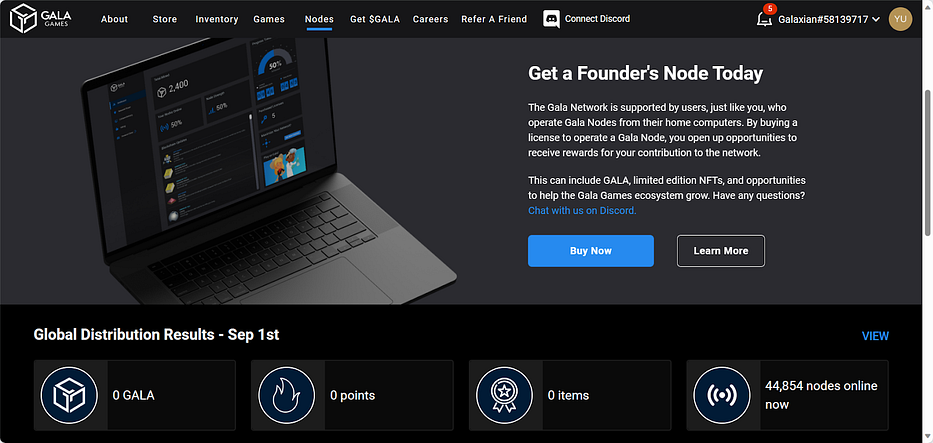
According to Gala’s official website, the number of active nodes has reached 44,854. Active nodes refer to Founder Nodes that ran for more than six hours daily and received GALA token rewards. The actual total node count is likely higher. The maximum cap is 50,000 nodes. Initial Founder Node pricing started at $2,000. After selling 19,000 nodes, Gala adopted a tiered pricing model—price increases every 100 nodes sold—making later purchases progressively more expensive. Buyers not only face rising costs but also longer payback or profitability periods due to the halving of Founder Node rewards every July 21. With over 44,000 nodes already sold, Gala’s node sales strategy has clearly been successful.
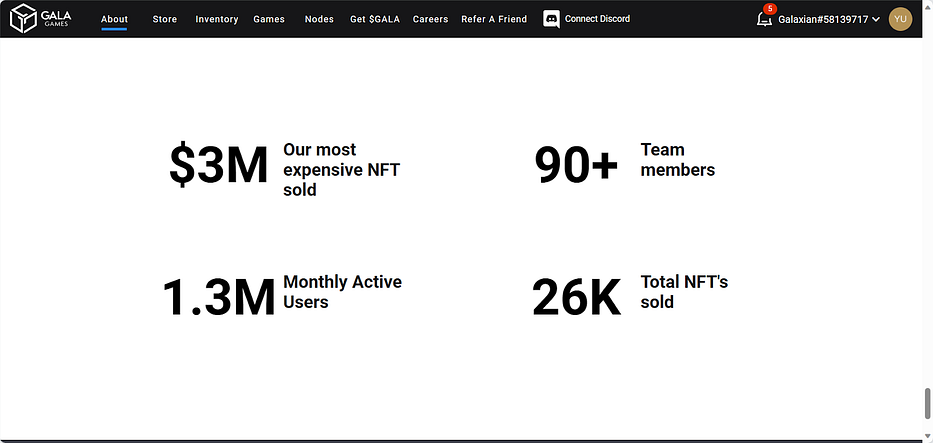
Next comes NFT sales. Over 26,000 primary-market NFTs issued by Gala have been sold according to the website, with key in-game NFTs typically selling out quickly. We’ve compiled a detailed table showing royalty income from several of Gala’s most popular NFT collections on secondary markets.

Gala offers many NFT series; less-traded ones aren’t included here. Clearly, whether in primary issuance or overall secondary royalties, Gala generates substantial revenue.
3.3 Community Engagement Data Analysis
On social media, Gala Games currently has 466,000 followers on Twitter and around 200,000 members in its official Discord server. Despite being in a bear market, engagement remains high—tweets from Gala’s official account or PR figure Jason consistently generate robust comment interactions, and discussions in the Discord chat remain active.
4. $GALA Token
4.1 Token Utility
The primary uses of $GALA today are purchasing Founder Nodes and buying in-game NFTs. The official team also states that in the future, when Gala migrates to its Project GYRI blockchain, the utility and functionality of the GALA token within the ecosystem will be further enhanced.
Regarding nodes: The current price for a Founder Node on the official site is around 5 million GALA tokens—approximately $100,000 at current market rates. Once users purchase a node license, they can run a Founder Node on their personal computer or a virtual private server without needing to stake any tokens. A maximum of 50,000 Founder Nodes will ever exist. Purchased nodes are permanent and cannot be resold on secondary markets. Currently, active nodes number around 44,000. Buying a Founder Node with GALA is akin to mining—it functions as a PoS node. Half of the daily GALA emissions are distributed to Founder Nodes. Running your node for at least six hours per day qualifies you for daily reward credits based on Gala’s scoring system—the longer the uptime, the higher the reward. Besides daily GALA payouts, Founder Nodes also receive Gala-based game tokens (e.g., $TOWN from Town Star) and randomly allocated in-game NFTs as bonuses. Every July 21, the daily GALA emission is halved.
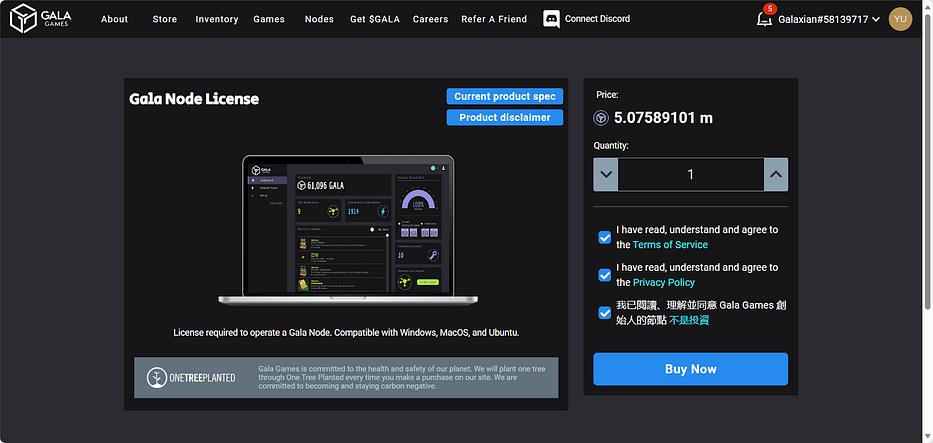
Official Node Pricing
4.2 Tokenomics
GALA has a maximum supply of 50 billion tokens. Until January 13 this year, emissions consisted solely of daily outputs—one half distributed via mechanism to Founder Nodes, the other half allocated to the “Gala Games Conservatorship,” essentially a community treasury fund supporting project development. Daily GALA emissions are halved annually on July 21. Importantly, the $GALA allocated to Founder Nodes isn’t directly deposited by the project team into wallets. Instead, node operators must manually mint their earned amount via the official website each day.
Additionally, to address declining operator incentives caused by annual halvings of daily node rewards, Gala introduced a PAY-BY-BURN burn mechanism on January 13 this year. Now, whenever users spend GALA tokens on purchases within the platform (excluding node purchases), the spent GALA is burned, and an equivalent amount is redistributed to Founder Nodes. Previously, purchased GALA would mostly flow to the project team—whether reinvested in development or sold on secondary markets, control remained with the team. The PAY-BY-BURN mechanism effectively transfers what would have been team revenue to node operators, increasing their yield.

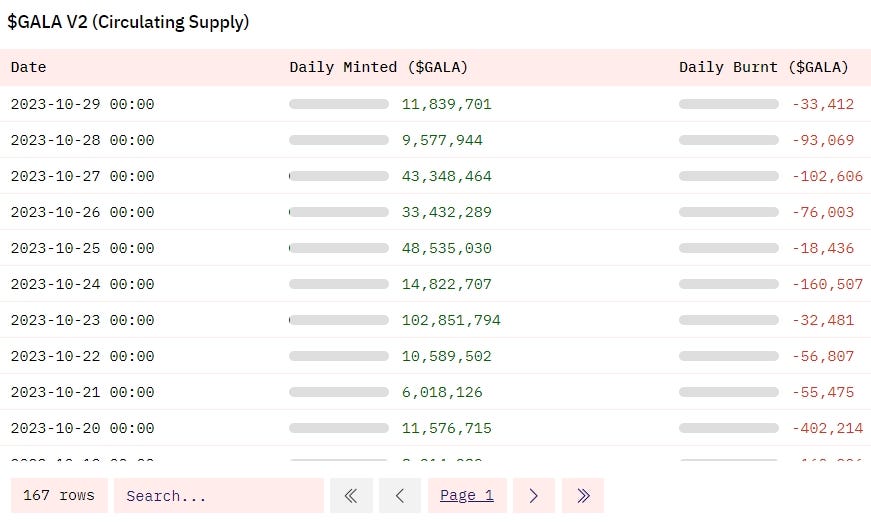
On May 15 this year, GALA underwent a smart contract upgrade from the original $GALA to the new $GALA token—known as the Gala V2 upgrade. The dashboard above accurately records daily minting and burning volumes before and after the contract swap, from September 11, 2020 (when GALA minting began) to present. Today marks day 948 of minting, with approximately 48.3 billion tokens minted and 27.3 billion in circulation. Maximum supply remains capped at 50 billion.
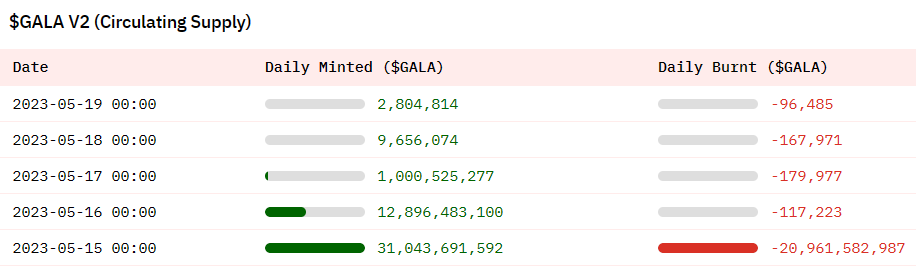
Considering GALA’s economic model, combining the burn mechanism with annual halving of emissions, if a blockbuster game drives demand growth, $GALA could easily transition into a deflationary model. Furthermore, the team occasionally burns tokens. For example, on May 15 during the contract swap, Gala destroyed nearly 21 billion of its own $GALA tokens (see chart below). While the team claims such holdings support project development and ecosystem funding, many community members still perceive large team-held balances as a risk to the overall token economy. In short, Gala believes large-scale token destruction helps alleviate holder concerns about potential massive sell-offs by the team that could depress prices.
4.3 Holder Address Analysis
Source: Etherscan, Nansen
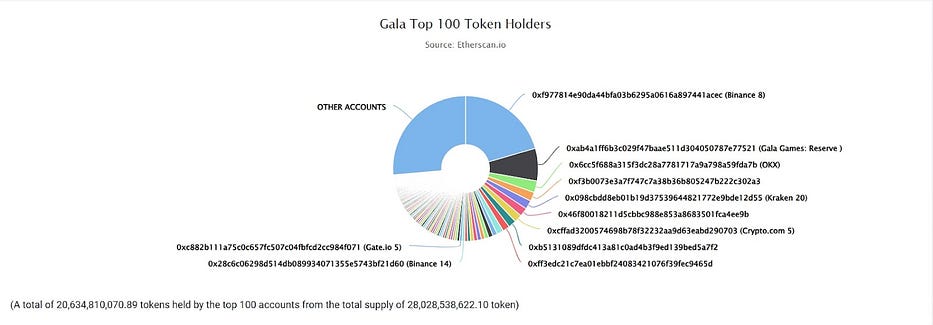
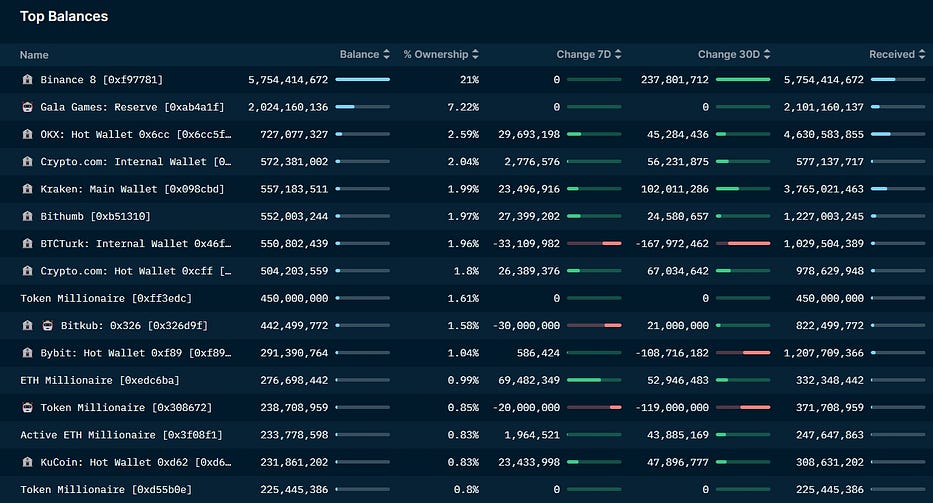
Data shows that as of November 22, 2023, there were 18,726 $GALA holders on Ethereum. The top 10 addresses hold 42.81% of the total supply, while the top 100 hold 73.26%. Most top 10 addresses belong to exchanges.
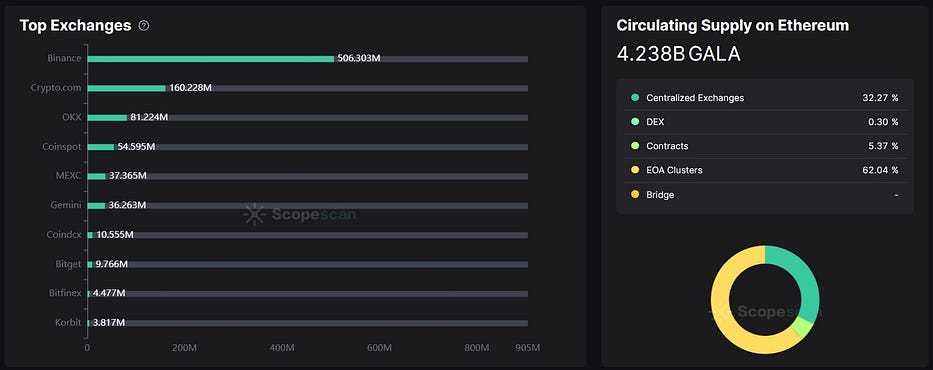
Source: Scopescan
According to Scopescan data, CEX holdings account for 32.27% of total $GALA supply, with Binance holding the largest share. Binance is also the largest single holder of $GALA, accounting for 21% of total supply.
4.4 Market Flow Analysis
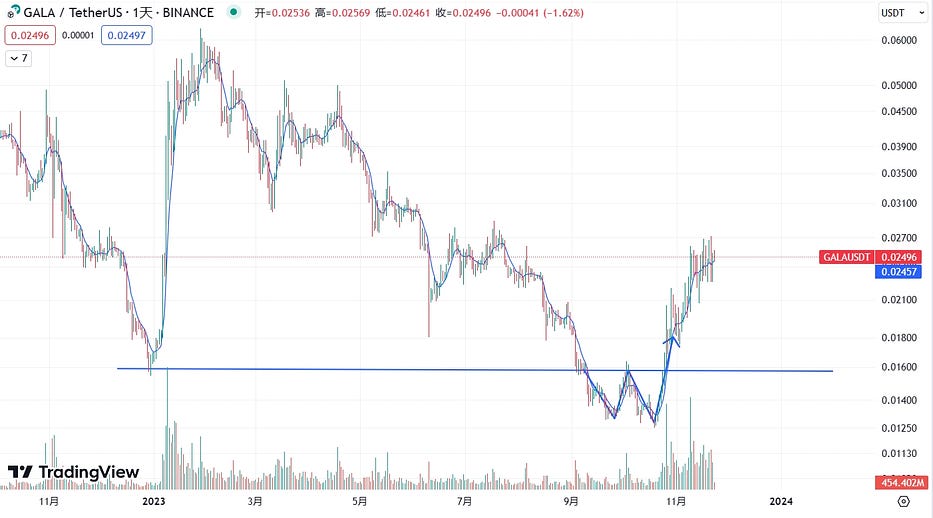
Binance $GALA Spot Price Chart Source: TradingView
According to TradingView data, $GALA hit bottom on October 19 on Binance spot and began a volume-backed rally afterward. It now trades around $0.025, up approximately 100% from lows, forming a classic bullish W-bottom pattern. The neckline aligns with a strong support level from the previous downtrend. It appears highly likely that $GALA has completed its bottom formation and is positioning itself for the next bull cycle.
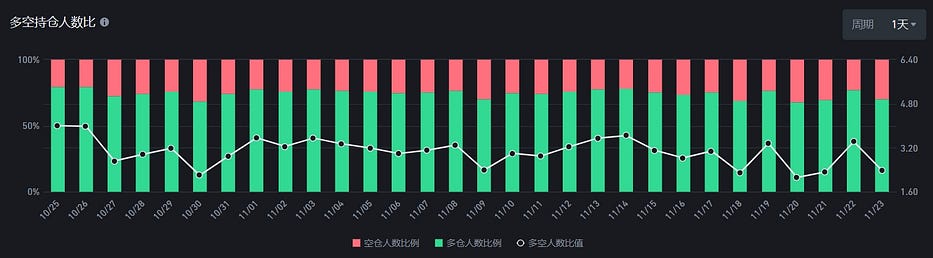
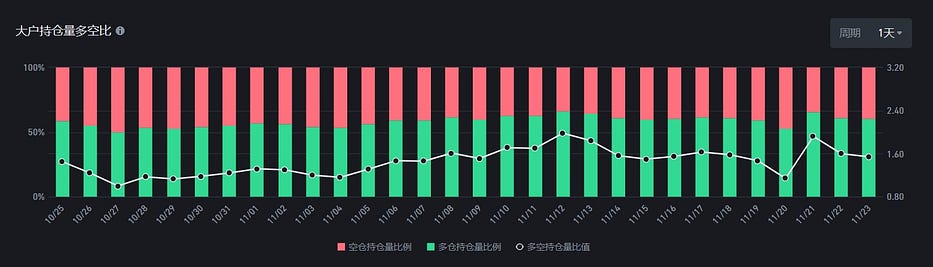
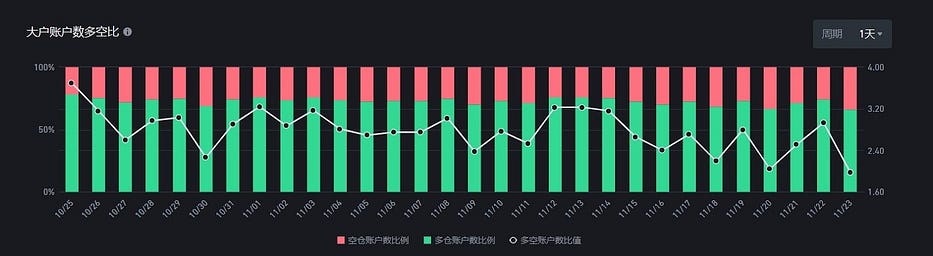
$GALA Futures Position Data on Binance
Recent Binance futures data shows ratios of long vs. short positions, large trader position ratios, and large account count ratios—all significantly exceeding 1. This clearly indicates both retail and whale participants are predominantly bullish, reflecting positive sentiment toward future $GALA price movements.
5. Sector Analysis
5.1 Current State of the GameFi Sector
Gala belongs to the GameFi sector—a portmanteau of Game and Finance—referring to blockchain games that offer financial incentives, allowing players to earn while playing. GameFi ecosystems leverage cryptocurrencies, non-fungible tokens (NFTs), and blockchain technology to create virtual gaming environments. Players typically earn in-game rewards by completing tasks, battling others, or leveling up, and can withdraw their assets to trade on crypto exchanges and NFT marketplaces.
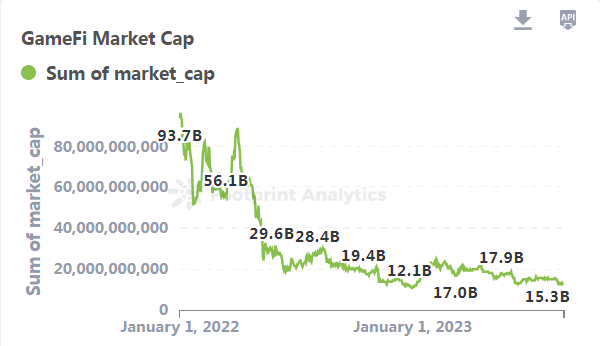
GameFi Market Cap, Source: Footprint Analytics
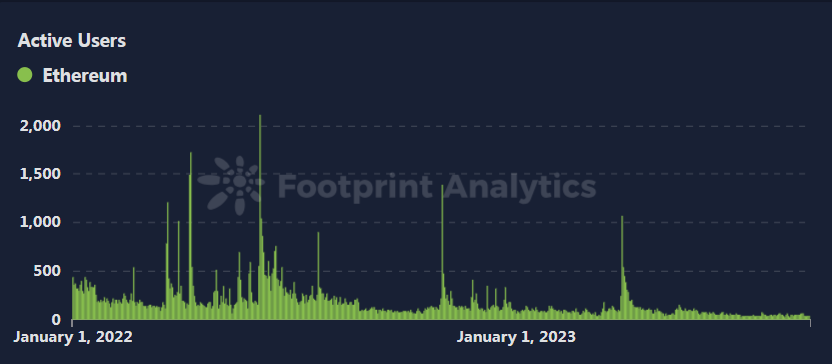
Gala Active User Count, Source: Footprint Analytics
From the chart, we see signs of revival in blockchain gaming recently. However, overall, the GameFi sector has remained sluggish from 2022 to present. Gala’s active user count (this metric reflects addresses interacting with on-chain contracts—i.e., those using GALA for purchases. Given Gala’s centralized platform structure, this number is certainly lower than actual active users, but still useful for trend analysis) has declined sharply and remained flat for an extended period.
If the 2021 GameFi boom was driven by ample liquidity and speculation during a bull market, today’s GameFi token prices reflect a post-bubble correction—settling into a stable, bottomed-out phase where value prevails.
5.2 Gala’s Advantages Within the GameFi Sector
During the last bull cycle, the fundamental hype logic behind GameFi was the P2E (play-to-earn) model. Since players could earn money just by playing, blockchain games attracted massive inflows, pushing token prices upward. Gala rode this wave too, achieving thousand-fold gains during the last cycle. Why place “ride” in quotes? Because Gala’s philosophy differs from most blockchain games. Gala doesn't prioritize P2E. Take Town Star, for instance—it’s free to play, but balancing resources is extremely challenging, often trapping players in dead-end scenarios. The game emphasizes player experience over fast profits. Gala’s true vision has always been creating blockchain games people genuinely want to play—this remains the team’s unwavering mission.
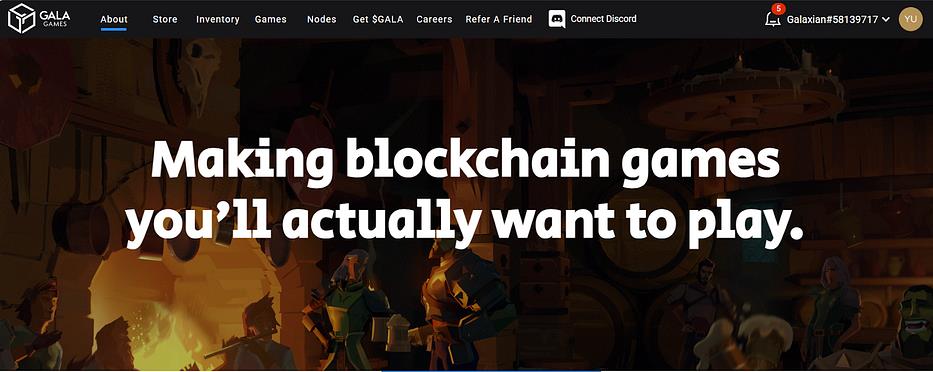
What does this mean? Gala wants people to play blockchain games not because they can make money, but because the games are genuinely fun. While most Web3 gaming companies like Immutable X and Axie Infinity increasingly focus on P2E mechanics and infrastructure, Gala Games continues to communicate its vision—“building blockchain games you truly want to play”—through the polished production quality, engaging gameplay, and refined details seen in titles like GRIT and Spider Tanks.
Moreover, in terms of development talent, Gala Games stands out as one of the few blockchain gaming teams composed of renowned developers from traditional gaming. Aside from blockchain director Jason, most team members have backgrounds at top-tier game studios. Compared to other blockchain gaming teams, Gala clearly demonstrates superior game development standards and delivery capabilities.
6. Potential Risks Facing the Project
1. If Gala aims to develop high-quality, truly enjoyable blockchain games, development cycles may be long, which不利于 short-term increases in token demand.
2. Unlike other Web3 projects, Gala Games resembles a Web2 game developer, with its website and store operating in a relatively opaque and centralized manner.
3. Whether Gala can surpass infrastructure-focused projects like Immutable X with its Project GYRI, and meet developer expectations to attract more creators, remains uncertain. The success of GYRI’s development will significantly impact the Gala ecosystem.
7. Conclusion
By destroying 21 billion $GALA to ease holder concerns, and indirectly redirecting what would have been team-controlled funds to node operators via PAY-BY-BURN, it’s evident that the Gala team is genuinely committed to long-term sustainability, prioritizing community interests and token holder value.
Secondly, $GALA holdings are relatively concentrated, yet the token has already shown massive momentum, completing its bottom formation and moving off lows. Contract position data further reveals strong bullish sentiment among large holders in the near term.
Looking back,爆款 games like Treasure DAO’s The Beacon, GMT’s “hamster wheel” model, or even the P2E concept itself—all eventually ended up like today’s fragmented GameFi landscape: left in disarray after the hype faded. Whether in traditional gaming or post-hype Web3 games, I believe P2E is merely temporary fuel. True longevity comes from crafting exceptional games—titles like League of Legends, PUBG, Tomb Raider, or Assassin’s Creed—that retain players for years and ensure sustainable project growth. That is the ultimate endgame of the gaming industry.
When games are fun, user numbers grow, in-game item demand rises, and so does demand for $GALA—naturally driving token price appreciation. With $GALA having rebounded from its bottom, we’re clearly exiting the bear market. If you believe in the GameFi sector and can manage risk appropriately, $GALA stands out as a compelling value investment. I believe, given Gala’s vision and ambition, creating a truly fun Web3 blockbuster game that retains users long-term is only a matter of time.
Join TechFlow official community to stay tuned
Telegram:https://t.me/TechFlowDaily
X (Twitter):https://x.com/TechFlowPost
X (Twitter) EN:https://x.com/BlockFlow_News
 @gryphsisacademy











