Exclusive Interview with Bitget Research: Unveiling the "Core Principles" Behind Spot Trading's Dark Horse Token Listings
TechFlow Selected TechFlow Selected
Exclusive Interview with Bitget Research: Unveiling the "Core Principles" Behind Spot Trading's Dark Horse Token Listings
At this critical turning point from bear to bull market, Bitget has achieved阶段性 results by combining a top-down research-driven approach with its listing philosophy emphasizing quality, efficiency, and comprehensiveness.
 Navigating Web3 tides with focused insights
Author: Flower, ChainCatcher
Anticipation around spot Bitcoin ETFs is driving the market into a broad bullish phase. Beyond rising prices for mainstream cryptocurrencies like Bitcoin and Ethereum, new sectors such as BRC20 have also surged in popularity.
As the market transitions from bearish to bullish, centralized exchanges (CEXs) face a major test—those who identify and meet user demand first will capture the most value. Recently, leading assets such as ORDI from the BRC20 space, TIA from modular blockchains, and GAS—the native token of the Neo blockchain—have delivered strong price performance and seen explosive trading volume growth, making them among the hottest cryptocurrencies in the market. According to CoinGecko data, these popular tokens are predominantly traded on Binance, OKX, and Bitget, which occupy the top three market share positions.
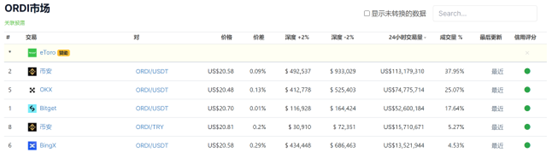
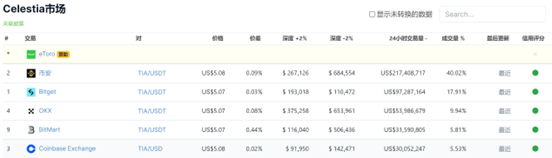
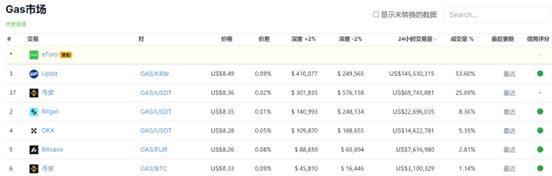
Compared to Binance and OKX, Bitget's performance during this wave of trending token opportunities has been surprisingly strong. Additionally, according to 0xScope’s recently released “2023 CEX Market Report,” Bitget has now climbed to fourth place in overall market share and ranks among the fastest-growing centralized exchanges in spot trading.
During each critical transition from bear to bull markets, the competitive landscape among centralized exchanges reshuffles. As an exchange that started with derivatives trading, how did Bitget break through within less than a year to become a dark horse in the spot market? And how has it managed to swiftly identify user needs and capitalize on the hottest tokens? Recently, we interviewed Bitget Research to uncover its underlying listing "philosophy."
A New Dark Horse in the CEX Spot Market
Recently, Web3 knowledge graph protocol 0xScope released its 2023 CEX Market Report, analyzing significant shifts in market share across major centralized exchanges (CEXs) over the past year.
The report highlights a key emerging trend: intensifying competition in spot trading. While Binance remains dominant, its grip on the market is loosening—not only due to challenges from traditional rivals like OKX and Coinbase but also from aggressive newcomers like Bitget and MEXC. Exchanges like Bitget are capturing trading volume through proactive listing strategies. Currently, Bitget ranks fourth in overall market share and stands out as one of the fastest-growing centralized exchanges in spot trading.
Looking at Bitget’s recent listing performance, it has successfully captured some of the hottest concept-driven tokens, allowing users to access early-stage gains. For instance, in high-profile categories such as BRC20 leader ORDI and modular blockchain leader TIA, Bitget ranks just behind Binance and OKX in spot trading volume, consistently holding third place. On November 16, ORDI achieved $440 million in global spot trading volume, with Binance leading at $160 million, OKX second at $110 million, and Bitget following closely at $41 million.
On the other hand, Bitget has also demonstrated precise timing in relisting previously dormant tokens poised for resurgence, delivering unexpected wealth-generating opportunities. For example, GAS, the gas token of the Neo blockchain—which had already launched on other CEXs—surged nearly 10x within two weeks after being listed on Bitget on October 25, creating a notable wealth effect.
The Principles Behind Creating Wealth Effects
After passing the test of this broad market rally, Bitget has earned recognition in the crypto community as a hybrid of “Binance + MEXC”—offering Binance-like selectivity and MEXC-like speed, combining quality with efficiency.
How does Bitget balance quality and efficiency? What exactly is its listing philosophy? In our interview, Bitget Research revealed three core principles: value-driven, efficiency-first, and comprehensive coverage.
Value-driven means prioritizing tokens that offer real profit potential—either through short-term upside or sustainable long-term growth based on solid fundamentals. For example, recently listed popular tokens like ORDI, TIA, and GAS continued to rise after listing on Bitget, generating substantial returns for users.
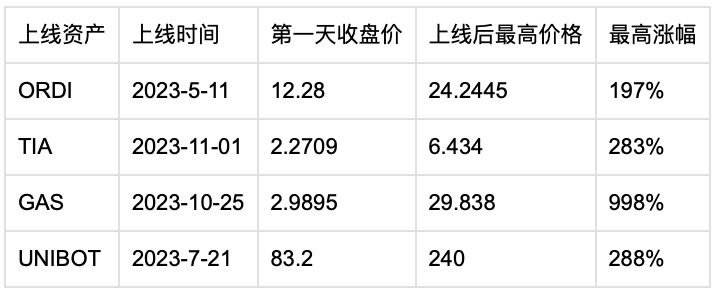
Efficiency-first emphasizes immediate listing. For early-stage trending assets, Bitget typically acts as the first or second CEX to list them. For example, UNIBOT—a key asset in the Telegram bot sector—was listed by Bitget as early as July, giving users valuable time to build positions. For tokens experiencing a second wind due to major catalysts, Bitget chooses optimal timing to maximize user gains. After detecting unusual activity in GAS, Bitget quickly listed it, enabling its users to achieve a 10x return within two weeks.
Comprehensive coverage ensures users can access all popular assets in one place. Whether it’s trending tokens like ORDI, TIA, and GAS, niche fan tokens like SPURS, meme coins like GROK, or Bot-sector assets like UNIBOT, Bitget offers one-stop trading to meet diverse user demands. Moreover, Bitget supports SWAP functionality and includes nearly every token with a liquidity pool across chains, making even highly obscure assets accessible.
Top-Down, Research-Driven Decision Making
Balancing wealth generation, speed, and comprehensiveness is no easy task. How does Bitget stay ahead of market trends? What is the research mechanism behind its success?
Bitget Research explained that while there are clear quantitative criteria for listing evaluation, unlike many other CEXs, Bitget does not rely primarily on business development or channel referrals. Instead, it adopts a top-down, research-driven approach, actively identifying high-quality assets.
First, Bitget’s research team has built an automated on-chain data monitoring system that enables real-time detection of asset movements. Second, continuous research and early positioning across various sectors ensure that no promising opportunity is missed.
Under this research-driven framework, Bitget evaluates listings across five key dimensions:
1. Industry Trends and Market Hype
Bitget believes projects aligned with industry trends are more likely to become market favorites. Criteria for determining whether a project fits current “industry trends” include:
1) Does it effectively solve native blockchain problems? For example, ARB and OP aim to address Ethereum’s scalability issues;
2) Does it fulfill actual user trading needs? For example, Unibot simplifies and enhances on-chain trading efficiency; 3) Is it receiving significant market attention? PEPE, though a meme coin, enjoys strong community consensus and visibility.
Based on this principle, Bitget identified Arbitrum-related opportunities early this year, when Arbitrum’s ecosystem TVL was growing rapidly, DeFi projects were expanding, and anticipation for ARB’s launch and airdrop was high. In early February, Bitget launched an Arbitrum Ecosystem Week, promptly listing numerous popular Arbitrum-based assets and generating significant wealth effects, establishing itself as a primary hub for Arbitrum ecosystem tokens.
Conversely, Bitget remains cautious about short-lived hype cycles. When the “room-temperature ambient-pressure superconductor LK-99” sparked massive social media buzz, an associated meme coin named LK99 emerged on-chain. After evaluating factors including crypto-community consensus, on-chain热度, and risk, Bitget decided against listing it—and indeed, the LK99 token eventually collapsed to near zero.
2. Community Consensus
“He who wins community consensus wins the market.”
When assessing social media buzz, Bitget doesn’t simply look at Twitter impressions or Telegram group size—these metrics are easily faked at low cost and hold little value.
Instead, Bitget has built proprietary databases of smart money addresses and Twitter KOLs, and daily scrapes Google Trends for trending crypto-related search terms to supplement analysis. Website traffic quality—including unique visitors, session duration, pages viewed, and bounce rate—is also factored in.
Additionally, on-chain data authenticity is verified. For example, a newly emerged meme coin may show $10M in 24-hour trading volume, but upon inspection, over $7M could be attributed to MEV transactions, indicating artificially inflated activity. Similarly, some pre-TGE projects may appear to have many holder addresses, but most receive negligible amounts (under $10). In such cases, Bitget sets thresholds to evaluate the number of effective holders.
3. Technological Innovation
Bitget values technological innovation that meets real market needs and integrates well with existing ecosystems. Two decisive listing decisions illustrate this criterion:
First, Bitget was the first CEX globally to list a token from the Telegram Bot sector. Recognizing that during meme seasons, many users struggle with inefficient and inconvenient Meme coin trading, Bitget saw demand for simpler tools to support advanced on-chain trading. The emergence of Telegram bots addressed a genuine need and was tightly coupled with the meme ecosystem, suggesting strong growth potential.
At the time, UNIBOT’s contract carried potential risks (e.g., ability to pause trading or change fees), meaning a CEX listing would involve significant risk. However, after deep analysis, Bitget determined that UNIBOT was generating up to $100K daily in revenue (later peaking at $600K)—far exceeding any incentive to exit scam. The likelihood of a malicious rug pull was deemed extremely low. Thus, Bitget confidently became the first CEX to list UNIBOT, which later delivered extraordinary returns to investors.
Second, Bitget was among the first CEXs to list BRC20 tokens under the Ordinals protocol. Bitget recognized that BRC20’s innovation wasn’t merely about “minting tokens on Bitcoin,” but about revitalizing the otherwise dormant BTC ecosystem. This innovation boosted transaction activity on the Bitcoin chain, aligning with miner incentives and ensuring support from large-scale mining operations. Furthermore, Ordinals rekindled investor interest in Bitcoin’s ecosystem potential—exactly the kind of “high expectation” needed to revive a stagnant market. Consequently, Bitget swiftly listed multiple popular BRC-20 assets.
4. Tokenomics
Bitget views tokenomics as the most direct factor influencing a token’s performance. Poorly designed token models often lead to tokens peaking at launch and declining thereafter.
Rather than relying rigidly on absolute initial circulating market cap, Bitget assesses valuation relative to a project’s position within its ecosystem. If a token’s market cap is clearly undervalued given its ecosystem role, product quality, and market expectations, its upside potential is greater. Distribution model and vesting schedule also significantly impact future selling pressure and price trajectory.
Moreover, Bitget places emphasis on whether token distribution is fair and community-oriented. Projects with decentralized allocations tend to exhibit stronger longevity. For example, AIDOGE, which Bitget listed early, allocated 95% of its supply to addresses that had previously claimed ARB airdrops, instantly building strong community consensus and traffic, fueling explosive growth during the early stages of the meme season.
In contrast, Simpson-series meme tokens, despite high on-chain热度, exhibited suspicious distribution patterns. The creator deployed about one-third of the initial supply into a Uniswap liquidity pool and distributed 2% each to 20 addresses—effectively concealing single-entity control of over 40% of the supply. Additionally, they used CoinTool four times to distribute tiny amounts to 800 addresses, creating a false impression of broad ownership and high popularity. Ultimately, the 20 whale addresses dumped their holdings en masse on May 13. Through systematic tokenomic and on-chain analysis, Bitget excluded such assets from listing.
5. Security
Bitget considers security the foundation of any token—without it, even the most promising project can collapse. To this end, Bitget has established a comprehensive security review framework:
Regarding contract security, Bitget has an internal smart contract audit team that identifies and flags all potential risks for further analyst assessment. Many early meme assets initially carry contract risks, but renouncing ownership is a common mitigation. Bitget evaluates these developments carefully.
For liquidity pool security, Bitget examines whether LP tokens are locked, what percentage is secured, for how long, or whether they’ve been burned. If most tokens in the pool can be withdrawn immediately, the token faces high risk of sudden price drops, prompting extreme caution.
Concerning concentration of holdings, Bitget checks whether tokens are concentrated in a small number of EOA addresses (indicating whale dumping risk) and whether there are hidden whales using tactics like those seen with the Simpson tokens.
Regarding project history and potential risks, Bitget thoroughly investigates whether the project or its team has faced compliance issues or serious ethical concerns. For instance, although PulseChain generated considerable hype, Bitget discovered ongoing disputes with the SEC during due diligence and chose not to engage.
During this critical bear-to-bull transition, Bitget has achieved阶段性 success by combining a high-quality, efficient, and comprehensive listing strategy with a top-down, research-driven methodology, emerging as a dark horse in the CEX spot market. As the market continues to strengthen, whether Bitget can sustain and evolve its listing advantages to gain broader market recognition remains to be seen.
Join TechFlow official community to stay tuned
Telegram:https://t.me/TechFlowDaily
X (Twitter):https://x.com/TechFlowPost
X (Twitter) EN:https://x.com/BlockFlow_News
 ChainCatcher 链捕手