








NFT & ERC-6551: A Rising Star Shines Again
TechFlow Selected TechFlow Selected
NFT & ERC-6551: A Rising Star Shines Again
This article will analyze the current NFT market landscape, explore the latest developments within the ecosystem, and discuss potential challenges and future prospects.
 Navigating Web3 tides with focused insights
Author: Bing Ventures
Key Insights:
-
Trading volume dropped significantly in 2023. NFT liquidity declined due to lack of innovation and playability.
-
ERC-6551, Blend lending, and OpenSea's Deals could be key catalysts for an NFT market recovery.
-
The depth of the NFT market downturn largely depends on broader cryptocurrency market performance.
-
Long-term future trends for NFTs: integration with quantum computing; convergence with virtual and augmented reality technologies; combination with biotechnology; and super AI emerging as mainstream artists. Over the past few years, NFTs have risen like a brilliant new star, rapidly becoming a global topic of discussion. These unique digital assets, empowered by blockchain technology and their non-fungible nature, are redefining creativity, ownership, and the exchange of digital value.
As awareness of NFTs has grown, their distinctive attributes have led to applications such as proving ownership of digital assets like music, videos, images, artworks, cars, or event tickets, as well as physical assets. Numerous institutions have recognized the unique potential of NFTs and moved early to establish positions in this space.
In the first half of 2022, we witnessed the peak of NFT popularity and speculation around digital assets, which gave rise to the concept of NFTfi — completing a financial innovation from idle assets to liquidity. Through fractionalization, lending, and other financial products, NFT liquidity was enhanced, driving ecosystem development. This shows that innovations related to NFTs can make them even more impactful.
In this deep research report by Bing Ventures, we analyze the current state of the NFT market, uncover the latest developments within the ecosystem, and explore potential challenges and future prospects.
NFT Market Overview
Starting in the summer of 2021, the NFT market entered a period of rapid growth and widespread adoption. During this time, both trading volumes and prices reached record highs. The total transaction volume for NFTs in 2021 reached approximately $20 billion, a tenfold increase compared to 2020.
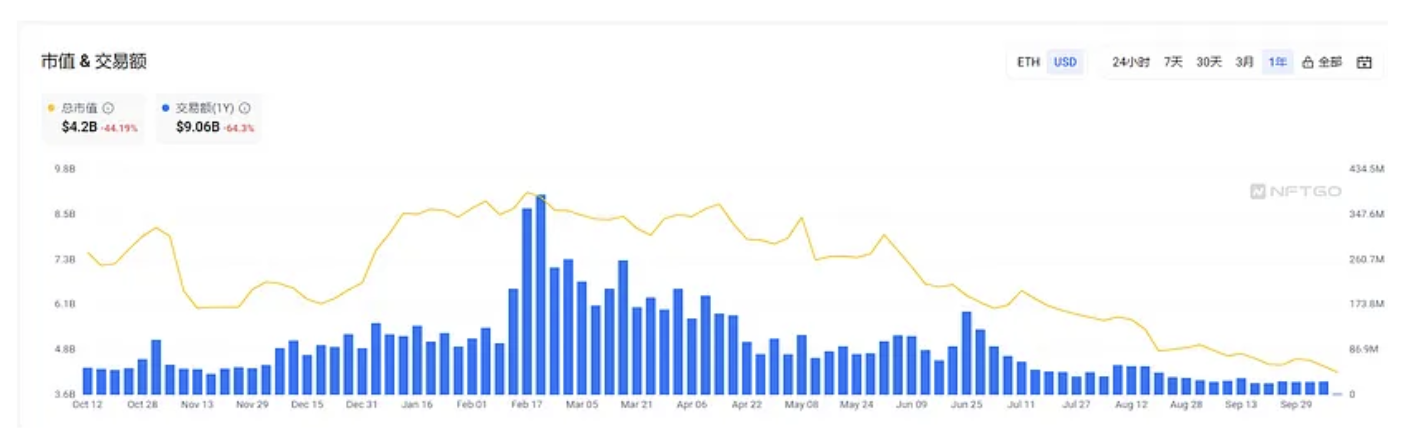
However, the second half of 2022 became a difficult period for the NFT space. From the collapse of Luna to the FTX bankruptcy, the entire crypto ecosystem suffered major setbacks. Although NFTs maintained some momentum through new projects and experimentation, the overall bearish environment dragged the NFT market into a downturn. The total market cap of NFTs has fallen from its peak of $21B in 2021 to $4.2B as of October 8, 2023, with trading volume also sharply contracting.
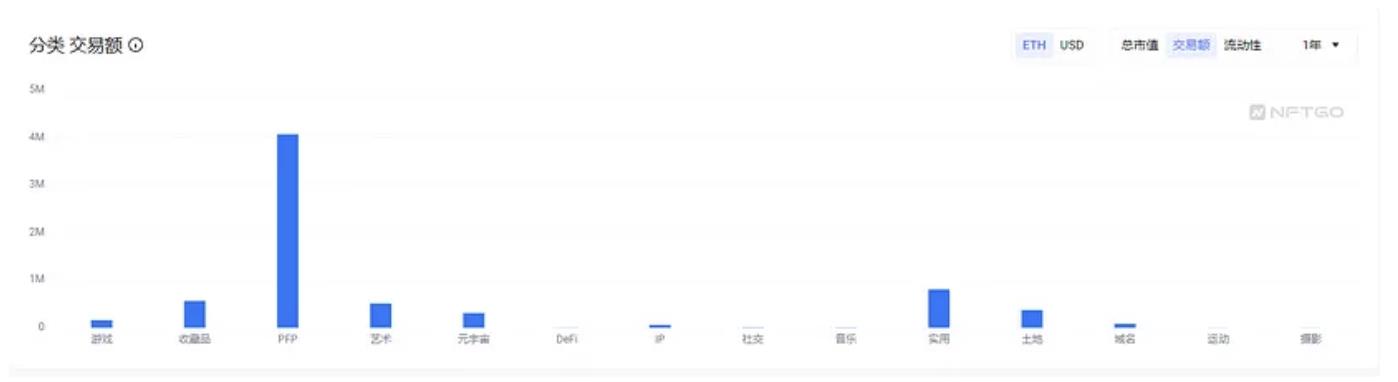
By analyzing transaction data across different types of NFTs, we find that PFP (Profile Picture) collections dominate in trading volume due to their overwhelming popularity. Most of the top-tier blue-chip NFTs are also PFP-based, followed by utility, collectible, and art NFTs.
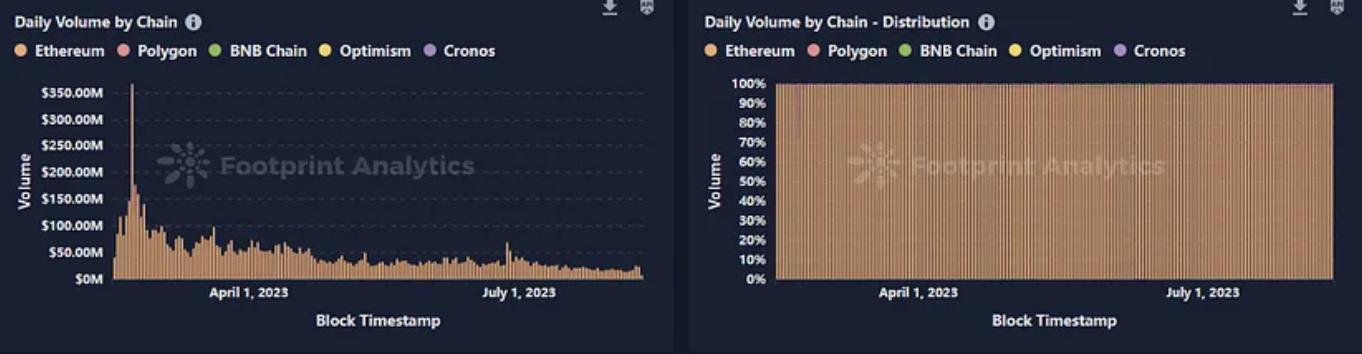
At the blockchain level, Ethereum continues to dominate the NFT market, followed by Polygon. This dominance is steadily increasing — according to 2023 data, Ethereum’s market share grows slightly each month. This trend underscores how Ethereum’s established reputation, security, and widely recognized technical capabilities are critical to NFT operations.
Notable Innovations
Compared to 2021, overall trading volume has dropped significantly this year. Declining liquidity due to lack of innovation and playability has become increasingly severe. Recently, features such as ERC-6551, Blur’s Blend lending, and OpenSea’s Deals have emerged, bringing renewed hope. These small but meaningful iterations during the bear market may become key drivers for a future NFT market recovery.
Deals
Deals is an NFT bundle swap feature launched by OpenSea, allowing users to exchange bundles of NFTs with other users. It is built on the Seaport protocol — a decentralized smart contract protocol used to create and fulfill orders for ERC-721 and ERC-1155 tokens. Each order includes a set of tokens offered by the seller and a corresponding set requested by the buyer.
Value Proposition
-
Simplified Exchange Process – OpenSea’s "Deals" aims to attract more users to the NFT community by simplifying exchanges. Using a barter-style interactive bundle trading model, it reduces transaction steps and addresses NFT liquidity issues by streamlining the existing trading process.
-
Risk Reduction – By leveraging Seaport, collectors can swap NFTs on OpenSea without exposure to risks associated with off-platform transactions.
Blend
Blend is a peer-to-peer perpetual lending protocol launched by Blur, supporting any collateral including NFTs. According to its whitepaper, “Blend is a flexible, permissionless floating-rate lending protocol that supports arbitrary collateral without reliance on oracles, enabling market-determined interest rates and loan-to-value ratios.”
Value Proposition
-
Flexibility – Blend offers loans with no maturity date, allowing borrowers to repay at their convenience. A refinancing auction mechanism further enhances this flexibility.
-
Simplicity – By avoiding oracles, Blend simplifies the NFT lending process. Lenders assume risk and set preferred loan-to-value (LTV) ratios and interest rates, while the market determines final terms.
-
Capital Efficiency – The “Buy Now, Pay Later” option lowers entry barriers for smaller traders, enabling them to trade high-value collectibles such as BAYC and Wrapped CryptoPunks.
-
Risk Management – Refinancing auctions reduce default risk and improve efficiency. However, they require both borrowers and lenders to monitor NFT floor prices, especially during periods of high market volatility.
ERC-6551
ERC-6551, also known as “Token Bound Accounts,” is a new Ethereum standard introduced by the @futureprimitive team. ERC-6551 enables each NFT to have its own dedicated wallet.
Moreover, since it uses CA (contract accounts — accounts without private keys, controlled via code in smart contracts), all NFTs supporting ERC-6551 automatically receive a bound address without requiring additional actions. ERC-6551 provides a smart contract account for every ERC-721 token, enabling these tokens not only to hold various assets such as ERC-20, ERC-721, and ERC-1155 tokens, but also to interact with various applications. Since the proposal of ERC-6551 and its real-world implementation, the unique user experience has quickly attracted intense attention from the crypto community. Today, numerous applications based on ERC-6551 have already emerged.
Value Proposition
-
Enhanced Interactivity and Functionality – ERC-6551 is not just a new NFT standard; it adds significant interactivity and functionality to NFTs. This means NFTs can now interact with other smart contracts, own tokens, and even represent real-world entities. For example, gamers could use a single NFT account to hold all their in-game assets.
-
Improved Security – A major advantage of token-bound accounts is enhanced security. Since ERC-6551 NFTs can store the complete ownership history of all associated assets, those assets become more resistant to hacking and theft. Additionally, NFT ownership and transaction records are fully transparent, providing greater trust and certainty for users.
-
Solving Limitations of ERC-721 – While ERC-721 paved the way for broad NFT adoption, it has inherent limitations — such as inability to interact with other smart contracts or store additional information or value. ERC-6551 resolves these issues, transforming NFTs from simple ownership proofs into powerful smart contract tools.
-
Greater Innovation Potential – By addressing multiple limitations of ERC-721, ERC-6551 blurs the boundaries between NFTs, wallets, and smart contracts, opening vast new possibilities for developers. It brings immense potential and opportunities to the entire blockchain ecosystem.
Promising ERC-6551 Projects We Are Watching:
1. AquaNet: Social product, finalist at ETHGlobal Waterloo 2023 Hackathon
Features & Innovation:
-
NFT "Activation" Social Network: AquaNet is an AI-driven NFT social network where NFTs can interact with one another, develop unique "personalities," share information, express interests, etc.
-
NFT Activity Records: Leveraging the ERC-6551 standard, each NFT can create its own account on AquaNet and retain a full record of its activities, offering holders richer insights and added value.
-
AI Personality: Using GPT-3.5 technology, each NFT generates a unique personality based on its metadata — such as username, bio, etc. — enhancing its value and appeal.
Future Outlook:
-
Social Revolution for NFTs: By combining AI and ERC-6551, AquaNet has the potential to lead a social revolution in the NFT space, pioneering NFT socialization and unlocking unprecedented value and opportunities.
-
Leveraging Advantages of ERC-6551: AquaNet can capitalize on ERC-6551’s capabilities to enhance NFT interactivity and functionality, potentially attracting more users and developers.
-
New Application Areas for NFTs: AquaNet may open new frontiers for NFTs, such as NFT-based social media and interactive gaming experiences.
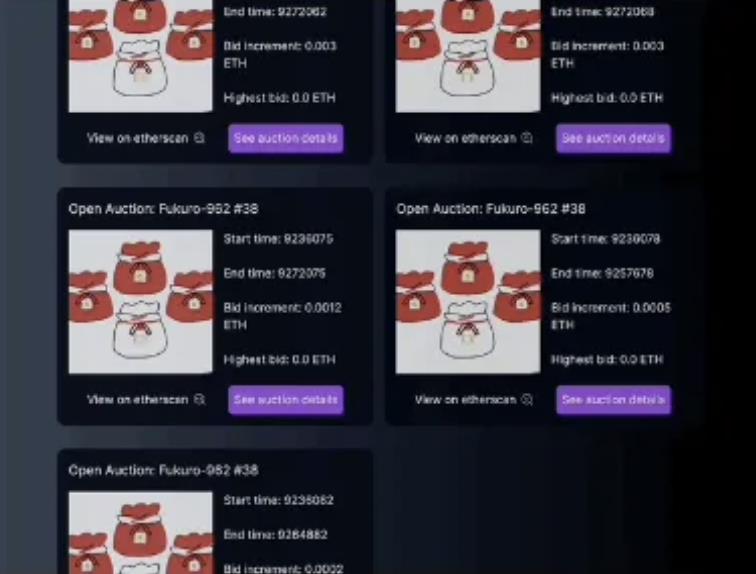
2. Fukuro: Blind box product, finalist at ETHGlobal Waterloo 2023 Hackathon
Features & Innovation:
-
Innovative Trading via EIP-6551: This project leverages EIP-6551 to build an auction marketplace where users can list and bid on Fukuro packs. Inspired by Japanese "Fukubukuro" (lucky bags), each Fukuro pack can contain anything an Ethereum address holds — including other NFTs, ERC-20 tokens, etc.
-
Diversified Asset Trading: Users can trade a wide range of assets — from art collections and trading card sets to strategic investment portfolios.
-
Complete Marketplace Experience: From listing to bidding and trading, users enjoy a seamless end-to-end market experience on a single platform.
Future Outlook:
-
Expanded Use Cases: As the NFT market grows and users embrace novel trading models, the concept of Fukuro packs may attract more artists, investors, and collectors — not only due to its novelty but also because it allows multi-asset bundling, enabling complex trading strategies.
-
Leadership in NFT Auctions: Given the uniqueness of Fukuro packs and their application in auctions, this project could emerge as a leader in the NFT auction space, delivering unprecedented trading experiences and drawing in more users and developers.
-
Integration with Other Platforms: The Fukuro concept could integrate with other platforms and services for richer user experiences — e.g., integrating with DeFi platforms to allow using Fukuro packs as collateral for loans, or with gaming platforms to enable in-game trading of assets inside the packs.
3. Piggybank: Savings jar, finalist at ETHGlobal Waterloo 2023 Hackathon
Features & Innovation:
-
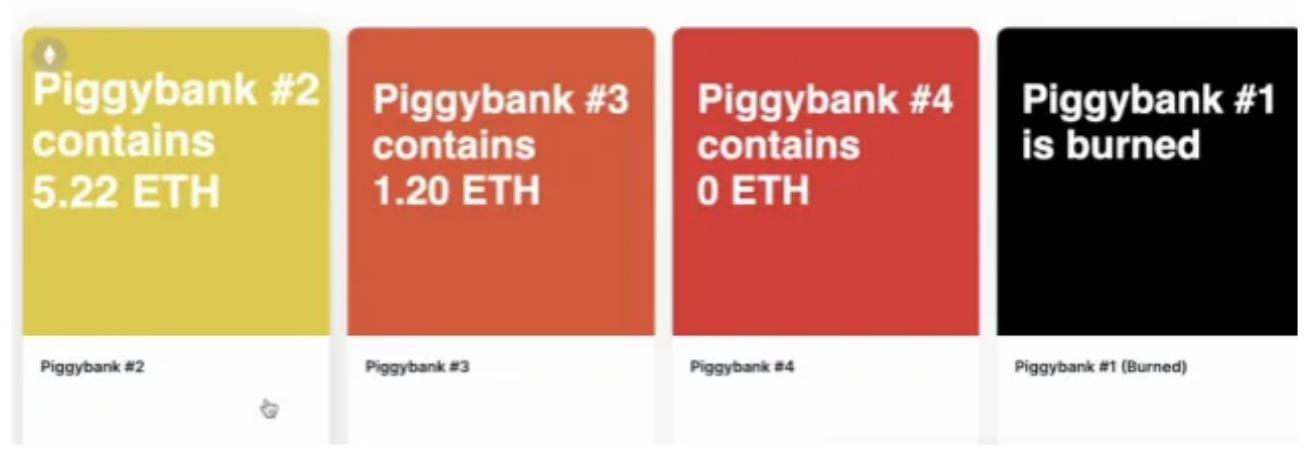
NFT Savings Account: Piggybank 6551 is an NFT-based savings account. Users mint a Piggybank NFT and fund it either through a payment function or by directly sending ETH to the NFT’s 6551 account address.
-
Real-time Metadata Updates: As ETH accumulates in each Piggybank, the NFT’s metadata (color, text labels, attributes) updates instantly thanks to 100% on-chain metadata rendering. Real-time feedback gives users immediate visibility into their savings status.
-
Secure ETH Withdrawal: Piggybank 6551 ensures ETH security — users can only withdraw ETH by burning the NFT. Mint NFT (piggy bank) → Send ETH into NFT → NFT color changes with ETH balance → Withdraw by destroying the NFT.
Future Outlook
-
Integration with Existing NFTs: Piggybank 6551’s design is compatible with all existing NFTs, meaning users can create Piggybank-style vault wallets for any NFT they own.
-
Technical Innovation: By leveraging ERC-6551 and other technologies, Piggybank may introduce new features in the future — such as enhanced security, faster transactions, or improved UI.
-
Pioneer in NFT Savings: By merging NFTs with savings accounts, Piggybank 6551 has the potential to become a leader in the NFT savings sector.
Features & Innovation:
-
Dynamically Generated NFTs: Players own unique NFTs with distinct abilities and traits, creating personalized gameplay experiences.
-
Strategic NPC Battles: Players engage in tactical arena battles against NPCs owned by others.
-
Upgrade System Extends Game Longevity: NPCs can level up through victories, improving stats and unlocking new abilities and combinations. This system provides depth and long-term engagement, encouraging players to continuously enhance their NFTs.
Future Outlook:
-
Richer Game Content: As technology advances, more NPCs, battle scenarios, and strategies can be introduced, offering increasingly diverse player experiences.
-
Cross-Game Applications: The combination of ERC-6551 and dynamic NFTs isn't limited to this game — it may appear in other games or apps, expanding its potential value.
-
Enhanced Strategy and Depth: With ERC-6551, NPCs can own other assets, leading to more complex strategic decisions and increased game appeal.
-
Setting New Trends in NFT Gaming: The project’s uniqueness positions it to set new benchmarks in the NFT gaming space, driving industry-wide innovation.
Features & Innovation:
-
AI-Powered Fully On-Chain Simulation Strategy Game: Parallel Colony is a fully on-chain game where players guide avatars exploring mining colonies. All simulation elements run on-chain, providing a transparent and verifiable gaming environment.
-
ERC-6551 Wallet Functionality: Each avatar functions as an ERC-6551 wallet, capable of owning and trading digital assets such as ERC-20 and ERC-1155 tokens, strengthening player ownership.
-
AI-Agent Interaction: Beyond player commands, AI avatars can act based on their own decisions or requests from other AIs, creating a more complex and strategic gameplay environment.
-
Notable VC Backing: Parallel raised $50 million at a $500 million valuation in October 2021, with investors including Paradigm and YouTube co-founder Chad Hurley.
Future Prospects:
-
Expanding ERC-6551 Use Cases: Leveraging ERC-6551, the game could expand avatar functionalities — such as conducting complex trades, signing contracts, or interacting with other on-chain projects.
-
Leading the On-Chain Gaming Trend: By combining AI and ERC-6551, Parallel Colony has the potential to lead the on-chain gaming space, creating new opportunities and challenges for the industry.
Features & Innovation:
-
Spacebar is a space-themed casual game integrating Web3 tools such as decentralized identity systems, decentralized finance (DeFi), non-fungible tokens (NFTs), and gaming guilds. Players can earn money by selling in-game items. The game will release major updates, with players participating in decision-making. It resembles a mobile game rather than a triple-A title.
-
Autonomy: Spacebar believes a fun game co-built with the community can drive mass adoption of Web3 and crypto. It aims for users to enjoy not just gameplay, but also shaping and governing the game itself.
-
AO Labs raised $4.5 million for its Spacebar Web3 gaming platform.
Future Prospects:
-
Game Launch: Spacebar plans to launch its first game in the coming months, expected to attract many players and crypto enthusiasts.
-
Dynamic and Personalized NFTs: Given ERC-6551’s capabilities, Spacebar may leverage dynamic generation and personalization of NFTs to deliver unique gaming experiences.
-
Enhanced Interactivity: As NFT and Web3 technologies evolve, Spacebar may introduce more interactive mechanics, deepening player immersion.
-
Pioneer in NFT Gaming: Spacebar has the potential to become a leader in NFT gaming, setting new trends and innovations that bring fresh opportunities to the entire industry.
Features & Innovation:
-
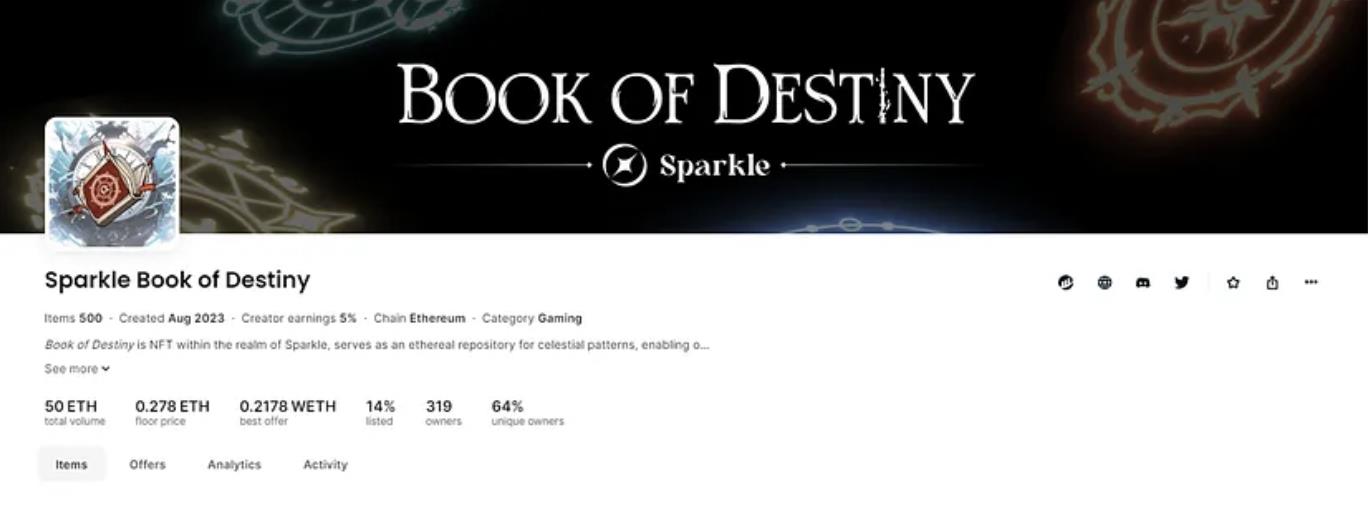
Sparkle is a gamified astrology social app featuring multiple Web3 and AIGC functions, previously selected for Batch 6 of the Binance Labs MVB Accelerator Program.
-
Launched its Genesis NFT on August 7 using the ERC-6551 protocol — limited to 500 units, with total trading volume reaching 50 ETH and a current floor price of 0.27 ETH.
Features & Innovation:
-
Decentralized Music Experience: Onchain Albums offers a decentralized music platform enabling artists to interact directly with fans, bypassing traditional distribution channels.
-
Cross-Platform Support: Artists can publish music across multiple platforms (e.g., Sound, Zora, Lens) and consolidate them into Onchain Albums’ album accounts.
-
Enhanced Copyright Management: Using ERC-6551, artists ensure proper protection and management of their works, while fans gain a secure platform to purchase and listen to music.
-
Flexibility: Artists can update and modify their music anytime, ensuring fans always access the latest and best listening experience.
Future Outlook:
-
More Artist Participation: As Onchain Albums gains recognition, more artists may adopt the platform for releasing and managing their music.
-
Expansion to Other Media: Onchain Albums might extend services to other art forms — such as films, TV shows, or podcasts.
-
Community-Driven Features: Leveraging ERC-6551 and decentralization trends, Onchain Albums could introduce more community-driven features — such as fan voting, crowdfunding, or direct artist-fan interactions.
-
Innovation in Music Industry: Onchain Albums has the potential to pioneer innovation in the music industry, offering new opportunities and experiences for artists and fans alike.
9. Lens V2
Features & Innovation:
-
Decentralized Social Experience: Lens V2 offers a decentralized social platform where users can interact and share content freely, beyond constraints of centralized platforms, resulting in richer, more personalized experiences.
-
Socialization of NFTs: By adopting the ERC-6551 standard, Lens V2 allows users to accumulate value in profile NFTs instead of traditional wallet addresses, enhancing social interaction and experience. By giving NFTs their own social relationships and monetization paths, Lens V2 unlocks new value and opportunities for the NFT market.
-
Multi-Community Support: Users can access and engage with multiple communities, creating unique actions and experiences tied to their handle and NFT.
-
Advantages of Decentralization: Lens V2 leverages decentralization to provide a safer, more transparent, and reliable social platform.
Future Outlook:
-
Greater Interactivity: As technology advances and user demands grow, Lens may introduce new interactive features such as video chat or live streaming.
-
Expanding ERC-6551 Applications: Given ERC-6551’s potential, Lens may further explore its use in social contexts, delivering richer and more personalized experiences.
-
Leadership in NFT Social Networks: With its unique features and decentralized advantages, Lens has the potential to become a leader in the NFT social networking space, bringing new opportunities and challenges to the industry.
-
Integration with Other Platforms: Lens may partner with popular social platforms and NFT markets to offer users an all-in-one social and NFT experience.
Challenges and Difficulties
Macro Challenges Facing the NFT Market
The NFT market is closely tied to the broader cryptocurrency market, especially Ethereum. When the crypto market performs poorly, the NFT market often suffers too. This high correlation implies that the stability and health of the NFT market heavily depend on the wider crypto market’s performance.
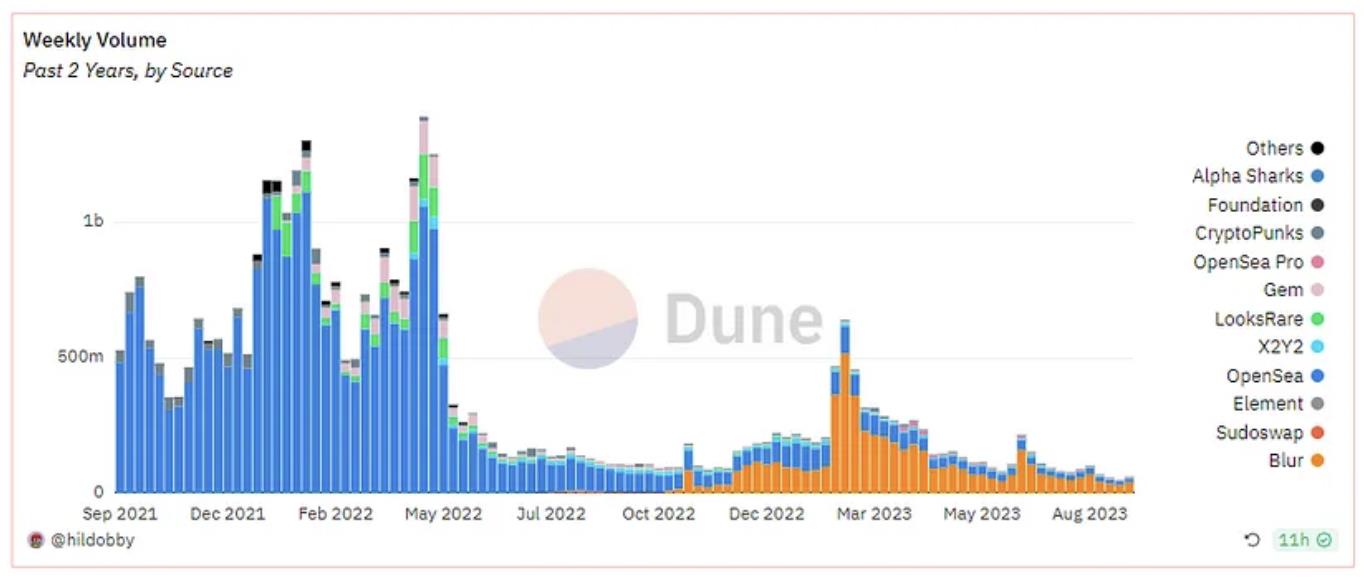
Data further highlights the severity of the NFT market downturn. The market resembles last summer’s slump — trading volume has plummeted. Although Blur briefly boosted demand, bear market conditions have made investors far more cautious. Very little capital is being allocated to NFTs as investments, which also hinders the development of new NFT technologies. Due to market stagnation, the appeal and utility of NFTs are being challenged. To revive the market, new technologies and innovations are needed — otherwise, NFTs may fall into a cycle of pure speculation and hype, losing their true value and potential.
Innovation Bottlenecks
-
Potential and Limitations of ERC-6551: While ERC-6551 enhances NFT interoperability and playability, truly innovative products leveraging this standard remain relatively scarce. This may be because developers and projects are still exploring how to fully unlock its potential.
-
Risk of Fraudulent Behavior: In a decentralized environment, fraud remains a persistent concern. In the NFT market, this could mean bad actors selling counterfeit or fake NFTs. While ERC-6551 adds functionality, it does not directly solve this issue. Ensuring market safety and buyer protection may require solutions at the marketplace level or through external smart contracts.
-
The Problem of Ownership Loops: A potential risk with ERC-6551 is accidentally transferring an NFT to its own token-bound account, locking the asset permanently. Such “ownership loops” could result in irreversible loss. Preventing this may require additional technical safeguards and user education.
Future Outlook: The Strange Evolution of NFTs
For the long-term development of the NFT ecosystem, a recovery in the broader crypto market remains crucial. If the crypto market achieves stable and sustained growth, it will help attract more investors into the NFT space. At the same time, NFT projects themselves must continue innovating and evolving, offering more compelling use cases and practical utility to stimulate market activity.
The arrival of ERC-6551 marks a historic milestone for the NFT space — by turning each NFT into its own smart contract account, it opens a world of new possibilities. This greatly enhances NFT versatility, making them more useful and relevant to users. In the near term, we should closely watch the growing adoption and experimentation with ERC-6551 over the coming months.
In the short term, here are several practical use cases we can expect for ERC-6551:
-
Extension Stores: Developers could build plug-ins installable onto NFTs. Imagine owning an Azuki NFT — currently, you must wait for the project team to deploy new contracts to add features. But with an ERC-6551-powered extension store, developers could release various plugins, allowing you to enhance your NFT independently, without relying on the original creators.
-
Social Sector Applications: Platforms like Lens are already adopting ERC-6551 as a core component. The synergy between ERC-6551 and decentralized social networks could make future social experiences more seamless, enhancing usability while lowering user entry barriers.
-
Blind Box Applications: ERC-6551-based blind box models could bring fresh innovation to the NFT market. By redefining user experience, expanding collectible value, and unlocking new possibilities, this model may become a standout trend.
-
Gaming Sector: ERC-6551’s features could significantly improve user experience in blockchain games — enabling character-level progression, NFT equipment upgrades, character outfitting (NFT fashion), and other essential gameplay functions. ERC-6551 may inject new vitality into gaming and inspire greater creativity among developers.
-
Integration with DAOs: ERC-6551 could enrich DAO communities. For instance, points and SBTs could be embedded into members’ NFTs, granting expanded rights and incentives. This multi-layered empowerment not only boosts member engagement but also lays a solid foundation for sustainable DAO development.
Looking ahead, long-term trends in NFT evolution include:
-
Quantum Copyright Era
In the 21st-century digital age, as quantum computing begins to emerge, we must ask: what happens when quantum computing meets NFTs? Imagine a future where quantum NFTs exist in a state of “superposition” — simultaneously occupying multiple ownership states until observed or traded. This unprecedented “quantum copyright” would completely disrupt traditional notions of ownership and trading, opening vast new creative spaces for artists and creators.
-
Multiverse Interaction with NFTs
With advancements in VR and AR technologies, a multidimensional digital universe may emerge, with NFTs serving as bridges connecting dimensions. For example, a single NFT could exist simultaneously as a 2D digital artwork, a 3D virtual sculpture, and a 4D time-based art piece. This would allow creative works to express different aesthetics across dimensions, adding profound depth to NFTs.
-
DNA-Level Digital Verification
Currently, counterfeiting and fraud are major challenges for NFTs. But imagine combining NFTs with biotechnology — using DNA sequences as unique identifiers for each NFT. This level of authenticity and uniqueness would be nearly impossible to forge. Future NFTs might be tightly linked to their creator’s DNA, guaranteeing provenance and singularity.
-
Super AI as Art Creators
As super AI becomes reality, these AIs could become the future’s leading artists and creators, using NFTs to sell and trade their artworks. With deep learning and big data training, AI-generated art may achieve unprecedented complexity, introducing entirely new possibilities to the NFT market.
-
Fully Automated Circular NFTs
Today’s NFT market focuses mainly on buying and selling individual assets. But in the future, we might see a circular economy model for NFTs — where NFTs can be recycled, remodeled, and reused to create entirely new artworks. This not only helps protect the environment but also delivers continuous value to artists and investors.
In conclusion, the future of the NFT market will far exceed our current imagination — its potential limited only by our creativity and technological progress. Regardless of how NFTs evolve, their core value — providing authenticity, uniqueness, and value for creators — will remain unchanged. There’s no need to feel overly pessimistic about today’s NFT bear market.
Join TechFlow official community to stay tuned
Telegram:https://t.me/TechFlowDaily
X (Twitter):https://x.com/TechFlowPost
X (Twitter) EN:https://x.com/BlockFlow_News
 Bing Ventures


