









Messari Cosmos Hub 2023 Q3 Report: Token price declines quarter-on-quarter, highlighting its role as an interchain security provider
TechFlow Selected TechFlow Selected
Messari Cosmos Hub 2023 Q3 Report: Token price declines quarter-on-quarter, highlighting its role as an interchain security provider
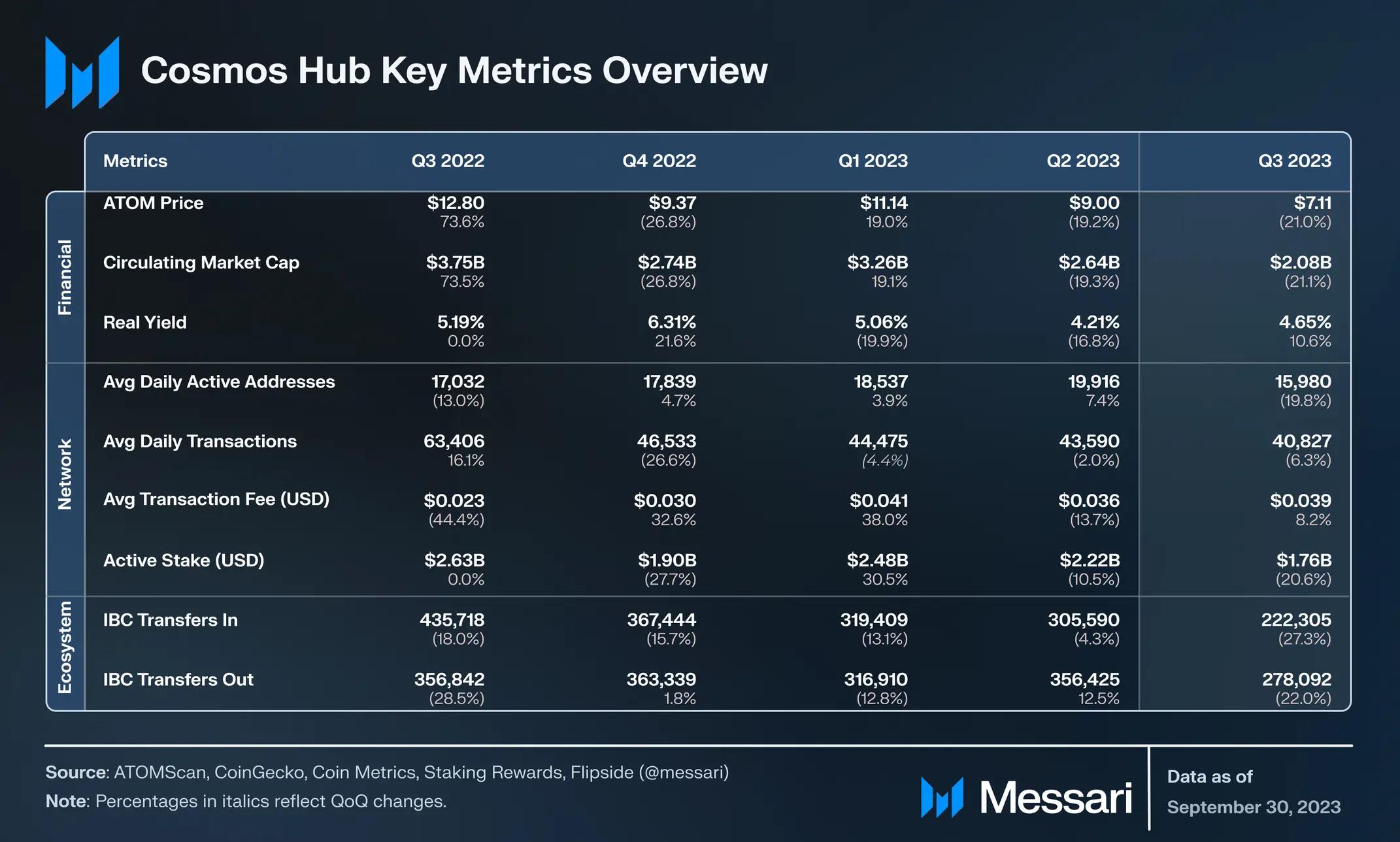
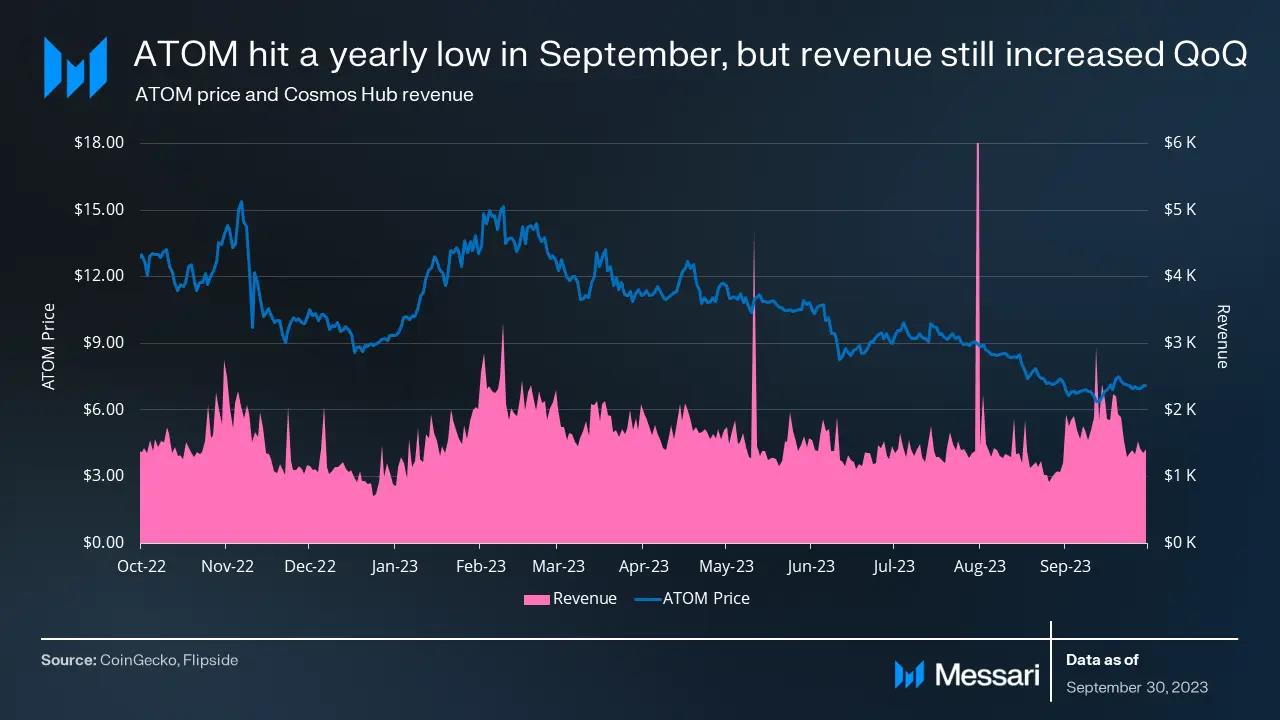
Despite declining ATOM price and Cosmos Hub activity, its revenue increased by 2.4% quarter-over-quarter.
 Navigating Web3 tides with focused insights
Author: Red Sheehan, Messari
Translation: TechFlow
Key Insights
-
Neutron and Stride became the first blockchains secured by Cosmos Hub’s replication security mechanism, sharing its validator set. This marks the beginning of the Atom Economic Zone (AEZ).
-
IBC inbound and outbound transfers declined by 27.3% and 22.0%, respectively. The role of Cosmos Hub is shifting from an interoperability hub to a provider of security.
-
Despite declining ATOM price and reduced activity on Cosmos Hub, its revenue grew quarter-over-quarter by 2.4%.
-
Daily active addresses and daily transaction volume decreased by 19.8% and 6.3% quarter-over-quarter, respectively.
-
The Atom Accelerator DAO selected Blockworks Research, Binary Builders, and RMIT University to propose comprehensive reforms to ATOM tokenomics—the Tokenomics RFP. These teams submitted five forum posts detailing their proposals.
Overview of Cosmos Hub
Cosmos Hub is a standalone application-specific chain focused on interoperability and security. It is a sovereign blockchain using a proof-of-stake (PoS) consensus mechanism with an account-based accounting model and no native smart contract functionality. ATOM is the native token of Cosmos Hub. Cosmos Hub pioneered technologies such as the Cosmos SDK, CometBFT (Tendermint), ABCI, and IBC—technologies later adopted by numerous interconnected networks, collectively known as the Cosmos ecosystem.
The Atom Economic Zone (AEZ) refers to an ecosystem of networks aligned with the ATOM token, including those integrated or otherwise associated with ATOM. Networks that rent security services from Cosmos Hub validators—known as consumer chains—are part of the AEZ. Unlike EigenLayer’s restaking model, Cosmos Hub's security cannot be freely shared due to lack of programmability but can be enabled individually through governance. Replication security (formerly called Interchain Security) allows another chain to share the full validator set of Cosmos Hub via governance-approved authorization.
Launched in 2019, Cosmos Hub leveraged technologies developed by the Interchain Foundation and Ignite (formerly Tendermint). Multiple teams—including the Interchain Foundation, Binary Builders, Atom Accelerator DAO, Informal Systems, and Strangelove—continue to support the development of Cosmos Hub and the broader Cosmos technology stack. The interchain network comprises over 100 independent networks, each backed by distinct supporting entities.
Key Metrics
Financial Analysis
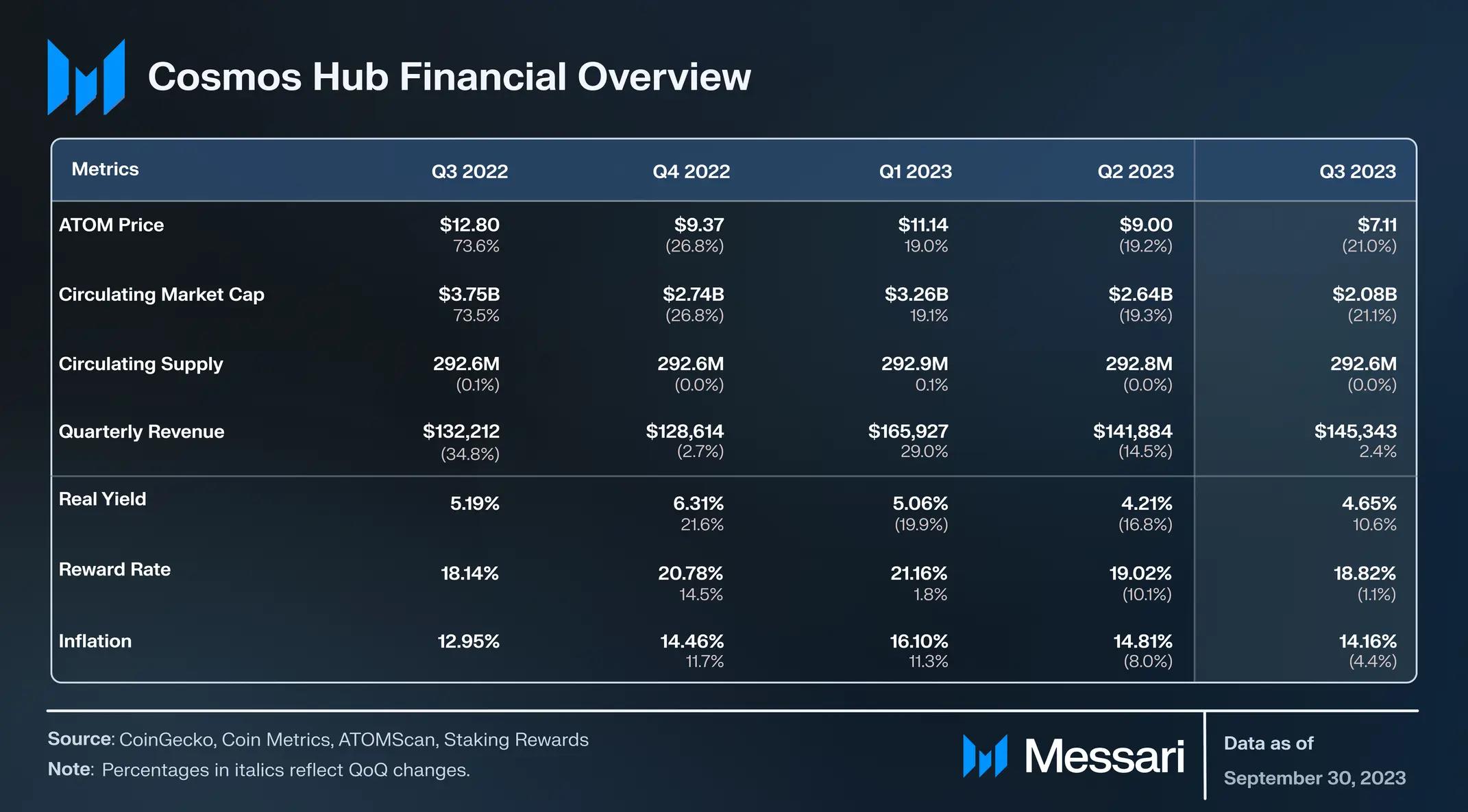
ATOM price declined for the second consecutive quarter, falling 21.0% to $7.11. This underperformed the broader cryptocurrency market, which declined 9.2% during the same period. ATOM’s overall market capitalization ranking slipped from 23rd to 24th. By the end of Q3, ATOM ranked 10th among network tokens by market cap.
ATOM is the native token of Cosmos Hub and is ICS-20 compatible, allowing users to transfer ATOM across chains via the IBC protocol. Total ATOM supply is approximately 356 million, with a circulating supply of about 293 million. This asset serves several functions:
-
Transactions on Cosmos require ATOM to pay fees.
-
Holders can stake ATOM to run validators, secure the network, and earn rewards.
-
Holders can delegate ATOM to existing validators to help secure the network and earn a portion of validator rewards.
-
All staked and delegated ATOM can be used to participate in network governance.
Revenue is measured in total transaction fees. Cosmos Hub’s revenue increased by 2.4% quarter-over-quarter. A spike occurred on July 31, when average daily transaction fees rose to $0.22—far above the quarterly average of $0.04.
ATOM Tokenomics
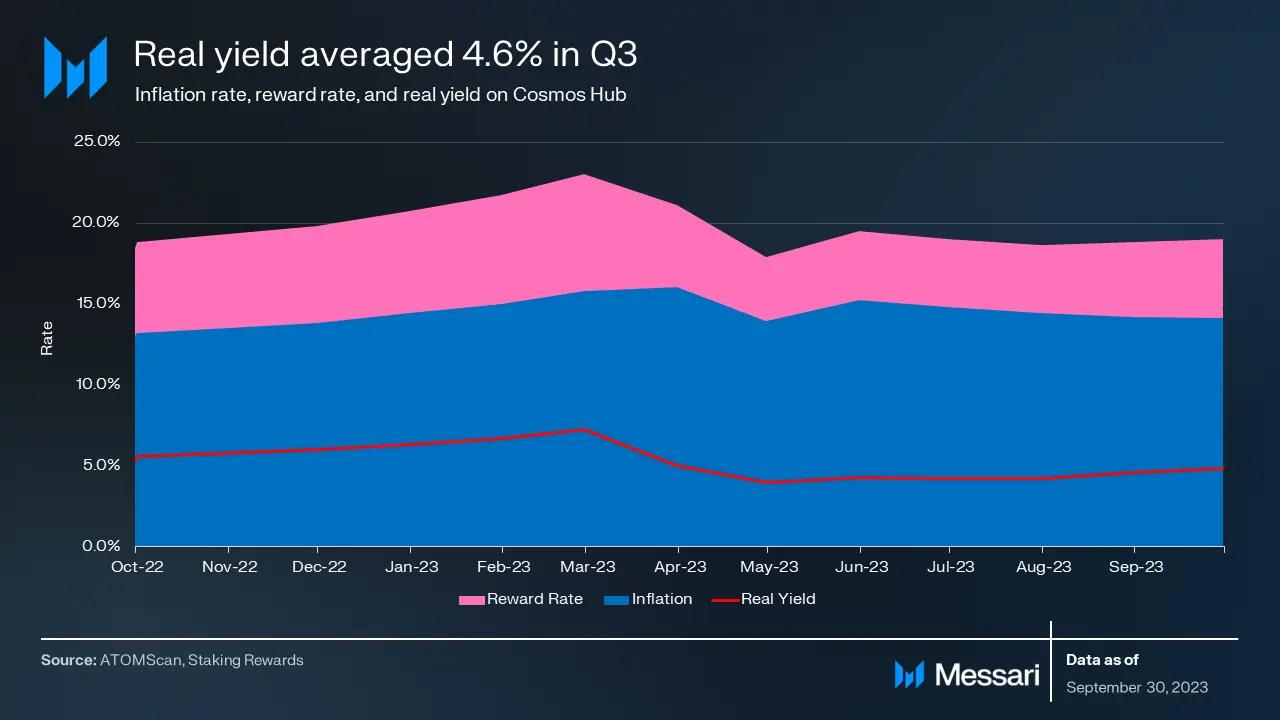
In Q3, the realized yield on Cosmos Hub averaged around 4.5%, ending the quarter at 4.65%. High inflation of ~14% nearly offsets the ~19% reward rate paid to validators and delegators. Circulating supply is primarily affected by staking rewards distributed to validators and delegators. Given both high inflation and high rewards, non-participating ATOM holders face significant dilution pressure.
As of Q3, two deflationary pressures exist for ATOM:
-
Governance Burn - Cosmos Hub features on-chain governance where ATOM holders can vote on and submit proposals, such as changes to consensus parameters or community pool fund allocations. Submitting a proposal requires a minimum deposit of 250 ATOM from any token holder. If the proposal is rejected, the deposited ATOM is burned.
-
Slashing - Validator nodes may have their ATOM rewards slashed if they double-sign transactions or remain offline for extended periods. Slashed rewards are subsequently destroyed.
The rejected ATOM 2.0 proposal reimagined ATOM tokenomics. Its goals included significantly reducing ATOM issuance over several years and eventually eliminating inflation entirely. Additionally, it aimed to improve capital efficiency through liquid staking and position ATOM as an interchain reserve asset. Ultimately, these measures were intended to drive value accrual for the ATOM token.
Although the original proposal was rejected due to its broad scope and rapid implementation timeline, individual components continue to be explored as separate proposals. Notably, two elements introduced in ATOM 2.0—increasing treasury size and enabling liquid staking to improve ATOM capital efficiency—were later approved in subsequent standalone proposals. The community continues discussing other ATOM 2.0 features, including permissionless shared security models and establishing Cosmos Hub as a social coordination (i.e., governance) center for interchain technologies like IBC and CosmWasm.
Since then, the community has failed to pass additional tokenomic-related proposals, such as burning ATOM based on transaction fee volume or incentivizing holders to stake their tokens. Developers are also exploring improvements to Cosmos Hub’s fee mechanism to reduce spam transactions. One proposed solution involves adopting an EIP-1559-like model, where part of the fees paid go to validators and part are burned.
In Q3, the Atom Accelerator DAO (AADAO) selected Blockworks Research, Binary Builders, and RMIT University to propose a new ATOM tokenomics reform—the Tokenomics RFP. These five teams explored governance, liquid staking, treasury, public funding, relationships within the AEZ, and ATOM issuance.
Blockworks Research proposed changes to fiscal policy. The proposal aims to transition from the current static 10% community pool tax to a more diversified taxation approach. This new framework includes:
-
Voting Power Tax: Introduce a tax to discourage delegation to validators with high voting power, addressing centralization concerns.
-
Dynamic Community Pool Tax: Propose changing the community pool tax from a fixed percentage of inflation to a time-declining schedule until reaching a base rate of 5%.
Network Analysis
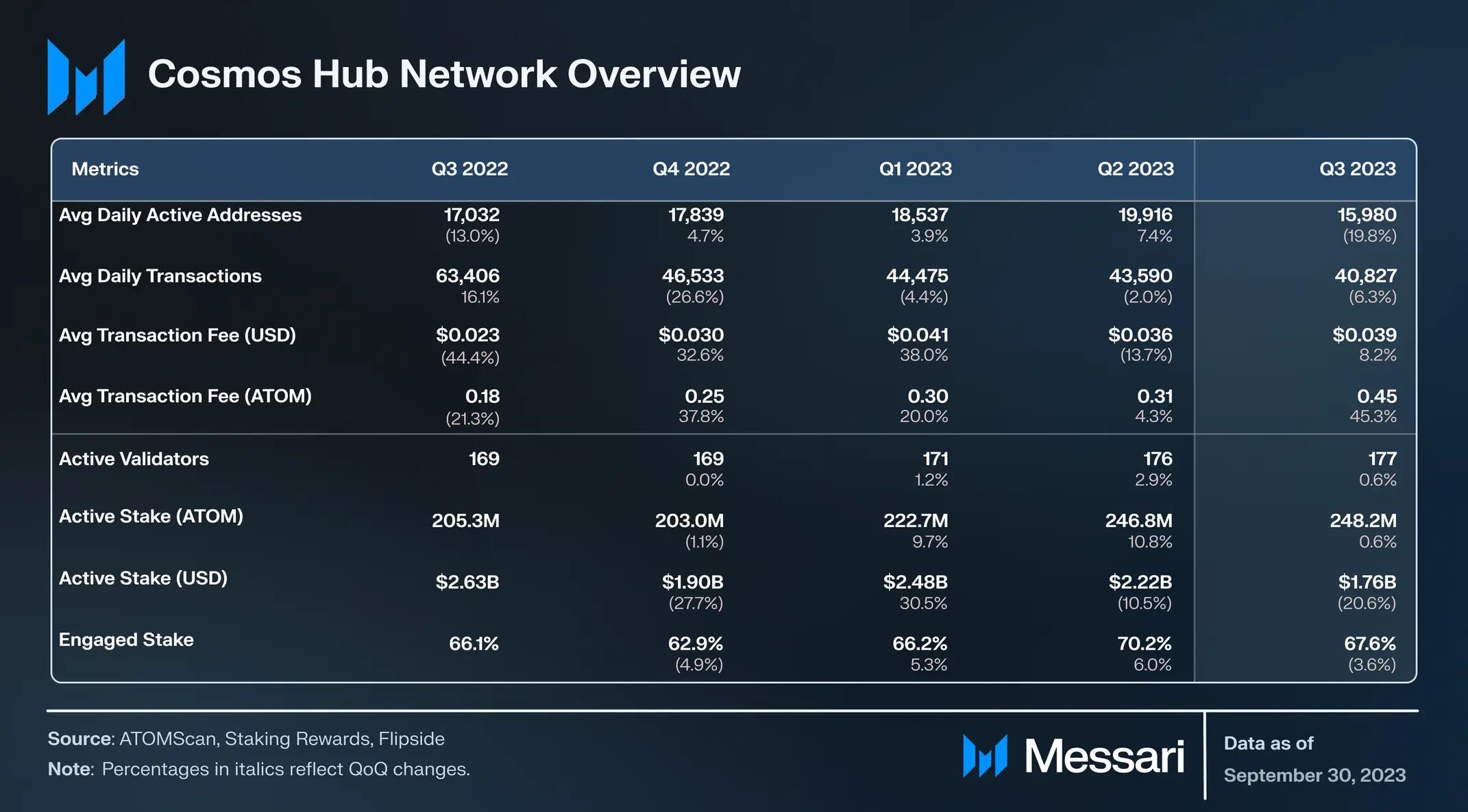
Daily active addresses and daily transaction volume declined by 19.8% and 6.3% quarter-over-quarter, respectively. Cosmos Hub continues transitioning toward becoming the center of a new type of multi-chain ecosystem, serving as a security provider rather than just an interoperability hub. As this transformation progresses, on-chain activity on the Cosmos Hub mainnet may decrease as usage shifts to its “child chains.” This shift is further discussed in the Atom Economic Zone analysis section.
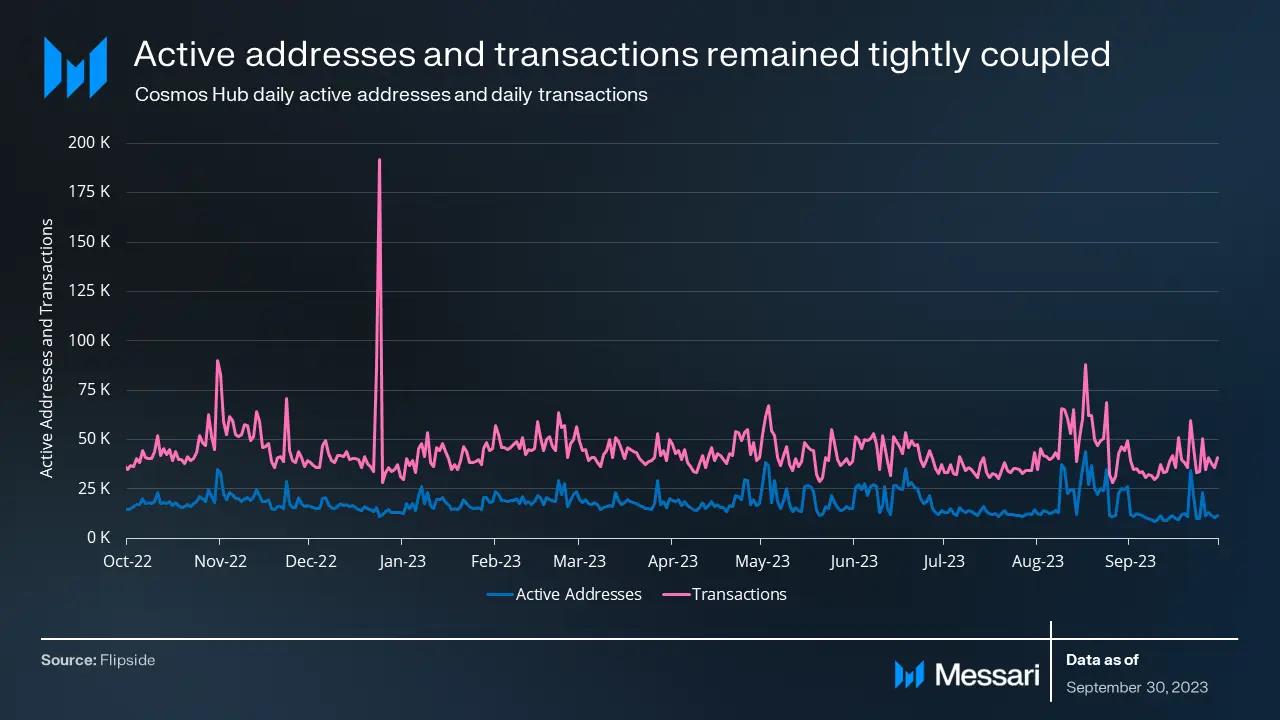
Historically, active addresses and transaction volume have been closely correlated—and this remained true in Q3. The persistent correlation suggests that the surge in transaction activity in August was driven by new users joining and interacting with the network, not merely existing users transacting more frequently.
Staking and Decentralization
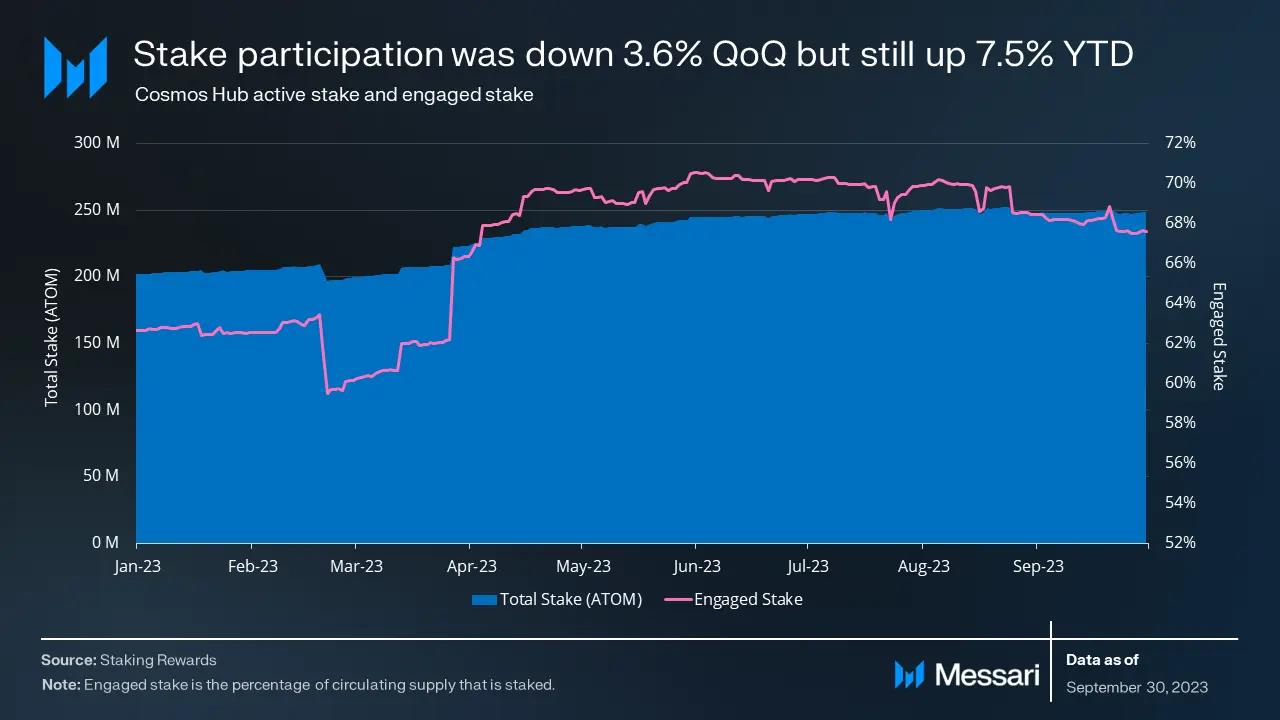
Cosmos Hub’s staking rate of 67.6%, while down 3.6% quarter-over-quarter, remains one of the highest among L1 networks. Stakers include both validators and delegators. Users meeting system requirements can run validators by staking ATOM to secure the network and earn rewards. Token holders can delegate at least one ATOM to existing validators to earn a share of validator rewards. Delegators receive rewards proportional to their staked amount, though they must pay commissions set individually by validators. In Q3, Governance Proposal 826 set a minimum commission rate of 5% for validators.
Only the top 180 validators (ranked by self-staked and delegated ATOM) earn rewards. Among them, the top eight control 33% of total staked ATOM, giving Cosmos Hub a Nakamoto coefficient of 8.
Governance and Grants
Cosmos Hub combines off-chain and on-chain governance processes. Network improvement proposals and parameter changes are designed and discussed off-chain, typically on the Cosmos governance forum. Anyone can propose network or fiscal management initiatives and participate in discussions about pursuing them. Users can also submit formal change requests as official proposals to Cosmos Hub’s on-chain governance system. Once submitted, ATOM holders vote on whether to approve (and ultimately execute) the proposed changes.
There were 24 governance proposals in Q3, with 10 passing. Notable approvals included software upgrades V11, V12, and V13, as well as expanded authority for AADAO over ATOM protocol-owned liquidity (POL). AADAO Transparency Report 4 details the DAO’s financial allocations and grants. In Q3, AADAO disbursed $1.097 million across its fourth and fifth grant rounds to recipients. Funded projects included sponsorship of Cosmoverse and DoraHacks hackathons. The sixth round was announced afterward and grants were distributed in October. These rounds bring the total number of AADAO grants awarded to 27, valued at $2.5 million.
Binary Builders’ “ATOM Aligned Treasury” (AAT) initiative aims to increase decentralization of Cosmos Hub governance and voting. Amid rising validator operating costs and concerns about network centralization, Binary Builders proposed allocating additional shares to validators based on their voting power. The proposal seeks to support smaller validators and further decentralize the network. It also explores how ATOM could be used to exercise voting power on other AEZ networks (see Atom Economic Zone analysis for more detail).
Blockworks Research’s proposal has governance implications beyond fiscal policy changes, as outlined in the financial analysis section on ATOM tokenomics.
The voting power tax aims to address equity concentration by taxing delegations to validators with high voting power.
With growing demand for liquid staking, a dynamic liquid staking tax would apply to liquid stakers. The goal is to generate revenue for Cosmos Hub while finding a natural equilibrium for market penetration of liquid staking.
Removing the 25% liquid staking cap would allow more participants to benefit from liquid staking. While Cosmos Hub itself does not natively support liquid staking, it can be accessed via Stride within the AEZ. This is further discussed in the Atom Economic Zone analysis.
Cubic Delegation (Cubic Delegation) could potentially resolve centralization issues in on-chain governance while still ensuring quorum requirements are met.
IBC
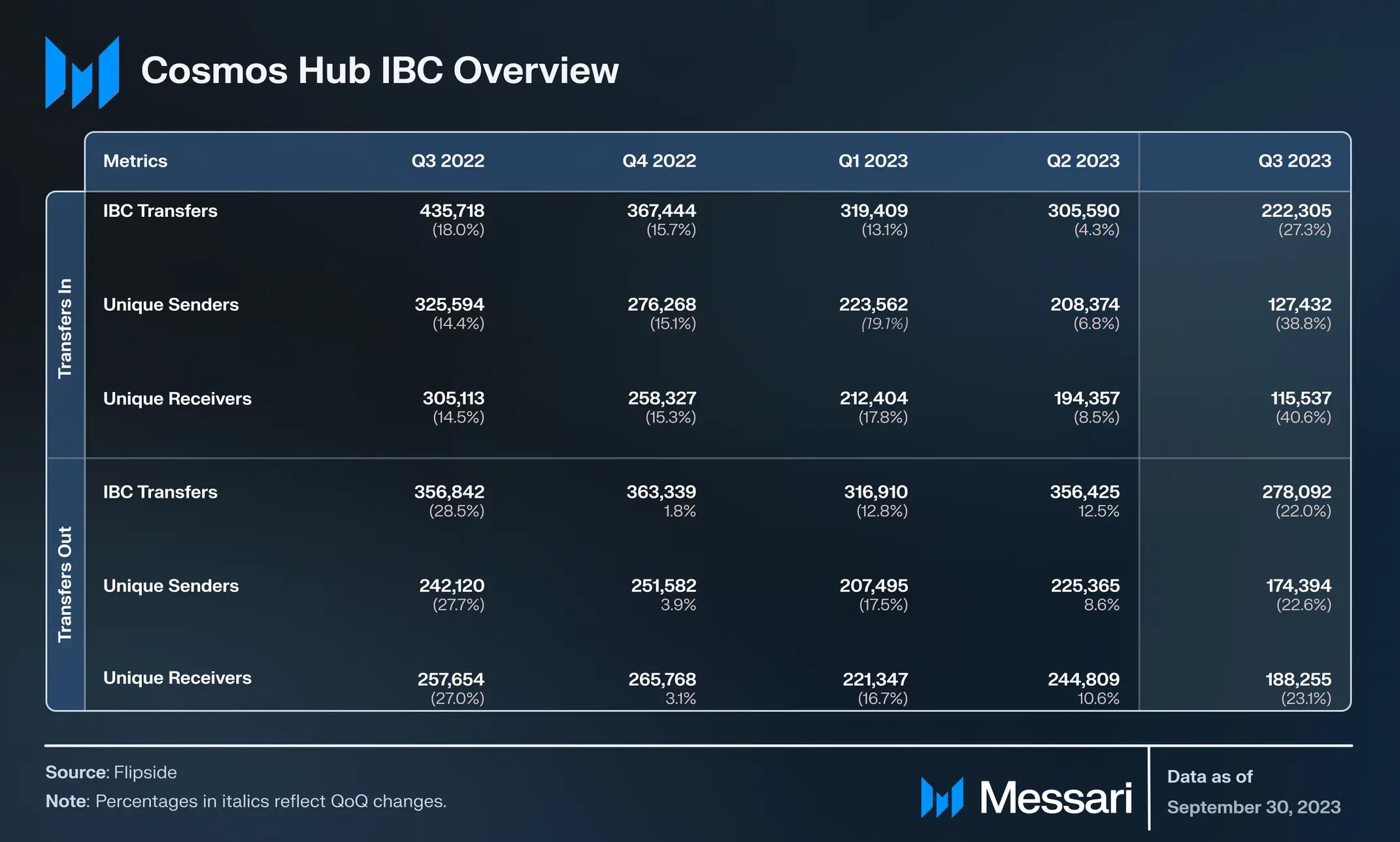
Cosmos Hub has 56 IBC peers and 269 IBC channels. "Peers" refer to distinct counterparties that have established IBC connections with Cosmos Hub; "channels" refer to the total number of available routing paths between peers. Activity metrics—including unique senders, unique receivers, and total transfer volume (inbound and outbound)—all declined. Inbound unique receivers dropped the most, decreasing 40.6% quarter-over-quarter. All IBC metrics reached annual lows.
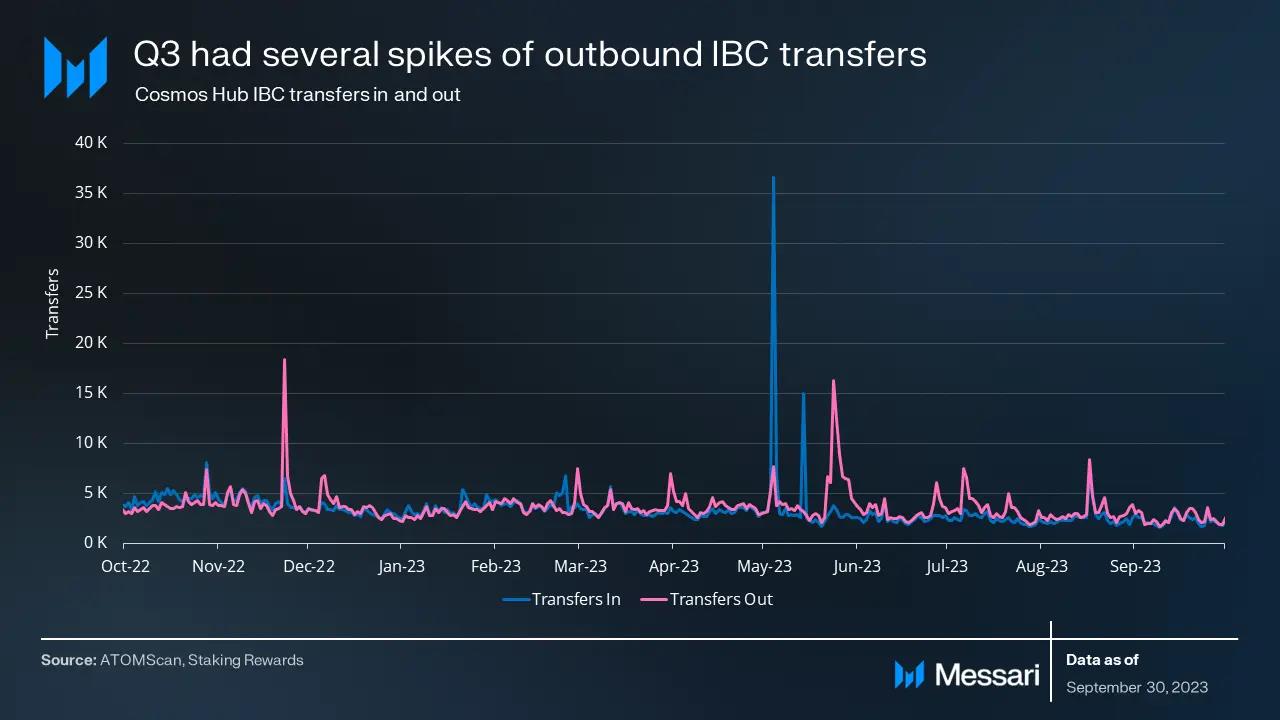
In most cases, inbound and outbound transfers are closely correlated. Exceptions include a major inbound spike in May 2023. In Q3, there were several instances where daily outbound transfers exceeded inbound volumes by 2–3 times.
Atom Economic Zone
The Atom Economic Zone (AEZ) is a collection of ecosystems aligned with the ATOM token, including networks that integrate or associate with ATOM in various ways. The AEZ includes multiple networks with differing capabilities. Stride and Neutron receive replication security; Osmosis allows ATOM to be used for fee payments. Other networks (such as Kujira or Agoric) rely heavily on ATOM for liquidity provision.
Replication security (formerly Interchain Security), a form of shared security, is the most prominent AEZ strategy pursued by the Cosmos Hub community and other interchain networks. Shared security enables validators from one network to use their stake to participate in the consensus of another network. This setup allows smaller-market-cap networks to “rent” security from larger ones. As of Q3, Neutron and Stride are the only chains utilizing replication security.
Binary Builders’ “ATOM Aligned Treasury” (AAT) aims to make ATOM the default currency within the AEZ and align staking and governance between Cosmos Hub and consumer chains. The team intends to use AAT funds for development work and providing liquidity within the AEZ.
Neutron
The passage of Proposal 792 made Neutron the first chain to leverage Cosmos Hub’s validator set and security via replication security. Functioning as a CosmWasm extension of Cosmos Hub, Neutron effectively becomes the DeFi hub of the Cosmos ecosystem.
Neutron remains a relatively new network, launched only this year. Proposal 72 allocated Cosmos Hub funds for Neutron’s development, and Proposal 819 redirected those funds directly to the Neutron Foundation.
Stride
Stride implemented replication security shortly after Neutron. The network provides liquid staking for various interchain networks and assets. Since ATOM is central to Stride’s activity, it was a natural early candidate for Cosmos Hub security. Liquid staking represents a large market narrative present across other ecosystems. With replication security, Cosmos Hub now offers a liquid staking solution within the AEZ, with utility enhanced through governance alignment.
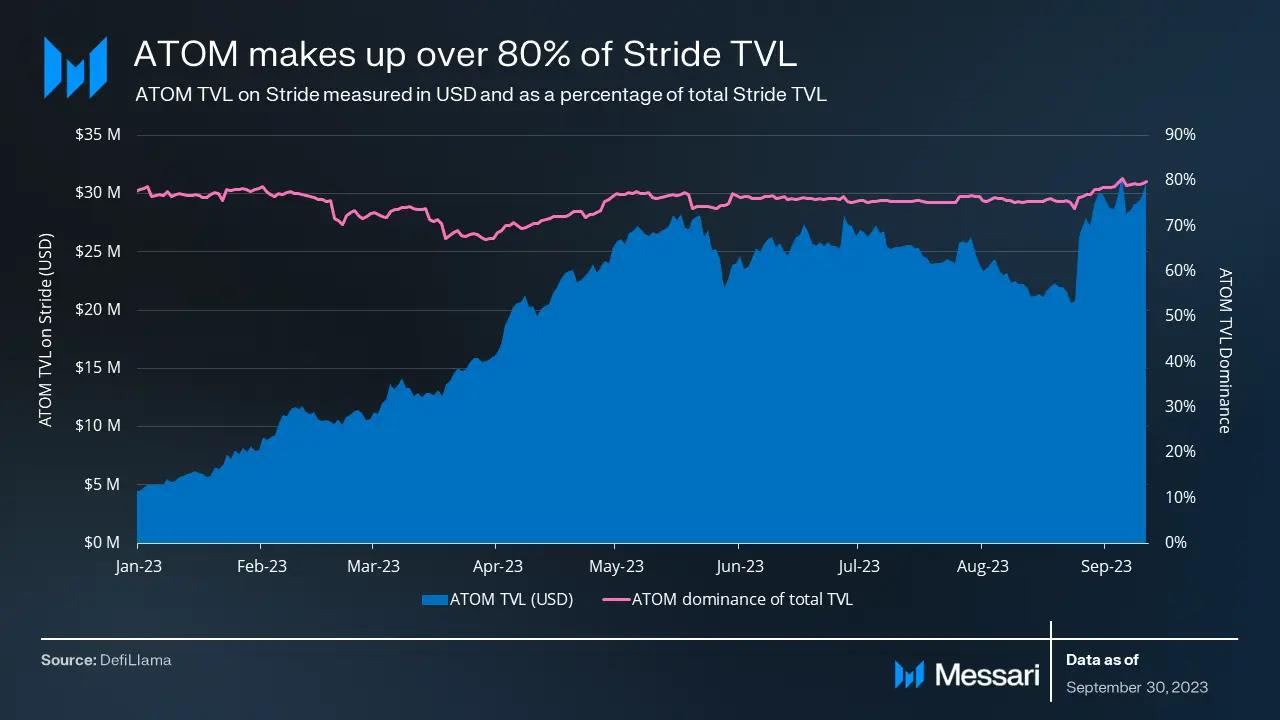
Other networks within the AEZ also place strong emphasis on stATOM—the staked form of ATOM via Stride. Cosmos Hub Proposal 805 (an amendment to Proposal 800—"Liquidity as a Service") will enable AADAO to deploy 450,000 ATOM into an ATOM/stATOM constant product pool on Astroport Neutron. On Osmosis, the ATOM/stATOM pool has over $20 million in TVL.
Governance Proposal 817 seeks community approval to appoint a five-member advisory committee responsible for evaluating and selecting host chain validators through the Stride delegation process.
Osmosis
Osmosis AMM DEX has been deeply integrated with Cosmos Hub and ATOM since inception. As of Q3 2023, the largest and first pool on Osmosis is the ATOM/OSMO pool. Approximately 75% of Osmosis’ TVL comes from ATOM pools (primarily ATOM/OSMO and ATOM/stATOM).
Osmosis’ role and “ATOM alignment” within the AEZ extend far beyond liquidity pairs. ATOM serves as an alternative fuel token on the DEX. While ATOM is used for fees in some cases, many such activities are suspected to be bot-driven due to observed patterns.
Proposal 810 on Cosmos Hub will determine Osmosis DEX’s eligibility for flexible fee payment options. The proposal would allow transaction fees on Cosmos Hub to be paid in any token, leveraging Osmosis to swap alternative tokens into ATOM.
Other Networks
Additional chains may soon join the AEZ with varying capabilities. Composable Finance submitted a proposal to join the AEZ and obtain replication security from Cosmos Hub, similar to Stride and Neutron. With Neutron positioned as the programmability and DeFi hub, Stride as the liquid staking solution, Composable proposes to become a rollup settlement center, connecting to other multi-chain ecosystems.
While replication security has a clear definition, “ATOM alignment” is more subjective. Some community members argue that networks whose ecosystems are deeply intertwined with ATOM—such as Agoric and Kujira—are already part of the AEZ. In other words, ATOM tokens can provide substantial liquidity to Cosmos Hub and facilitate extensive interchain activity.
Conclusion
Since its inception, Cosmos Hub’s role has been that of an interoperability center and focal point for the broader Cosmos ecosystem. In Q3, Cosmos Hub took a significant step toward becoming a security provider. Through replication security, Neutron and Stride became the first chains protected by Cosmos Hub. This new positioning of Cosmos Hub as a modular security provider strengthens its role as a cultural centerpiece for the wider Cosmos ecosystem as more chains join the Atom Economic Zone.
The Cosmos community has submitted proposals for additional chains such as Composable Finance to join. Moreover, other interchain networks are exploring different forms of “ATOM alignment,” such as using ATOM for fee payments, to become part of the Atom Economic Zone.
Following the rejection of the ATOM 2.0 proposal—which reimagined ATOM tokenomics in multiple ways—most of its concepts continue to be explored as smaller, standalone proposals. Governance, decentralization, liquid staking, fiscal policy, and tokenomics were key themes explored in Q3. AADAO has continued funding teams to address these topics, including through the Tokenomics RFP initiative.
Join TechFlow official community to stay tuned
Telegram:https://t.me/TechFlowDaily
X (Twitter):https://x.com/TechFlowPost
X (Twitter) EN:https://x.com/BlockFlow_News
 Messari











