It's been a year since FTX collapsed—how are crypto market makers doing?
TechFlow Selected TechFlow Selected
It's been a year since FTX collapsed—how are crypto market makers doing?
Some have shifted the focus of their trading activities, while others are seeking new sources of revenue beyond market making.
 Navigating Web3 tides with focused insights
By Suvashree Ghosh, Olga Kharif
Translated by Luffy, Foresight News
Alameda Research, the core trading arm of Sam Bankman-Fried’s failed crypto empire, has left a lasting void. Nearly a year after its collapse, the business of providing liquidity in crypto markets is still struggling to recover.
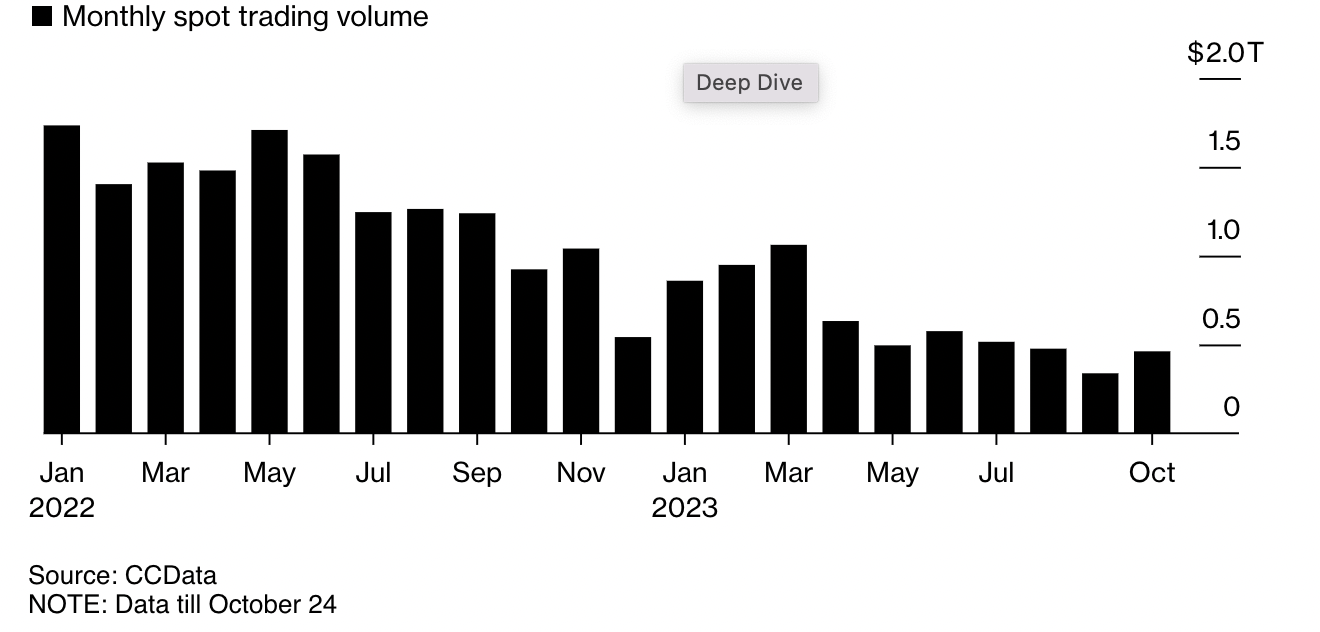
Despite last week's nearly 16% surge in Bitcoin that boosted trading volumes, the market remains far from pre-crypto winter levels. According to CCData, October saw the first monthly increase in trading volume since June, yet it was still down 50% compared to before FTX’s bankruptcy in November 2022.
This means liquidity providers—firms that profit from the spread between buy and sell prices of tokens—face the daunting task of generating revenue in a market lacking both volatility and volume, once defining features of the cryptocurrency industry. Some have shifted their trading focus, while others are seeking new income streams beyond market making.
"This year has been very difficult for market makers due to lower trading volumes, regulatory uncertainty across multiple jurisdictions, and heightened concerns about counterparty risk on exchanges," said Richard Galvin, co-founder of Digital Asset Capital Management. He added that if the recent rally continues, "it will be a welcome opportunity for profit for those market makers and traders still active."
Trading volume across exchanges has halved since FTX collapsed a year ago.
Here’s what some of the remaining major players in crypto market making are up to:
Wintermute
Evgeny Gaevoy, co-founder of Wintermute Trading Ltd., said in an interview that Wintermute, one of the largest crypto market makers, has remained profitable and is diversifying its operations in preparation for another bull cycle. The firm currently trades between $2 billion and $3 billion daily, down from $7.5 billion at the peak of the 2021 market, according to Marina Gurevich, chief operating officer.
As part of efforts to generate revenue beyond traditional market making, Wintermute has become a key player on the Ethereum network by helping to bundle transaction blocks. Gaevoy said the goal is to gain a competitive edge in block building, which helps the firm earn more from arbitrage and other opportunities.
Gaevoy also said Wintermute is backing an as-yet-unlaunched lending project, considering launching a crypto derivatives exchange, and working on rolling out a crypto-related index. He declined to provide further details on each initiative, though timelines remain undetermined. Since 2020, the company’s venture arm has backed more than 80 projects.
Gurevich said in written responses to Bloomberg inquiries that Wintermute, based in London and Singapore, plans to add 10% or 10 employees over the next two to six months.
Cumberland DRW
Cumberland, the crypto subsidiary of Chicago-based DRW, was founded in 2014 and focuses on over-the-counter (OTC) and proprietary trading. The firm said its OTC derivatives business continues to grow and offers bilateral crypto options on BTC, ETH, and SOL through ISDA agreements.
DRW, Cumberland’s parent company, co-founded ErisX (later acquired by Cboe Global Markets Inc.) and Digital Asset Holdings. Cumberland Labs, its blockchain incubation arm, has supported companies such as Hashnote and Expand.network.
GSR Markets
Based in London, GSR is one of the oldest market makers in the crypto space, founded in 2013 by former Goldman Sachs traders, and has grown into one of the leading firms in the sector. It recently received approval from Singapore’s central bank to offer digital payment token services in the country.
GSR told Bloomberg it has historically traded across various tokens but is now focusing more on Bitcoin and Ethereum, the two largest cryptocurrencies.
The company is also an active venture investor through its investment arm, GSR Investments. According to a spokesperson citing data from Messari, GSR Investments is one of the most active investors in the industry, holding stakes in EDX Markets, Ethena, and LayerN. The spokesperson said venture activity had picked up this quarter after a “quiet summer.”
GSR laid off staff this year, joining many crypto firms seeking to adapt to harsher market conditions. The spokesperson said the cuts were made to “align and develop our business with the current direction of the crypto industry.” The company is now “actively hiring” for roles in trading, engineering, legal, and finance.
Jump Crypto
Chicago-based Jump Trading, primarily engaged in traditional securities trading, launched Jump Crypto in late 2015 to begin investing in crypto assets. However, amid regulatory uncertainty in the U.S., the firm has been winding down its crypto trading activities in the country. Jump was a major backer of the TerraUSD project and was among the firms questioned by U.S. prosecutors during the investigation into TerraUSD. Jump Crypto also incurred losses from the FTX collapse—having been a client of FTX—and compensated users after the Wormhole protocol suffered a $320 million hack. According to research by Blockworks, Jump appears to have recovered its funds.
Jump Crypto is another prolific venture investor, with recent investments including Outdid and Coinflow Labs. A Jump spokesperson declined to comment on details related to the company.
Flow Traders
Amsterdam-based Flow Traders is a well-established market maker across various traditional asset classes and has been active in crypto since 2017. Its crypto division employs around 60 people, mainly based in Europe, and the firm remains cautious about expanding the team.
Flow’s exposure to FTX was “negligible,” and it remains “committed to building the digital asset ecosystem as a market maker and strategic investor.” According to the company’s half-year earnings report, it held €89.2 million ($94.1 million) in digital assets for trading as of end-June, up from €58.3 million at end-December.
In its report, Flow Traders said it expects regulatory uncertainty to persist into 2023 and beyond, adding that it is working with regulators to help establish a “clear and fair regulatory framework.”
According to Flow Traders’ half-year report and website, it trades spot, futures, options, and exchange-traded products in digital assets without taking directional bets. In July 2022, the company established its venture arm, Flow Traders Capital, with a €50 million ($52.7 million) fund and has invested in firms including Blockdaemon, Elwood, Sei Network, and Ondo.
Auros Global
The New York- and Hong Kong-based market maker had approximately $20 million in assets frozen when FTX collapsed, ultimately prompting the company to file for provisional liquidation in the British Virgin Islands to restructure its debt.
In March, Auros raised $17 million from investors including Vivienne Court, Bit Digital, Trovio, Epoch Capital, Primal Capital, and a consortium of alumni from top-tier market maker Optiver, helping it navigate the crisis.
Since then, the company has “optimized its investments in certain crypto exchanges and strengthened risk management,” while demanding greater transparency from exchanges it works with, a spokesperson said. The firm collaborates with over 50 exchanges and is currently focused on higher-liquidity tokens, according to its website.
Auros said it processed $1.3 million in daily trading volume in October, down from a peak of $2.5 million per day in May 2021.
Portofino Technologies
Switzerland-based Portofino, founded in April 2021 by former Citadel Securities employees, is a relatively young player among digital asset market makers. In 2021, it raised $50 million from investors including Coatue Management, Valar Ventures, and Global Founders Capital.
A Portofino spokesperson said in an email to Bloomberg that the firm typically focuses on high-market-cap tokens traded on the largest crypto exchanges. The spokesperson added that Portofino was actively trading on FTX in 2022 but had limited assets there. While market-making profits across certain asset types have declined sharply globally, Portofino expects “trading volumes in the crypto market to continue growing over the coming months, as we see several significant catalysts bringing institutional and retail investors back into the crypto market.”
Join TechFlow official community to stay tuned
Telegram:https://t.me/TechFlowDaily
X (Twitter):https://x.com/TechFlowPost
X (Twitter) EN:https://x.com/BlockFlow_News
 @Bloomberg