









Secure Sui Move is the cornerstone of Web3's path to mass adoption
TechFlow Selected TechFlow Selected
Secure Sui Move is the cornerstone of Web3's path to mass adoption
The design of Sui Move is inherently secure and can address vulnerabilities present in other programming languages.
 Navigating Web3 tides with focused insights
Without trust, there can be no mass adoption of Web3. While other significant barriers to the arrival of the first billion users include confusing user experiences, complex authentication patterns, and uncertain regulatory frameworks, the most critical obstacle remains the widespread skepticism and distrust toward blockchain technology.
For many people, blockchain equals crypto, which equals scams. Stories of hacks or rogue actors dominate the Web3 narratives seen in mainstream media. In just the first eight months of 2023, nearly $1 billion in funds was lost on-chain due to malicious activities. Until people believe blockchain is secure, Web3 will not become standard infrastructure for mainstream products.
Just as technology carries many risks, security also has many components. But a key aspect of keeping blockchains secure is writing secure code. Insecure code can lead to asset theft, fraud, and unauthorized access, which in turn may reduce investment in high-value sectors like DeFi. Vulnerable code can be exploited by attackers, resulting in data manipulation and financial losses. Users rely on the security of cryptographic code to trust the integrity of transactions and smart contracts. Breaches caused by poorly written code can undermine this trust, leading to a loss of confidence in the system.
Ethereum launched in 2015 as a smart contract platform. Despite known security vulnerabilities in programming languages such as Solidity, Ethereum's Solidity language remains popular, along with Vyper, across most EVM and EVM-compatible chains. Even with improvements in tools and audits, many major exploits and large-scale hacks are still caused by vulnerabilities that have been known since the early days of smart contract programming. New programming languages have been developed to address these issues, offering higher security for developers and users. For example, on Sui, a variant of the Move programming language called Sui Move is used because it is inherently secure and expressive.
Move is particularly secure by design and was created in part to address vulnerabilities found in Solidity, such as reentrancy attacks, double-spending, DoS attacks, and compiler issues. These types of attacks continue to cause significant financial losses, including the July 2023 recursive attack on Curve Finance pools (https://cointelegraph.com/news/curve-vyper-exploit-whole-story-so-far), where attackers stole digital assets worth $60 million. While Move is explicitly designed to eliminate many of Solidity’s flaws by protecting developers from writing certain errors and vulnerabilities into their code, it does not prevent people from intentionally writing malicious code. Audits and other checks are still required to detect such issues and other vulnerabilities.
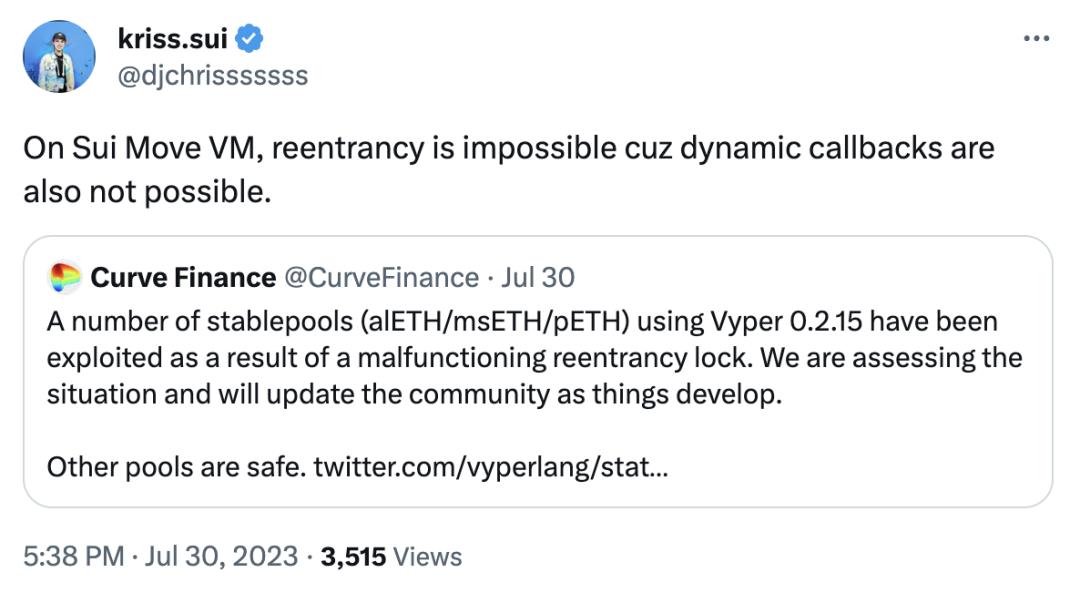
Another built-in security feature of Move is the bytecode verifier. It ensures that a smart contract’s bytecode is valid and safely executable. The EVM only offers source code verification, which merely confirms that the source code matches the bytecode to be executed, but does not verify the correctness of the smart contract itself. The bytecode verifier is designed to ensure that malicious code—such as code that creates counterfeit coins, artificially inflates coin values, or copies/deletes existing coins—cannot be executed on-chain.
Sui Move is object-centric, which also helps minimize the execution of insecure code. Naturally, each function clearly shows which object it is operating on. By simply looking at a function signature, you can determine the maximum potential damage if the contract were designed to behave maliciously. You can clearly see what parameters a function accepts and what it returns. For instance, when you accept a coin balance, it is obvious you are operating on the coin balance in your wallet—there are no surprises. This level of clarity is not always present in contracts written in Solidity.
While no smart contract programming language is completely secure today, Move—and especially Sui Move—is significantly more secure than others currently available in the market. Start learning Move today!
Join TechFlow official community to stay tuned
Telegram:https://t.me/TechFlowDaily
X (Twitter):https://x.com/TechFlowPost
X (Twitter) EN:https://x.com/BlockFlow_News
 Sui Network






