Interview with Monad Labs CEO: From Traditional to Future — The Former Jump Trading Team Exploring the Role of Public Blockchains in On-Chain Finance
TechFlow Selected TechFlow Selected
Interview with Monad Labs CEO: From Traditional to Future — The Former Jump Trading Team Exploring the Role of Public Blockchains in On-Chain Finance
Currently, DeFi's inefficiency is insufficient to effectively compete with traditional finance, which processes billions of transactions daily.
 Navigating Web3 tides with focused insights
Interview & Editing: Sunny and David
Monad Labs: Keone Hon
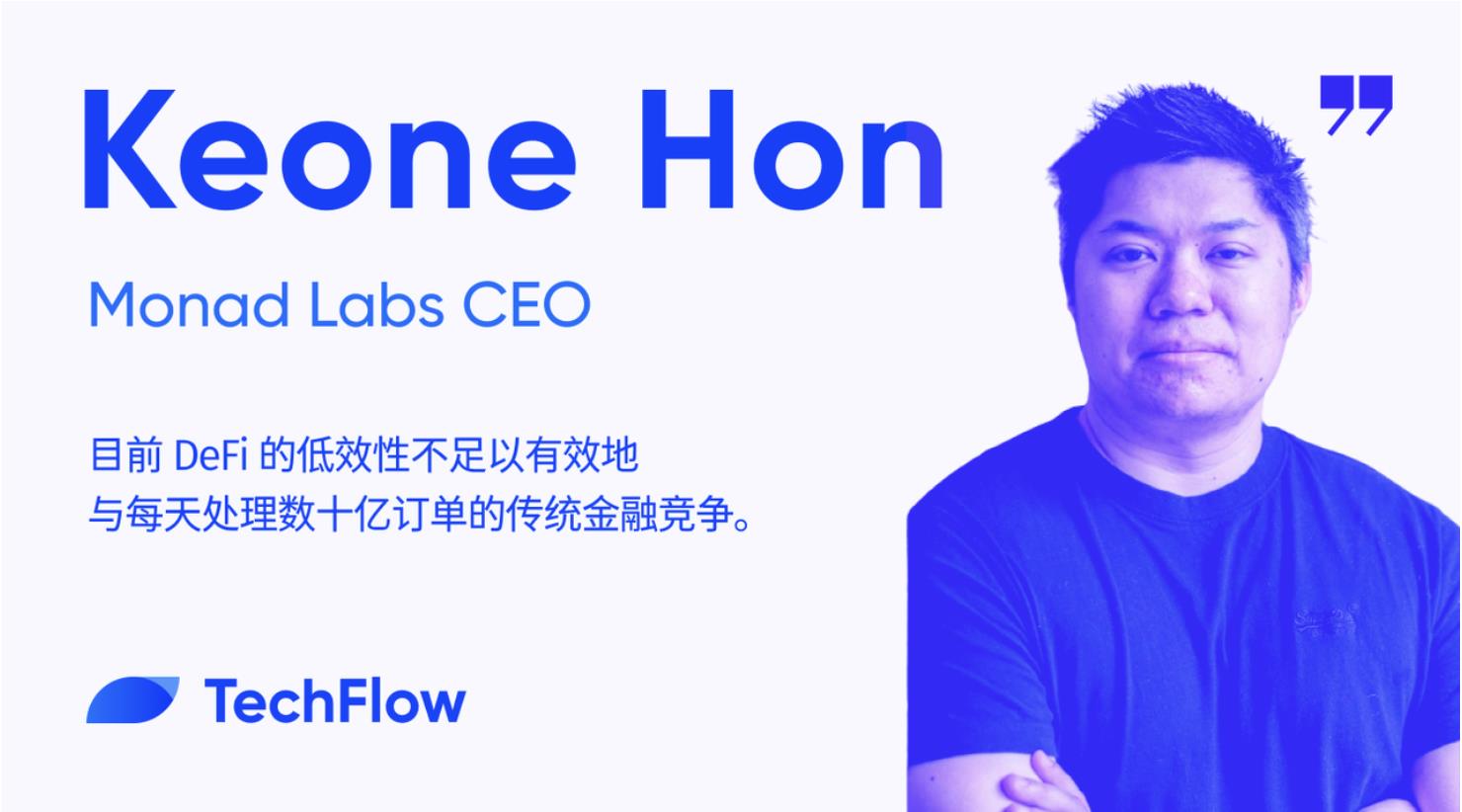
“The current inefficiency of DeFi is insufficient to effectively compete with traditional finance, which processes billions of orders daily.”
--- Keone Hon, CEO of Monad Labs
Preface
“In traditional finance, the S&P 500 mini futures contract is a high-volume trading instrument, with each contract having a notional value of $250,000. It trades between 2 to 4 million contracts per day, resulting in up to $1 trillion in notional trading volume.
In contrast, a DeFi platform like Uniswap has only reached $1 trillion in total historical trading volume. Transaction sizes in DeFi are also much smaller.”
Keone is the founder and CEO of Monad Labs. Prior to founding Monad Labs, Keone spent eight years at Jump Trading, a leading proprietary trading firm in both traditional and crypto markets, focusing on algorithmic and high-frequency trading strategies. There, Keone led teams of high-frequency traders and engineers managing vast amounts of unstructured market data from various exchanges, transforming chaos into actionable insights.
At Jump Trading, Keone met his co-founder James Hunsaker, and together they challenged the status quo: “Ethereum cannot operate efficiently” enough to support the scale and user experience required for future on-chain financial markets. As a result, they set out to rebuild a first-layer smart contract platform compatible with the Ethereum Virtual Machine (EVM).
With extensive experience in formal financial engineering, Keone offers valuable insights into capital inefficiencies in DeFi, along with a sharp understanding of technically feasible solutions.
Recently, TechFlow invited Keone, founder of Monad Labs, to share his observations in the DeFi infrastructure space—insights that inspired him to boldly rethink the architecture of EVM Layer 1 and deliver more optimized solutions.
Earlier this year, Monad Labs closed a $19M seed round led by Dragonfly Capital. Keone emphasized that he and his co-founder place great importance on early-stage teams, and this funding will primarily be used to expand the team and focus on developing a more efficient EVM L1 to prepare for the onboarding of emerging assets.
Monad Labs expects to launch its testnet by the end of this year, with mainnet planned for early 2024. The entire team is currently focused on finalizing improvements and launching the testnet. In 2024, Monad Labs aims to collaborate with developers across different regions to support the applications they are building.
Now, let’s dive into the interview through Keone’s perspective.
Origin: Scale Differences Between Traditional Finance, Centralized Exchanges, and Decentralized Exchanges
TechFlow: In previous interviews, you mentioned that Monad's co-founders started this project after identifying significant differences between traditional finance and crypto finance. Could you elaborate on these differences?
Keone:
From our founders’ background in high-frequency quantitative trading: In traditional finance, quantitative trading is extremely competitive. Exchange data packets are sent simultaneously to multiple competing firms. Machines then recalculate and decide whether to send back an order. In such an environment, speed is the decisive factor in winning trades. This competition drives innovation and intense focus on low-level details to maximize system performance.
The cryptocurrency space is more volatile, with numerous exchanges and less mature technology.
In terms of maturity, traditional finance sits at the top, followed by centralized crypto finance, and then decentralized finance (DeFi).
-
From an exchange perspective
Compared to traditional finance, the crypto space is still maturing. Major crypto exchanges only gained significant volume and usage around 2017–2018, making them relatively new. Traditional exchanges have evolved over longer periods, with new technologies implemented over multi-year efforts.
-
From an infrastructure determinism perspective
Many decentralized crypto exchanges actually run on AWS (Amazon Web Services). This deployment introduces greater variability in system performance—network latency, server response times, etc.—which may be affected by AWS’s operational conditions.
Because these exchanges operate on cloud services, participants cannot colocate their servers near matching engines (the servers that process buy/sell orders), as is common in traditional financial exchanges. In traditional markets, some high-frequency trading firms place their servers physically close to exchange servers to reduce network transmission time, gaining microsecond-level advantages. However, since crypto exchanges run on cloud infrastructure, participants cannot employ this strategy, making trade outcomes potentially less predictable.
-
From a user experience perspective
In DeFi, users frequently experience significant slippage, sometimes as high as 1%. This inefficiency leads to higher costs—not just in gas fees, but also in actual execution costs. These inefficiencies are especially pronounced when compared to what would be considered small trades in traditional finance.
-
From a scale perspective
In traditional finance, the S&P 500 mini futures contract is a high-volume instrument, with each contract valued at $250,000 notional. It trades 2 to 4 million contracts per day, reaching up to $1 trillion in daily notional volume.
In contrast, a DeFi platform like Uniswap has only reached $1 trillion in total historical trading volume. Transaction sizes in DeFi are also much smaller—executing a $100,000 trade in DeFi could already result in significant slippage.
The inefficiency in DeFi is evident when compared to centralized crypto or traditional markets. Users on DeFi platforms often face 1% or 2% slippage, which is rare in traditional finance.
The goal of Monad Labs is to bridge this execution gap and elevate DeFi to the efficiency levels seen in traditional markets.
High Gas Fees Reveal DeFi’s Need for an Efficient EVM
TechFlow: We can currently observe innovations at the DEX protocol level, such as those from Uniswap and dYdX. How are current DEXs narrowing the gap with CEXs?
Keone:
Professional traders, typically high-frequency traders, provide most of the liquidity in traditional markets. These firms manage risk across various assets and trading venues, executing hundreds of millions or even billions of orders daily to maintain market liquidity and competitiveness. They also compete to narrow bid-ask spreads, aiming to make them as tight as possible for given volumes.
In traditional finance, limit order books incentivize market makers to compete and reduce spreads, improving user experience. In contrast, DeFi platforms rarely use limit order books. Notable exceptions like dYdX operate on standalone Layer 2 solutions, limiting their composability with other DeFi applications.
To bridge the gap between centralized finance, traditional finance, and DeFi, it is necessary to create an environment where professional market makers can efficiently update quotes to minimize spreads (spread = highest bid - lowest ask). To achieve this, on-chain transactions must be cost-effective, because market makers must pay gas fees every time they update a quote. Currently, the high cost of updating quotes on-chain does not incentivize frequent adjustments needed to minimize spreads.
This leads to Monad’s vision. During my time at Jump Trading, particularly at Jump Crypto, my co-founder James and I identified the need for efficient Ethereum Virtual Machine (EVM) execution. The current EVM environment has limited capacity in processing transactions and delivering low gas fees.
For users and developers, the best currently available options offer only 100 to 200 transactions per second, or 10 to 20 million transactions per day.
This is insufficient for DeFi to effectively compete with traditional finance, which processes billions of orders daily.
There is a significant gap in execution quality between DeFi and traditional finance, primarily due to the extremely high cost of using underlying blockchains.
Fundamentally, Uniswap’s design choices stem from the fact that gas (transaction fees) on the Ethereum network is very expensive.
On platforms like Uniswap, liquidity providers (users who supply capital to trading pools) can set a price and allocate capital accordingly. Their capital is then used to execute trades around that price based on market movements. If liquidity providers had to update their quotes every time prices changed, high gas fees would make this impractical.
Thus, Uniswap’s design allows liquidity providers to set a price once and leave it unchanged, saving on gas fees. However, this comes with a side effect: capital inefficiency. Liquidity providers' capital is spread across a broad automated market maker (AMM) curve, meaning their funds are active across a wide price range.
This results in insufficient capital near fair market value. When users want to trade at this price, they may encounter "slippage"—the difference between expected and actual execution prices. This is especially common during high-volume or volatile market conditions.
If the root issue—high gas fees—is resolved, all these other problems can be addressed.
Monad Introduces Parallelization to EVM for the First Time
TechFlow: How does Monad solve the fundamental problem of expensive blockchain operations leading to high gas fees?
Keone:
Monad has made four key improvements to advance the Ethereum ecosystem:
-
Parallel transaction execution,
-
Delayed execution relative to consensus,
-
High-performance state access,
-
An efficient consensus mechanism based on HotStuff, enhanced with additional research improvements.
These optimizations address various bottlenecks observed when re-simulating Ethereum transactions on distributed networks.
Monad is a Layer 1 fully compatible with EVM bytecode, capable of handling 10,000 transactions per second. This TPS accounts for average historical Ethereum transaction complexity, not just simple transfers. Technically, it can process a billion transactions per day, supporting applications with massive daily active users. This represents a significant improvement over Ethereum’s ~1 million daily transactions and other EVM-compatible platforms (~10 million daily).
Developers can easily migrate Ethereum-based applications to Monad without modifications, maintaining full bytecode and RPC compatibility. This ensures seamless integration with tools like MetaMask and Etherscan.
A key innovation in Monad is parallel execution. Transactions remain linearly ordered, but the system parallelizes work during execution. For example, if transaction 1 and transaction 4 are interdependent—because they affect the same state—the system will execute transactions 1, 2, and 3 in parallel, but will sequence transaction 4 after transaction 1.
From the user’s perspective, the only change is increased TPS. There is no risk of transactions interfering with each other. The system uses *optimistic parallel execution* to ensure that parallelized transactions remain consistent with their original order. If unexpected dependencies arise, subsequent transactions are rolled back and rescheduled.
Monad is the first platform to introduce parallelization to the Ethereum Virtual Machine (EVM). While other blockchains like Solana have achieved parallelism, they operate under different assumptions and standards.
The main challenge lies in proper scheduling or “pipelining,” similar to how modern CPUs pipeline and execute multiple instructions in parallel to improve speed and capacity. We believe this approach is crucial for efficient execution and may eventually be adopted by other blockchains, most of which currently use single-threaded execution models.
*Optimistic Parallel Execution: A computing model or execution strategy designed to improve processing speed and system performance. In optimistic parallel execution, the system pre-executes multiple tasks, even if some may ultimately be unnecessary. This method relies on the “optimistic” assumption that parallel execution will enhance efficiency without causing errors or inconsistencies.
This strategy is applied in fields such as multi-core processors, distributed computing systems, and blockchains. For example, on blockchain platforms like Ethereum, optimistic parallel execution can significantly improve transaction throughput and overall network performance.
Monad’s Core Driver: Market Demand in DeFi
TechFlow: How should we understand the underlying commercial motivation behind Monad’s challenge to the current EVM paradigm?
Keone:
In my view, there are several major business models in DeFi today.
-
One is exchanges, enabling users to transfer risk. This is clearly a valuable service people are willing to pay for.
-
Another is real yield. With relatively high USD interest rates, business models like MakerDAO create synthetic dollars (e.g., Dai) through their protocols. The ability to generate synthetic dollars enables interest-bearing lending, forming a viable and robust business model.
-
ETH staking. The Ethereum protocol generates billions of dollars in fees annually.
Understanding these different business models and identifying real user needs helps predict other valuable services DeFi can offer. While short-term incentives like liquidity mining may temporarily attract users, long-term sustainable business models are what truly matter.
I feel that many of the most prominent decentralized applications today are primarily DeFi applications.
Can Machine Learning Power Non-Financial dApps?
TechFlow: Recently, we’ve seen non-financial applications beyond DeFi starting to emerge. What are your thoughts on these non-financial applications and the machine learning technologies needed to enhance user experience?
Keone:
From my experience with machine learning, it holds immense potential as a powerful tool for precise predictions in consumer-facing applications, thereby enhancing user experience. For example, Twitter’s feed algorithm and Tinder’s matching algorithm are excellent illustrations. But currently, on-chain computational power is virtually zero.
While DeFi remains the primary focus in crypto, machine learning could expand its application scope, ultimately aiming to improve user experience. The Monad team is actively exploring ways to enable machine learning-powered applications on-chain. The key challenge lies in integrating machine learning outputs into the blockchain. Although computation is relatively cheap compared to storage in the Ethereum ecosystem, achieving this integration still requires overcoming significant technical hurdles.
Afterword: Asia’s Unique Advantages
TechFlow: TechFlow focuses on the Asian market. What are your thoughts on the state of DeFi in Asia?
Keone:
Key factors influencing blockchain adoption include institutional efforts across countries, user demand in personal finance, and vibrant developer communities. In some developing countries, people are using crypto for personal financial management, serving as a strong catalyst for infrastructure and payment channel development. This is especially evident in nations facing high inflation and seeking stable assets like USDC.
An interesting observation is that certain Asian countries excel across multiple factors. For instance, Hong Kong is making coordinated efforts to integrate crypto into various government services, demonstrating strong institutional adoption.
Asia, particularly Southeast Asia, boasts a robust developer community with a large number of Web3 developers. User behavior varies by country, but in places where DeFi already offers better alternatives than traditional finance, it acts as a powerful growth catalyst.
Further Reading:
Monad Technical Overview: https://docs.monad.xyz/
Join TechFlow official community to stay tuned
Telegram:https://t.me/TechFlowDaily
X (Twitter):https://x.com/TechFlowPost
X (Twitter) EN:https://x.com/BlockFlow_News
 深潮TechFlow