








The Bible of Autonomous Worlds: Active Worlds
TechFlow Selected TechFlow Selected
The Bible of Autonomous Worlds: Active Worlds
The essence of Autonomous Worlds is that as long as certain invariants hold, anyone—not just its creator—can sustain its vitality.
 Navigating Web3 tides with focused insights
Author: David Huang
Translation: MetaCat

What does it mean for something—say, a world—to feel more "alive" than others? Aliveness is a fuzzy quality, but clearly, when people talk about the vitality of things like rooms, paintings, or parties, they're referring to an observable feature. To us, a bustling farmers' market on a busy weekend feels more alive than a virtual meeting hosted in Meta’s Horizon Workrooms.
Yet aliveness also resists reduction to biological terms, where life typically involves entities capable of self-replication and converting thermal energy into work. While one can view the world through a biological lens, this framework can become awkward when applied to non-organisms. Guerrilla warfare can exist, but doesn’t always exist the way a gorilla does.
The most interesting worlds are evolved, not designed. What if we think of liveliness as creating space for rich novelty and surprise? A world is most alive when it has enough openness to allow unexpected behaviors to emerge from the bottom up, in a democratic fashion. A lively world can be a complex system composed of many elements that interact with each other and influence each other's trajectories.
However, it’s easy to create a complex yet not maximally alive system. For example, a poorly written codebase is complex, yet frustrating enough to hinder its own development and that of the world it sustains. A “living” world is about the rules governing how relationships between entities are constantly created and destroyed.
On-Chain Games and Autonomous Worlds
The essence of Autonomous Worlds is this: as long as certain invariants hold, anyone—not just its creator—can sustain its vitality. Today, the most common manifestation of autonomous worlds is on-chain games.
A popular belief in the on-chain gaming space is that magically increasing agency—for instance, allowing players to change game rules or introduce new entities—will automatically make the world more alive, as if it were some natural consequence of blockchain’s permissionless nature.
But in many cases, players of a game are worse stewards than its creators. Imagine an MMO that allows players to add any custom item with associated custom behavior into the game. Granting anyone the ability to create any kind of object means everyone becomes a god—players could create swords of immense power or armor that’s indestructible. But eventually, things trend toward “interest equilibrium,” because every newly introduced object, such as indestructible armor, also enables someone else to introduce a counter, like a sword that destroys indestructible armor.
The world starts vibrant, but gradually declines in vitality until it can no longer surprise itself. Without formalized rules for introduction, the relationships between entities in the world become arbitrary and tend toward meaninglessness.
Feedback Loops in Worlds
A vibrant world is an economy where relationships are the primary currency. The most valuable relationships for encouraging vitality are positive ones: one party benefits from another, and neither is harmed.
Because new relationships can build upon previous ones, what you need for vitality—continuous novelty and surprise—is a feedback loop:
1. New information is introduced into the world. This could be a discovery (e.g., a physical exploit) or something intentionally created (e.g., an item to achieve certain goals).
2. The new information disrupts existing relationships among entities. Existing entities may leverage it to form new connections, or even break old ones.
3. If the number of positive connections received by the new entity reaches a critical threshold, it becomes “integrated” as part of the world and can interact with future new information in the next cycle. Otherwise, it gets eliminated by competition.
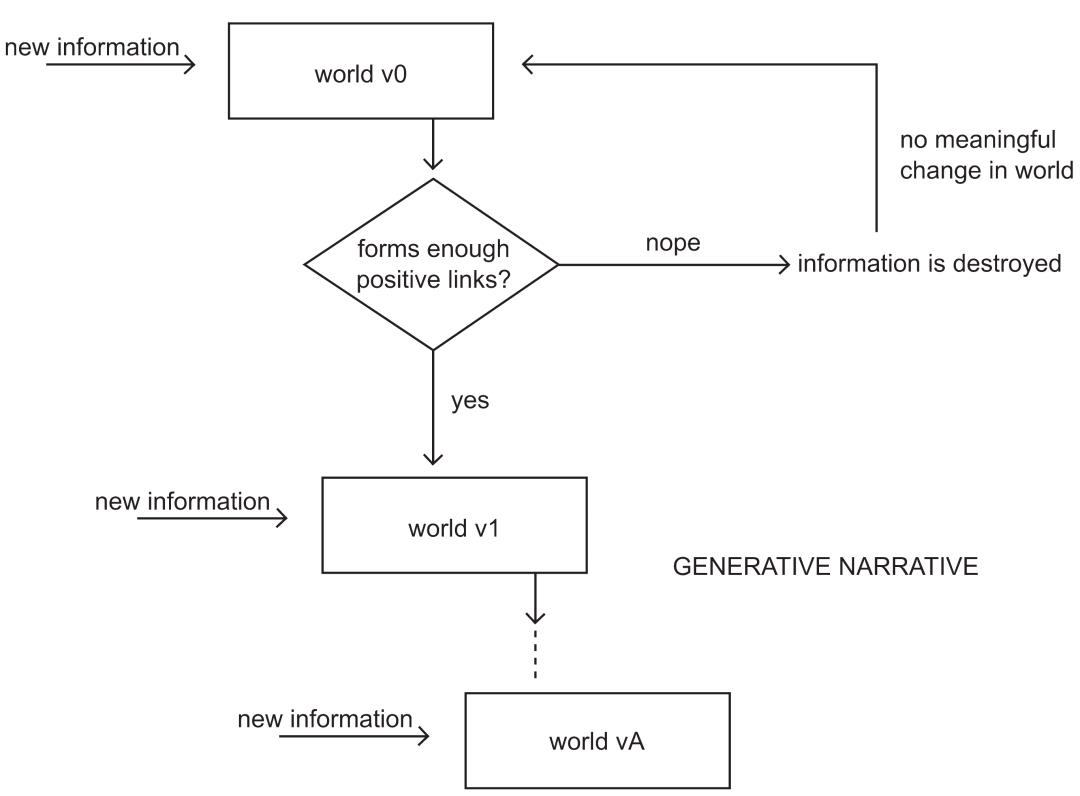
Emergent Cooperation
We’ve outlined a general algorithm describing how worlds change, but haven’t precisely defined how “relationships and connections form or transform.” What exactly is the world’s process for evaluating whether it can absorb novelty? How does it transition into its next version?
Let’s reconsider our earlier MMO example and define a more structured way for relationships to form:
-
Any newly introduced item can be destroyed by anyone; destroying its creator also destroys the item.
-
Rebuilding a destroyed item is costly.
-
Each player can only introduce one item.
This creates an interface for destructive interaction: introducing competition into the world.
Imagine a player introduces a machine that lets you detach and reattach limbs at will. If the machine unlocks new heroes and spawns an entire industry—bodybuilders auctioning their arms, engineers replacing your legs with rockets—the world might build castles to protect the machine. But if the machine suddenly forgets how to reconnect limbs, an assassination market targeting its creator might emerge.
How does the three-step system apply here? The player introduces new information into the world in the form of the limb machine (step 1). The machine then interacts with existing entities in the world (step 2). Once it forms enough positive relationships—such as the emergence of markets—it becomes deeply embedded as part of the world and is unlikely to be destroyed (step 3).
This model implies that avoiding competition is the best strategy for an entity to ensure its continued existence in the world. Suppose both Player A and Player B decide to build ultra-efficient shovels to harvest resources faster. If the resource is scarce, competition arises. Under our rules, players could try to destroy each other to escape the cycle. Because competition entails ongoing threats, selfishness is hard to sustain in this world.
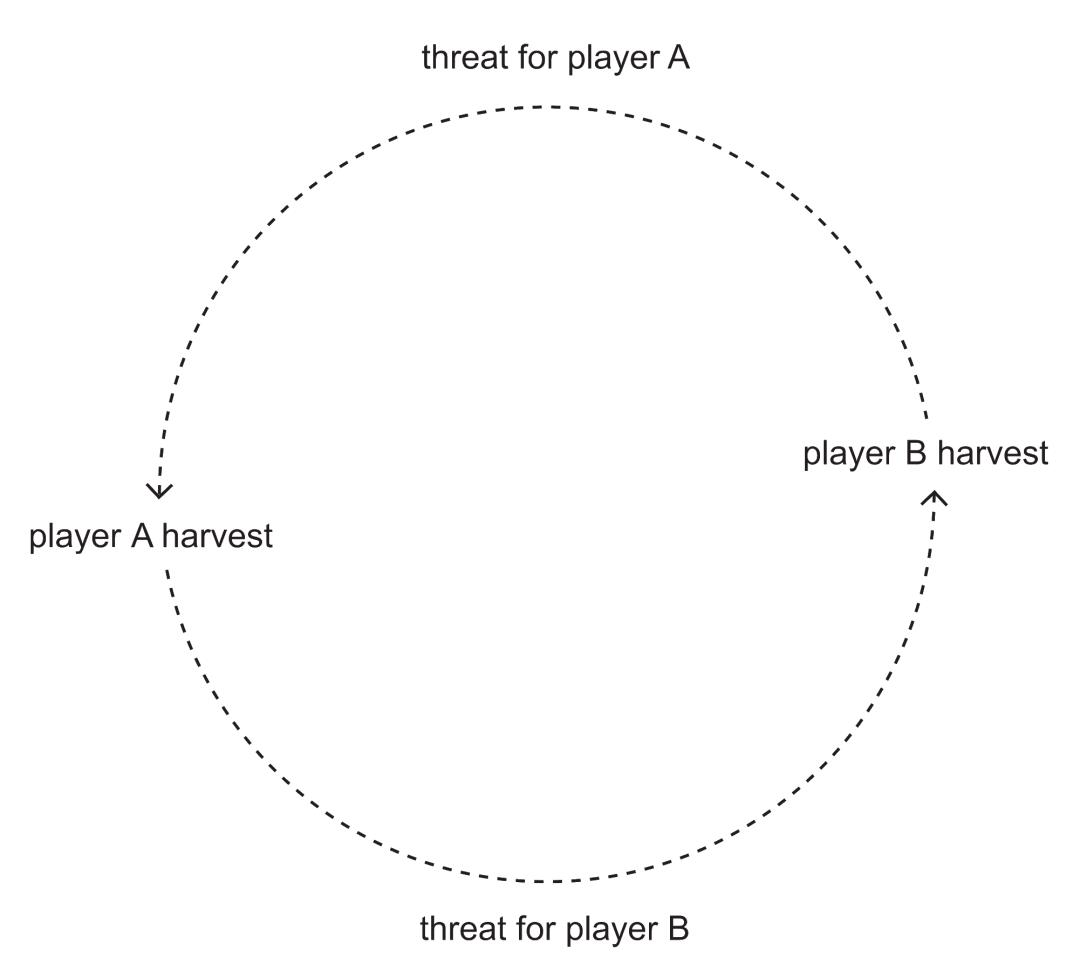
Another way to escape the cycle is specialization and cooperation. For example, Player A builds a device that makes crops grow larger and collaborates with Player B, who owns an ultra-efficient harvester. Cooperation can also take combinatorial forms, where relationships and ideas build upon each other. This is most evident in economic development, where new products or technologies are combinations of existing ones.
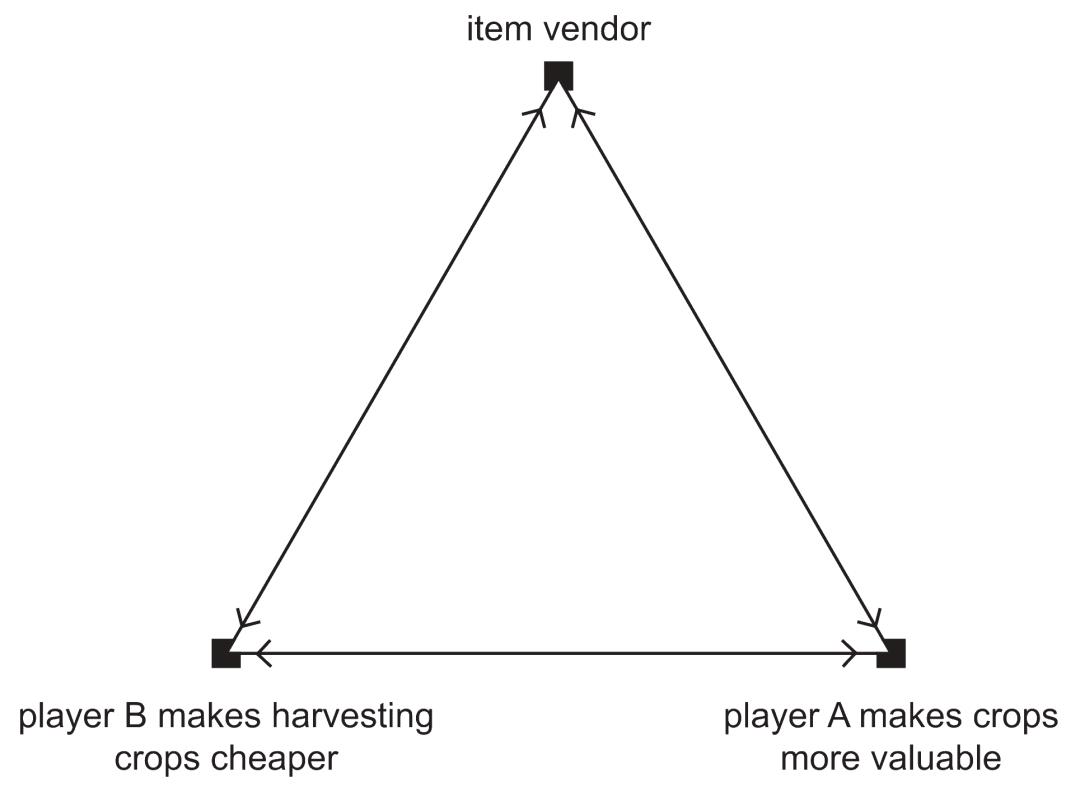
When many positive connections point to an item, it is more likely to persist. Cooperation increases the survival chances of each project (and its creator) by increasing the number of positive connections each receives. Therefore, when items that generate many positive relationships are destroyed, the world becomes less vibrant—a natural-world analogy being the extinction of keystone species in an ecosystem.
Every world has its own “positive connection evaluation process” that determines whether new information can be accepted. We can measure how well novelty integrates into the world by the number of positive cycles (mutually beneficial relationships in both directions between two entities) it creates. As long as new information maximizes the number of positive cycles it generates, others’ motivation to destroy it diminishes.
The drive to maximize cycles means entities not only maintain positive connections but actively seek out potential new ones. The more positive links an entity already has, the greater the likelihood that new entities will attach further links to it. We could say the most alive worlds exhibit a semilattice structure. In Christopher Alexander’s essay “A City is Not a Tree,” a semilattice is described as a pattern of connections where all elements are deeply interwoven. Alexander argues that embodying such maximally connected structures in our cities can create the healthiest communities.
Systematizing Worlds
When the goal is to create simulations as realistic and interesting as possible, there are two approaches at opposite ends of the abstraction ladder:
1. A symbolic approach, where each interaction and entity is defined by high-level concepts specified by humans. For example, nearly all video games.
2. A physical approach, where interactions between individual basic components are represented via low-level primitives, such as cellular automata. For example, sand falling games.
Adopting a concave disposition won’t let us design specific outcomes, but it helps answer questions about how different parts of a world generally work together in the future—questions like “Under what conditions does cooperation occur?”—without having to zoom into the world’s implementation (physical) or zoom out of its human-centered biases (symbolic).
You might find that viewing everything through a systems lens makes it hard to locate meaning. The heart is just a bundle of cells (muscle) moving another bundle of cells (blood) through more cells (arteries and veins); it doesn’t care about the things we humans care about.
How do we make sense of the complexity around us? Often, culture uses storytelling and narrative to extract meaning from within the world. The heart may be a bundle of cells, but it’s also the engine that moves your arms when you go to hug your family.
Meaning is created by identifying a slice of the world—a journey or story—and giving participants the ability to progress within that slice. The more open and surprising the world, the greater the opportunity to find the parts most meaningful to oneself. Over time, the boundaries of the slice (and participants’ capabilities within it) can expand and contract. Slices often grow into their own worlds, colliding with each other as they move through the larger metaworld. Lively worlds have ample room for many journeys.
World creators should not see them as bags full of systems, but as carefully curated interfaces supporting a rich medium for meaning-making. As more people experiment with making autonomous worlds part of our lives, we have the opportunity to elevate them beyond mere MMO containers and push them toward models of worlds worth inhabiting.
Join TechFlow official community to stay tuned
Telegram:https://t.me/TechFlowDaily
X (Twitter):https://x.com/TechFlowPost
X (Twitter) EN:https://x.com/BlockFlow_News
 @autonomousworld











