
a16z: How Should Web3 Governance Reward Systems Be Designed?
TechFlow Selected TechFlow Selected
a16z: How Should Web3 Governance Reward Systems Be Designed?
This article will compare reputation-based and token-based participation governance reward systems, outlining considerations for each type of governance reward system.
 Navigating Web3 tides with focused insights
Author: Eliza Oak, a16z
Translation: Karen, Foresight News
A core challenge in democratizing online governance systems is how to incentivize long-term civic participation through rewards.
Current Web3 governance systems often use transferable tokens, but these tokens have notable limitations (e.g., tendencies toward oligarchic concentration, low resistance to Sybil attacks, and incentives for holders to sell tokens and exit), which can be overcome by moving beyond token-based voting.
In this article, I compare reputation-based and token-based participation reward systems for governance, outline key considerations for each type of governance reward system, and discuss how such rewards are obtained and what powers they might translate into.
Precedents for Rewarding Contribution
Political influence has historically been based on wealth, not merit
Historically, social and political influence has largely been based on wealth rather than merit. For example, in ancient Rome, senatorial status was distinguished by birth and land ownership.
During the Renaissance, wealthy families like the Medici bankers of Florence used their wealth to influence politics, religious affairs, and cultural movements.
Even today in many liberal representative democracies, wealthy individuals and corporations influence political affairs through donations and lobbying. Other systems explicitly designed to reward merit, such as university admissions, often still reward the wealthy and well-connected through legacy admissions or alumni donations.
If Web3 aims to create truly democratic online systems, the question becomes: how do we prevent recreating wealth-based hierarchies? How can we prioritize merit, value, and contribution over wealth and connections?
Merit-based reputation systems struggle to scale beyond niche environments
Reputation is society’s attempt to capture merit.
For centuries, we’ve sought ways to collect and aggregate signals to determine who is trustworthy, competent, or worthy of recognition—and then how to convert those signals into social status, access rights, and decision-making power.
Examples include medieval European guilds certifying craftsmanship; reputations within tight-knit tribal communities; academic credentials from universities; and credit scores assessing someone’s likelihood of defaulting on financial obligations.
Moreover, in today’s digital environments, tech platforms have explored reputation indicators based on observed behavior rather than wealth. Examples include Google’s PageRank algorithm, Reddit’s karma score, and peer reviews on Amazon and Yelp. However, these systems, while less tied to wealth and connections, are often confined to specific contexts and don’t generalize broadly. They are also vulnerable to fraud and abuse.
Of course, large-scale reward systems are not without significant social risks. The key lies in balancing technological power with the goals of decentralized design.
Web3 enables merit-based online governance
For the first time in history, Web3 allows us to design and implement highly credible, large-scale reward systems.
For instance, blockchain immutability ensures rewards cannot be tampered with and are securely recorded, while smart contracts can transparently automate reward distribution, reducing reliance on intermediaries.
MakerDAO’s delegate compensation system is one example of exploring reward systems in Web3—other examples will be discussed later in this article.
These reward systems, built on new mechanisms for establishing trust and allocating rewards, could be designed around participation patterns across broad user bases to democratize governance processes for entire tech platforms or other online communities.
Two Core Challenges in Designing Reward Structures
Two critical questions in designing reward systems are:
-
What should be rewarded?
-
Who receives the rewards?
What should be rewarded?
Models such as academic credentials, skill certifications, or credit scores are rough proxies for credibility, contribution, and skill value. The key to determining what to reward lies in whether it genuinely reflects reputation.
For example, in online governance, users might earn reputation scores for actions like voting, attending town halls, or submitting governance proposals. Beyond simply tracking frequency (quantity) of such actions, is there a way to assess the effort and value (quality) of these behaviors?
Who receives the rewards?
The core issue in determining who gets rewarded is aggregation—the tricky part being creating a standardized method and a common language for interpretation.
With reputation, metrics are typically context-specific: for instance, credit scores reflect financial reliability, driving records measure driving responsibility, and online reviews assess culinary skills at restaurants.
These metrics aren't meant to be interchangeable—an excellent credit score doesn’t guarantee cooking ability. But in online communities using reputation-based governance, adopting a more inclusive view of reputation may make sense.
So how should we weigh these different components of reputation, and how can they be adapted to broader social contexts? Should reputation design encompass everything in someone’s crypto wallet—including financial data, identity, and even virtual art and property?
Reputation systems vs. token-based systems
Token-based rewards are transferable, whereas reputation-based rewards are non-transferable. One might wonder which to use, and why.
Early Web3 governance experiments were typically token-based, but there's now a trend toward favoring more reputation-based systems as defaults, because if successfully implemented, they offer clear advantages (summarized in the table below).
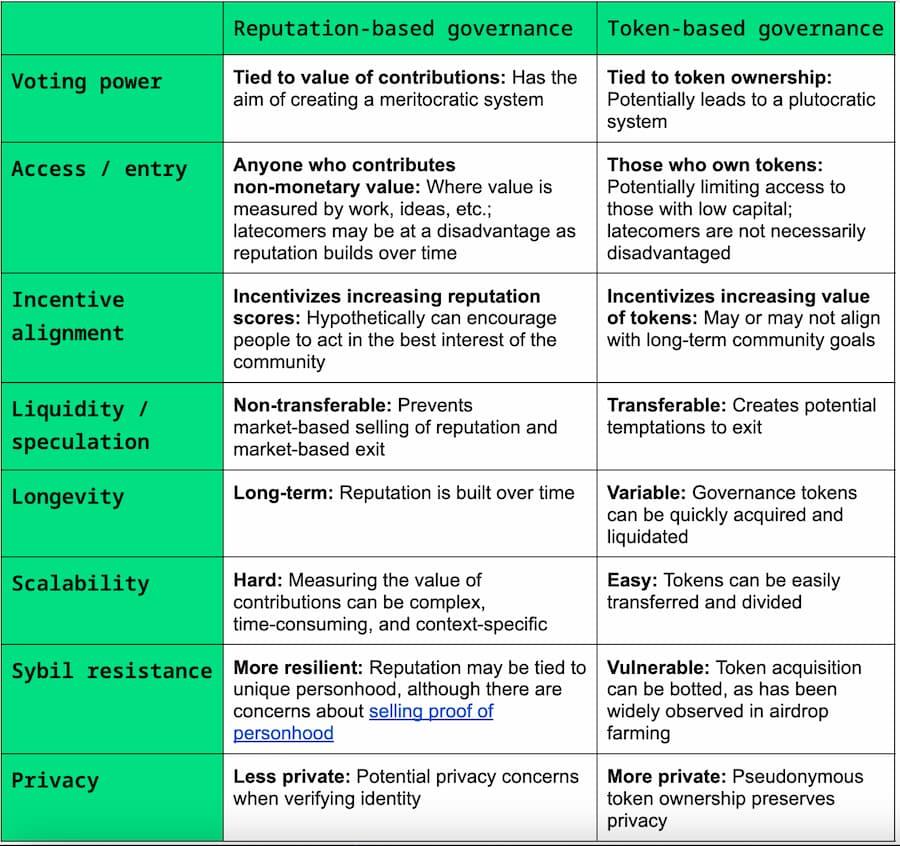
Overall, reputation-based governance may be justified for meritocratic models prioritizing long-term community alignment, while token-based governance may better suit projects emphasizing scalability and liquidity. On the access/participation dimension, reputation-based systems may favor early community members who can start building reputation sooner, while token-based systems may favor wealthier individuals. On Sybil resistance, reputation-based systems aim to overcome inherent Sybil vulnerabilities in token-based systems (e.g., the Beanstalk hack) by tying reputation to identity. However, this may raise privacy concerns depending on identity verification methods—though these can potentially be mitigated via zk-SNARKs or other zero-knowledge proofs.
In practice, a hybrid combining tokens and reputation scores may be reasonable. Optimism’s “bicameral” model—with a reputation-based Citizens’ House and a token-based Token House—is one such implementation, though the design space is broad. Past research suggests reputation systems could rely on a pair of tokens—one representing reputation and another providing liquidity. Other projects explore dual governance models where staked token holders have veto power over governance token holders. In Lido’s case, both LDO and stETH tokens are transferable, though one could imagine integrating a non-transferable, reputation-based governance token into a similar two-token model.
Token-based systems
“Token-based governance” refers to systems where incentives or rewards are tied to owning or acquiring fungible tokens. For example, Uniswap’s UNI token can be used to vote in Uniswap governance.
Compared to reputation-based systems, the transferability of these tokens makes it easier for new participants to engage in protocol governance, though these systems risk leading to oligarchy—where those with more capital exert disproportionate influence. Token holders have direct financial stakes in the project’s success, incentivizing them to vote in ways that promote their own long-term financial interests.
Unfortunately, token holders’ financial interests don’t always align with long-term, non-financial community interests. Examples of such tokens include Ethereum ERC-20 tokens, Cosmos ICS-20 tokens, and Solana SPL tokens.
Currently, most projects use a “one token, one vote” model for decision-making. For instance, in MakerDAO, MKR token holders vote on protocol changes affecting risk parameters for DAI stablecoin collateral. In the decentralized lending protocol Aave, AAVE token holders vote on which projects should receive funding from the Aave ecosystem reserve. In the decentralized exchange Uniswap, UNI token holders voted on changes to the fee structure, affecting how trading fees are distributed between liquidity providers and token holders.
Some examples of reward mechanisms using transferable tokens in token-based systems include:
-
Airdrops: Tokens are distributed to wallets at discrete points in time based on specific eligibility criteria. Airdrops are often used to incentivize certain behaviors, promote new projects, or distribute ownership more widely within a community. DeFi protocols (e.g., Uniswap), Layer 2 solutions (e.g., Optimism), blockchain identity solutions (e.g., ENS), and even NFT projects (e.g., Yuga Labs’ Bored Ape Yacht Club) have experimented with airdrop rewards.
-
Retroactive rewards: Optimism has implemented multiple rounds of retroactive rewards, distributing OP tokens to users whose contributions supported the development and adoption of Optimism public goods, benefiting the broader OP Stack ecosystem. Examples of public goods include adding code to the developer ecosystem, contributing to user experience and adoption, or actively participating in Optimism governance. Recipients are selected through community nominations and voting by the Optimism Citizens’ House.
-
Liquidity mining: Users earn token rewards by providing liquidity to decentralized exchanges or liquidity pools. Protocols like Compound Finance and Synthetix issued token rewards through liquidity mining. Unlike airdrops, which occur at discrete times, liquidity mining sends continuous token rewards for activities like lending. This is analogous to “anonymity mining” in Tornado Cash, where users earn tokens by depositing into an anonymous pool.
-
Voting-escrowed tokens: To participate in governance, users must lock their tokens in a voting escrow. Users gain greater voting power by locking tokens for longer periods. For example, Curve Finance uses veCRV (voting-escrowed CRV tokens). On Curve, the longer veCRV is locked, the greater the voting power and associated yield boosts. This can also serve as a defense against flash-loan-based governance attacks.
Reputation-based systems
Reputation is earned, not bought. While reputation can take token form, it differs from fungible tokens tradable on open markets. In practice, reputation often leverages non-fungible tokens (NFTs), such as ERC-5114 (“soulbound badges”) on Ethereum. The Optimism Citizens’ House badge and Polygon’s proposed reputation-based voting via Polygon ID are current examples of identity-based governance systems. Reputation-based governance can function in various ways in practice, including peer attestations, automated scoring based on observable behavior, or centralized selection (below, I outline trade-offs among different reward mechanisms).
Assuming reputation tokens could take the form of non-transferable fungible tokens (e.g., if the transfer function in an ERC-20 contract is disabled), one might use non-transferable fungible tokens to rate community members’ contributions with finer granularity.
Such reputation-based governance systems could distribute influence more fairly and potentially offer stronger Sybil resistance. However, reputation-based systems face inherent challenges, such as scalability and subjective measurement of contributions.
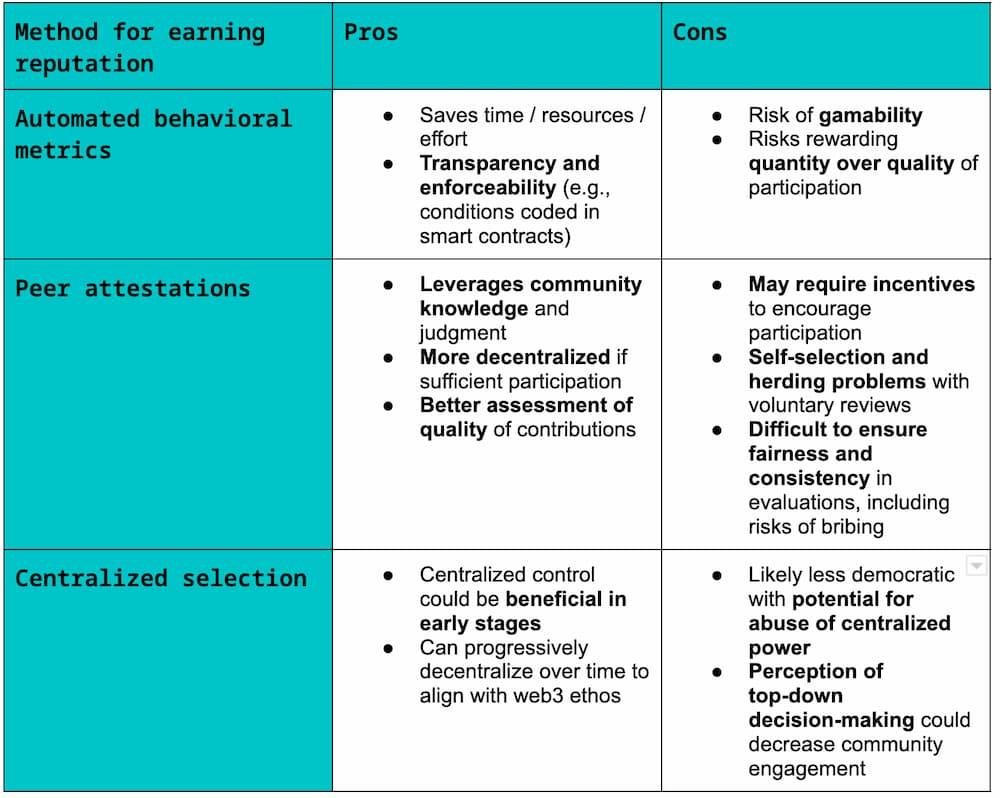
Reputation-based governance rewards are still in early stages of implementation. Potential methods for earning reputation include:
-
Automated behavioral metrics: Reputation is automatically calculated based on users’ observable actions within the system. For example, attending a town hall might earn one reputation point, while voting earns five. Such behavioral metrics could be hardcoded into smart contracts.
-
Peer attestations: Reputation is established through recognition or evaluation by other participants. This approach leverages peer review to go beyond observable behavior, potentially offering better assessment of participation quality—but requires incentives for people to spend time rating peers. A key challenge here is preventing bribery or other forms of reputation purchasing. An example is Boys Club DAO collaborating with Govrn, allowing members to record DAO contributions attested by other community members and eventually converted into retroactive rewards. Another example is proof-of-contribution to enhance governance accessibility, as proposed in the Optimism governance forum, possibly using something like Ethereum Attestation Service (EAS) to create, verify, and revoke attestations.
-
Centralized selection: In early project stages, a dedicated team manually selects individuals and assigns high reputation scores based on set criteria. As the system matures, decentralization can gradually increase, giving the broader community a larger role in refining reputation standards. This approach aims to balance initial quality assurance with the ultimate goal of fully decentralized governance. Vitalik Buterin mentioned this model in an August 2021 blog post, suggesting: “The simplest solution might be to bootstrap the system by manually selecting 10–100 early contributors, then gradually decentralize as selected participants in round N help determine the selection criteria for round N+1.”
Because reputation systems aren’t simply purchased on open markets, there’s substantial design space in how reputation rewards are earned. The table below summarizes pros and cons of different ways ecosystem participants can earn reputation:
What powers do rewards confer?
Beyond deciding how to distribute rewards, a key question is what value, access, privileges, or influence they confer. Currently, most Web3 governance systems use transferable tokens that translate directly into voting power—one token, one vote.
Different types of value can be linked to rewards. Whether rewards are transferable (token-based systems) or non-transferable (reputation-based systems) affects the implications of these decisions, but at a high level, these powers can be combined with either transferable or non-transferable reputation.
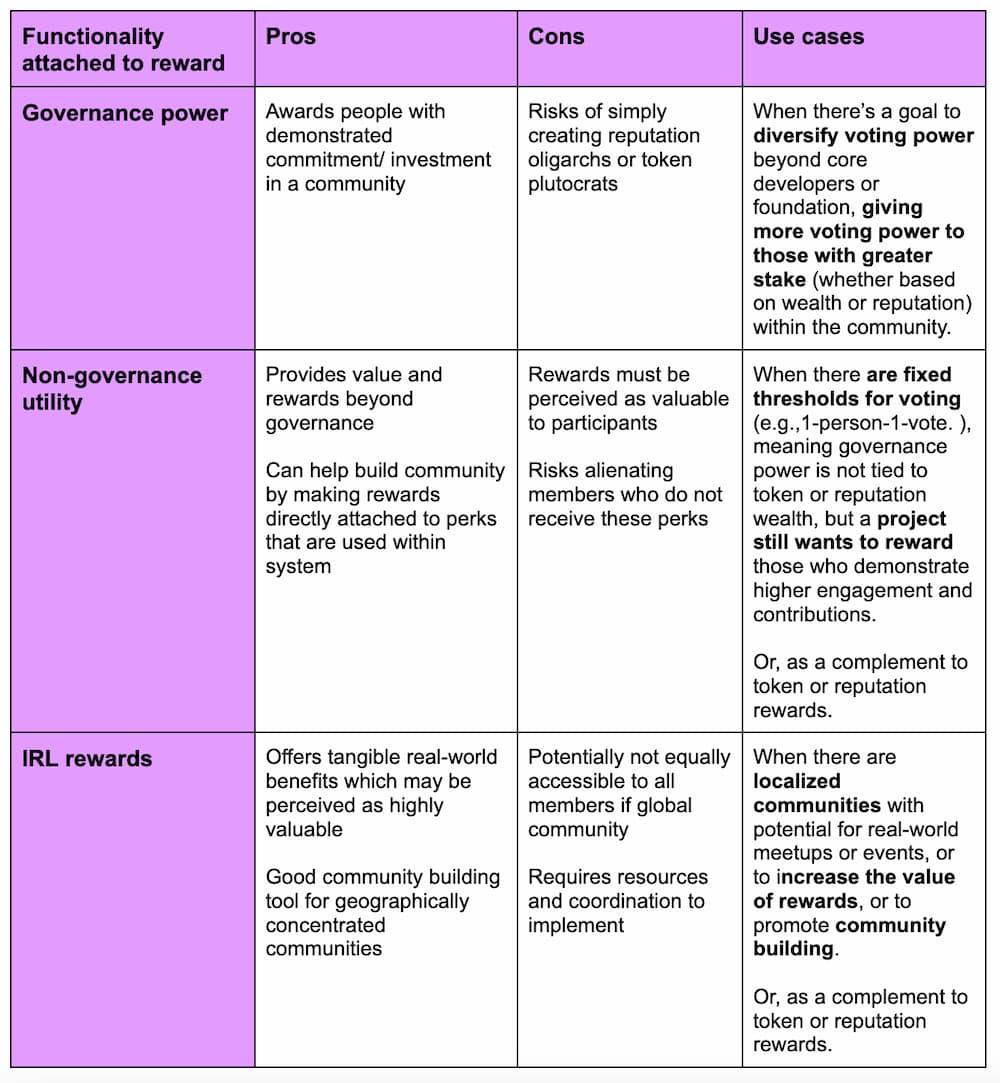
What forms do rewards take?
-
Governance power: Rewards directly translate into abilities such as voting, delegating, serving as a representative, submitting proposals, or other governance functions.
-
Non-governance utility: Rewards translate directly into non-governance benefits within the online system. Examples include special access to community groups and events, priority access to staking, unique avatars, or community status symbols.
-
IRL rewards: Rewards translate directly into real-life (IRL) benefits, such as attending official events (e.g., meetups, workshops, webinars) with community members, receiving physical gifts, or other non-digital consumer goods.
Successful reward structures will likely involve hybrid mechanisms tailored to a project’s nature and goals, with governance rewards corresponding to different combinations of governance power, non-governance utility, or real-world benefits.
Trade-offs in designing online governance reward systems
To recap, designing online governance reward systems involves trade-offs across multiple factors. A project’s answers to these questions will shape whether its reward system should lean toward reputation or tokens.
-
How is information collected and aggregated into rewards?
-
How do rewards translate—can we achieve interoperability of rewards (e.g., reputation scores) across ecosystems (e.g., cross-chain interactions)?
-
Will rewards be designed by intermediaries or primarily based on decentralized interactions?
-
Do you want rewards tied to real-world identities or anonymous accounts?
-
Is Sybil resistance crucial for your project and reward mechanism?
-
Do you plan to combine reputation tokens with transferable tokens?
Whether a project adopts token-based governance depends on whether it is civic- or economic-oriented. As outlined earlier, there are specific trade-offs across dimensions (e.g., scalability, access, privacy, Byzantine resistance). While some defend token voting (e.g., stakeholder participation), a common concern with token-based governance is the potential for oligarchy—wealthy participants wielding disproportionate influence, clearly contradicting Web3 ideals.
Reputation systems aim to tie governance or other powers to individuals’ earned standing within a community. However, non-transferable reputation systems are difficult to implement due to the complexity of measuring and verifying reputation.
Therefore, exploring reputation-based governance and alternative approaches beyond transferable token voting remains an open and potentially fruitful area for decentralized governance.
I’ve outlined several considerations for implementing reputation systems, but this is an evolving field. I look forward to further discussion and experimentation in designing effective systems for democratic online governance.
Join TechFlow official community to stay tuned
Telegram:https://t.me/TechFlowDaily
X (Twitter):https://x.com/TechFlowPost
X (Twitter) EN:https://x.com/BlockFlow_News
 a16z
a16z