








A Comprehensive Overview of Celestia: A Modular Blockchain Focused on Data Availability
TechFlow Selected TechFlow Selected
A Comprehensive Overview of Celestia: A Modular Blockchain Focused on Data Availability
Modular blockchains will be one of the major trends in the future development of blockchain architecture.
 Navigating Web3 tides with focused insights
Celestia is a modular blockchain project focused on data availability. Architecturally, it primarily serves the consensus and data availability layers, while introducing the Sovereign Rollup solution to handle execution and settlement layers. Benefiting from Ethereum's technological advancements and rollup implementations, the concept of modular blockchains is gradually becoming feasible and represents one of the key future directions in the public chain space. Additionally, the project team has strong technical expertise, and with the mainnet launch approaching, we have chosen to focus on Celestia.
Investment Summary
Celestia is a modular blockchain project dedicated to data availability. In terms of architecture, it primarily assumes responsibilities for the consensus layer and data availability layer, while proposing the Sovereign Rollup solution to serve as the execution and settlement layers.
From a team and funding perspective, Celestia boasts solid technical foundations and development capabilities, maintaining a consistent development pace. Compared to our initial research report (first published on March 2, 2022, on the First Research official website), Celestia has seen significant growth in both funding raised and team size, indicating that it will likely sustain strong momentum in the medium to long term.
From a product and technology standpoint, data availability sampling and namespace Merkle trees enable breakthroughs in decentralization and security for Celestia as a consensus and data availability layer. Sovereign Rollups ensure scalability for execution and settlement layers built on Celestia, allowing Celestia as a modular blockchain to effectively address the blockchain trilemma. Therefore, it holds promising development prospects and potential.
Regarding project development, Celestia remains in the testnet phase, with the mainnet expected to launch soon. Currently, testnet nodes are relatively centralized. However, thanks to Celestia’s network architecture and data availability implementation, hardware requirements for operating various types of nodes are relatively low. After mainnet launch, node count could significantly increase, enhancing network throughput, decentralization, and security. Additionally, Celestia currently enjoys substantial social media following and an active community, which can support future ecosystem growth. The ecosystem itself is still in very early stages, dominated by technical infrastructure projects. It will take considerable time before users can experience application-level projects within the ecosystem.
Application-focused projects will require a very long time.
From a token economics perspective, Celestia’s token distribution is average, with investors and the team collectively receiving over half of the tokens, 33% of which will unlock one year after launch. Token utility aligns with typical public chain design principles—TIA will serve consensus, fee payment, and governance functions, with inflationary issuance. This design appears neutral; the token does not inherently enhance network functionality but instead relies on network growth to drive a positive economic cycle.
From a sector perspective, benefiting from successful rollup implementations and Ethereum’s technological progress, modular blockchains represent a major trend in future blockchain architecture, with Celestia playing a significant role. Compared to current competitors, Celestia’s data availability solution has lower deployment barriers and faster development progress, although its ceiling may be lower than solutions using KZG polynomial commitments. Ongoing attention should be paid to project development, Ethereum’s upcoming Cancun upgrade, and developments across upstream and downstream sectors including rollups. In the short term, due to the ongoing bear market, the project’s potential will depend on market recovery and underlying technological accumulation.
In summary, the Celestia project warrants attention.
1. Overview
1.1 Project Introduction
Celestia is a modular blockchain project focused on data availability. Architecturally, it primarily serves the consensus and data availability layers, while proposing the Sovereign Rollup solution to handle execution and settlement layers. The project is progressing well and is about to launch its mainnet.
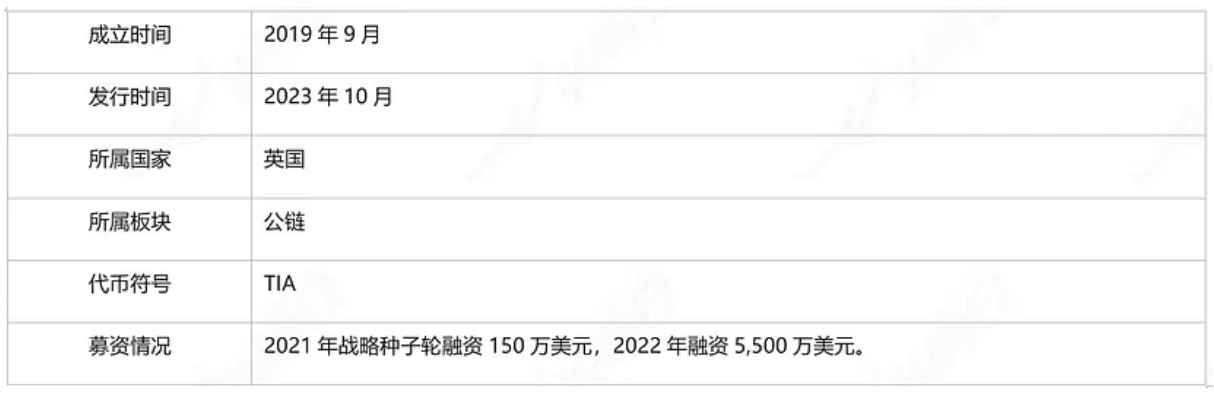
1.2 Basic Information [1]
2. Project Details
2.1 Team
Celestia’s team is based in the UK, with 40 members disclosed on LinkedIn and 46 listed on the official website[2]. Key team member profiles are detailed below:

Mustafa Al-Bassam — Co-founder & CEO, holds a Bachelor’s degree in Computer Science from King’s College London and a PhD in Computer Science from University College London. At age 16, Al-Bassam founded and was a core member of the hacker group LulzSec, engaging in long-term hacking activities. In August 2018, he co-founded Chainspace, a blockchain scalability research team acquired by Facebook in 2019. In May 2019, Al-Bassam published the LazyLedger paper and co-founded LazyLedger (later renamed Celestia) in September 2019, serving as CEO ever since.

Ismail Khoffi — Co-founder & CTO, holds a Master’s degree in Mathematics and Computer Science from Bonn University. After graduation, he worked extensively in software development and computer science research. In 2018, Ismail joined Tendermint for software development and in 2019 joined Interchain Foundation as a senior software engineer. He co-founded LazyLedger (later Celestia) in September 2019 and has served as CTO since.

John Adler — Co-founder & CRO, holds a Bachelor’s and Master’s degrees in Engineering Science, and a PhD in Electrical and Computer Engineering from the University of Toronto. After graduation, he joined Consensys as a researcher and developer focusing on Layer-2 scalability. In 2020, John co-founded Fuel Labs and served as Chief Scientist. That same year, he co-founded LazyLedger and has served as Chief Research Officer (CRO) ever since.

Nick White — COO, holds a Bachelor’s and Master’s degrees in Electrical Engineering from Stanford University. He is also a co-founder of Harmony Protocol. Nick joined Celestia in 2021 and has served as Chief Operating Officer since.
The core team possesses deep technical and industry expertise. Since our first report, Celestia’s team size has notably increased, especially in software development, now exceeding 20 engineers, giving the project strong development capabilities.
2.2 Funding
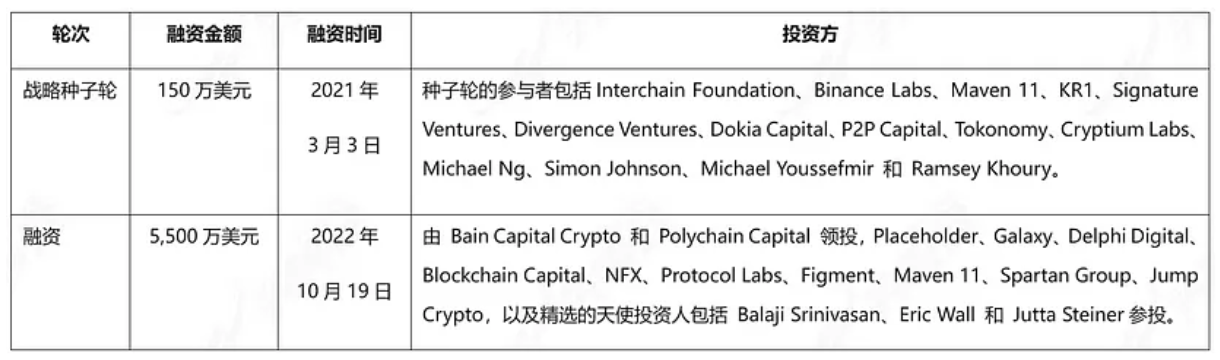
To date, Celestia has publicly disclosed two funding rounds totaling $56.5 million. Investors include Binance Labs, Polychain Capital, Protocol Labs, and Delphi Digital. Overall, Celestia enjoys strong financial backing sufficient to support prolonged development.
2.3 Code
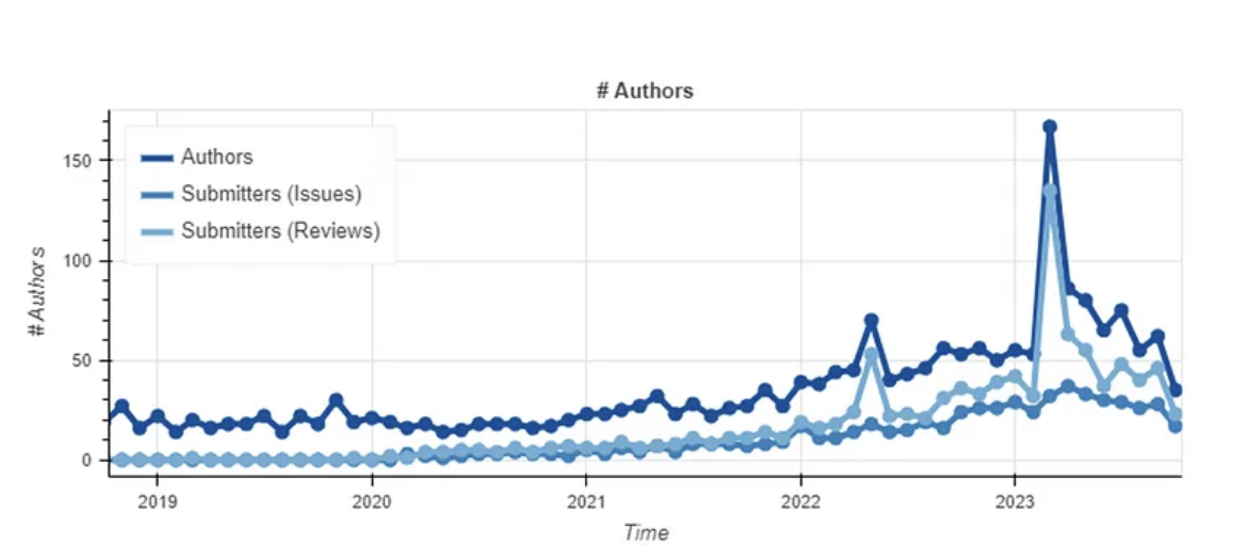 Figure 2–1 Celestia code contribution history[3]
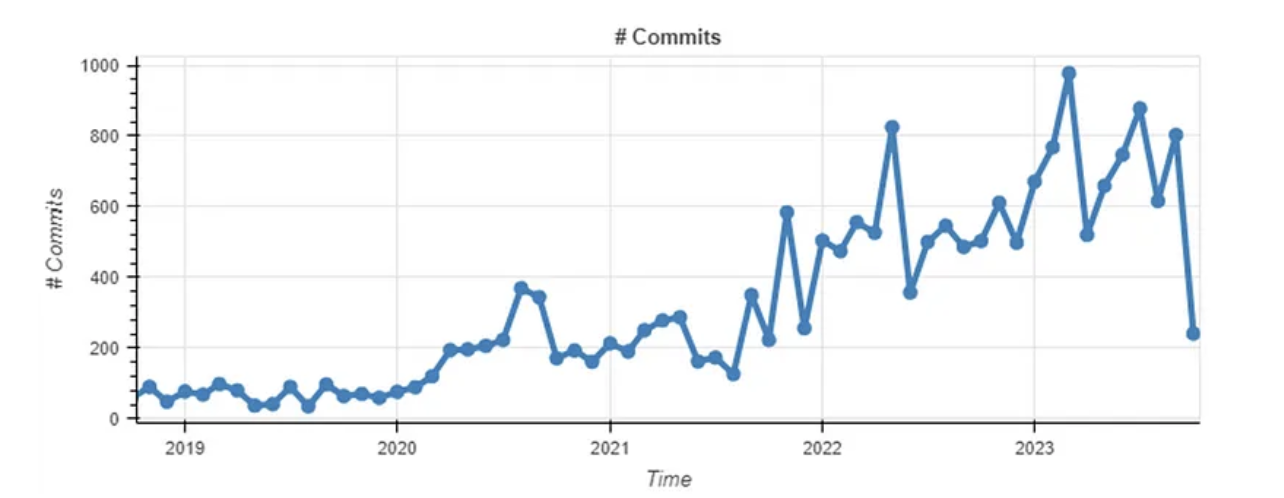
Figure 2–2 Celestia code contributors
Celestia’s source code is open-source on GitHub. Development is robust, with 25,707 total commits and 8,410 in the past year. The average number of monthly developers is around 100. The graph shows continuous growth in commit volume and developer count. Two major development peaks occurred: one in May 2022 for Mamaki testnet development, and another in March 2023 for the modular rollup Rollkit and incentivized testnet. Overall, development progress remains strong and consistently updated.
2.4 Product & Technology
Celestia is a modular blockchain. Modularity means the blockchain no longer independently performs all on-chain tasks (execution, settlement, consensus, data availability), but instead specializes to optimize specific functions.
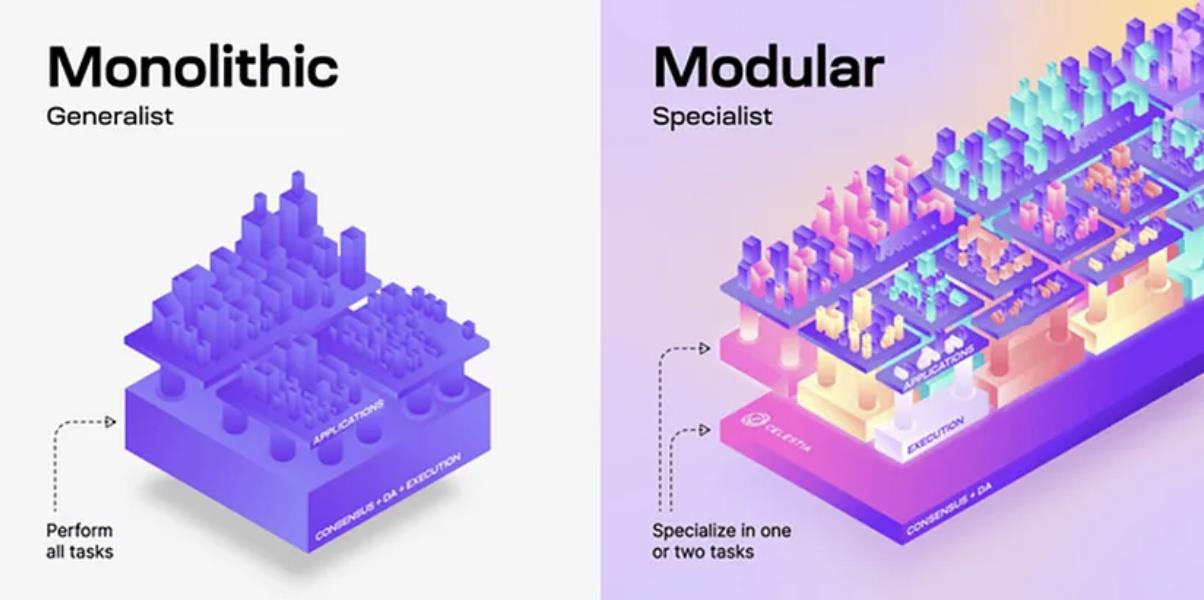
Figure 2–3 Difference between monolithic and modular blockchains[4]
From a scalability perspective, modular blockchains offer superior composability. Multiple modular chains can interconnect like building blocks to perform all functions of a monolithic chain, enabling better cross-chain and multi-chain collaboration.
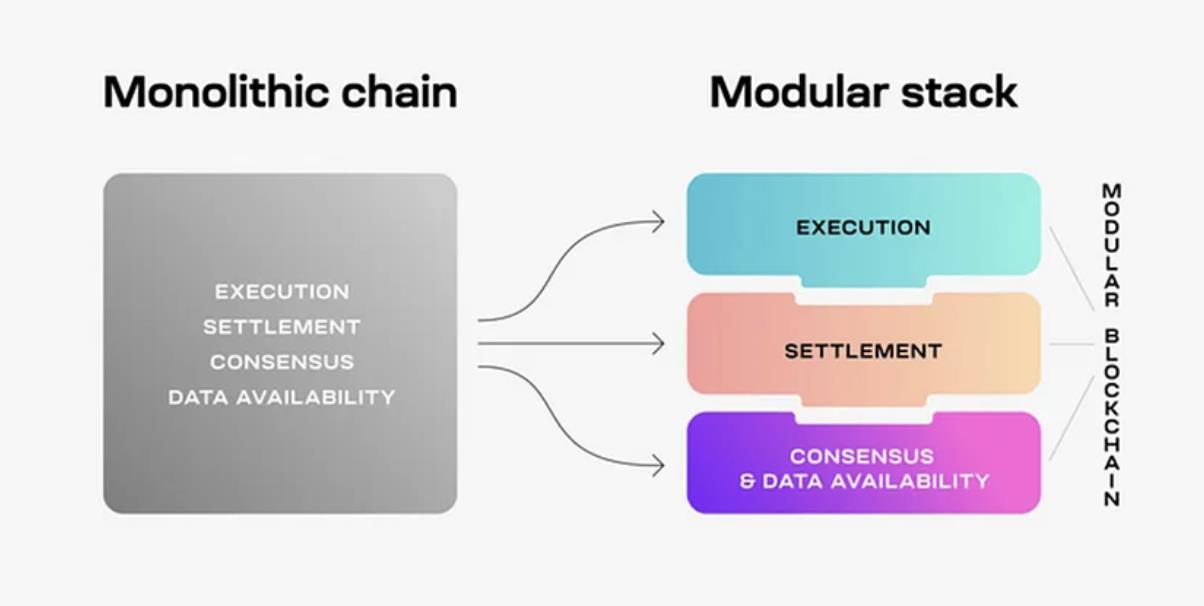
Figure 2–4 Monolithic blockchain vs modular stack
Modular blockchains follow three key principles:
1) Modular blockchains achieve decentralization by reducing the cost for users to run nodes and verify the network.
2) Modular blockchains enhance scalability without increasing the cost for users to verify and secure the network.
3) Modular blockchains rely on a decentralized user network to ensure network security.
These three principles correspond respectively to decentralization, scalability, and security in the blockchain trilemma.
Theoretically, rollups are practical implementations under the modular blockchain paradigm. Both Optimistic Rollups and ZK Rollups leverage Ethereum as a consensus layer for security while specializing execution-layer capabilities, thus advancing both Layer-1 and Layer-2 networks. Furthermore, with Ethereum’s upcoming Cancun upgrade and EIP-4844 Proto-Danksharding, a new transaction type will allow users to store data in a "blob" space rather than directly on Layer-1, drastically reducing transaction fees for Layer-2s and pushing Ethereum closer to a modular blockchain structure.
As a blockchain designed from inception to be modular, Celestia takes a different path from most monolithic public chains by focusing on consensus and data availability, positioning itself specifically as a Data Availability (DA) Layer, while relying on rollups to provide execution-layer functionality. In short, the Celestia network handles only two things: ordering transactions to ensure data availability, and providing an effective solution to the data availability problem—light nodes can verify data availability with minimal resources.
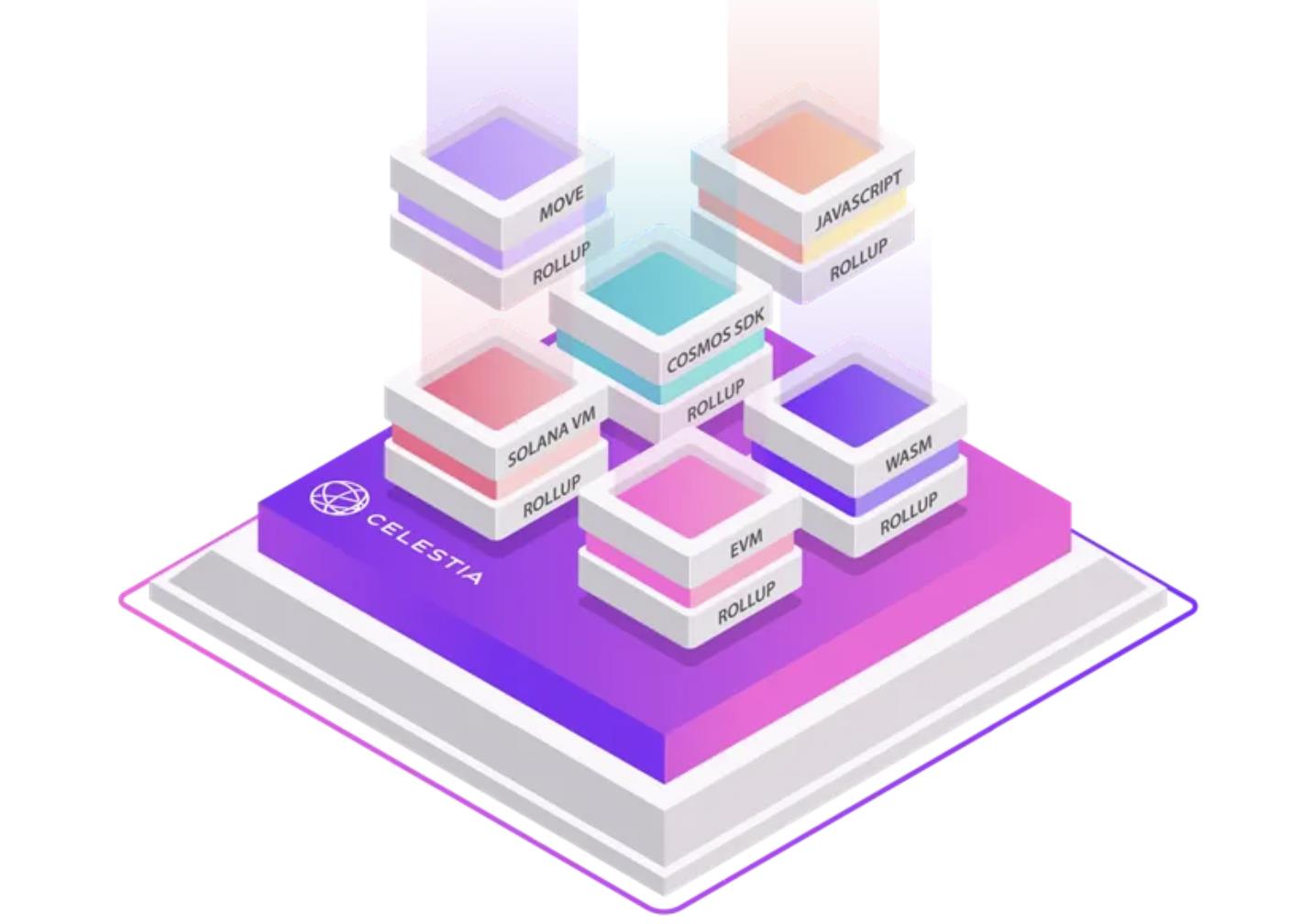
Figure 2–5 Celestia Network Architecture
As a data availability layer, Celestia adopts a PoS consensus mechanism and uses Cosmos SDK for development, though it modifies the Tendermint consensus algorithm. The modified Tendermint Core includes two key components solving data availability: Data Availability Sampling (DAS) and Namespaced Merkle Trees (NMTs).
2.4.1 Data Availability Sampling (DAS)
Typically, light nodes in blockchain networks only download block headers containing commitments (Merkle roots) to block data (transaction lists), preventing them from verifying actual content and thus unable to confirm data availability.
However, with the two-dimensional Reed-Solomon erasure coding scheme, data availability sampling via light nodes becomes possible:
1) Each block’s data is divided into k×k chunks arranged in a k×k matrix. Applying RS erasure coding multiple times expands this k×k matrix into a 2k×2k matrix.
2) Celestia then computes 4k separate Merkle roots—one for each row and column of the 2k×2k matrix—as commitments in the block header.
3) During data availability verification, Celestia’s light nodes sample the 2k×2k data grid. Each light node randomly selects unique coordinates and queries full nodes for the corresponding data chunk and Merkle proof. If all sampled queries receive valid responses, the block is probabilistically deemed data-available.
Additionally, every correctly proven data chunk is propagated across the network, so as long as light nodes collectively sample enough data (at least k×k unique chunks), honest full nodes can reconstruct the complete block.
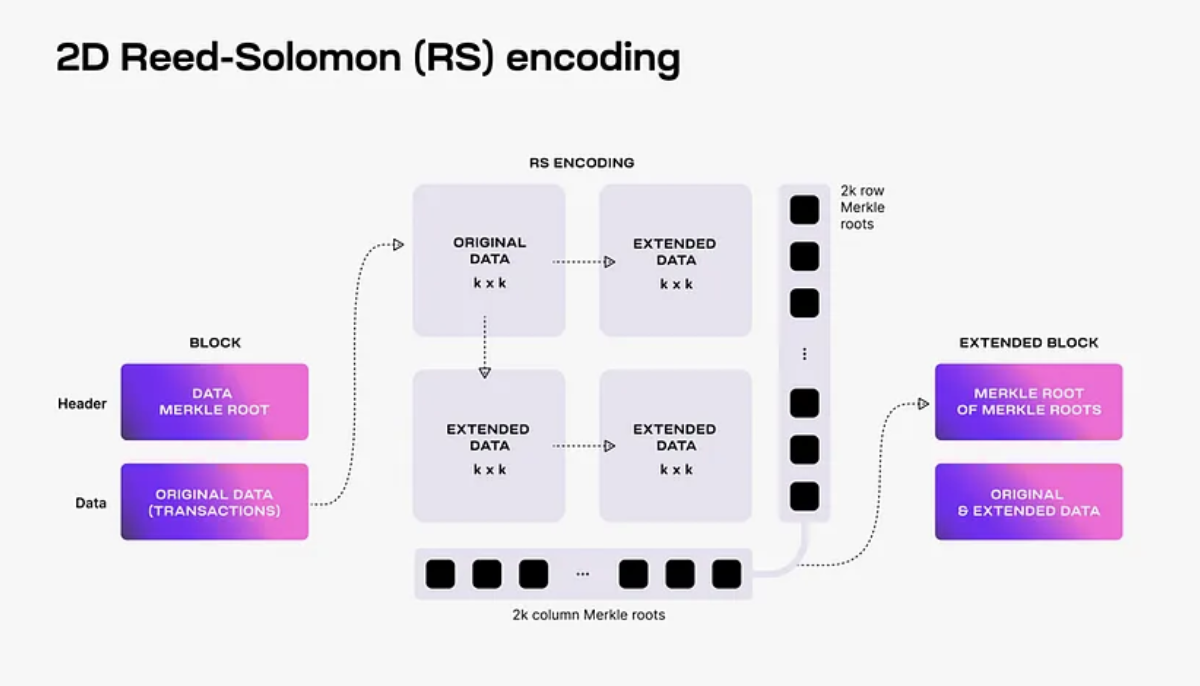
Figure 2–6 Two-dimensional RS Erasure Coding Scheme[5]
The implementation of data availability sampling ensures scalability for Celestia as a data availability layer. Since each light node samples only part of the block data, operational costs for both individual nodes and the entire network are reduced. Moreover, the more light nodes participate in sampling, the more data they can collectively download and store, meaning network TPS can scale with the number of light nodes.
2.4.2 Namespaced Merkle Tree (NMT)
Data availability sampling solves the verification problem, while reducing execution and settlement layer costs is addressed by the namespaced Merkle tree approach.
Celestia divides block data into multiple namespaces, each corresponding to an execution or settlement layer using Celestia for data availability. Thus, each execution/settlement layer only needs to download relevant data to function. Conceptually, Celestia creates a separate folder for each user, using Merkle trees as indexes to help users locate and access their files.
Such a Merkle tree capable of returning all data under a given namespace is called a Namespaced Merkle Tree. Its leaves are ordered by namespace identifiers, and the hash function is modified so that each node contains the namespace range of all its descendants.
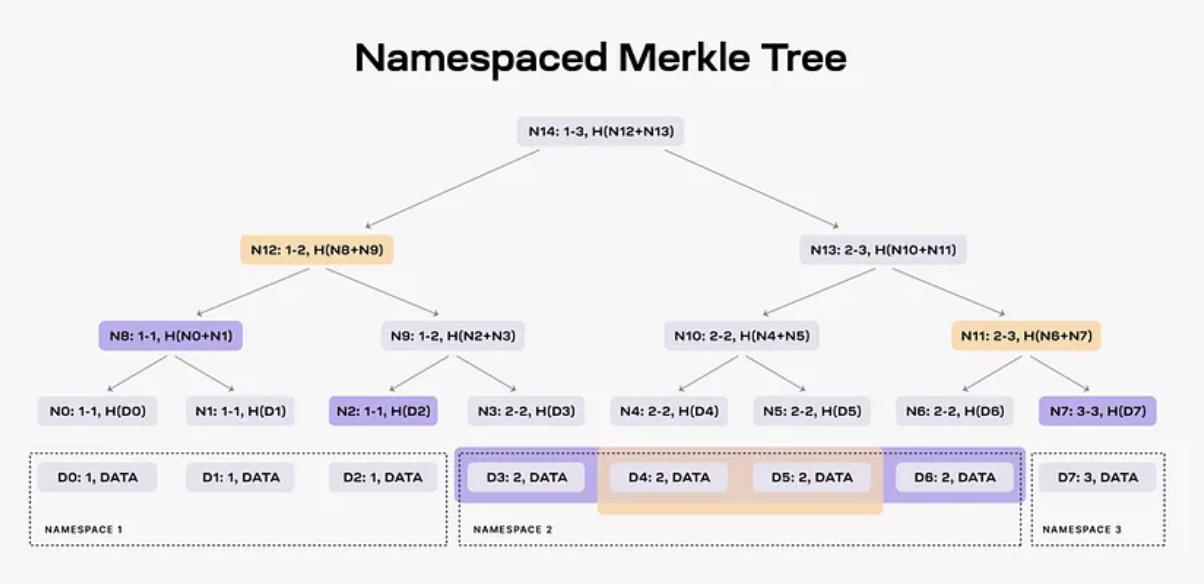
Figure 2–7 Example of a Namespaced Merkle Tree
Using Figure 2–7 as an example, an eight-block Merkle tree is divided into three namespaces.
When data from namespace 2 is requested, the data availability layer (Celestia) submits blocks D3, D4, D5, and D6 along with proofs from nodes N2, N7, and N8 to guarantee data availability. Applications can also verify receipt of all data from namespace 2 by checking whether the provided data matches the namespace ranges of the proving nodes, thereby confirming data integrity.
After addressing data availability through data availability sampling and namespaced Merkle trees, Celestia focuses on execution-layer applications above the data availability layer, introducing the concept of Sovereign Rollups.
2.4.3 Sovereign Rollups
Celestia’s proposed Sovereign Rollups differ from common Ethereum-based rollups.
Common Ethereum rollups are referred to by Celestia as Smart Contract Rollups. They publish entire blocks to a settlement layer, which orders them, checks data availability, and validates transaction correctness—all handled by smart contracts on the settlement layer. In other words, the settlement layer’s smart contracts determine whether these Smart Contract Rollups operate properly.
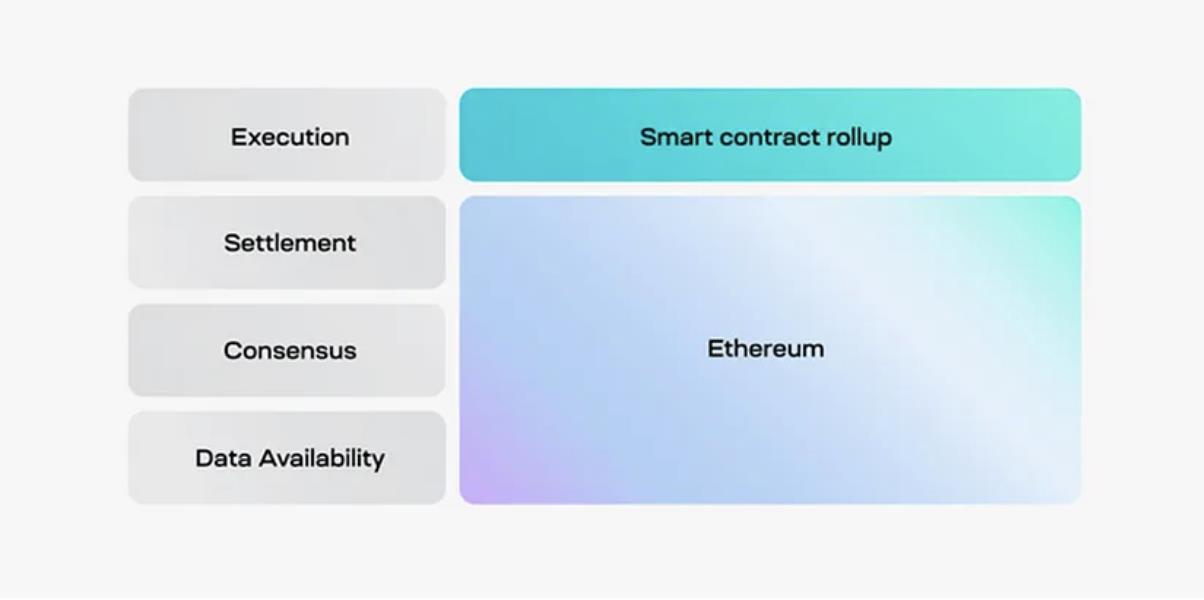
Figure 2–8 Ethereum and Smart Contract Rollup Architecture 1
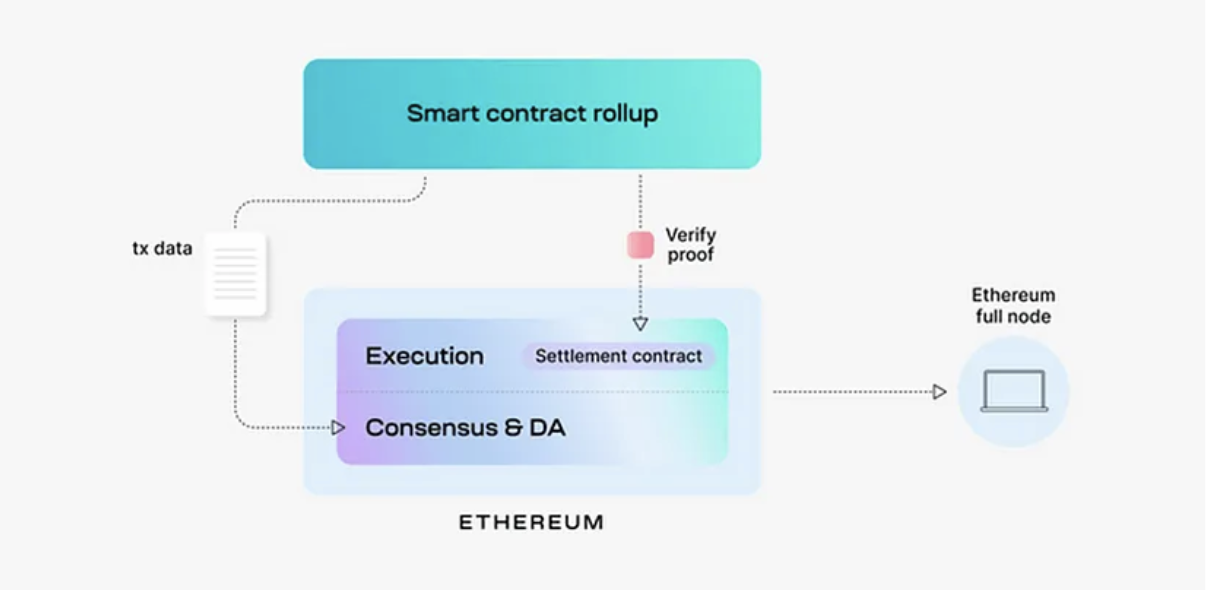
Figure 2–8 Ethereum and Smart Contract Rollup Architecture 2
This Smart Contract Rollup architecture makes it nearly impossible for Layer-1 nodes to individually verify each transaction. Whether Optimistic or ZK Rollups, submitted proofs only validate block validity. For Layer-1 validators to inspect individual transactions, they would need a native trust-minimized bridge, forcing Layer-1 networks to rely on a few honest participants for security.
To solve this, unlike Smart Contract Rollups, Sovereign Rollups incorporate the settlement layer within the rollup itself.[6]

Figure 2–9 Sovereign Rollup Architecture 1
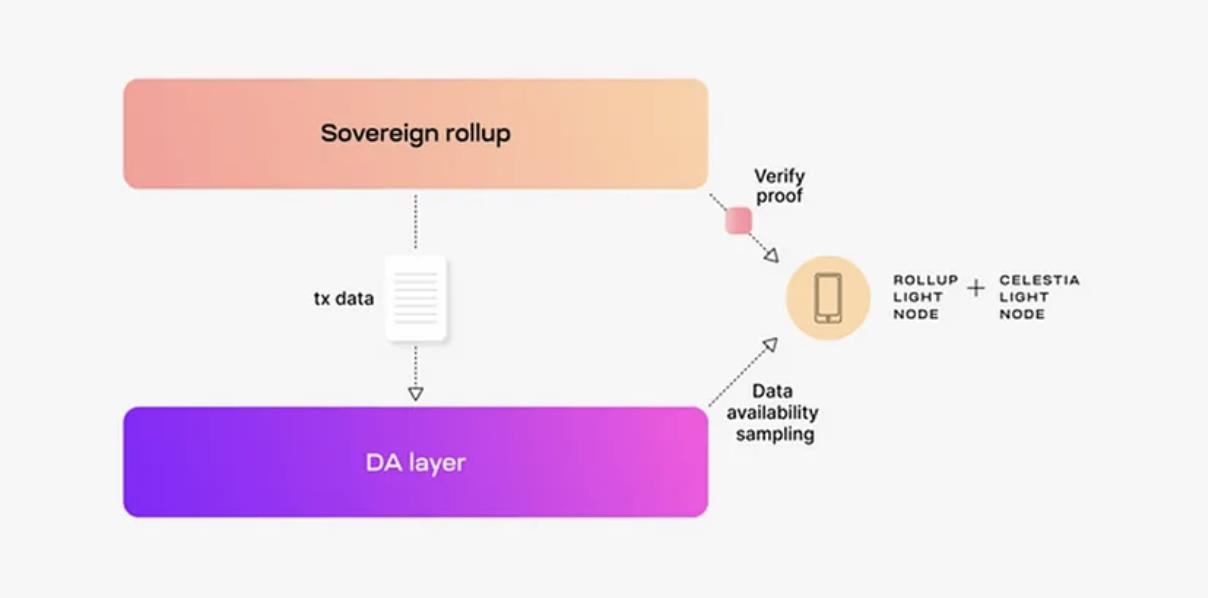
Figure 2–10 Sovereign Rollup Architecture 2
In the Sovereign Rollup architecture, Sovereign Rollups handle execution and settlement, while the data availability layer (Celestia) manages consensus and data availability. Under this model, Celestia no longer verifies transaction correctness. Instead, validation authority is returned to the Sovereign Rollup’s own validators, who examine transaction validity and decide whether to accept or reject them. This eliminates the need for a native trust-minimized bridge between Sovereign Rollups and their data availability layer.
Therefore, the key difference between Sovereign Rollups and Smart Contract Rollups lies in who verifies transaction correctness: in Smart Contract Rollups, settlement-layer smart contracts perform this role, whereas in Sovereign Rollups, the rollup’s own validators do.
Based on this, Sovereign Rollups enjoy greater autonomy compared to Smart Contract Rollups. For instance, upgrading Smart Contract Rollups involves changing smart contracts and is constrained by settlement-layer consensus, whereas Sovereign Rollups face no such limitation and can upgrade via forks like a Layer-1 blockchain, granting nodes greater autonomy.
Summary
From a team and funding perspective, Celestia has strong technical expertise and development capability, maintaining steady progress. Compared to our first report, both funding and team size have significantly grown, suggesting continued strong momentum in the medium to long term.
From a product and technology standpoint, data availability sampling and namespaced Merkle trees enable breakthroughs in decentralization and security for Celestia as a consensus and data availability layer, while Sovereign Rollups ensure scalability for execution and settlement layers built on Celestia. This allows Celestia, as a modular blockchain, to effectively address the blockchain trilemma, giving it strong development prospects and potential.
3. Development
3.1 History
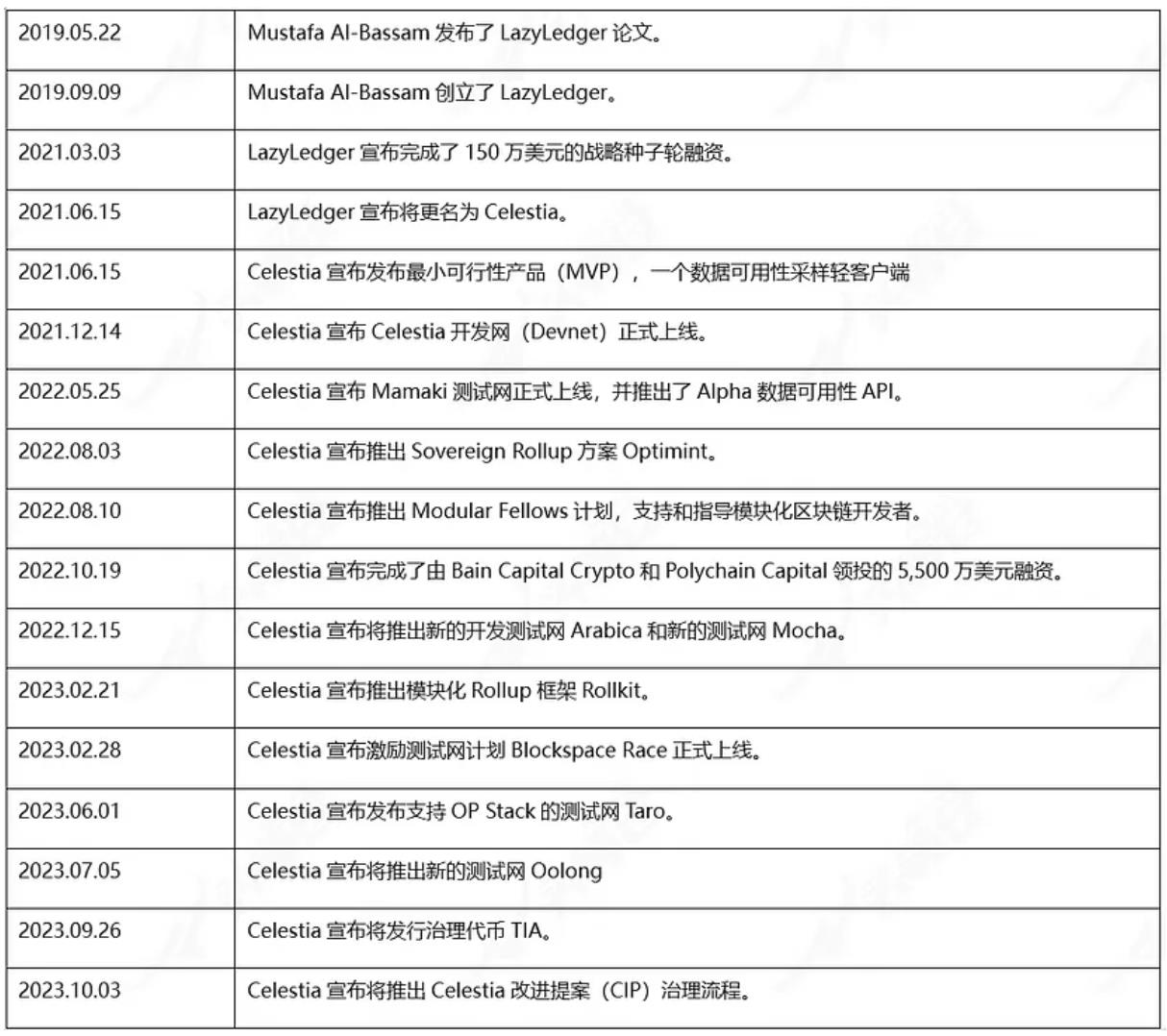
Table 3–1 Celestia Major Events
3.2 Current Status
3.2.1 Operational Data
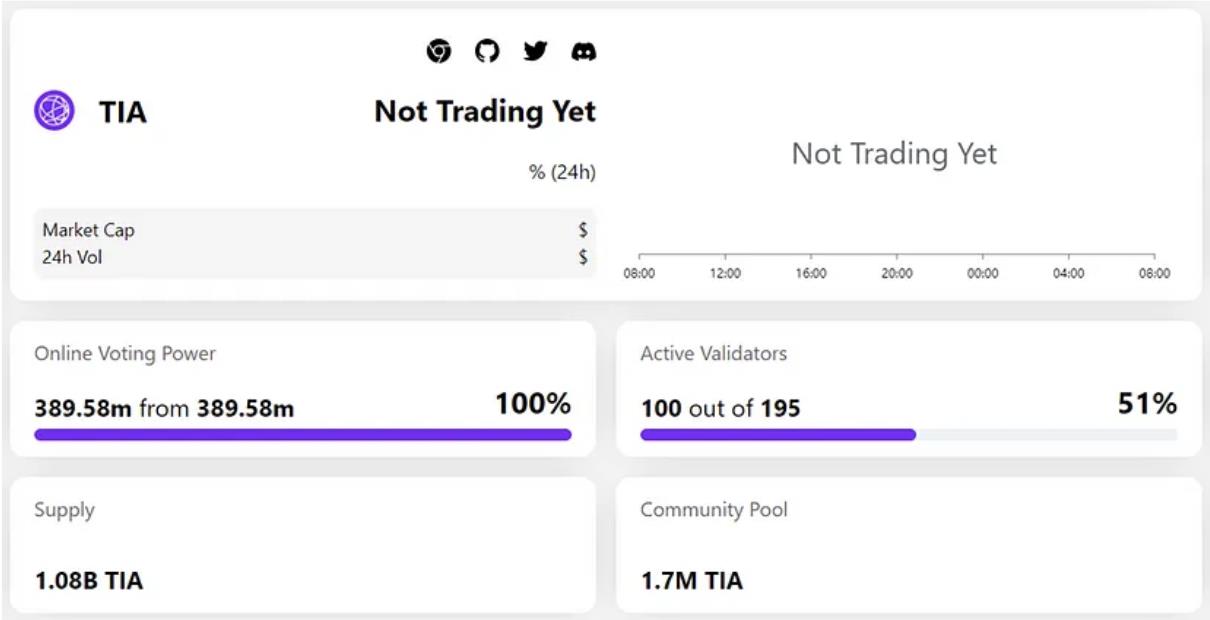
Figure 3–1 Celestia Testnet Status 1[7]
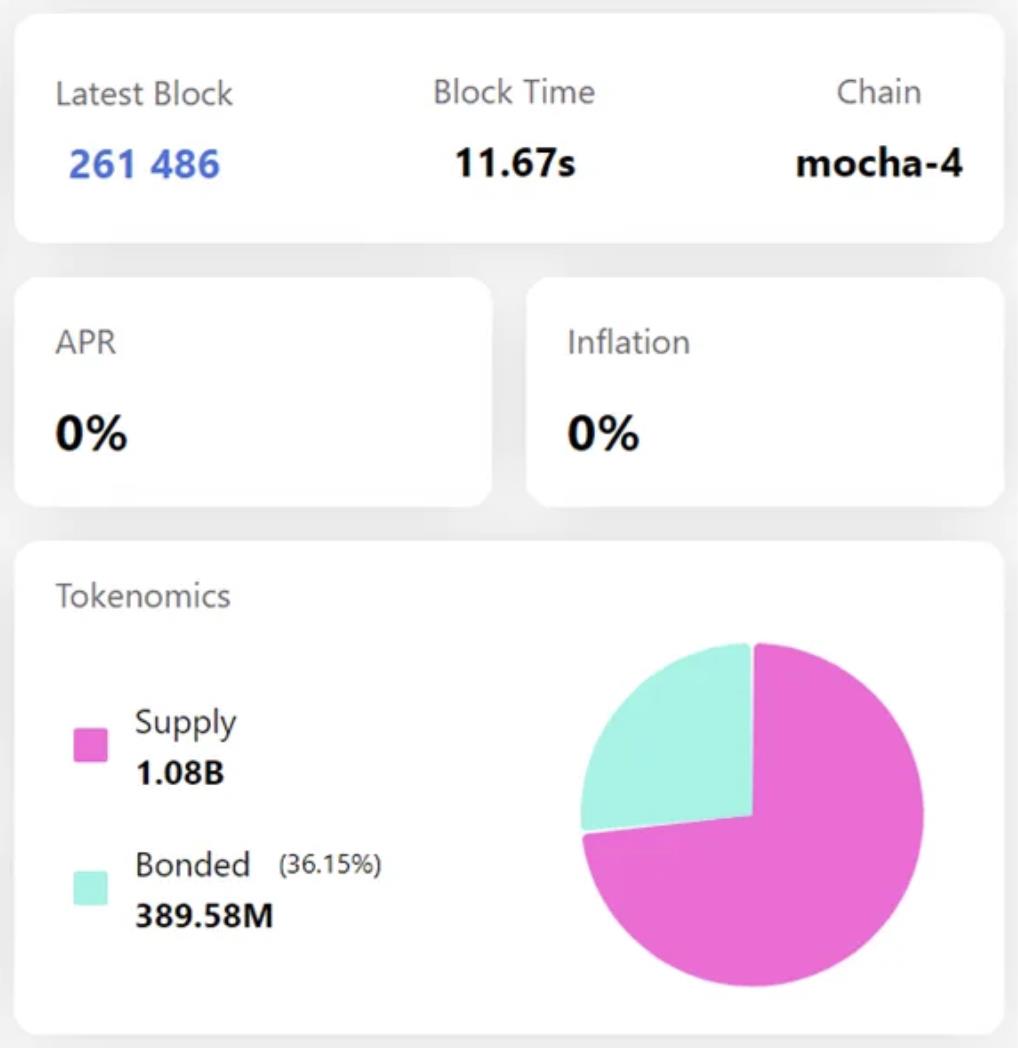
Figure 3–2 Celestia Testnet Status 2
Celestia remains in the testnet phase, with the mainnet expected to launch shortly. The testnet continues stable operation, having produced 261,495 blocks, with approximately 389,580,000 TIA staked. There are 100 initial validator nodes, with the top 9 controlling 60.57% of network share, indicating high centralization.
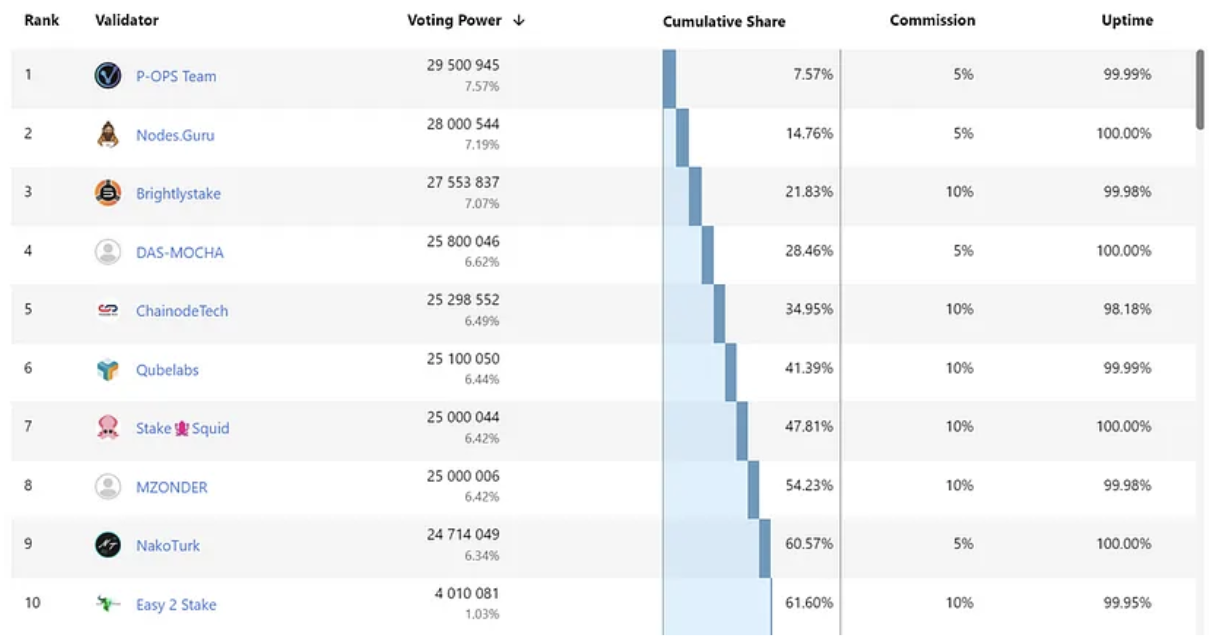
Figure 3–3 Celestia Testnet Node Rankings
Thanks to Celestia’s network architecture, hardware requirements for running Celestia light nodes are low, requiring only 2GB RAM, a single-core CPU, 25GB SSD, and 56 Kbps upload/download bandwidth. Other node types—bridge, full, validator, and consensus nodes—also have relatively modest requirements compared to other public chains. Therefore, after mainnet launch, the number of various node types is expected to rise significantly, further enhancing network decentralization.
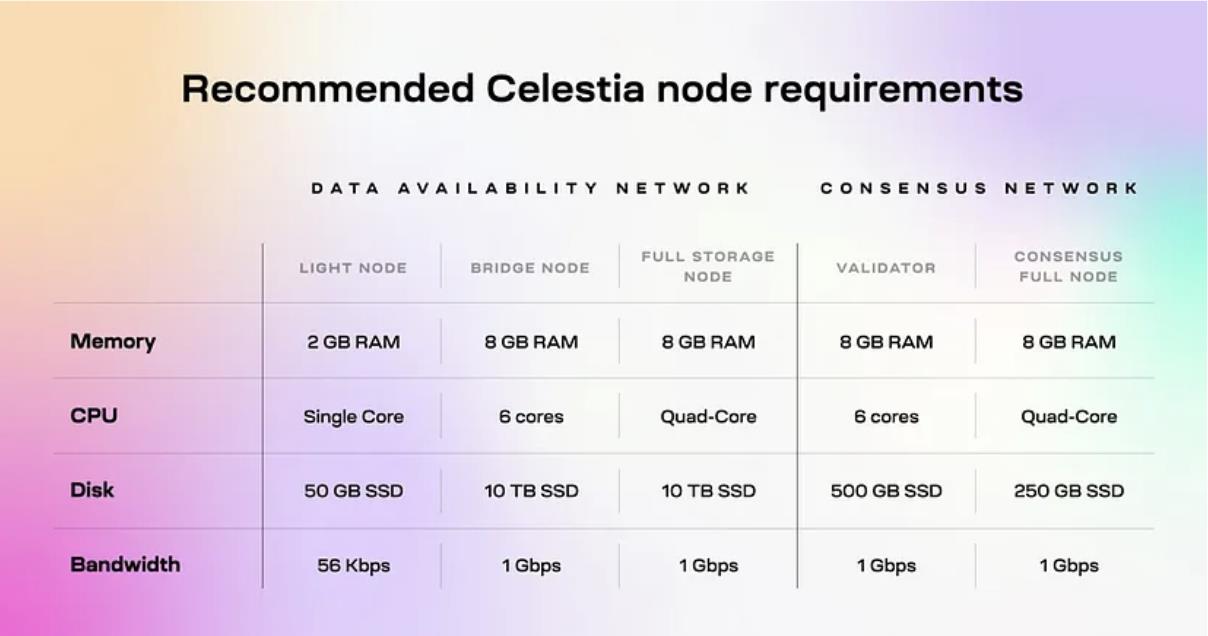
Figure 3–4 Celestia Node Requirements[8]
Currently, 50[9] projects have announced plans to deploy on Celestia: including 5 Rollups-as-a-Service (RaaS) projects; 3 sequencer network projects; 5 settlement layer network projects; 5 rollup framework projects (including Cosmos SDK, OP Stack, Celestia’s own Rollkit, Sovereign, and Stackr); 3 virtual machine projects; 6 cross-chain projects; 3 wallet projects; 5 DeFi projects; 5 gaming projects; and 10 infrastructure projects.
It is evident that projects on Celestia are still primarily technical infrastructure-focused, with few user-facing application DApps.
3.2.2 Social Media Scale
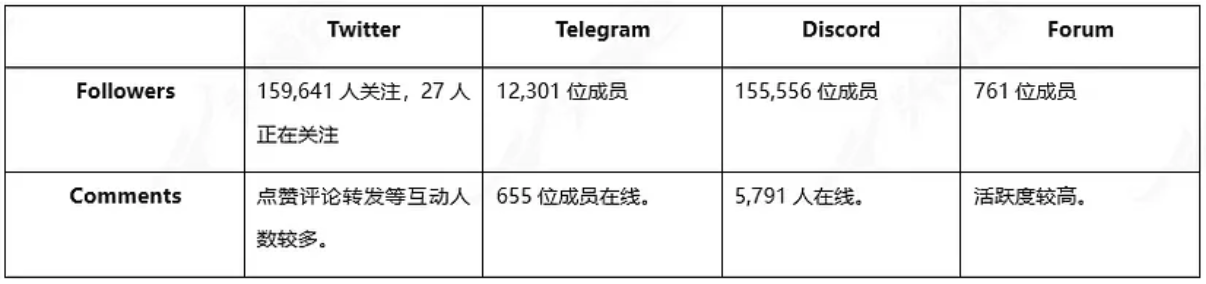
Table 3–2 Celestia Social Media Metrics
As of October 12, 2023, Celestia has a large social media following, active engagement, and a vibrant official community, with discussions primarily centered on technical development and token airdrops.
3.3 Future Outlook
Celestia has not released a formal roadmap, but based on available information, the TIA token airdrop will conclude on October 17 at 12:00 UTC, followed shortly by mainnet launch. The known 60-million TIA airdrop plan is as follows:
(Snapshot taken January 1, 2023, covering 576,653 on-chain addresses across Ethereum, rollups, Cosmos Hub, and Osmosis)
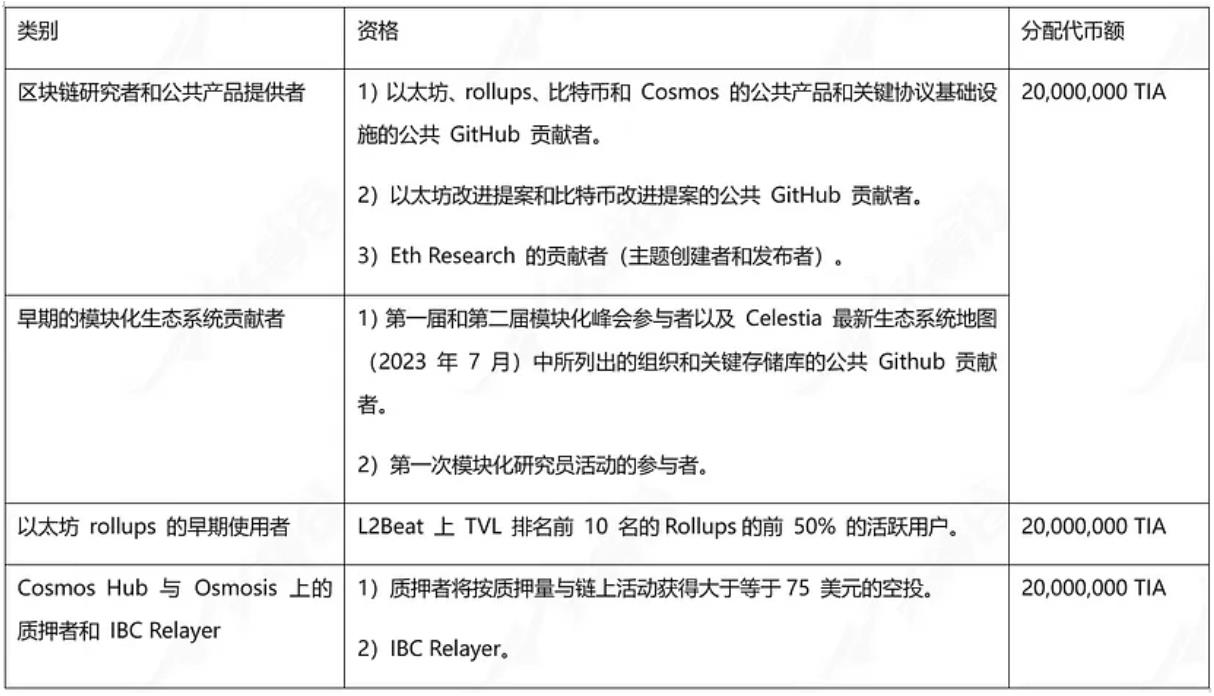
Table 3–2 Celestia TIA Token Airdrop Plan
Summary:
From a development standpoint, Celestia remains in the testnet phase, with mainnet launch expected soon. While current testnet nodes are relatively centralized, Celestia’s network architecture and data availability implementation entail low hardware requirements for node operation. After mainnet launch, node count could significantly increase, improving throughput, decentralization, and security. Additionally, Celestia enjoys strong social media presence and an active community, supporting future ecosystem growth. The ecosystem is still in very early stages, dominated by technical infrastructure projects. Considerable time will pass before users can experience application-level projects within the ecosystem.
4. Economic Model
Celestia’s native token is TIA, with an initial supply of 1,000,000,000 tokens. TIA has not yet entered circulation; the airdrop will occur on October 17, 2023. TIA will inflate annually, starting at 8%, decreasing by 10% each year until stabilizing at a 1.5% annual inflation rate.
4.1 Supply
4.1.1 TIA Token Distribution[10]
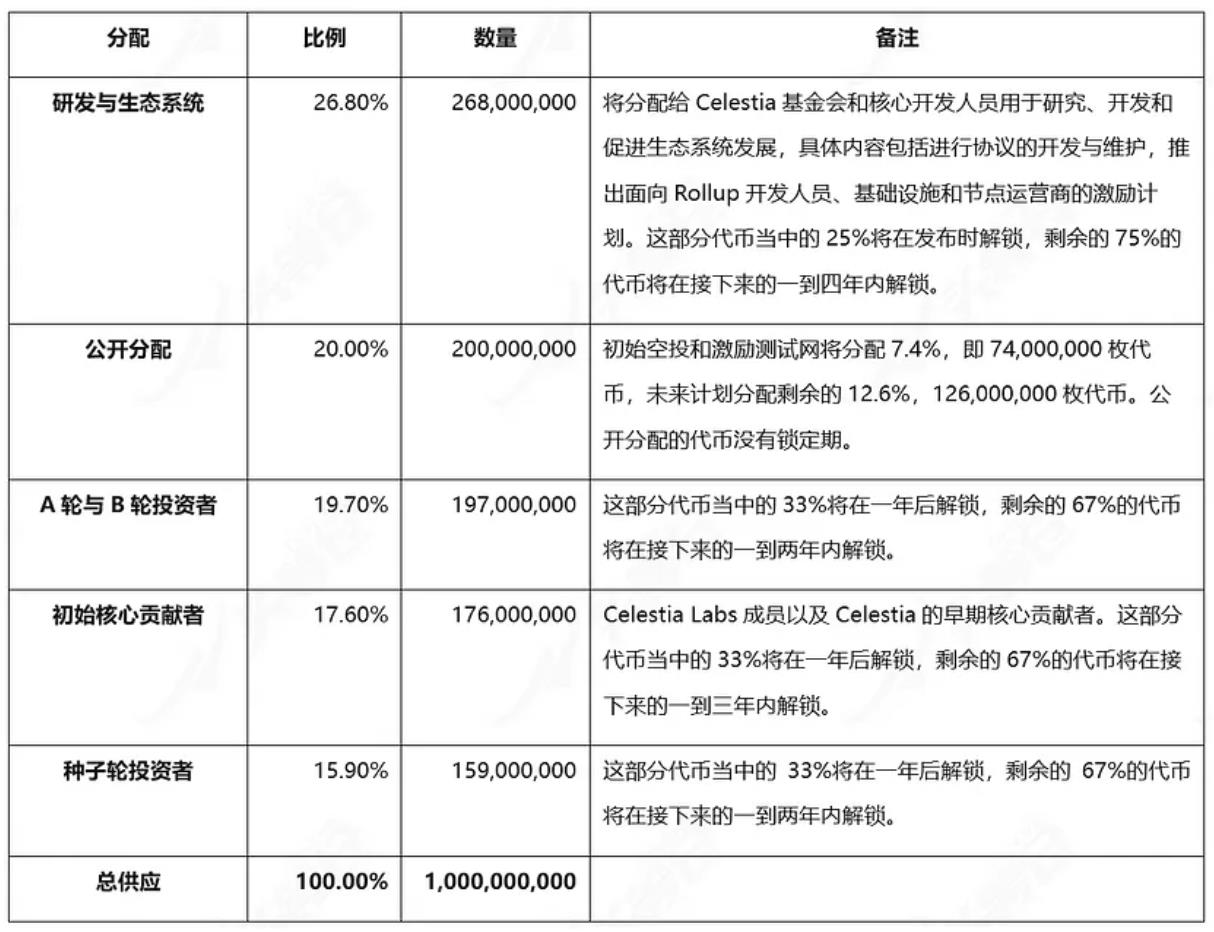
Table 4–1 TIA Token Distribution
Join TechFlow official community to stay tuned Telegram:https://t.me/TechFlowDaily X (Twitter):https://x.com/TechFlowPost X (Twitter) EN:https://x.com/BlockFlow_News

 @firstvip61






