Understanding Dojo: Starknet's On-Chain Gaming Engine and Its Competitive Edge
TechFlow Selected TechFlow Selected
Understanding Dojo: Starknet's On-Chain Gaming Engine and Its Competitive Edge
Dojo and the Starknet ecosystem are well-positioned to become the industry-leading tech stack enabling this development.
 Navigating Web3 tides with focused insights
Author: PAUL VERADITTAKIT
Translation: TechFlow

Dojo is a verifiable on-chain gaming engine for Starknet that provides developers with a toolkit to create high-quality games where all in-game assets, user actions, and transactions occur directly on the Starknet blockchain. Before diving into Dojo's features, let’s first explore its use of the Cairo programming language. Then we’ll examine some applications built using this novel on-chain game framework, and finally discuss the broader implications of Dojo for the evolution of on-chain gaming.
Dojo's Features
As a game engine, Dojo consists of several subcomponents: a native Cairo-based ECS (Entity-Component-System), the Torii auto indexer, the Katana game sequencer, and the Sozu development and deployment toolchain. Let’s briefly go over each of these.
Entity-Component-System (ECS)
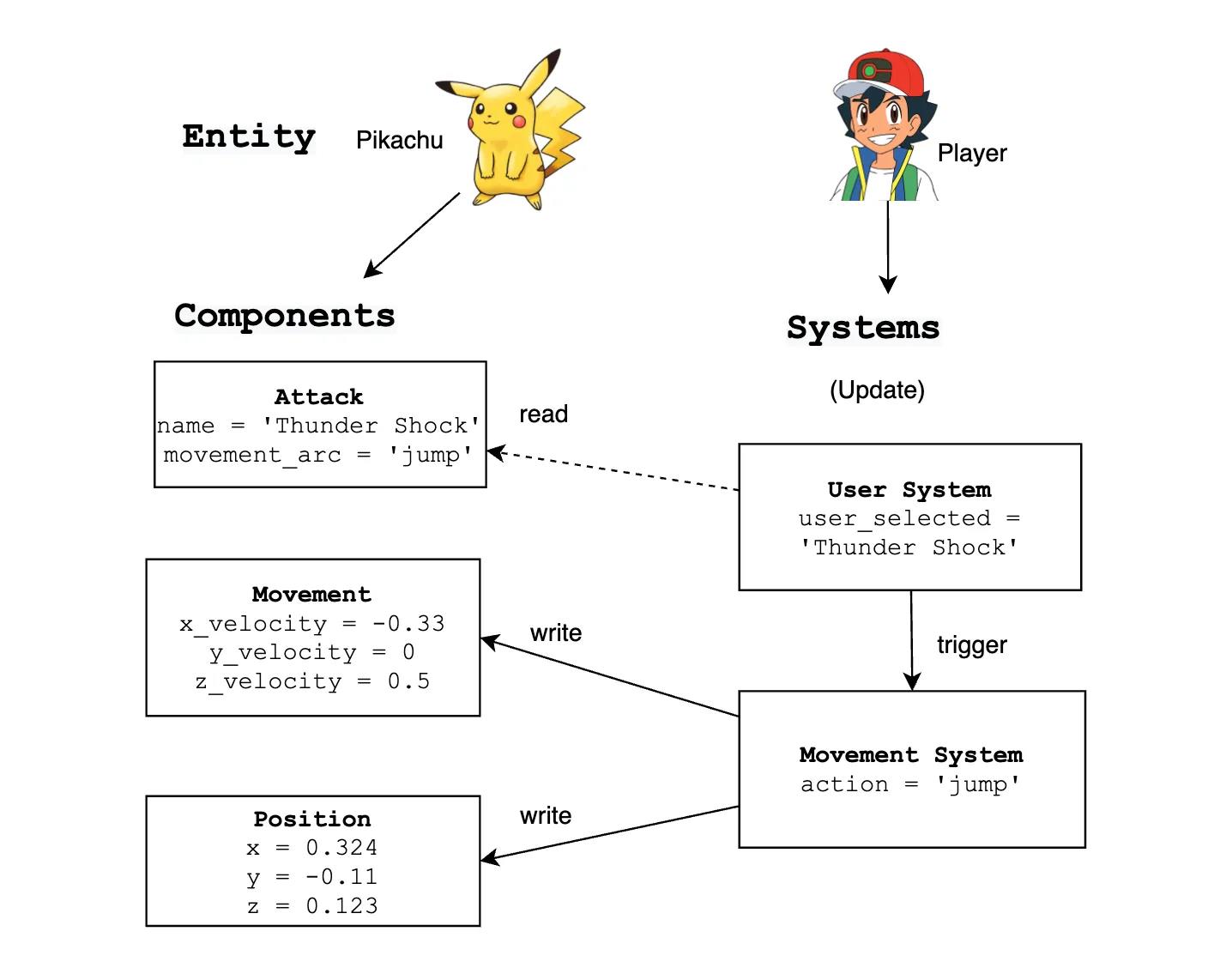
ECS is a design pattern commonly used in game development that breaks down interactions within a game into “entities,” “components,” and “systems.”
At a basic level, an entity represents an agent within the game—such as Pikachu. This agent possesses multiple components, which are essentially modular groupings of functionality. Examples of components might include position, movement, and attack. These components contain no logic themselves—only data. The logic is defined within systems, which users interact with. For instance, a user might interact with a “user system” that reads data from the “attack” component, then triggers an update in the “movement system,” which updates both the movement and position components. Additionally, different entities or categories of entities may share different combinations of components. For example, NPCs (non-player characters) might have movement and positioning components but lack an attack component.
Therefore, ECS is an incredibly flexible, intuitive, and powerful framework that allows game developers to define how various agents interact within a game environment. One of Dojo’s key strengths is bringing this familiar and flexible framework into Cairo, enabling game developers to build games quickly using established workflows.
Torii: Auto Indexer
Having a Cairo-native ECS framework is great, but our goal isn’t just to develop regular games—it’s to build blockchain games, where all assets, states, and logic are stored on a public blockchain like Starknet. To achieve this, we need a way to interact with and monitor information on the public chain: a blockchain indexer.
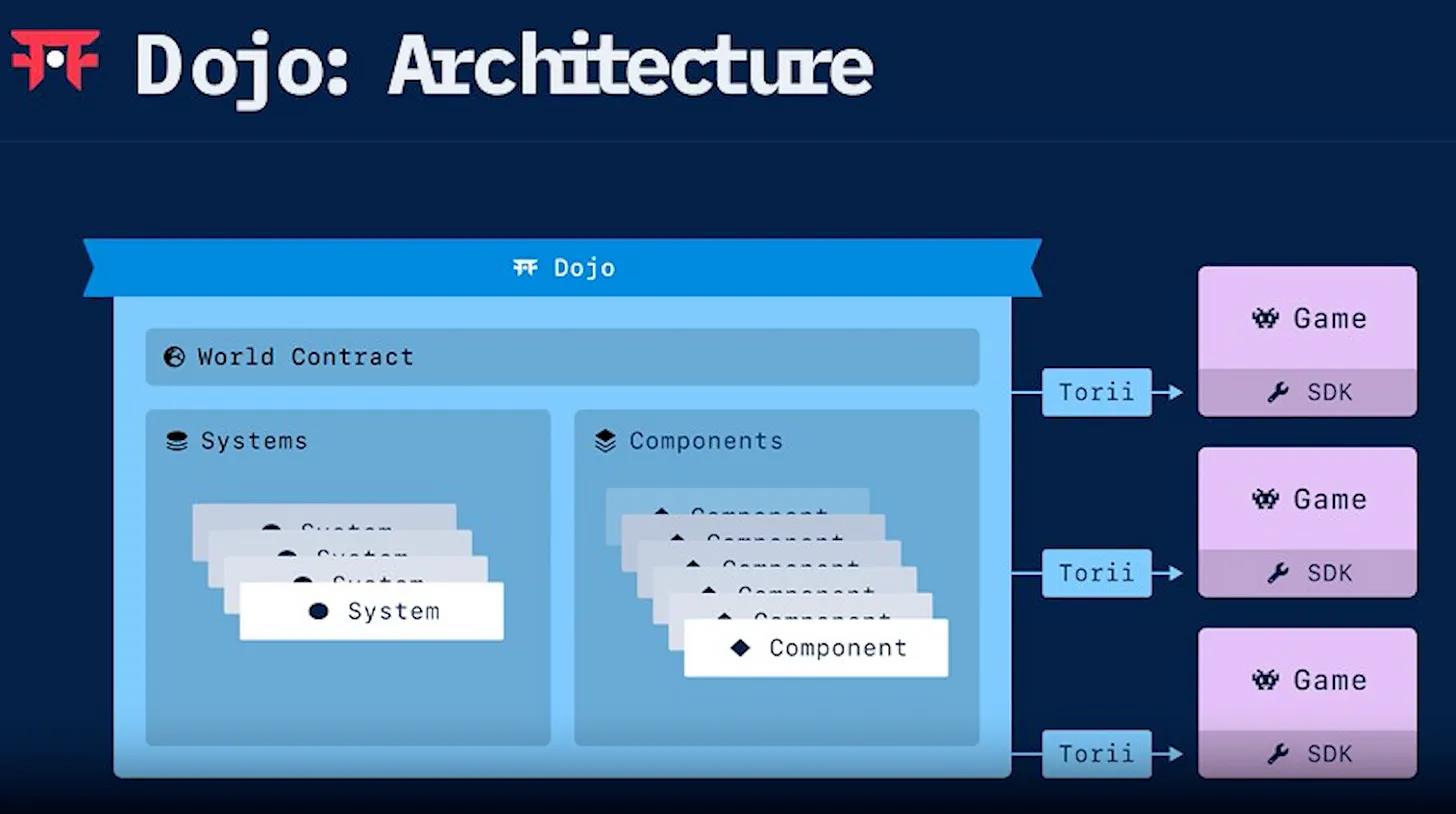
This is where Torii comes in—the auto indexer specifically designed for Dojo. Torii automatically indexes Dojo worlds and provides low-latency, high-performance GraphQL and gRPC interfaces for game clients, allowing them to render real-time changes in game state. Using Torii enables users to quickly index any events occurring within Dojo-powered game worlds deployed on-chain. As a result, Dojo developers avoid the need to write custom indexers for their specific games, which could introduce unnecessary overhead and bugs.
Katana: Game-Oriented Sequencer
The next feature in the Dojo toolkit is Katana, a sequencer tailored for gaming. Katana was designed with the unique needs of on-chain game development and deployment in mind. It operates as a centralized sequencer optimized for low latency and high throughput, supporting both local development and production deployment. In production environments, its architecture supports execution sharding and regional deployments that roll up into a canonical parent chain, enabling games to scale horizontally across large user bases.
Sozo: Development and Deployment Toolchain
Finally, Sozo is a set of scaffolding tools that allow developers to easily build, develop, test, and deploy their games. Sozo offers a suite of project commands such as init, build, test, and migrate, saving developers time on boilerplate code—especially during deployment. With a simple sozo migrate command, users can rapidly deploy their game world on-chain, while the Sozo library handles state differences between existing on-chain data and newly deployed code.
Applications in the Dojo Ecosystem
As shown above, Dojo provides a comprehensive development infrastructure that combines common practices from traditional game development (like the ECS model) with blockchain-specific tools (Torii, Katana, Sozo). Now, let’s look at some applications running on Starknet that currently use, or plan to use, Dojo in future versions.
Loot Realm
Loot Realms, developed by BibliothecaDAO, is more than just a game—it’s a loosely connected collection of on-chain intellectual property (IP) being used to continuously spawn related games, lore, and history. Originating from the text-based Loot NFT collection in 2021, Loot has since become the foundation for many games. As a primary source of fully on-chain IP, Loot-based games and culture may emerge as a major force within the Dojo ecosystem and the broader on-chain gaming space.
One major game built using Loot Realms IP is Realms: Eternum, a player-NFT-based MMO strategy game. Essentially, Realm NFTs represent geographic regions, complete with features like cities, zones, ports, rivers, and resources such as copper, stone, coal, and rubies. The attributes of these NFTs determine how much resource development players can undertake on their territories—all of which can be traded on liquid markets. Since players must constantly make strategic decisions and balance resources, the game delivers a strong sense of control and strategic depth.
Another game based on Loot IP is Loot Survivor, a text-based survival game inspired by Loot’s textual origins. Players develop RPG-style strategies, compete with others for loot, and progress in a real-time strategy format.
Roll Your Own
Roll Your Own (RYO) is a multiplayer strategy game developed by Cartridge Gaming Company, one of the core teams behind Dojo. Originally built in Cairo Zero in 2021, the smart contracts had to be rewritten when Starknet upgraded to Cairo—and Cartridge used Dojo to accomplish this. In fact, Dojo was initially created specifically to rebuild RYO, a process led by the Cartridge team.
During a recent player test deployed on the Katana sequencer, RYO recorded over 70,000 transactions across more than 2,500 rounds—demonstrating Dojo’s ability to handle the massive computational loads typical of gaming applications.
Briq
Briq is another interesting gaming project on Starknet, with its team being one of the maintainers of the Dojo software. At its core, Briq aims to realize a “Lego-on-chain” concept, allowing players to mint “briq” collections and build their own creations, which can then be exported as NFTs. Existing “briq” structures can also be disassembled back into individual bricks and reused to build new structures.
The Significance of Dojo for On-Chain Gaming
From Dojo’s architecture and its applications, it’s clear that the focus lies on open game design and player-driven resource trading. Indeed, this may represent a key aspect of blockchain’s promise for new forms of gaming—a form where shared resources are registered on a public blockchain like Starknet, enhancing multiplayer interactivity within a given game.
Arguably, this enhanced multiplayer experience powered by blockchain embodies the core promise of “autonomous worlds.” Under this definition, a “world” is a self-contained space with its own rules and unique culture. An “autonomous world,” recorded on blockchain yet shaped by users, offers a new platform for creative expression—one that may represent a significant long-term value proposition in the evolution of blockchain gaming.
Within this ambitious vision, the Dojo and Starknet ecosystem is well-positioned to become an industry-leading tech stack capable of enabling this transformation. Whether due to Cairo’s language advantages over Solidity, Starknet’s advanced and high-performance STARK proof system, or Dojo’s comprehensive testing suite and architecture, this ecosystem appears equipped with the technical capabilities to unlock the full potential of on-chain gaming and “autonomous worlds”—and ultimately help establish Cairo as an accessible, widely adopted general-purpose programming language.
Join TechFlow official community to stay tuned
Telegram:https://t.me/TechFlowDaily
X (Twitter):https://x.com/TechFlowPost
X (Twitter) EN:https://x.com/BlockFlow_News
 Pantera Capital