








Interview with Manta Network CEO: A Startup Story from a Small City Near Gaza, Israel
TechFlow Selected TechFlow Selected
Interview with Manta Network CEO: A Startup Story from a Small City Near Gaza, Israel
ZK is meant to be used by people, not just a concept for people to talk about.
 Navigating Web3 tides with focused insights
TechFlow: Sunny
Manta Network: Victor Ji
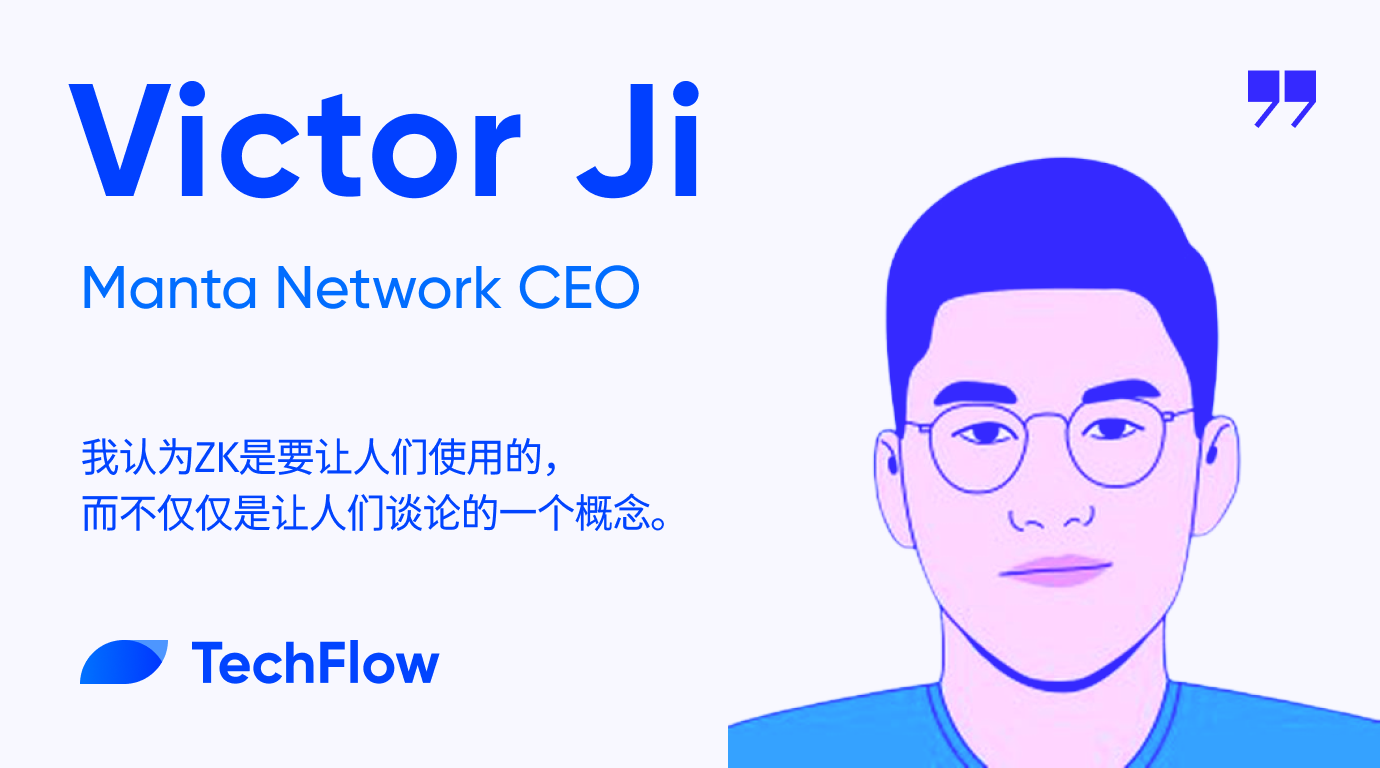
"I believe ZK should be something people use, not just talk about."
---Victor Ji
Victor's Entrepreneurial Journey: From Gary Gensler’s Classroom to Israel, From CBDC to a Passion for ZK
To write the introduction for this dialogue, the editor特意 watched several episodes of Gary Gensler’s MIT course titled “Blockchain and Money.” Gary Gensler, now the SEC chair often criticized for opposing cryptocurrency in the U.S., was once a strong advocate for blockchain education and held optimistic views about Web3.
Sitting among Gensler’s students at the time was the current CEO of Manta Network—the very subject of today’s conversation—a passionate crypto maximalist studying at Harvard.
Before studying in the U.S., Victor briefly worked in Israel, experiencing firsthand the entrepreneurial spirit described in the book "The Startup Nation." "Living in Ashdod, a small city near Gaza, during one of the best years of my life deeply influenced me. The Jewish culture has had a profound impact on my life and work. The Israeli work visa on my passport is probably one of the hardest visas to get again," he said. With personal experiences spanning entrepreneurship, crypto, and regulation, Victor brings a uniquely informed perspective.
After completing Gensler’s course, Victor discovered zero-knowledge proofs while researching Singapore’s central bank digital currency (CBDC). Yet he believes zk technology should be treated as an enabling tool rather than a product to boast about. If more user-friendly applications could emerge that naturally integrate this technology, perhaps Web3 could truly break into the mainstream. In my conversation with Victor, I heard many unique and valuable insights from his journey. I hope you, the reader, will also find inspiration in this engaging dialogue.
The Dialogue
TechFlow: As far as I know, Manta Network is one of Asia's earliest projects to explore ZK modular blockchains. In July this year, you announced exciting news—an $25 million Series A round at a $500 million valuation. Investors in this round include leading industry players such as Polychain, Binance Labs, and Coinfund.
I’ve looked into your background and learned that as early as 2017, you conducted in-depth research on cryptocurrencies—for example, exploring their economic models and financial frameworks in developing countries using statistical methods. By 2020, you were studying CBDC—central bank digital currencies—at Harvard. I’m very curious: how did you first encounter cryptocurrency, and how did that lead you to Manta Network?
Victor:
I started my career in 2016, when my first job was in investment in Israel. Although I studied finance and economics—and most graduates typically go into banking, private equity, or accounting firms like PwC—I chose a different path. Back then, few people opted to work in Israel, but I found it fascinating. I happened to have an offer there, mainly focused on investment and fundraising. Our work was mostly in traditional finance—infrastructure investments such as roads, bridges, and real estate. There’s a famous book about Israel called *The Startup Nation*, which describes its entrepreneurial culture. That left a deep impression on me. I felt Jewish people were exceptionally intelligent, and this influenced both my work and worldview.
I’ve always been deeply interested in entrepreneurship and familiarized myself with many local projects and academic research. In Israel, I encountered many new technologies, including cryptocurrency. In fact, many zero-knowledge proof (ZK) projects like Starkware and zkSync are connected to Israel or the Jewish community. However, at that time, I was exposed primarily to general crypto technologies, not specifically ZK.
After 2017, I continued working in Israel, but realized the country is quite small, with tense relations with neighboring nations and certain areas being off-limits. So when I got the chance to pursue research at Harvard, I took it. At Harvard, I conducted economic research and began focusing on emerging tech fields. I also entered the crypto space—early on, I even served as a community manager for Binance in the U.S. My friends and I co-founded a fund. My core interest has always been approaching crypto projects from an investment angle and helping them grow.
While everyone was euphoric during the 2017 bull market, by 2018 I faced a decision: continue working or pursue further education? I was fortunate enough to receive an offer from Harvard’s master’s program and considered whether to continue studying. Even though the crypto market was still booming in 2018, I ultimately chose the academic path.
I decided to keep learning. I believed education would allow continuous growth, so I pursued a master’s degree. I studied at Harvard’s Kennedy School, which leans toward government and policy. My focus was public administration, political science, and economics. The economics curriculum was heavily statistical—we took courses equivalent to PhD-level statistics, along with extensive public management training.
For instance, a popular topic today is UBI (Universal Basic Income) and how to solve poverty. We discussed this frequently in class. While I strongly support crypto and decentralization, most of my classmates worked with governments and leaned toward centralized thinking—believing democratic freedom comes through government support and elections, not direct cash transfers to the poor. I wanted a more decentralized, trustless system where technology plays a key role. During my studies, I also took courses at MIT, including Gary Gensler’s “Blockchain and Money”. Through these classes, I learned about NFTs, algorithmic stablecoins, and regulatory perspectives. Indeed, regulators think differently—it was a way to understand the issue from a non-“Crypto Maximalist” viewpoint (the opposite being “Crypto Minimalist”).
At the same time, I participated in a government project collaborating with the Monetary Authority of Singapore (MAS) on an interbank payment system based on CBDC.
During our research—which included what is now Celo Foundation’s ecosystem lead and my co-founder Kenny Li, who was then my teaching assistant—we wrote a paper on using zero-knowledge proofs for KYC in banking systems. I realized this technology held immense value. I began considering building a user-friendly ZK application to broaden its adoption. Starting in 2020, I kept encouraging Kenny (Manta’s co-founder) to start a company. We concluded that partnering directly with traditional banks or CBDCs wasn’t ideal due to slow progress. But DeFi gave us hope—anyone could design mechanisms via smart contracts to build decentralized systems. We teamed up with another friend researching Web3 and officially launched Manta around May-June 2020.
Initially, we wanted to build an identity-based project—similar to today’s Worldcoin—where each person gets a biometric-linked address verified via zero-knowledge proofs. But back then, the technology was too immature; generating a single proof took four minutes. So we pivoted to privacy payments and DeFi. At that time, large amounts of funds were moving from centralized exchanges onto chains, and on-chain transactions already accounted for 15% of total crypto activity. Manta Pay became our starting point, and we’ve made steady progress every year since 2020.
The Regulator: Gary Gensler
TechFlow: You began learning about digital currencies as early as 2016, and by 2018, you gained deeper insight from a regulator’s perspective. But for audiences today, this might be confusing—Gary Gensler now seems strongly opposed to decentralization. Do you think this dramatic shift is genuine, or merely a strategic move to pressure non-compliant markets?
Victor:
I think it’s simply a matter of “when in power, act accordingly.” Everyone has their responsibilities. I think he was a great teacher at school—every year, MIT ranked him as the top lecturer at Sloan School of Management. He really taught well. I always sat in the front row and raised my hand to speak because I was such a crypto maximalist back then. I even wore Binance-branded clothes to class. The professor pointed out that the exchange wasn’t compliant, and I argued it would eventually become compliant. He explained his position—he had his reasons.
You see, Gensler has spent his entire career in traditional finance and banking. He likely believes that no matter how much technology advances, people should still trust governments, rely on regulations to protect investors, and have clear oversight to ensure safety.
From the perspective of securities classification in crypto, the clearest benchmark is probably the “Howey Test.” But this can be examined from two angles. First, the Howey Test hasn’t truly advanced technological development—it treats crypto more as an investment product, ill-suited for driving tech innovation. Second, while modern cryptocurrencies do exhibit some security-like features through staking and incentive mechanisms, how can we make this ecosystem foster organic innovation? I predict in the next cycle, we’ll see greater innovation and broader applications, which will genuinely shift regulators’ views. Our work on ZK aims to achieve exactly that—to show the value of our project goes beyond mere speculation.
TechFlow: What are the limitations of the current regulatory view that treats tokens solely as securities? What needs to change before they reconsider this stance?
Victor:
I see two possible directions. One is clearly defining what investors can and cannot buy—for example, Hong Kong is gradually moving in this direction. The other is maintaining an open market with high freedom. Such a fast-moving market allows people to eventually identify truly valuable projects.
Looking back to the early days, there were hardly any choices. Most projects were direct Bitcoin clones with minor tweaks. Then people realized copying Bitcoin wasn’t enough, leading to innovations like ERC20 tokens with new value propositions. Over time, many of these functions were absorbed by Ethereum, which offered stronger decentralization, broader consensus, and higher user adoption.
Now we’re in the Layer 2 era, exemplified by Arbitrum. When such networks launch their tokens, they already represent mature, active ecosystems. Compared to traditional stocks or emerging technologies like biotech, these tokens have a much stronger foundation.
The pace of technological advancement has surpassed financial attributes. As Layer 1 and Layer 2 technologies strengthen real-world applications, public understanding of this industry will deepen. A free market can effectively shape industry trends and influence regulators. It takes time, but this is clearly an irreversible trend.
TechFlow: The evolution of this industry is astonishing, especially when rapid technological and informational progress intersects with regulatory awareness. I’m curious—back in 2016 and 2018, what moment, what element in crypto captivated you and turned you into a firm believer?
Victor:
First, I was born in China, but since university, I’ve studied in the UK and other European countries. Since then, I’ve traveled extensively—including to Israel—and visited over 50 countries. I love traveling and deeply experiencing diverse cultures and histories.
This passion for travel aligns perfectly with the blockchain industry. Whether working for others, starting a business, or investing, this field offers opportunities to collaborate globally. This open collaboration feels incredibly valuable.
For example, in traditional finance, investors usually focus on familiar regional markets—like Jiangsu-Zhejiang-Shanghai or Beijing-Shanghai-Guangzhou in China. But in crypto, whether it’s Adelaide in South Australia, the U.S., Europe, or Finland, people everywhere exchange capital and products, speaking the same language and using the same tools.
Over time, I’ve noticed a trend that goes beyond internationalization—a shared global culture is forming. People are collectively exploring better ways to apply this technology. From an infrastructure standpoint, cooperation and practical application are increasingly prioritized. Everyone is open-minded and willing to collaborate for the prosperity of the entire ecosystem. This, to me, is the true significance of the blockchain industry.
Zero-Knowledge Proofs and Modular Blockchains
TechFlow: Returning to project and technical topics, what exactly does Manta offer in terms of modularity and zero-knowledge proofs?
Victor:
In essence, ZK (zero-knowledge proofs) solves a fundamental problem: establishing trust without revealing information. For most decentralized systems, as the amount of required data increases, so do the risks. It’s like the load on a bridge increasing with more traffic. Similarly, as blockchain accumulates more data and functionality, its risk grows. ZK is the optimal solution to this. Alternatives like Trusted Execution Environments (TE) have drawn attention, but people later realized these tend toward centralization—despite more participants running hardware, single points of failure remain. ZK, however, is a more decentralized approach.
Anyone can generate a proof, and you only need to verify it. When verification matches the proof, you achieve a trustless process. This is both trustless and decentralized—highly satisfying. That’s why, although we initially studied central bank digital currencies (CBDC), we wanted to enable broader ownership distribution among banks. I believe the more distributed bank ownership becomes, the less dominant central banks will be. This creates a healthier market environment, though it’s a complex topic. Another reason we explored ZK was discovering its potential to protect data privacy in machine learning during our early AI research.
TechFlow: Manta Network is one of Asia’s earliest privacy-focused blockchain projects. Can you explain to readers what Manta’s current landscape looks like?
Victor:
Today, Manta is more of a platform built for ZK applications, providing a framework that helps apps adopt ZK technology easily and scale broadly. That’s our mission. The platform includes two chains—similar to how Polygon operates multiple chains. Manta gradually designs multiple execution layers for different developer environments. The first is Manta Atlantic, a parachain on Polkadot, allowing Rust developers to build applications and implement features. Our focus here is compliant privacy identities, incorporating ZK, SBTs, and compliance-oriented privacy payment systems—all implemented on the Atlantic chain.
The second is Manta Pacific, our latest modular Layer 2 solution. We built an OP Rollup-style Layer 2 similar to OP Stack, but we use Celestia as the DA (data availability) layer to replace Ethereum’s data posting function. Settlement and consensus still run on Ethereum. This architecture enables extremely low gas fees while maintaining high decentralization. Additionally, we developed a “universal circuit”—a generalized circuit that allows developers to build ZK applications without writing ZK code themselves. They can simply use our circuits like regular smart contracts and compose them freely.
This way, developers can build new apps without writing circuits—this is the core concept of our ZK platform. Whether on Atlantic or Pacific, developers—Rust or Solidity—don’t need to understand ZK to build new applications, unlock new functionalities, and expand the ZK market and use cases.
TechFlow: You mentioned modularity earlier. Does this refer to technical modularity tailored to developers with different technical backgrounds, such as those using Rust or other languages?
Victor:
There are two levels of modularity. First, we use a modular public chain to reduce gas costs by publishing data on Celestia for data availability (DA layer)—a modular design. Previous solutions like OP, Arbitrum, or zkEVM posted data directly on Ethereum. Our consensus runs on Ethereum, but separating data to a DA layer is our biggest distinction.
The second level is circuit modularity. This means developers can call different circuits and contract SDKs to create new applications. This development process is composable and modular. Developers don’t need to write circuit code from scratch—they can build various features immediately. These are the two layers of modularity.
TechFlow: Earlier, you mentioned Manta started with a simple idea—maybe just a zk Payment. Between 2019 and 2023, what factors led Manta to evolve into a modular blockchain project?
Victor:
I believe the most important factor is users. Our focus has always been on how to get more people to use these products. Initially, DeFi seemed viable in the early 2020s, but we realized there was essentially only one DeFi model, and it was overly decentralized, creating friction with regulators. Projects ignoring compliance saw very low usage.
For example, Aztec’s zk.Money and Tornado Cash had very low daily active users (DAU) and engagement metrics. This showed limited understanding and adoption of the technology. I realized we couldn’t limit ourselves to DeFi—we needed to expand across various use cases to bring ZK to more people. So we began exploring ZK with SBTs (self-sovereign verifiable credentials). I noticed massive minting volumes of SBTs and NFTs. People willingly held these credentials for event participation, identity verification, etc. Based on this, we built a framework to mint zkSBTs and verify them afterward. Using this framework, we’ve launched 1,020 zkSVTs with over 500,000 issued credentials—all within half a year. For users, this demonstrates a tangible entry point into new ZK applications. We experimented and shifted our thinking.
Later, I realized zkSBT use cases weren’t abundant enough—many more ZK applications awaited exploration. For example, games built on-chain present more interesting possibilities. With universal circuits, we can directly invoke contracts to generate private random numbers for cross-chain gaming. We can also create new credential types across asset categories without revealing specific details. This is another product on our chain. Through such tools, we enable broader adoption, fostering growth in social, travel, and matchmaking applications via underlying technology.
TechFlow: This phenomenon is fascinating. In exploring ZK applications and user needs, you found that privacy-focused financial use cases weren’t particularly attractive. This sounds paradoxical—since for most users, the primary blockchain application today appears to be finance. Why hasn’t zk succeeded in real anonymous privacy protection?
Victor:
Actually, the largest current zk application isn’t in finance. If measured by daily active users (DAU) or transaction volume, social and gaming domains outperform finance. As you mentioned, looking at NFT badge mints, GameFi and social interaction frequency, and user retention rates, social gaming surpasses zk finance by a wide margin.
That’s a perspective I formed from observing on-chain behavior. Of course, in terms of capital scale, finance dominates. From a product standpoint, I want users to first develop habits using ZK and SVT tools, then guide them toward financial applications—not the reverse. Starting with finance leads to imitation and stifles innovation. Every new chain follows the same “trinity”: first a DEX, then lending, then derivatives. But we started with SocialFi, moved to GameFi, and only later returned to DeFi. Our approach is inverted. But from a user funnel perspective, there’s a clear progression. Currently, social has the most users, followed by gaming, then DeFi. Adopting a new narrative or cognitive model works—but without token incentives, if users hold tokens, they’re more likely to engage with DeFi based on perceived token value.
TechFlow: Since Manta builds EVM-native zk applications, why can’t Ethereum Foundation or other chains natively support ZK? Is it due to scale or technical constraints?
Victor:
There are many reasons. Projects like Starkware/Starknet focus heavily on novel ZK applications, but they require learning new programming languages—only highly skilled developers pick up Cairo. Exploring practical use cases is crucial, whether in scaling (zkEVM), privacy, or multi-purpose chains. However, product-market fit remains weak, so implementation lags. Research continues—we even use底层 technology from the Ethereum Foundation.
Additionally, different blockchains experiment in various directions—some privacy-focused ZK chains like Aleo and Aztec. Gradually, they require developers to learn proprietary languages, partly because high valuations push them to tell bigger stories, effectively building new programming languages.
But is it necessary for developers to learn a new language just to access these features? I don’t think so. That’s why we enable Solidity developers to build ZK apps using familiar contract patterns. Another thought: I never intended to compete directly with Facebook for non-crypto-native users. Instead, I asked: can I get existing cryptonative or centralized exchange users to adopt ZK apps and own credentials—without requiring everyone to scan their eyeballs for adoption? That’s my vision: let people first experience ZK apps. The underlying tech doesn’t require massive effort to implement—that’s Manta’s value.
Privacy
TechFlow: What are your thoughts on the future of privacy? What bottlenecks might arise in this area?
Victor:
Vitalik also mentioned three challenges facing Ethereum: scalability, account abstraction (AA), and privacy. But I believe privacy is the last frontier—in crypto, issues gain attention only after concrete problems emerge. For example, people only recognized the value of Layer 2 when bridges on Layer 1 failed—Layer 2 offers more localized bridging, avoiding cross-chain asset transfers. Privacy may follow a similar trajectory. Account abstraction, for instance, will likely attract external participants only after broader adoption.
People will realize, as new projects like Arweave emerge, that data itself can become valuable. When data reaches sufficient value, demand for privacy will surge. That’s my view on privacy’s evolution. But I believe this stage is still distant, so we don’t focus exclusively on it. Today, ZK applications are becoming more versatile—that’s why Manta is expanding its scope.
Beyond privacy, identity, and compliance, we can do much more. For example, using circuits to enable privacy in on-chain games unlocks new use cases. Credentials can drive adoption in social contexts. For asset verification, we have tools for binary verification of on-chain credentials. There are even more intriguing scenarios beyond privacy payments—such as rethinking how privacy concepts operate.
B2B vs. B2C Business Strategy
TechFlow: From Manta’s or the ZK field’s perspective, in terms of business strategy, should you prioritize B2C or B2B?
Victor:
Currently, we primarily serve B2B (business clients), and transitioning to B2C (end users) requires seeding through various B2B projects. However, compared to other infrastructure projects, we’re closer to end users, so seed distribution is more critical—and generates greater traffic. Thus, B2B partnerships mainly test product use cases. Like Tesla, after validating through B2B, we can enter the B2C market.
Additionally, B2B collaborations help refine products, streamlining use cases through accelerated feedback. That’s another important benefit.
Open Source and Competition
TechFlow: Next question concerns public goods. Which parts of Manta qualify as public goods? Also, public goods imply open source—how do you handle competition?
Victor:
That’s a great question. First, I don’t think our project has reached a stage where others can easily replicate our state. Still, everything we do is open source, and we actively contribute to public goods. From the beginning, we launched Open Zero—an open ZK library—inviting community contributions to shared resources.
Later, we hosted events inviting even competitors. Some asked: why invite rivals? But from our view, these are all ZK-related events. By bringing everyone together, users can compare what different ZK projects are doing. Users can judge for themselves: “I’ve used this project—I know it’s different.” So it’s actually beneficial.
Moreover, our goals differ. Half of what we do serves public goods; the other half drives adoption—including our own. Initially, I worried about copying. But now I believe the market hasn’t matured—if someone forks us, we can withstand it. First, we’ve built a solid user base, which takes time. Second, we welcome forks because more forks mean wider adoption, potentially uncovering unforeseen use cases. That’s how we contribute.
Finally, everyone approaches ZK differently. Some focus on creating new languages; we prefer building via contracts. These differences already exist. No one is copying anyone else—we’re just racing to see who moves fastest and performs best.
TechFlow: Finally, can you share any emerging directions you’re watching—new areas worth discovering and exploring?
Victor:
You’ve touched on several. First is the SBT direction—offering richer use cases and scenarios for various credentials. These can span asset-backed tokens to on-chain credentials, even integrating with new AI-based verification methods. Our tech can support these.
Second is SocialFi and GameFi. Beyond current card games, many opportunities exist to innovate in casual card gaming—making them more fun and valuable. That’s an area worth exploring.
Third is DeFi—improving capital efficiency by using these credentials to create over-collateralized assets on-chain, unlocking greater credit value and enhancing capital effectiveness. That’s one dimension we’re exploring in DeFi.
Join TechFlow official community to stay tuned
Telegram:https://t.me/TechFlowDaily
X (Twitter):https://x.com/TechFlowPost
X (Twitter) EN:https://x.com/BlockFlow_News
 深潮TechFlow


