a16z x OpenAI CTO: From Theory to Practice — How AI Technology Drives Future Innovation?
TechFlow Selected TechFlow Selected
a16z x OpenAI CTO: From Theory to Practice — How AI Technology Drives Future Innovation?
Although there won't be a single model dominating the future, as people will ultimately seek the tools that best suit their needs.
 Navigating Web3 tides with focused insights
By Saint Paul
After OpenAI launched ChatGPT at the end of 2022, investors' understanding of artificial intelligence has deepened significantly. The AI industry chain can broadly be divided into core technology providers, AI systems, and AI application users. From the perspective of global investors, there is now a shared recognition that AI is likely to become a long-term investment theme—akin to computers 30 years ago or the internet 20 years ago. Moreover, for the future, applications are already becoming a reality.
When it comes to understanding investments in niche areas, we always need to learn from industry-focused investors. Prominent venture capital firm A16Z has been making bold bets in the field of artificial intelligence. Recently, they sat down with Mira Murati, CTO of OpenAI, who shared the story behind ChatGPT and her vision for the future of AI and human-computer interaction. We can also see how Murati, with her product management background, places strong emphasis on practical applications.
Summary
-
The origin of ChatGPT lies in exploring how to build a safe AI system using reinforcement learning from human feedback.
-
OpenAI is redefining how people interact with digital information by creating assistant-like partners, continuously improving alignment and safety of AI systems. By productizing these technologies, they gather real-world user feedback rather than relying solely on theoretical assumptions made within lab environments.
-
Building upon text, ChatGPT is now incorporating images, videos, and other modalities. This enables models to gain a more comprehensive understanding of the world around us—similar to how humans perceive and interpret reality.
-
There won't be a single dominant model taking over everything in the future, as users will ultimately choose tools best suited to their individual needs.
Mira Murati’s Background
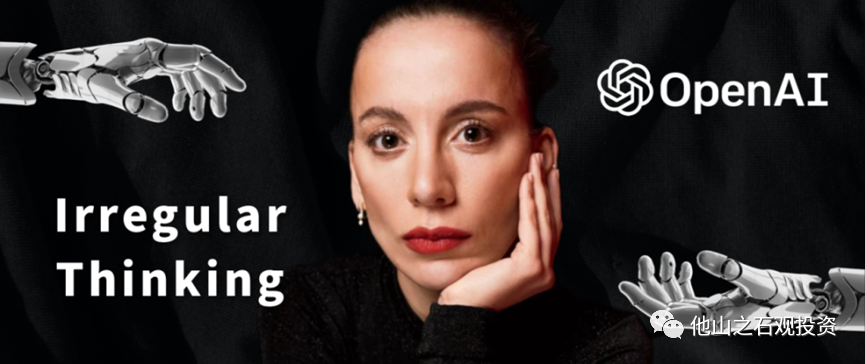
Mira was born in Albania shortly after the fall of communism—a country then similar to today's North Korea. In an era of constant change and uncertainty, education was key. At the time, there was almost no entertainment besides books. Mira turned to books in search of answers. She gravitated toward science because its truths were stable and could be deeply explored. In contrast, subjects like history and sociology seemed unreliable since historical narratives kept changing. Thus, growing up, Mira naturally leaned toward math and science. Fundamentally speaking, what she does today at OpenAI still revolves around mathematics.
Thanks to outstanding academic performance, Mira received a scholarship and completed her final two years of high school in Canada.
In college, Mira studied mechanical engineering because she believed it offered the best way to apply knowledge to solve real-world problems. She was particularly interested in sustainable transportation and energy solutions. Her senior project involved building a hybrid race car powered by supercapacitors.
Shortly afterward, Mira joined Tesla, where she worked on the dual-motor Model S. She began working on early designs of the Model X and eventually led the entire project launch.
It was during her time at Tesla that Mira first became fascinated with AI applications, especially autonomous driving—how AI and computer vision could revolutionize mobility. She started thinking more deeply about different uses of AI and grew increasingly intrigued by AI’s potential impact on the world.
Specifically, she became curious about how AI could transform human-computer interaction and the broader ways people engage with information. She developed a strong interest in spatial computing. Later, she joined the deep-tech startup Leap Motion as VP of Product and Engineering—an experience that further strengthened her product development skills.
(By the way, David Holz, founder of Leap Motion, went on to create Midjourney—one of today’s hottest AI applications—after selling Leap Motion.)
In 2018, Mira joined OpenAI. Since then, she has increasingly reflected on what might happen if one focused purely on generality.
Additionally, from Mira’s discussion of research methodology, we can observe her appreciation for exploratory thinking in innovation—especially when navigating uncertain environments:
-
Sometimes you go to sleep and wake up with a new idea. Over days or weeks, you gradually arrive at a solution. It’s not about quick returns, nor is it always iterative.
-
It’s almost like developing a different way of thinking—building intuition while maintaining discipline in problem-solving, trusting that you’ll eventually find the answer. Over time, you develop a sense for which problems are truly worth solving.
Conversation Highlights
A16Z, a leading venture capital firm, has made significant investments in artificial intelligence. Below is an excerpt from a conversation between Martin, an A16Z partner, and Mira Murati. Mira shares insights into the story behind ChatGPT and the future of AI and human-computer interaction. Her product-oriented mindset is clearly evident throughout.
Martin: Do you think this is more of a systems problem or an engineering problem right now?
Mira: Both. Systems and engineering challenges are enormous—we're deploying these technologies, trying to scale them to make them more efficient and accessible. This means enabling use without needing to understand the complexities of machine learning.
You can actually see the contrast between offering these models via API versus through ChatGPT. It's essentially the same underlying technology, perhaps with slight differences—ChatGPT incorporates reinforcement learning from human feedback. But the difference in how people react, how it captures imagination, and how it enables daily usage is entirely different.
Natural Language Interface
Martin: I also find the ChatGPT API fascinating. Whenever I use these models in programs, I feel like I'm wrapping a supercomputer in an abacus. Sometimes I say, "I'll give the model a keyboard and mouse and let it do the programming." The API is in English—I tell it what to do, and it writes all the code. I'm curious—when designing something like ChatGPT, do you envision natural language becoming the primary interface over time, or do you think traditional programming will still play a major role?
Mira: Programming becomes less abstract in ChatGPT—we’re able to communicate with computers at high bandwidth using natural language. But another shift is that this technology helps us learn how to truly collaborate with AI, rather than just program it. The programming layer itself is becoming easier and more accessible because you can now code in natural language. Yet another aspect we’ve seen in ChatGPT is that you can actually work *with* the model like a partner or colleague.
Martin: It will be interesting to see how this evolves over time. You've chosen to have an API for ChatGPT—but with a colleague, you don’t have an API. You talk. Could these interfaces evolve toward pure natural language? Or do you think there will always need to be some component based on finite state machines or conventional computing?
Mira: We're at a turning point—redefining how we interact with digital information through AI systems. Maybe we’ll have multiple AI systems, each with different capabilities. Or maybe we’ll have one general-purpose system that follows us everywhere, knows my background, what I did today, my goals in life and work, and helps me navigate and guides me. That would be incredibly powerful.
We're at an inflection point in redefining this. We don’t know exactly what the future holds. Our strategy has always been to make these tools widely available so others can experiment—and together, we can discover what emerges.
Just last week with ChatGPT, we worried it wasn’t good enough. But then we released it, and people showed us it excelled in unexpected use cases. When you make tools accessible and easy to use for everyone, that’s what happens.
OpenAI Roadmap
Martin: When it comes to AI, people still don’t know how to think about it. There must be some guidance—you have to make choices. At OpenAI, you decide what comes next. Can you walk us through your decision-making process: how do you decide what to pursue, focus on, release, or position?
Mira: If you trace back ChatGPT’s origins, it wasn’t originally intended as a product. Its roots go back over five years, when we were exploring how to build a safe AI system. You don’t want humans manually writing objective functions—because specifying complex goals perfectly is error-prone and potentially dangerous.
That’s where reinforcement learning from human feedback (RLHF) comes in. What we aimed to achieve was aligning AI systems with human values by incorporating human feedback. With such feedback, the model is more likely to do what you want and less likely to do things you don’t. After developing GPT-3 and releasing it via API, we had our first chance to apply safety research in the real world—through instruction-following models.
We used prompts from API customers, hired contractors to generate feedback for model training, fine-tuned the model on this data, and built instruction-following models that were more likely to follow user intent—doing exactly what users wanted. This was powerful because AI safety stopped being just a theoretical concept. It became tangible: How do we deploy safe AI systems in the real world?
Clearly, large language models show remarkable abilities in representing concepts and real-world ideas. But outputs remain problematic. One major issue is hallucination. We’ve been actively researching hallucinations and truthfulness—how can models express uncertainty?
ChatGPT’s precursor was actually another project called WebGPT, which used retrieval to pull in information and cite sources. That evolved into ChatGPT because we realized dialogue was special—it allows asking questions, correcting responses, and expressing uncertainty.
Martin: Continuously uncovering errors through interaction…
Mira: Exactly. Through interaction, you can dig deeper toward truth. We started moving in this direction using GPT-3 and GPT-3.5. From a safety standpoint, we were very excited. But one thing people forget: internally, we were already training GPT-4. At OpenAI, we were thrilled about GPT-4 and had put ChatGPT somewhat aside. Then we realized, “We’re going to spend six months focusing on aligning and securing GPT-4.” So we began thinking about what we could do—and one key step was releasing ChatGPT to researchers for feedback, thanks to its conversational format. The original goal was to collect researcher input to improve GPT-4’s alignment, safety, robustness, and reliability.
Martin: When you say alignment and safety, do you mean correctness—doing exactly what it’s supposed to do? Or do you mean safety in terms of protecting against harm?
Mira: Alignment typically means the model acts according to user intent—doing precisely what you want. Safety includes additional aspects, such as preventing misuse—when users intentionally try to prompt harmful outputs. With ChatGPT, we’re striving to make models more aligned—more likely to do what users intend. We’re also tackling hallucinations, which remains an extremely difficult challenge.
I believe reinforcement learning from human feedback, if pursued rigorously, may be sufficient for achieving alignment.
Martin: So there’s no grand master plan? To reach AGI, we just keep taking small steps forward?
Mira: Yes. And every small decision along the way matters. Perhaps one strategic decision we made years ago—to pursue productization—put us on a better path. We believed that developing these systems in a vacuum, without real-world user feedback, simply wouldn’t work. That assumption guided many of our decisions and helped us build the foundational infrastructure needed to eventually launch products like ChatGPT.
Scaling Laws
Martin: Can you revisit scaling laws? This is a big question for everyone. Progress has been astonishing. But AI history suggests diminishing returns eventually set in—it’s not always parameterized; gains taper off. From your vantage point—possibly the most informed in the industry—do you believe scaling laws will continue to hold, delivering ongoing progress, or are we approaching diminishing returns?
Mira: There is currently no evidence suggesting that continued scaling along data and compute dimensions won’t yield better, more powerful models. Whether this path leads all the way to AGI is a separate question. Along the way, additional breakthroughs may be required. To fully realize benefits from larger models, we still have a long way to go with scaling laws.
Martin: How do you define AGI?
Mira: In our OpenAI charter, we define it as a computer system capable of independently performing most economically valuable work.
Martin: I was having lunch recently with Robert Nishihara from Anyscale. He posed what I call the “Robert Nishihara Question,” which I think captures the landscape well. He said: “There’s a spectrum between computers and Einstein. You go from computer → cat → average person → Einstein.” Then he asked, “Where are we on that spectrum? What problems remain unsolved?”
The consensus was: we know how to get from cat to average person. We don’t yet know how to get from computer to cat—that’s the general perception challenge. We’re close, but not quite there. And we truly don’t know how to reach Einstein-level reasoning.
Mira: Fine-tuning gets you far, but overall, I’d say we’re at intern level across most tasks. The main issue is reliability. You can’t fully depend on the system to consistently perform as desired. It fails too often. The key questions are: how do we improve reliability over time, and how do we expand the range of new capabilities these models can offer?
I think it’s crucial to pay attention to emerging capabilities—even if they’re unreliable today. Especially for founders building companies now: ask yourself, “What’s possible today? What do you see emerging?” These models will become reliable quickly.
Will One Model Rule Them All?
Martin: Let me selfishly ask about the economics. This reminds me of the semiconductor industry. Back in the 90s, when you bought a computer, there were specialized processors for string matching, floating-point operations, encryption—all offloading CPU work.
Turns out, general-purpose computing was extremely powerful, creating a certain economic model where Intel and AMD both thrived. Of course, building these chips was expensive.
So I can imagine two futures. One where general-purpose models absorb all functionality over time. Another where many specialized models coexist—a fragmented landscape with diverse design points. What’s your take: Will OpenAI dominate, or will there be many models?
Mira: It depends on what you want to do. Clearly, the current trajectory is that AI systems will handle more and more of the tasks we do. They’ll operate autonomously, but still require direction, guidance, and oversight. Personally, I don’t want to spend my days on repetitive tasks. I’d prefer to focus on higher-value work. Maybe we won’t need to work 10–12 hours a day anymore—perhaps we can reduce working hours while increasing productivity. That’s my hope.
Even today, our platform offers a range of models via API—from small to frontier-level. Users don’t always need the most powerful model. Often, a smaller, cost-effective model tailored to a specific use case is sufficient. I believe there will be a spectrum. As for our platform vision, we definitely want people to build on top of our models. We aim to provide tools that make this easy, giving developers greater access and control. You can bring your own data, customize models, and focus on layers beyond the model itself—defining the actual product, which is extremely challenging. Right now, much attention is on building more models, but creating great products atop them is even harder.
Next 5–10 Years
Martin: Can you speculate on where you think this is heading in 3, 5, or 10 years?
Mira: Today’s foundation models have a strong representation of the world through text. We’re adding other modalities—images, video, and more—so models can understand the world more holistically, much like humans do. The world exists not just in words, but in visuals too. We’re moving in that direction: larger pre-trained models that incorporate all these modalities from the start. We want these pre-trained models to understand the world as we do.
On the output side, we’re applying reinforcement learning with human feedback. We want models to reliably do what we ask. Addressing hallucinations will require significant effort—possibly including web browsing, retrieving fresh information, citing sources. I don’t think it’s impossible. I believe it’s achievable.
From a product perspective, we aim to integrate all this into collaborative tools and provide a platform for others to build upon. Looking ahead, these models will become immensely powerful. Naturally, this raises concerns about misalignment with human intent. Superalignment—ensuring even extremely powerful models remain aligned—is a huge technical challenge. At OpenAI, we have a dedicated team fully focused on solving this problem.
Join TechFlow official community to stay tuned
Telegram:https://t.me/TechFlowDaily
X (Twitter):https://x.com/TechFlowPost
X (Twitter) EN:https://x.com/BlockFlow_News