








The Open Network: Backed by Telegram, Exploring the Path to Web2 and Web3 Interconnection
TechFlow Selected TechFlow Selected
The Open Network: Backed by Telegram, Exploring the Path to Web2 and Web3 Interconnection
From Telegram to TON: The Launch of a Decentralized Network
 Navigating Web3 tides with focused insights
Author: Jaden, LD Capital
August 14 marked Telegram's 10th anniversary. In his anniversary letter, founder and CEO Pavel Durov outlined Telegram’s next step: moving beyond messaging to lead innovation in social media. Due to its encrypted communications and strong privacy features, Telegram has become one of the most popular messaging apps.
This year’s surge in Telegram bots has drawn significant market attention. However, these bots only use the Telegram app as an interface for Ethereum protocols and do not directly interact with the TON blockchain. TON (The Open Network) evolved from the original Telegram Open Network blockchain platform. Launched by Telegram in 2017, the project was halted due to SEC allegations. Subsequently, the Telegram community independently reorganized, renaming the network The Open Network (TON), continuing its development and ecosystem growth. Currently, TON—the native token of this network—ranks 12th in overall cryptocurrency market cap and 6th among public blockchains, surpassing Polkadot and Polygon. Although Telegram no longer participates in TON’s technical development, the TON network may still benefit significantly from integration with Telegram’s massive user base. Moreover, Telegram bots have enabled a new paradigm for low-cost, low-barrier Web2-to-Web3 onboarding experiences.
1. Network Architecture
TON employs a multi-layered, multi-chain structure consisting of the masterchain, workchains, and shardchains. The masterchain acts as a central coordinator. Workchains support smart contracts and decentralized applications (DApps), requiring only compliance with standardized interoperability rules—similar to Polkadot. Within each workchain, shardchains are implemented to enhance scalability and enable parallel transaction processing, with each shard handling a subset of accounts.
TON currently uses a Proof-of-Stake (PoS) consensus mechanism. The network involves three key roles:
1) Validators: Participate in securing the network by staking TON tokens;
2) Fishermen: Monitor validators by submitting invalidity proofs. If a validator accepts an invalid proof, they are penalized;
3) Collators: Generate and verify shard states, then submit them to validators. They typically receive rewards allocated by validators.
2. Roadmap
1/ Enhance detection and penalties for inactive or non-performing validators;
2/ Develop cross-chain bridges connecting Ethereum and BNB Smart Chain;
3/ Enable stakers to participate in on-chain governance through network-wide voting;
4/ Payment improvements: Support payment channels between any two participants, enabling unlimited instant micropayments at no cost. Only channel creation and closure incur network fees.
3. Token Overview
During the launch of Telegram Open Network testnet 2, 5 billion tokens were minted, with 1.45% allocated to developers and testers. However, the SEC soon prohibited Telegram from distributing tokens to investors, prompting Telegram to halt further work on the TON ecosystem. The testnet 2 tokens were locked into a smart contract. All available Toncoin (TON) tokens were released via mining and placed in special Giver smart contracts, allowing anyone to mine until June 28, 2022.
After the initial distribution phase ended, TON transitioned into the PoS era. According to the whitepaper, staking rewards amount to approximately 20% of the staked supply annually, with an inflation rate close to 2%. The total token supply is projected to double over 35 years. The current total supply is 5.093 billion TON, with a circulating supply of 3.441 billion.
Use Cases:
1/ Payments: For domain names (DNS), data storage, TON proxies, on-chain gas, and cross-chain fees;
2/ Staking: Secures network integrity. A portion of slashed validator tokens is burned (exact ratio unspecified);
3/ Governance
4. Network Metrics
Currently, the TON network has 343 active validator sets. Total staked TON reaches 486 million, representing 9.5% of total supply and 14.12% of circulating supply. Approximately 41,600 tokens have been burned. Since January 2022, both account count and active addresses have grown steadily. There are now 3.351 million total accounts and about 765,000 active addresses, with around 160,000 daily transactions and 700–900 new on-chain addresses created per day.
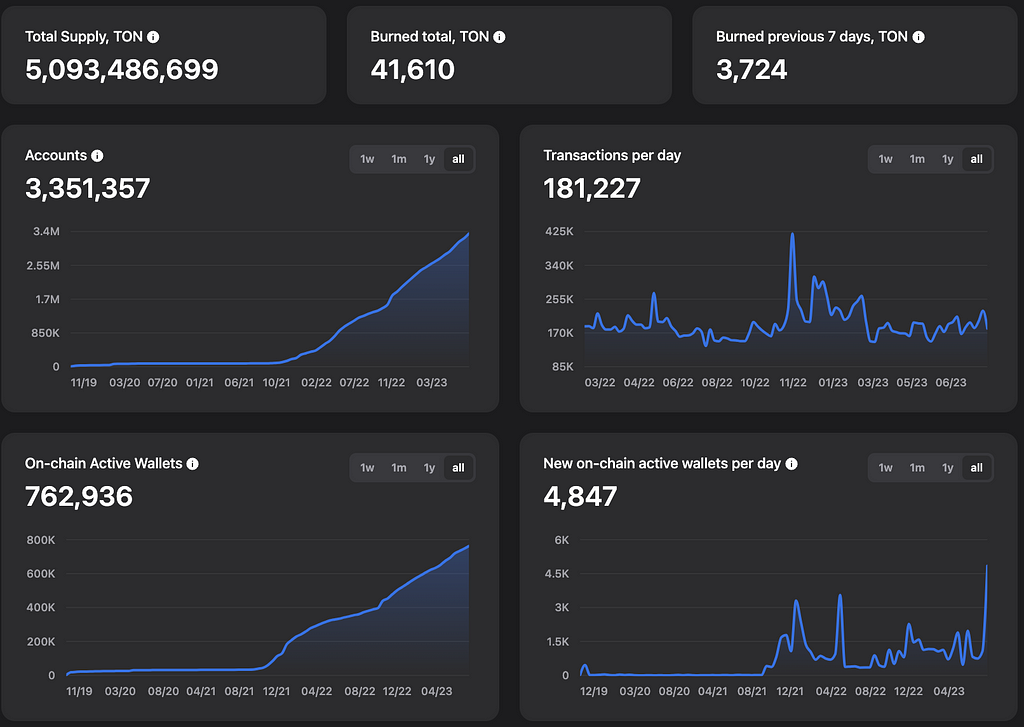
Despite over 3 million wallet addresses, Jetton wallets number only 133,000, indicating that deep engagement with the TON ecosystem remains limited.
(Note: Jetton is the token standard on TON; a Jetton wallet holds any Jetton-compliant tokens.) The total number of minted NFTs stands at 1.194 million. A total of 32,000 DNS domains have been sold (compared to 2.574 million ENS domains on Ethereum), generating sales of 6.205 million TON—approximately $10.67 million at current prices—with an average price of $333 per DNS, which is relatively high.
5. Ecosystem
The TON ecosystem is currently led by the TON Foundation, which operates entirely as a community-driven organization.
Since the beginning of 2023, the TON Foundation’s main initiatives include:
1) Regular liquidity grant programs;
2) Universal accelerator program: Launched in May 2023 with a funding pool of $25 million. The foundation has disclosed recipients from Q2 and Q3 2023, following 31 funded projects in 2022, 10 in Q2 2023, and 5 in Q3 2023—mostly infrastructure-focused.
3) Telegram Integration Initiative: In August, the TON Foundation launched the tApps Hub, a platform listing all apps supporting the Telegram ecosystem. In September, it introduced a Web3 Grant Program specifically targeting Telegram-integrated projects. While the total fund size was not disclosed, individual grants are expected to range between $20,000 and $50,000.
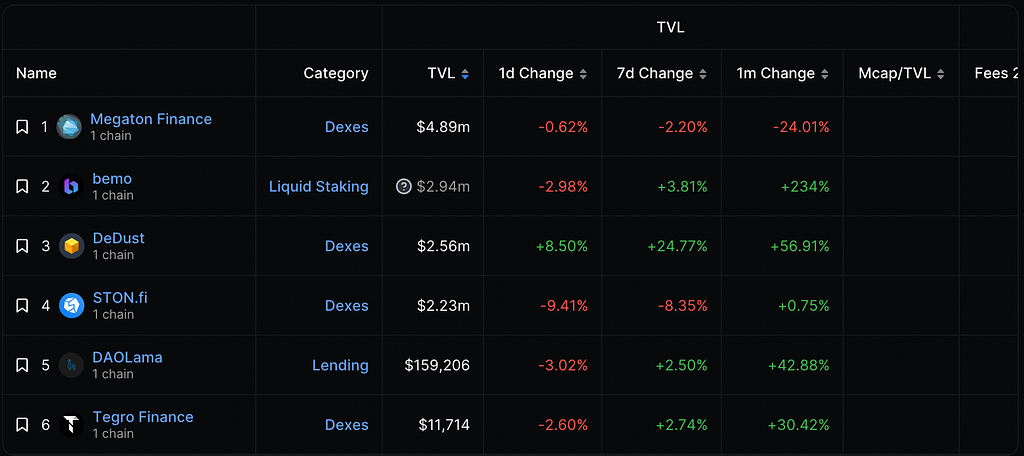
According to DefiLlama, TON’s current TVL is $9.85M, with a historical peak of just $21.04M, indicating that the ecosystem is still in its very early stages.
[DEX]
Megaton Finance
An AMM-based DEX developed by South Korean blockchain company OZYS, originally launched as Klayswap on Klaytn. It currently holds a TVL of $4.89M, accounting for roughly 50% of TON’s total TVL and dominating the TON DeFi space. Megaton Finance raised $1.5M in seed funding in March, led by TONcoin Fund, with participation from Cypher Capital, First Stage Labs, Orbs, and MEXC Ventures. Its token $MEGA is listed on MEXC, with 54% of tokens allocated to liquidity providers.
DeDust
Developed by Scaleton, DeDust now supports nearly all wallets available on the TON blockchain. It recently launched DeDust 2.0 and offers cross-chain bridging, enabling seamless token transfers between TON and Ethereum. Current TVL is $2.56M.
STON.fi
An AMM DEX with a 0.3% trading fee: 0.2% goes to liquidity providers and 0.1% to the STON.fi protocol. Current TVL is $2.23M.
[Lending]
DAOLama
A lending platform using NFTs as collateral. Current TVL is only $160,000.
[NFT Marketplace]
TON Diamonds
The primary NFT marketplace on TON. A 5% fee is charged on NFT trades, though users can reduce fees by purchasing official tiered Diamond NFTs.
[Others]
Fanzee
A fan engagement platform that raised $2M in pre-seed funding, co-led by the TON Foundation and First Stage Labs. Other investors include MEXC Global, Huobi Global, KuCoin Exchange, VLG Capital, Orbs, 3Commas.io, and Hexit Capital.
6. Summary
Although the Telegram team is no longer involved in The Open Network’s development, there remains some level of cooperation, and TON is actively integrating with Telegram’s ecosystem. Built on high performance and leveraging Telegram as a massive traffic gateway, TON aims to offer low-barrier use cases as its core competitive advantage. However, the TON ecosystem is still in its infancy, dominated by infrastructure projects, with a notable lack of innovative or highly engaging applications.
Join TechFlow official community to stay tuned
Telegram:https://t.me/TechFlowDaily
X (Twitter):https://x.com/TechFlowPost
X (Twitter) EN:https://x.com/BlockFlow_News
 Cycle Capital Research






