








Focusing on Real-World Use Cases and Doubling Down on Asia: Sun Yuchen on Proactive Transformation in the New Global Crypto Landscape
TechFlow Selected TechFlow Selected
Focusing on Real-World Use Cases and Doubling Down on Asia: Sun Yuchen on Proactive Transformation in the New Global Crypto Landscape
Regulatory hurdles and market cycles cannot stop the influx of talent and users into the crypto world.
 Navigating Web3 tides with focused insights
"If we can achieve comprehensive regulation, the crypto industry still has enormous growth potential. Currently, there are only around 100 million crypto users. With clear regulations, we could reach 2 to 3 billion users within 3 to 5 years."
— Sun Yuchen
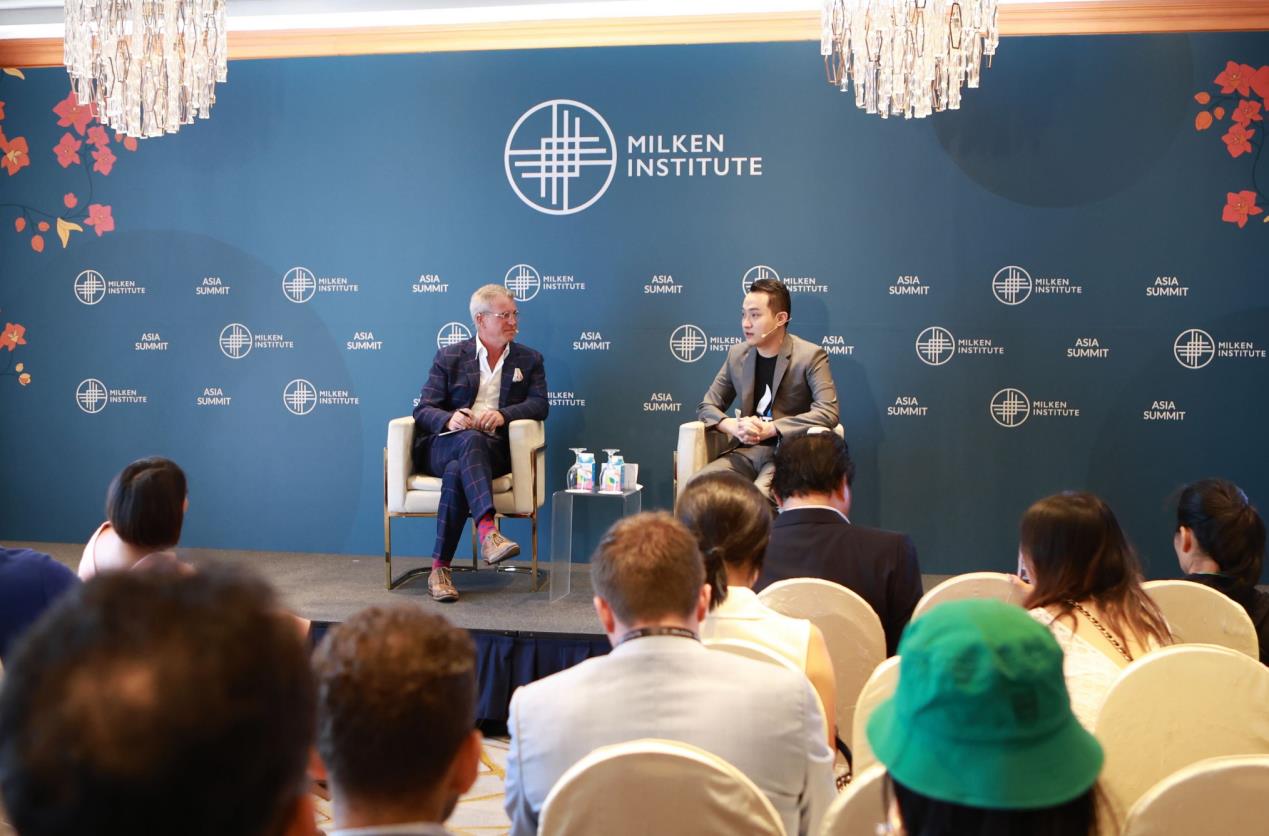
On September 14, Sun Yuchen, founder of TRON and member of HTX Global Advisory Council, was invited to attend the 2023 Milken Institute Asia Summit, where he engaged in an in-depth dialogue with Kirk Wagar, former U.S. Ambassador to Singapore and Chairman of Wagar Global Advisors, on topics including trends in cryptocurrency technology and the current regulatory landscape.
This marks Sun Yuchen’s third participation in the Milken Institute Asia Summit. Previously, he attended the eighth summit in 2021, joining a roundtable discussion on “A New Chapter for the Crypto Industry,” and took part in the ninth summit in 2022, holding an in-depth conversation with Curtis S. Chin, Director of the Milken Institute Asia Center, about “TRON's Vision for Global Financial Inclusion.”
Hosted by the Milken Institute—a U.S.-based nonprofit, nonpartisan think tank—the 2023 Milken Institute Asia Summit marked its tenth anniversary and served as a special milestone event. As one of Asia’s most influential gatherings, this year’s summit, themed “Bridging Complexity and Opportunity,” brought together over a thousand business leaders, policymakers, academic experts, and futurists to discuss critical global issues such as digital development and access to capital.
TRON’s Daily Transaction Volume Surpasses PayPal
Sun Yuchen founded TRON in 2017 and later served as Grenada's Permanent Representative and Plenipotentiary Ambassador to the WTO. He has consistently been a leading advocate and prominent figure in advancing global financial transformation and integrating cryptocurrency technology into sovereign nations, while actively working to create new economic opportunities for more countries.
At the summit, Sun discussed the challenges of promoting crypto use cases to traditional institutions and emphasized the importance of stablecoins: "I believe that blockchain and crypto technologies have immense application potential in global settlement and payment systems." Using TRON as an example, he noted: "In fact, TRON processes over $12 billion in daily transaction volume—more than PayPal—with significantly lower transaction costs."
Sun pointed out that regions like Nigeria, Uganda, and Kenya see substantial monetary activity, yet suffer from underdeveloped banking infrastructure. "Blockchain offers a very low-cost solution to provide financial services to the unbanked population in Africa. Many people in these areas are now using crypto as a daily payment method via the TRON network and decentralized systems. Cryptocurrency is genuinely addressing real-life challenges."
Currently, TRON has built a stablecoin ecosystem encompassing USDT, USDC, TUSD, USDJ, and USDD, covering various types of stablecoin services including high liquidity, compliance, decentralization, and high collateralization rates. TRON hosts the largest circulating supply of USDT across all networks—over $42.8 billion—capturing more than half of the market share and ranking first in the industry.
With billions of users and leadership in mainstream stablecoin circulation, building a thriving ecosystem is a natural next step for Sun Yuchen and TRON. Providing more reliable and transparent infrastructure for both users and regulators is a prerequisite for a robust global financial system.
On this point, Sun said: "This year, we’ve partnered with several data analytics firms to help analyze crypto transaction data and further prevent illicit use. We’ve made progress in both use cases and regulation. I believe regulatory frameworks also need these tools as a foundation for effective oversight, so we’ve done extensive technical preparation."
Passive Reshuffling and Active Transformation Under the New Regulatory Landscape
Change and innovation continue at pace in the Web3 space, and the current state of industry development alongside evolving regulatory realities are triggering a new reshuffling in the crypto sector. Sun Yuchen and TRON’s innovative explorations have never ceased.
Recognizing RWA (Real World Assets) as the most promising gateway for global institutions, governments, and enterprises to enter Web3, TRON launched stUSDT—the ecosystem’s first RWA product—on July 3, operating through the decentralized platform JustLend. This significant milestone on the TRON network was widely covered by international authoritative media outlets including Bloomberg, Yahoo Finance, CoinMarketCap, and CryptoSlate.
The widespread media coverage of stUSDT’s launch reflects growing recognition of blockchain applications in real-world assets, the advancement of the digital asset industry, DeFi innovation, and the diversity of the TRON ecosystem.
During the Asia Summit, Sun addressed how to overcome skepticism among sovereign nations like the United States, which often support blockchain technology while remaining wary of cryptocurrencies. The key, he said, lies in ensuring transparency. "Decentralization and transparency were Satoshi Nakamoto’s original principles in creating Bitcoin, and these values are equally important to regulators."
Sun stated: "As founder of TRON, I've always been committed to decentralization. Like Ethereum, Solana, and Ripple, TRON is operated by tens of thousands of nodes worldwide, giving regulators confidence due to its transparency and decentralized nature. This mirrors my experience at the WTO, which also champions transparency and decentralization. To gain true global consensus, these two elements are essential. Transparency and decentralization apply not only to crypto, but also to trade and diplomacy."
By September 2023, TRON had reached 184 million global users, processed over 6.4 billion cumulative transactions, and achieved a total value locked (TVL) exceeding $13.4 billion—second only to Ethereum and firmly positioned as the industry’s second-largest platform, demonstrating strong resilience even amid market volatility.
Building a Global Presence from Asia
Since the Hong Kong Special Administrative Region’s Financial Secretary released its policy statement on virtual assets on October 31 last year, Japan and South Korea have also frequently signaled their support for Web3.0. During the early stages of crypto industry development, Asia—represented by South Korea, Japan, and Hong Kong—has emerged as a major global force in cryptocurrency.
At the summit, Sun expressed optimism: "I am positive about crypto diplomacy in Asia. We started here, and Asia has become one of the most important crypto hubs globally. Especially after the U.S. SEC launched a series of aggressive regulatory actions, many top-tier U.S. investment firms like A16Z have begun shifting toward jurisdictions like the UK and Singapore. I believe this is undoubtedly beneficial for crypto—we need greater geographical decentralization."
Sun shared his efforts to promote a crypto-friendly regulatory environment in Asia: "Over the past three years, I’ve spent most of my time in Singapore, Hong Kong, South Korea, and Japan. I believe that once we succeed in Asia, we can advance the crypto agenda in the U.S. This approach can also generate more use cases and regulatory clarity, making regulators more comfortable."
In Sun’s view, the biggest issue in the U.S. isn’t the regulations themselves, but rather the ambiguity of the regulatory framework: "Many in the industry simply don’t know what they need to do to comply—that’s the core problem. Even though regulatory regimes in Japan and South Korea are strict, investors are still willing to operate there because they offer clarity. People know exactly what they can and cannot do. For instance, it took TRON two to three years to obtain licensing from Japan’s FSA (Financial Services Agency), but at least we gained certainty about legal operations, which is crucial. Hong Kong is also showing positive momentum, despite having a rigorous regulatory regime."
Recent policy shifts toward openness signal a new historical phase for Asia’s crypto industry. To actively respond to the emerging Web3.0 trend of “the East rising as the West declines” and drive mainstream global markets to embrace Web3.0, Sun Yuchen has been tirelessly advancing the development of Asia as a Web3.0 hub.
As Sun remarked at the summit, the crypto industry remains in its early stages. Despite a decade of development, much of the underlying infrastructure remains incomplete. There is still a long road ahead before mass adoption. However, regulatory hurdles and market cycles will not stop the influx of talent and users into the crypto space.
The crypto industry possesses unique advantages in solving real-world problems. As the industry continues to grow and deliver successful use cases, global regulatory acceptance is only a matter of time. As Sun put it: "I believe that within the next 5 to 10 years, crypto can enter mainstream usage scenarios and ultimately achieve widespread real-world adoption."
Join TechFlow official community to stay tuned
Telegram:https://t.me/TechFlowDaily
X (Twitter):https://x.com/TechFlowPost
X (Twitter) EN:https://x.com/BlockFlow_News












