








Analyzing "Crypto" Bots: A Flash in the Pan or a New Investment Frontier?
TechFlow Selected TechFlow Selected
Analyzing "Crypto" Bots: A Flash in the Pan or a New Investment Frontier?
Crypto bots genuinely address some pain points of crypto users, and projects that solve user pain points are bound to have long-term development.
 Navigating Web3 tides with focused insights
Author: Alfred, LD Capital
Since July this year, the price of UNIBOT has started to rise rapidly. According to data from CoinGecko, UNIBOT's token price surged from a low of $2.46 in May to a peak of $236.98 in August—a nearly 100-fold increase—leading a wave of enthusiasm for Telegram bots. Currently, UNIBOT’s price has pulled back to around $100, and other related tokens have also retreated significantly from their highs. Are these bot projects just fleeting trends, or will they evolve into a new sector poised for another breakout? This article analyzes three representative projects across different categories to explore this question.
1. What Are "Crypto" Bots?
Telegram bots are not a new concept. They are small applications that run within Telegram. Users can interact with bots through flexible interfaces capable of supporting communication and executing almost any type of task or service—such as replacing entire websites, receiving payments, creating custom tools, games, or even social networks.
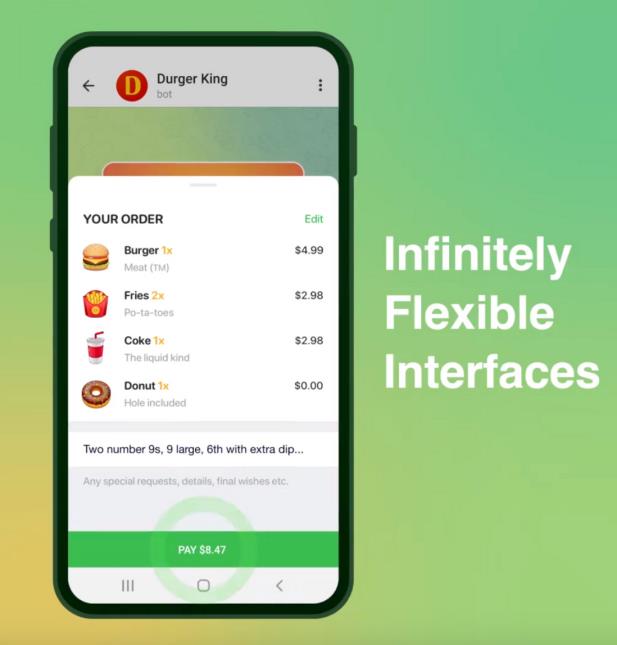
Source: Official Telegram (* The image shows a food-ordering mini-program developed on Telegram)
Thanks to Telegram’s open-source framework, various bots have gradually emerged on the platform since the birth of the crypto market. Examples include news bots that push important updates, or alert bots that track whale wallet movements or token metric fluctuations. Historically, these bots primarily served users either for free or via subscription models.
Today, in addition to Telegram-based bots, many bot-type dApps have appeared on platforms like Discord and Twitter, or directly on web interfaces. These bots leverage automation specifically to address needs within the crypto industry and incorporate features unique to the crypto ecosystem—such as dedicated tokenomics. Given the recent rapid development of bots, the author prefers to refer to them temporarily as “crypto” bots. This article categorizes “crypto” bots into three major types: trading bots, niche utility bots (* solving specific problems beyond trading), and GPT/AI bots—each represented by one leading project.
2. Trading Bot – Unibot
Unibot is a Telegram-based trading tool bot that allows users to conduct on-chain token trades on Uniswap via chat commands—including spot trading, limit orders, copy trading, new token sniping, and private transactions. According to official information, the bot executes trades up to six times faster than Uniswap. Additionally, Unibot introduced an attractive revenue-sharing mechanism that contributed to its token’s hundredfold price surge.
Other projects in this category include Maestro (* no token yet), Banana Gun, Wagie Bot, Boltbot, NitroBot, 0xSniper, and Dexbot.
1. Core Features
(1) Main Menu & Basic Trading
To get started, visit Unibot’s Telegram channel and click “start.” Unibot will generate three wallets and display the main menu. Deposit at least 0.01 ETH to begin trading. The main menu contains all of Unibot’s functions, accessible via button clicks and chat interactions.
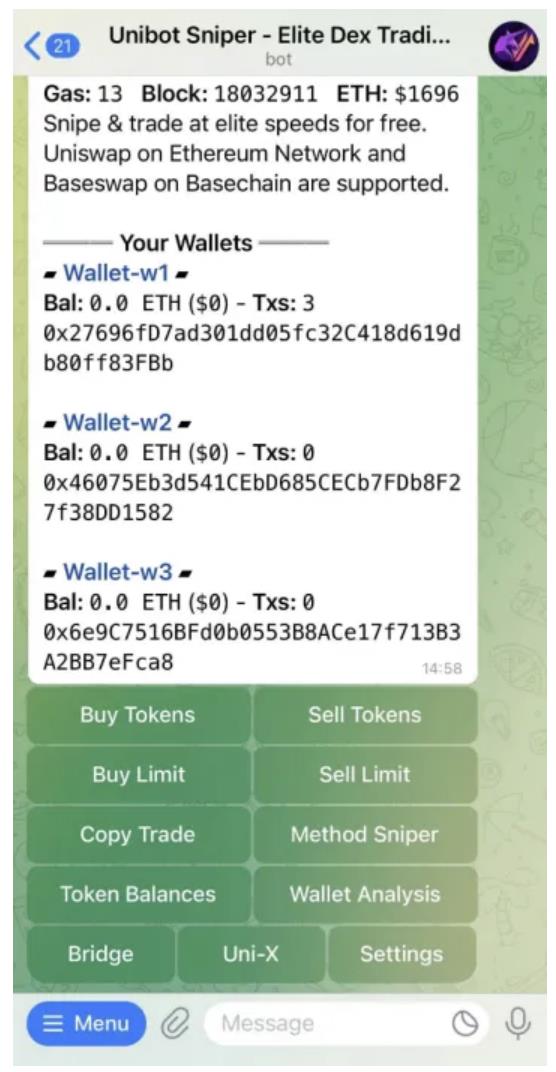
Source: Unibot
(2) Limit Orders
Users can set up limit orders through chat by specifying parameters such as token contract address, purchase amount, wallet selection, duration, and percentage-based triggers.

Source: Unibot Official
(3) Copy Trading
Users can select experienced traders to automatically copy their trades. Steps: first, choose the wallet for copy trading; second, set the maximum ETH amount per trade; third, add or remove Ethereum addresses (supporting multiple comma-separated addresses).
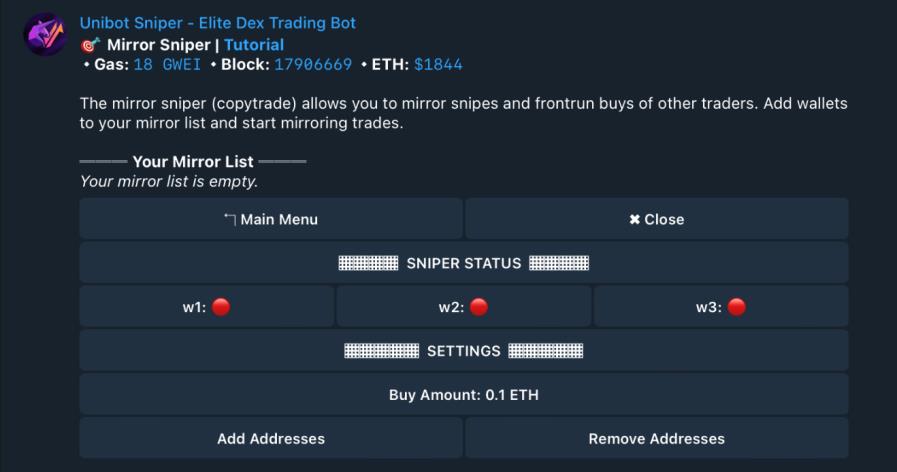
Source: Unibot Official
(4) New Token Sniping
This feature enables automatic early purchases when a new token launches. Steps: first, select the wallet for sniping; second, input the target token’s address; third, set the maximum ETH amount and highest gas price; fourth, configure function calls (e.g., enabling trading, adding liquidity); fifth, define the maximum number of tokens and number of blocks to wait before buying; sixth, add to the snipe list to activate. Unibot also provides an ERC-20 token deployment scanner (*unibotscanner) to quickly discover and view new tokens.
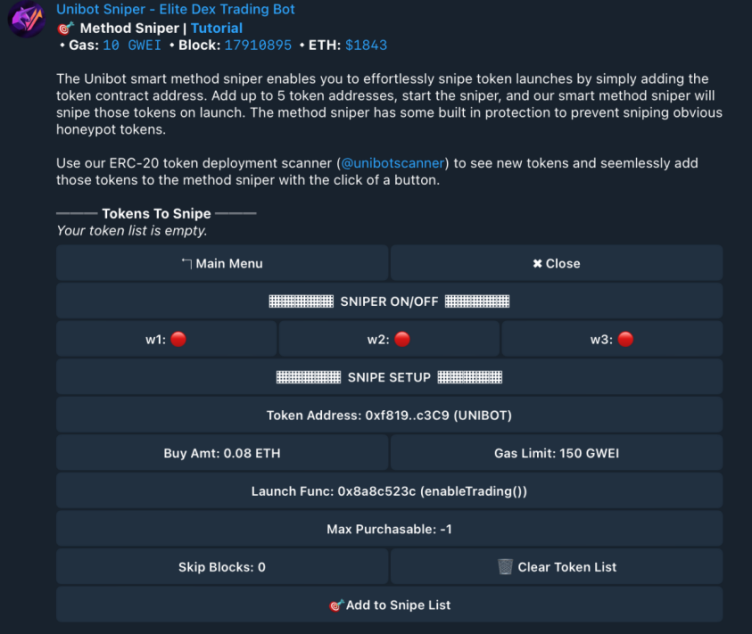
Source: Unibot Official
(5) Protection Selling
Enable Fail Guard to prevent gas loss. Once activated, transactions are simulated before being broadcasted to ensure they won’t fail. The purpose is to avoid wasting gas on failed transactions. This adds slight latency as simulation must occur before execution.
(6) Private Transactions
Private node transactions hide trades from Etherscan until completion, protecting against “sandwich attacks.” A sandwich attack is a common DeFi front-running tactic where attackers identify a pending victim transaction and place buy/sell orders around it to profit from price impact. For example, if a victim plans to buy asset Y using asset X, the attacker buys Y first, inflates the price via the victim’s trade, then sells high. Private nodes help mitigate such attacks.
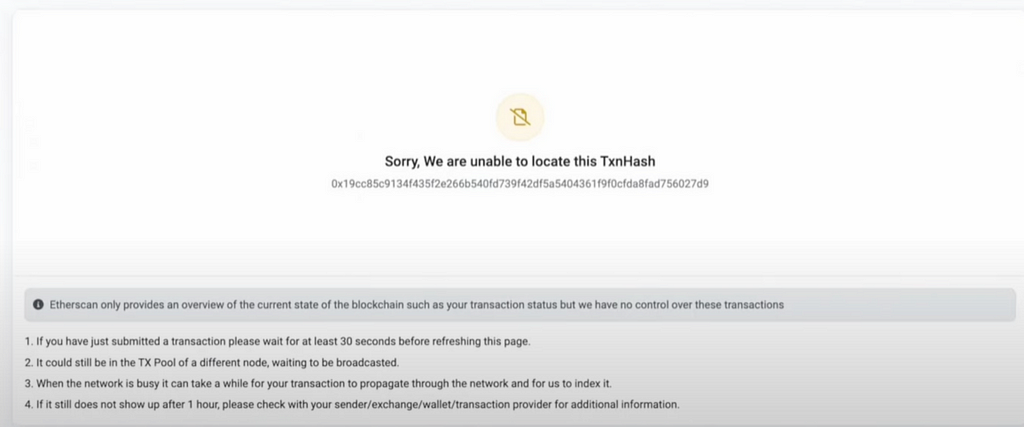
Source: Unibot Official
2. Tokenomics
The project launched fairly with 100% of the token supply added to liquidity at launch. Total supply is 1 million, fully circulating and non-dilutive.
Why buy UNIBOT? Holding UNIBOT offers several benefits: trading fee discounts, revenue sharing from platform activity and referrals. These incentives drive users and investors to buy and hold more UNIBOT, increasing total platform revenue and pushing up the token price, attracting further interest.

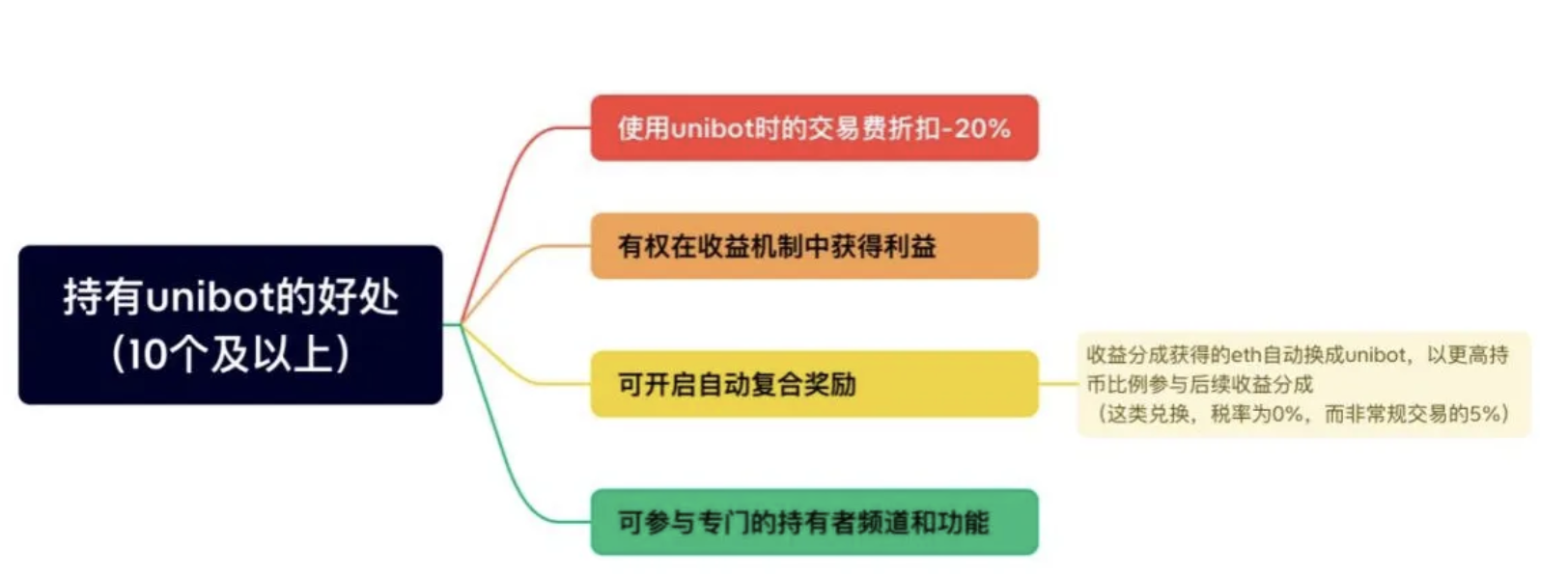
Source: LD Capital
How does UNIBOT’s revenue mechanism work? Revenue comes from two sources: usage fees and token transaction taxes. A significant portion is distributed to token holders, giving the token intrinsic value and encouraging holding. The 25% referral commission further incentivizes holders to invite new users to the platform.
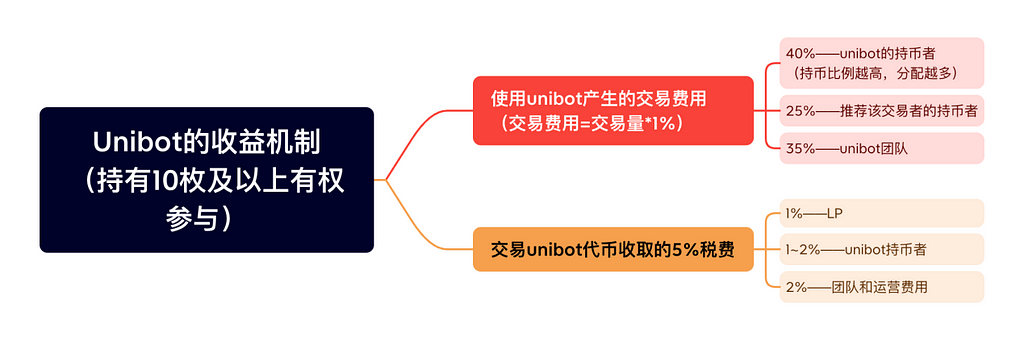
Source: LD Capital
Unibot’s highly attractive tokenomics design was key to its success. Holders earn returns both from revenue sharing and price appreciation, achieved by accumulating more tokens and referring others. To sustain this flywheel, the team must continuously iterate and operate the product so that real usage and new user acquisition continue—otherwise, it risks becoming just another meme coin. Additionally, strong market-making and marketing capabilities are needed to maintain trading volume and price appeal.
3. Performance Data
The total market cap of the entire crypto bots sector is currently only about $200 million. UNIBOT’s MC and FDV (* fully diluted) stand at $100 million, accounting for 50% of the sector—making it a bellwether. The top ten addresses hold approximately 18% of total supply, indicating highly dispersed holdings. The token price rose from a May low of $2.46 to a high of $236.98 in August—a near 100x increase—sparking a wave of Telegram bot interest.

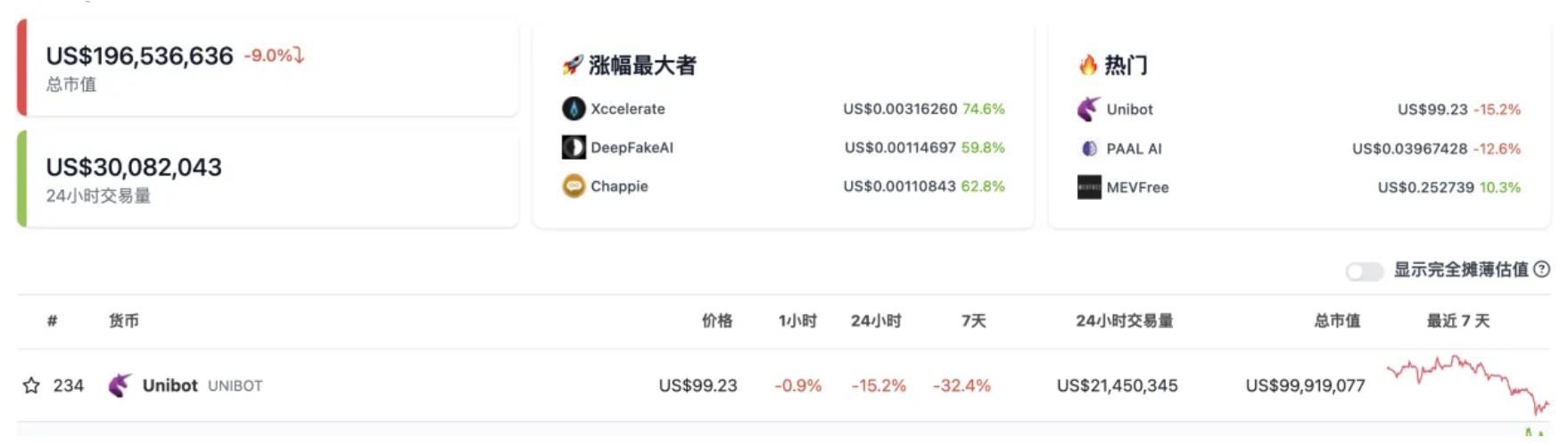
Source: CoinGecko
Peak daily revenue was 337.54 ETH on July 23. After declining from highs, recent daily income has rebounded to 100–200 ETH, with cumulative revenue reaching 7,649 ETH. EPS stands at $42.51, and P/E has dropped from over 3 to 1.85 recently, improving investment appeal. Revenue composition: tax fees account for 79.93%, bot fees 20.07%—still relatively low, leaving room for optimization.

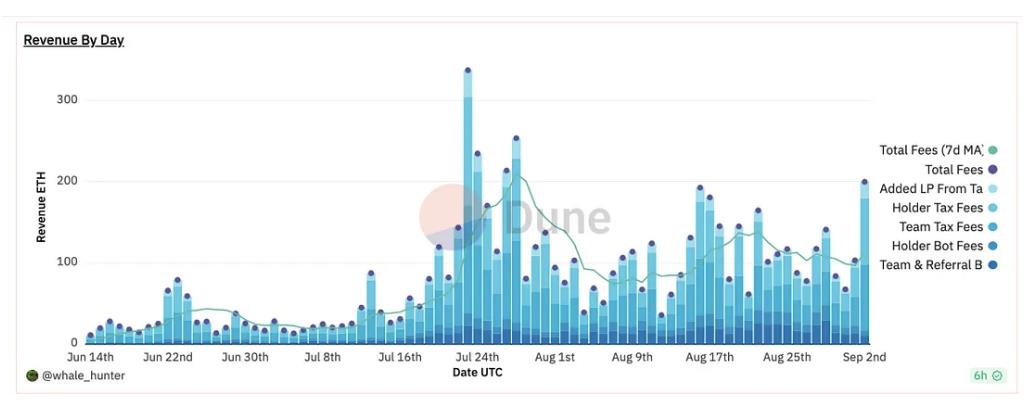

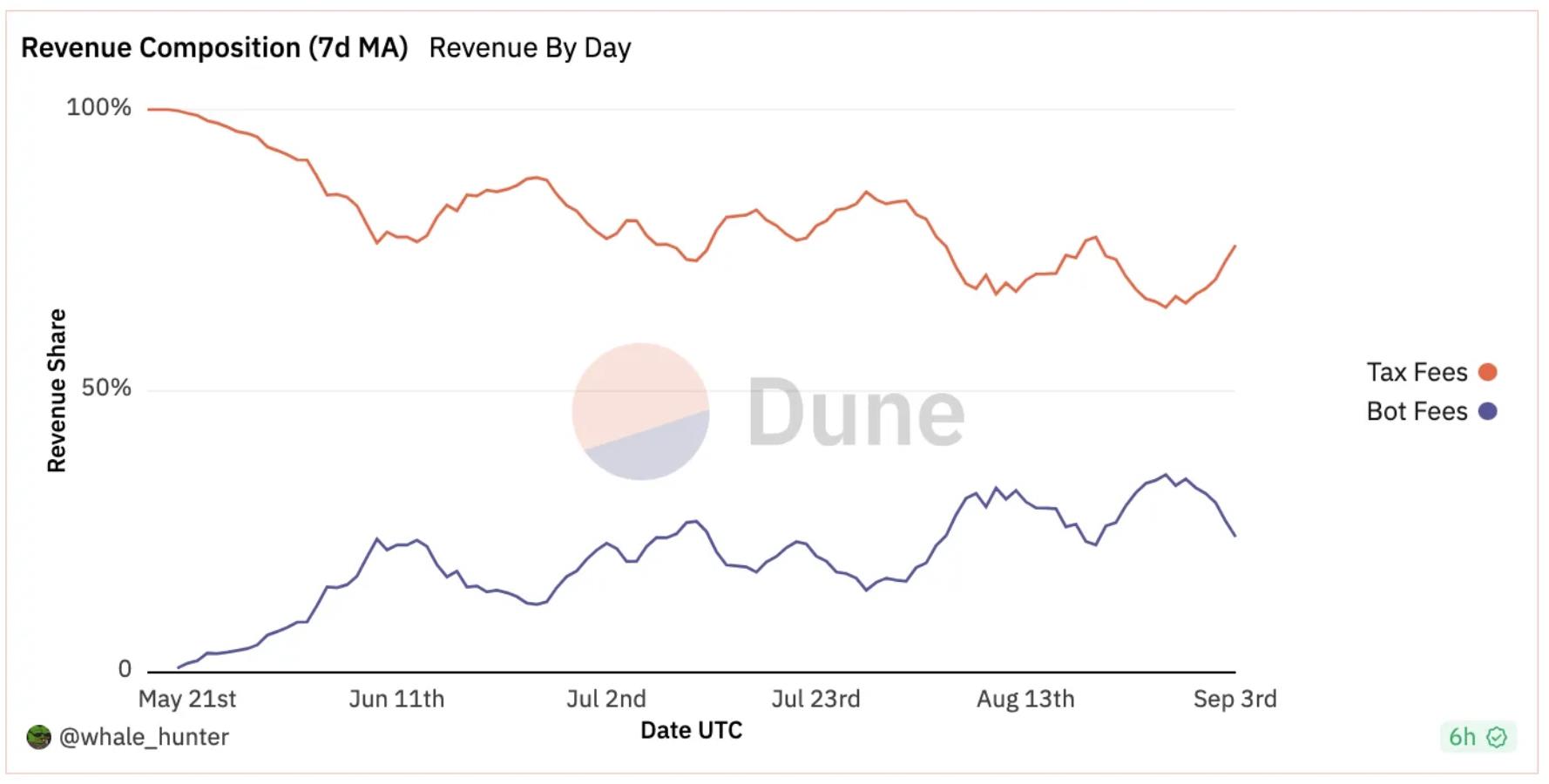
Source: Dune
UNIBOT has accumulated over $290 million in trading volume, 428,000 transactions, averaging ~$4 million daily—recent performance remains solid. Total bot users: 143,500; 7-day active: 1,808; daily users: ~1,000; new users: ~100/day. As the leading bot project, daily active users lag far behind leaders in other sectors. A significant and stable increase could potentially push prices above previous highs.

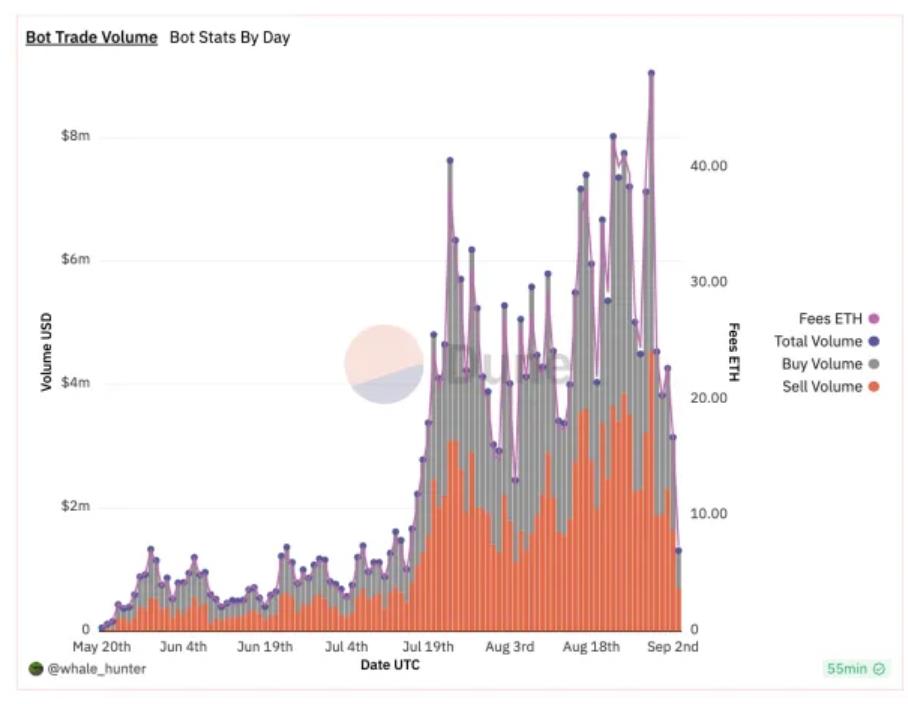

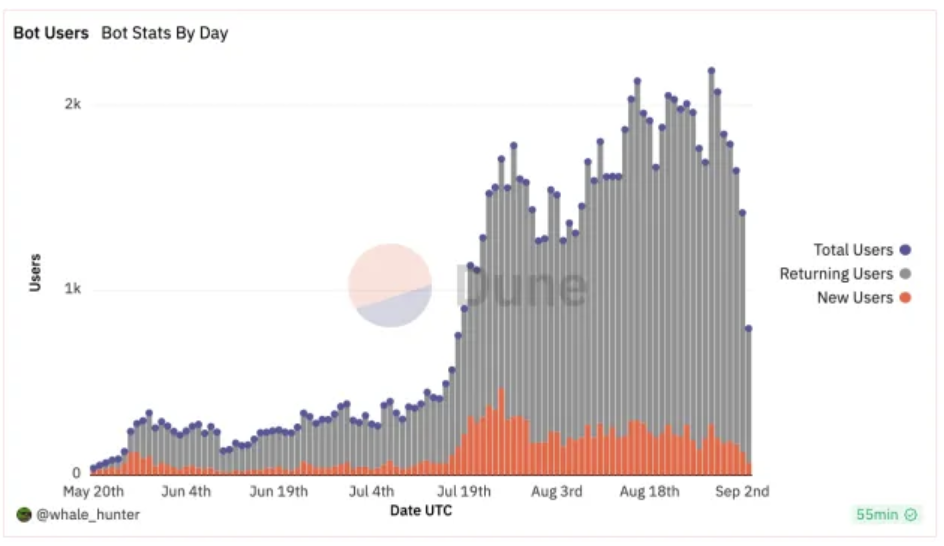
Source: Dune
4. Project Characteristics
(1) Introduced an attractive revenue mechanism—the core driver of price surge: Unibot wasn’t the first automated trading bot nor the most widely used. Maestro previously had the largest user base. However, Unibot implemented the most effective tokenomics, using a Ponzi-like model to attract users to hold and share profits while inviting others—this incentive alignment became the primary force behind its price explosion.
(2) Delivered genuinely useful bot functionalities, enhancing DEX efficiency: Features like copy trading and token sniping require automation to be efficient. Previously limited to professional quant traders, bots like Unibot now enable individuals to access similar advantages, giving DEXs competitive edges over CEXs.
(3) As a leader, still has room to improve security and lower user barriers: Investors commonly worry about security since bots automatically use private keys. Proving true security and decentralization is critical for attracting large capital flows. Also, despite leveraging high-traffic platforms like Telegram and Discord, current trading bots rely on simple clicks, inputs, and chats—not intuitive UIs. They require clear trading logic and experience to use effectively, serving as tools for experts rather than lowering entry barriers for beginners.
(4) Strong revenue potential and first-mover advantage offer sustainability: Many trading bots now adopt UNIBOT-style tokenomics to create quick price spirals. But long-term success requires combining product innovation, market-making, and operational marketing. Current leaders like Unibot still have modest user counts, activity levels, and bot fee ratios—many competitors show even weaker metrics. Unibot’s early lead and high revenue position it better to invest continuously in product and operations for long-term growth—evident in recent launches like Unibot X, offering improved frontend and UX.
3. Niche Utility Bot – Lootbot
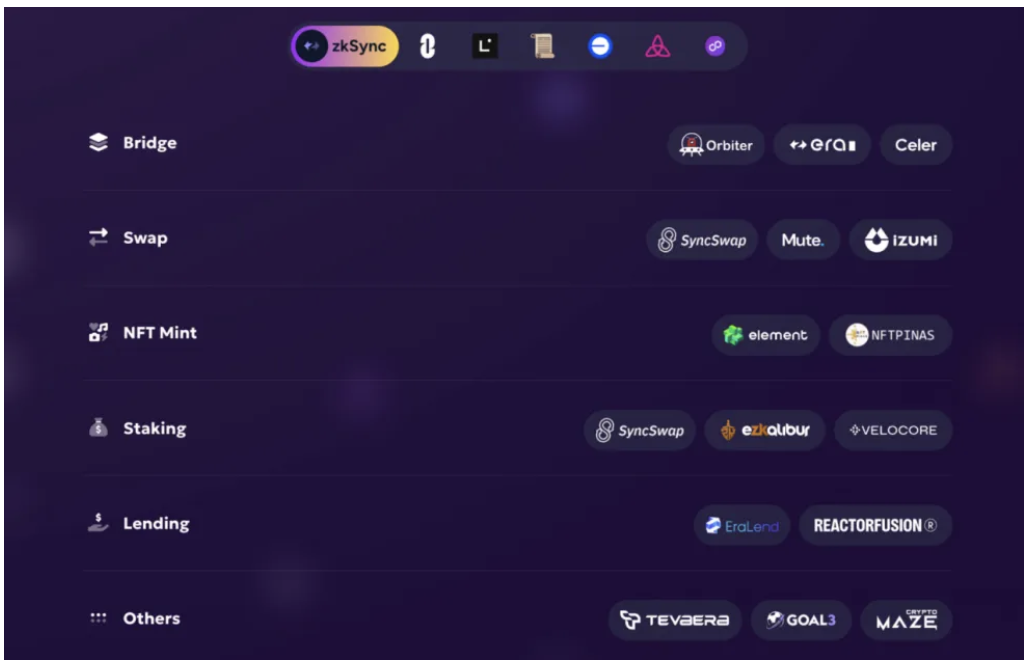
Lootbot specializes in automating potential airdrop interactions. Built on Telegram, it acts as a simplified frontend across multiple chains, deploying and automating on-chain actions via chat. It saves users significant time and effort on repetitive tasks and incorporates anti-Sybil mechanisms to efficiently farm airdrops. Currently supports Zksync and Linea interactions, with future plans for LayerZero, Scroll, Base, etc. Supported actions include bridging, swapping, and NFT minting.

Source: Lootbot Official
Other niche utility bots include Collab.Land (* community management), Bridge Bot (* cross-chain), WallyBot (* wallet analytics), NeoBot (* crypto analysis/tracking), and TokenBot (* community trading tool).
1. Core Features
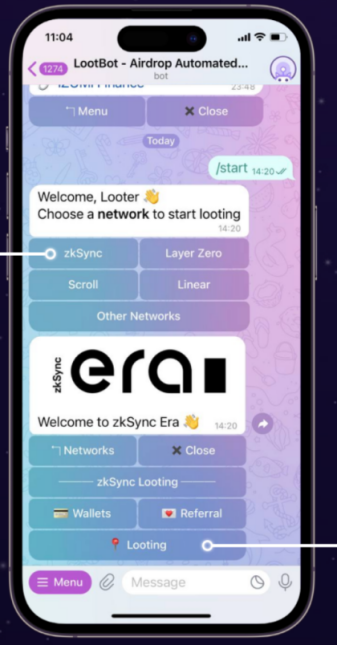
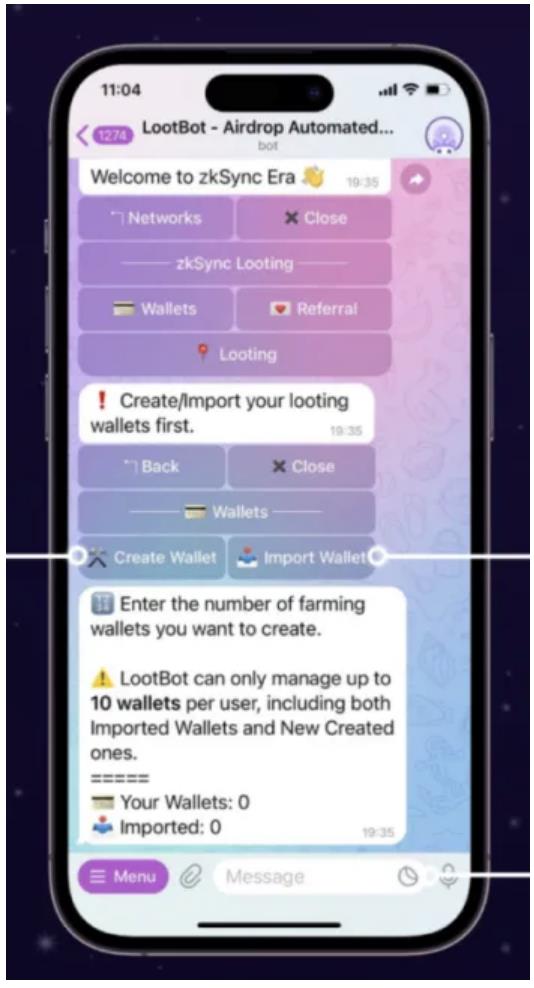
(1) Wallet Setup & Network Selection
First, create up to 10 wallets for airdrop tasks. Second, fund each wallet with at least 0.1 ETH on Ethereum mainnet (* recommended from CEX to avoid Sybil detection). Third, bridge funds from Ethereum to selected chains to begin looting.
Source: Lootbot Official
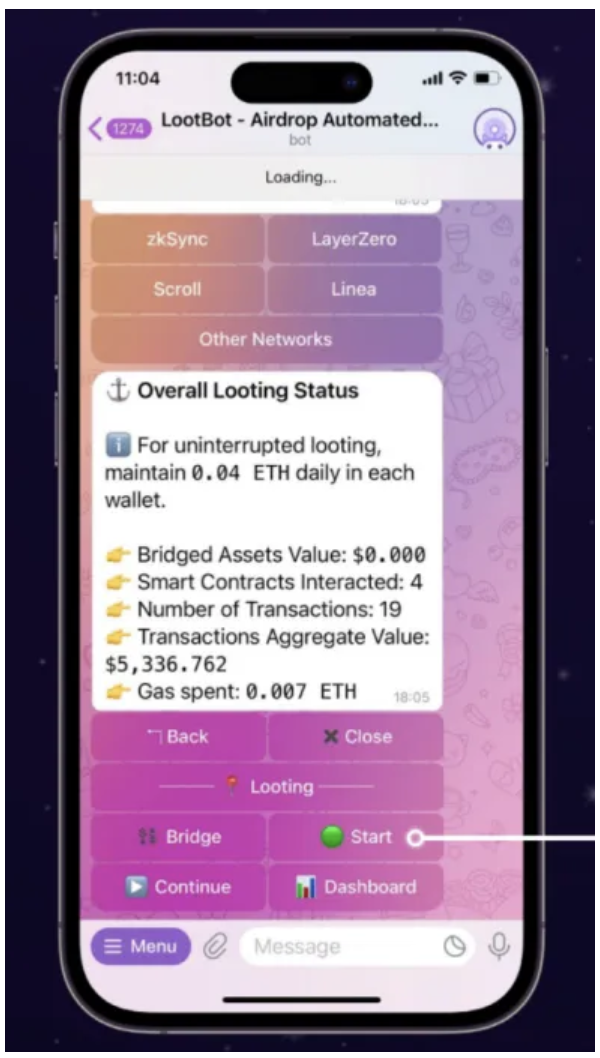
(2) Automated Airdrops:
Once started, bot automates all interaction tasks, saving users substantial time. Tasks typically trigger weekly, executed during lowest-cost periods. Task routes are advised by Lootbot consultants and finalized by the team. Users can monitor interaction data per wallet after starting.

Source: Lootbot Official
(3) Integrated Trading:
Beyond looting, Lootbot integrates trading—users can trade all ERC-20 tokens directly via Telegram. Unlike loot wallets, trading wallets allow up to three creations.
(4) Anti-Sybil Detection
Uses diverse curated strategies to prevent Sybil attacks and simulate genuine on-chain behavior, maximizing airdrop eligibility. Tactics include randomized patterns, hiding on-chain activities, obscuring fund flows, and automatic CEX fund mixing.
2. Roadmap
Lootbot is still early-stage. Fundraising and R&D occurred in Q2, with the official launch and LOOT token release in Q3. This year, Lootbot plans to integrate more chains, protocols, automated tasks, and enhance referral marketing.
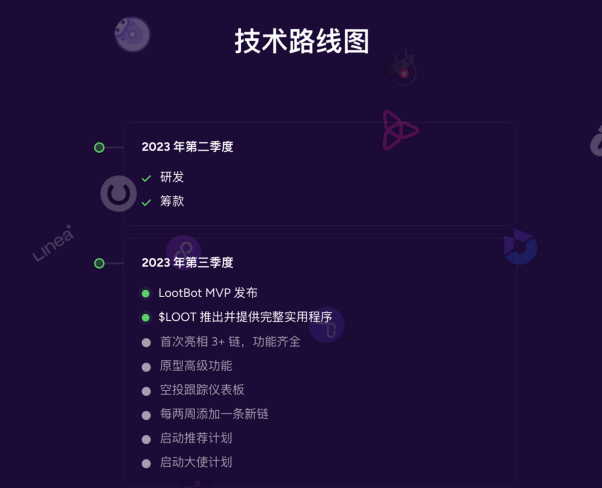
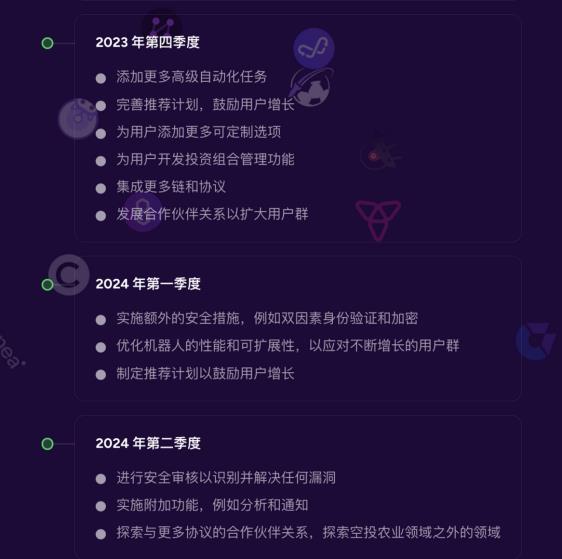
Source: Lootbot Official
3. Tokenomics
LOOT has a total supply of 10 million: 50% sold to seed investors, 40% for liquidity, 5% team, 5% CEX listing. Team allocation: 0% at TGE, cliff unlock at 6 months, linear thereafter. Seed: 33% at TGE, linear unlock after 1 month.
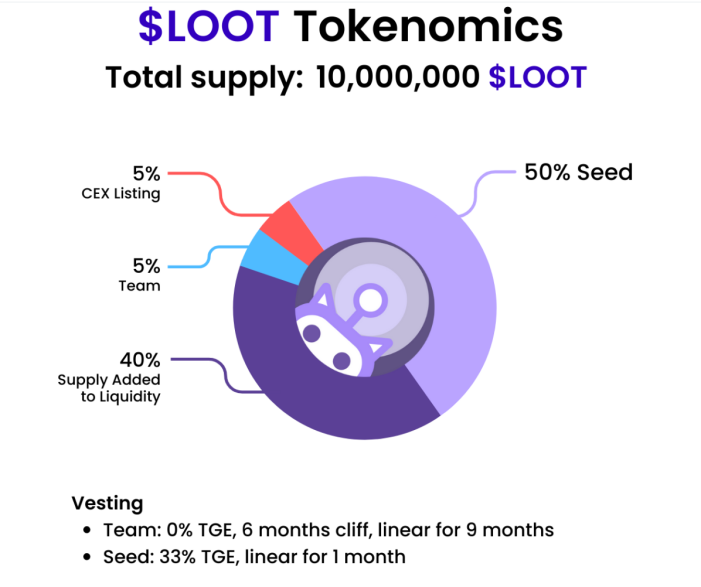
Source: Lootbot Official
Why use and hold LOOT? Similar to UNIBOT, holding LOOT grants subscription discounts and participation in revenue sharing from others’ usage fees.
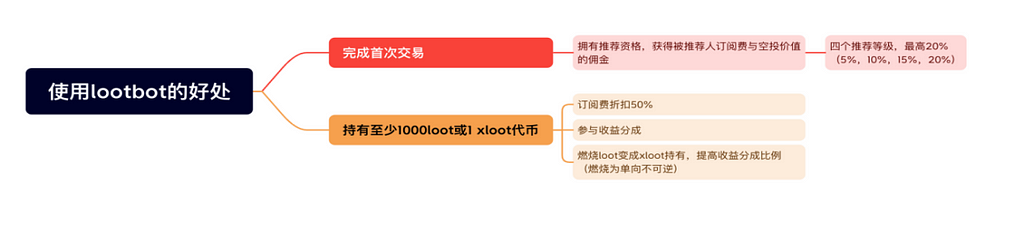
Source: LD Capital
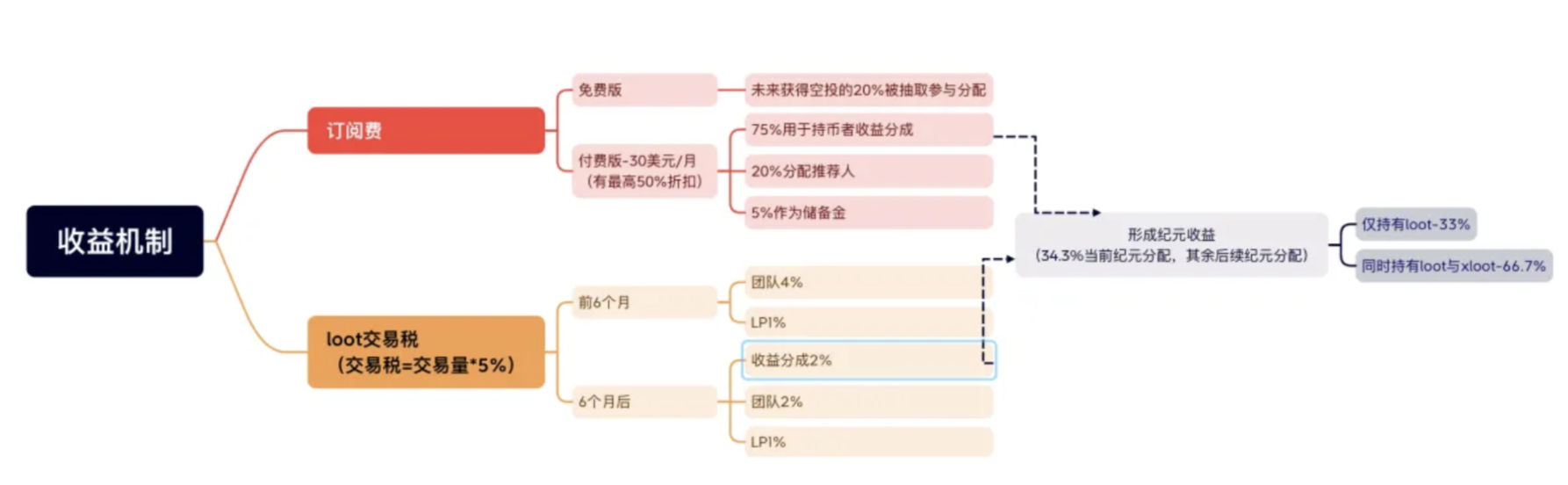
How does LOOT’s revenue model work? Revenue comes from two streams: monthly subscription fees and LOOT token transaction taxes. 75% of subscription fees go to token holders. After 6 months, 2% of transaction taxes join distributions. Lootbot introduces “Epoch Rewards”—accumulated rewards split so 33% goes to pure LOOT holders, 66.7% to those holding both LOOT and XLOOT. Epoch rewards are distributed gradually over multiple epochs instead of all at once, aiming for more stable and consistent payouts and reducing volatility from lump-sum distributions.

Source: LD Capital
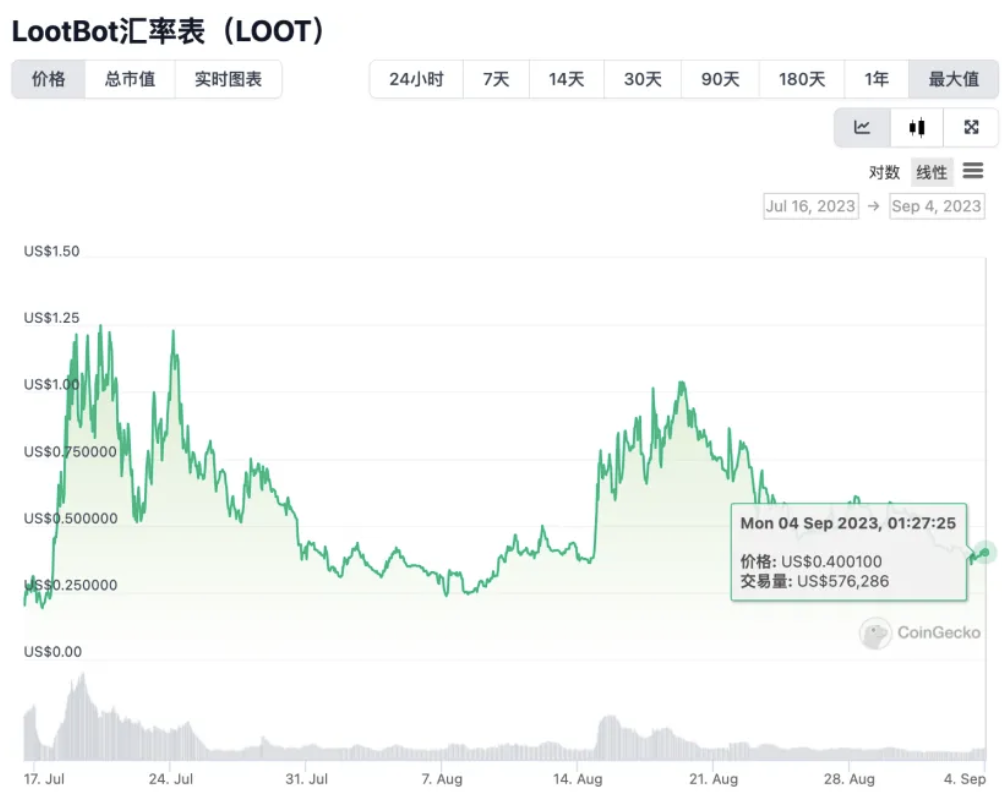
Current LOOT circulation: 8.7 million (87% of total). MC: $3.48M, FDV: $4M. ATL: $0.19 on July 17; ATH: $1.30 on July 20. Top 10 addresses hold ~36% of total supply.

Source: CoinGecko
4. Project Characteristics
(1) Adopted a Unibot-like revenue model but with different income sources and distribution—less price momentum: Like Unibot, revenue comes from service fees and token taxes. But Unibot charges per-trade fees, generating instant revenue. Lootbot uses monthly subscriptions—free users pay via future airdrop shares (uncertain, long-term), while paying users contribute less frequently. Plus, epoch-based linear distributions stretch out reward timing, weakening short-term price drivers compared to Unibot. However, given different product and operational models, Lootbot’s approach may better suit long-term sustainability.
(2) Airdrops highly benefit from bot tools—Lootbot dominates this niche: While many trading/DeFi bots exist, few personal-use airdrop bots are available. Airdrop tasks are highly mechanical—without bots, users manually repeat labor-intensive processes with weak parallelization and uncertain returns. Lootbot effectively serves individual “degen” farmers, establishing itself as the leader in this space.
4. GPT & AI Bot – ChainGPT
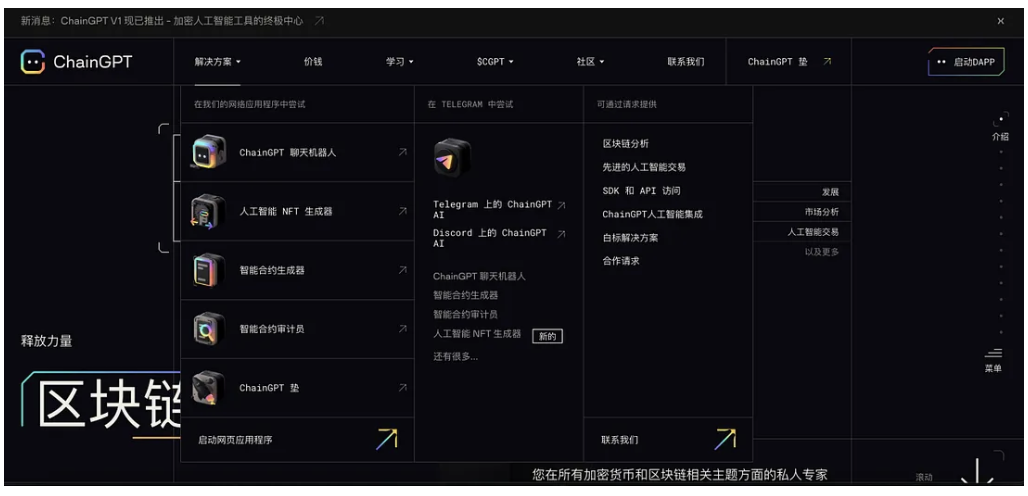
ChainGPT is an advanced AI model and toolkit designed specifically for blockchain and crypto topics. Key features include blockchain/crypto Q&A, no-code smart contract generator, smart contract auditor, AI-generated NFTs, and ChainGPT Virtual Machine (* Layer 1 blockchain). Its SDK and API services can be integrated into existing apps.
Source: ChainGPT Official Website
Other projects in this category include All In (* AI trading), Image Generation AI (* AI NFT creation), NexAI (* suite of AI tools), BlackSmith (* AI analytics), TrackerPepeBot (* AI analysis and contract security checks).
1. Core Features
(1) ChainGPT Chatbot: A conversational AI assistant that helps solve blockchain and crypto issues—no-code contract programming, debugging, market analysis, guidance, trading—suitable for individuals, developers, and enterprises. Available on Telegram, Discord, and Web.
(2) AI News: AI-powered news service scanning the web every 60 minutes to auto-generate articles on blockchain and crypto. Aims to deliver timely, accurate updates on industry trends.
(3) Smart Contract Generator & Auditor: Simplifies contract creation and auditing, especially beginner-friendly. Users describe desired functionality to generate contracts or paste code for instant audit.
(4) AI-Generated NFTs: Uses AI algorithms to create NFTs based on user prompts—for digital art, gaming items, collectibles. Anyone can deploy their NFT on-chain within 30–60 seconds.
(5) ChainGPT Pad: A decentralized fundraising platform for incubating crypto projects, supporting IDOs. CGPT holders gain priority access to IDOs, airdrops, early-stage projects, and other benefits.
(6) ChainGPT Virtual Machine (* Layer 1 Blockchain, under development): Offers a unique combination of EVM compatibility and on-chain AI, aiming to support decentralized AI app development on blockchain.
Additional features—SDK/API access, blockchain analytics, AI trading, AI security extensions—are available via permission-based testing.
2. Development Status & Roadmap
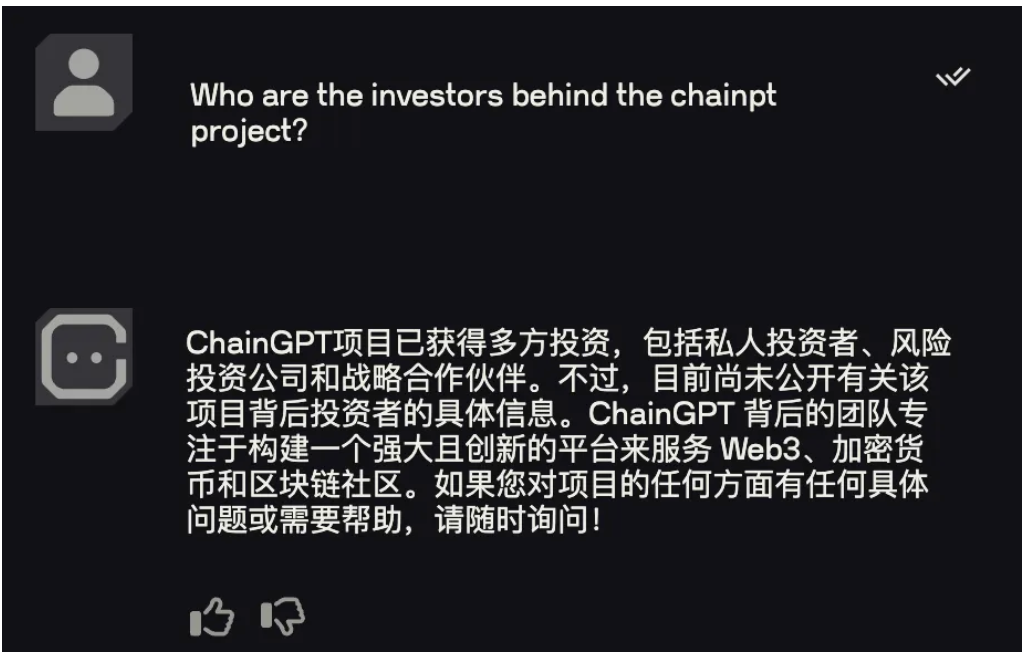
ChainGPT was founded in 2022 by experienced developers, blockchain engineers, and AI specialists. CEO and founder Ilan Rakhmanov leads the team, with Dr. Adnan Tariq—a renowned blockchain and AI engineer—heading development. The team designs complex AI models and presents research to major tech firms and entrepreneurs. In 2022, they launched the ChainGPT chatbot and published a research paper (* v1.0 whitepaper). On August 25, 2023, ChainGPT announced a $350,000 grant from Google, along with cloud computing resources to enhance its AI model processing. ChainGPT claims funding from private investors, VCs, and strategic partners, though specific backers remain undisclosed.
Source: ChainGPT
In the first three quarters of 2023, ChainGPT released beta and official versions of its chatbot, DevAssist browser extension, Stake & Farming DApp, ChainGPT News, iOS and Android apps, Telegram/Discord/Slack AI bots, and the CGPT token.
Q4 2023 will focus on improving the AI model and adding features—AI trading assistant, mobile apps with built-in CGPT wallets, and upgraded AI NFT generator.
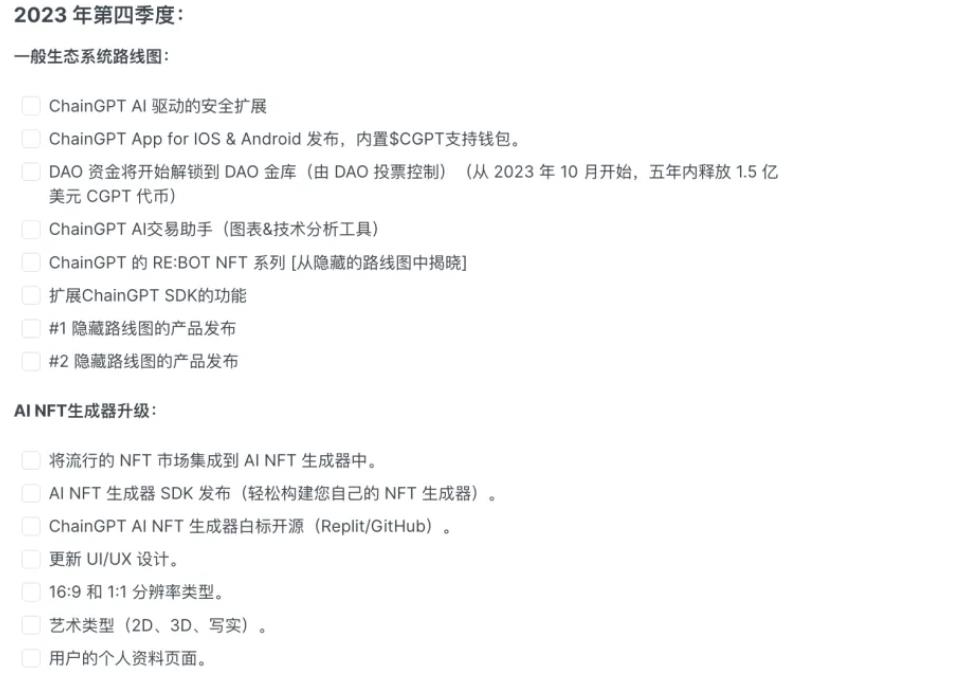
Source: ChainGPT Official
In 2024, ChainGPT will focus on launching testnet and mainnet, building Layer 1 and Layer 2 networks optimized for AI smart contracts and models.
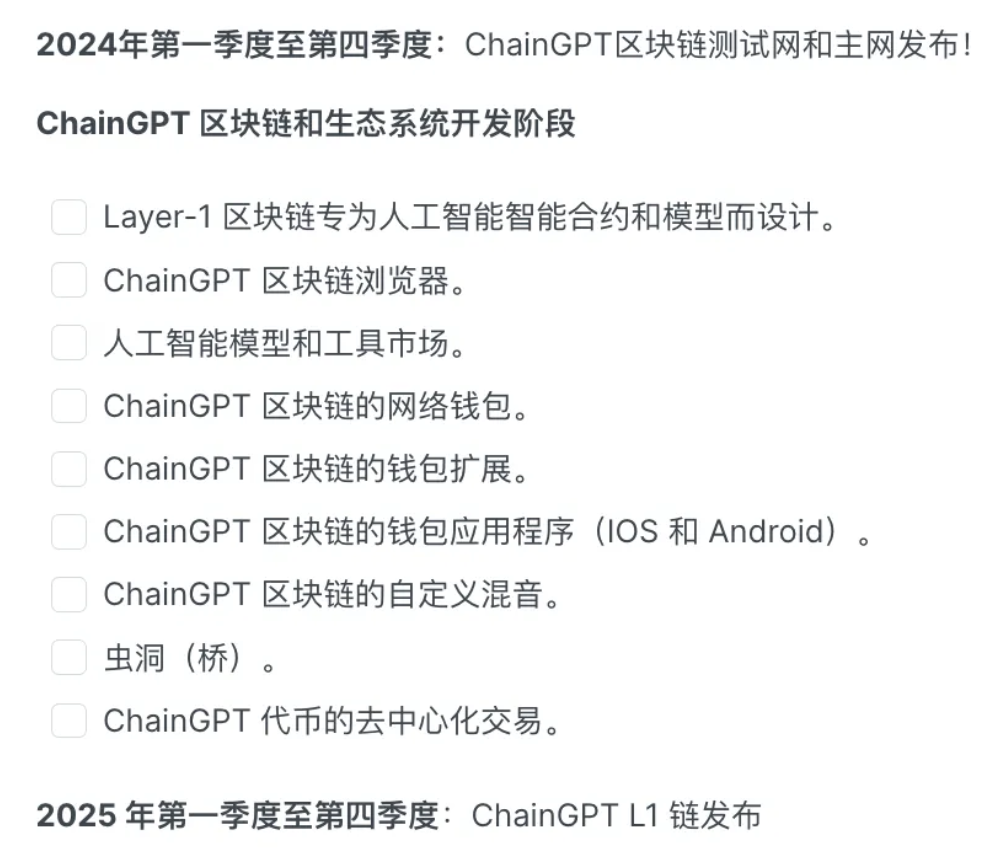
Source: ChainGPT Official
3. Tokenomics
Total CGPT supply: 1 billion. Allocation: Private A - 11.4%; Private B - 4.5%; Public - 9%; Liquidity - 20%; Team - 9%; Development - 4%; Advisors - 3%; DAO - 9%; Reserve - 9.85%; Marketing - 9%; KOL - 6.25%; Mining - 5%. Current circulating supply: 129,024,329 (12.9% including LP).
CGPT has four main use cases:
(1) Consumption in Specific Functions: Access to ChainGPT’s AI model—designed for crypto/blockchain—assisting with contract writing, concept explanation, Q&A, market analysis, etc.
(2) Burn Mechanism: Half of all fees/revenue generated by ChainGPT tools are automatically burned, reducing overall supply and increasing scarcity. To date, 1,294,904 tokens (~0.12%) have been burned.
(3) Staking: Token holders lock CGPT to earn rewards and contribute to network security. Stakers gain access to AI models, priority services, DAO governance rights, and higher membership tiers (* Bronze, Silver, Gold, Diamond) on ChainGPT Pad for greater Launchpad participation.
(4) Liquidity Provision: Holders provide liquidity on DEXs to earn rewards paid in CGPT tokens.
Current CGPT: MC $6.52M, FDV $50.54M. Price spiked post-launch in April, then gradually declined to a new low. ATH: $0.297 on April 29; ATL: $0.0492 on September 3.
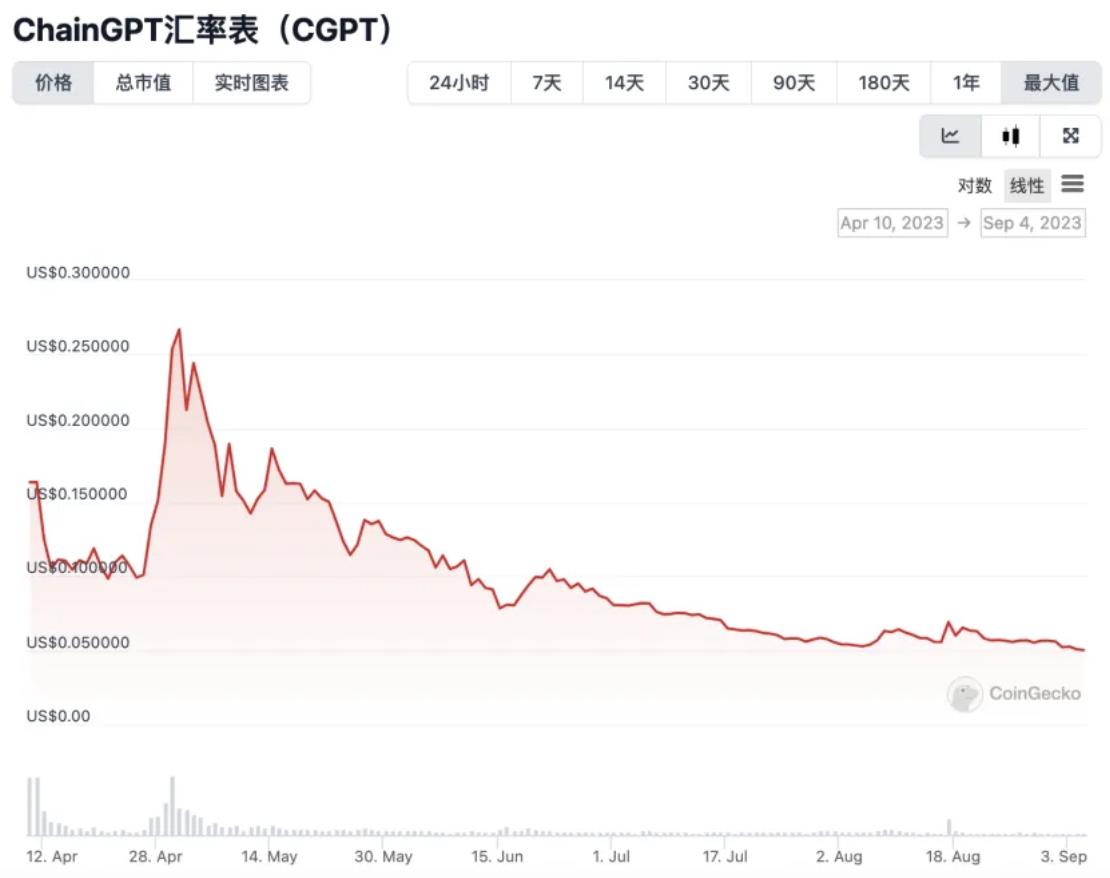
Source: CoinGecko
4. Project Characteristics
(1) Combines bots with AI to deliver powerful tools: ChainGPT chatbot solves blockchain/crypto questions; smart contract generator/auditor lowers coding barriers; AI NFT generator enables on-chain NFT creation in 30–60 seconds.
(2) Builds a comprehensive product matrix—potential for closed-loop ecosystem and strong moat: ChainGPT develops multiple AI tools applicable to crypto, forming a potential closed loop. Developers build with ChainGPT, launch on ChainGPT Pad, users participate via CGPT staking, trade intelligently, browse news, consult GPT—all while ChainGPT builds its own L1/L2 chain. If successfully executed, this creates a formidable competitive barrier—though implementation timeline and complexity remain significant challenges.
5. Summary & Reflections
By analyzing cutting-edge bot projects, we see that crypto bots genuinely solve real user pain points—copy trading, token sniping, automated airdrop interactions, AI-generated smart contracts or NFTs. Without such bots, individual users struggle to gain technical edges. The recent surge and popularity of Unibot have drawn investor and user attention, sparking rapid emergence of new projects with unique strengths. Given real underlying demand, crypto bots are evolving into a new sector.
Currently, the sector’s total market cap is small—around $200 million—leaving substantial room for growth compared to mature sectors. Long-term success depends on continuous product iteration to lower entry barriers and improve UX, enhanced asset security and decentralization, and deeper user retention.
In summary, projects solving real user pain points will have lasting potential. The current bot tokenomics models open new avenues for capital and price empowerment. Monitoring new products and iterations may reveal opportunities in the next market upswing.
Join TechFlow official community to stay tuned
Telegram:https://t.me/TechFlowDaily
X (Twitter):https://x.com/TechFlowPost
X (Twitter) EN:https://x.com/BlockFlow_News
 Cycle Capital Research











