








Dream Journey West "Treasure Pavilion" Revelation: Game Marketplace, Asset Valuation Dimensions, Meta-Economic Interactions...
TechFlow Selected TechFlow Selected
Dream Journey West "Treasure Pavilion" Revelation: Game Marketplace, Asset Valuation Dimensions, Meta-Economic Interactions...
Games, in any era, must align with human nature.
 Navigating Web3 tides with focused insights
Author: Aiko, Researcher @ Folius Ventures
Original Twitter thread: Link
It was an ordinary Sunday. I had two research projects running in parallel—one for a company report and another on AI. To gather more inspiration and material, I spent about two hours browsing NetEase’s Treasure Pavilion (Cangbao Ge). I ended up with some thoughts worth sharing. As the words piled up, it started to feel like a full article—so here it is.
This piece is divided into two parts:
1) An overview of the differences between web3 game marketplaces and Treasure Pavilion, along with suggestions on what a proper game asset marketplace should look like.
2) An exploration of the concept of "meta-economic interaction," extended into the realm of AI + gaming.
Insights from Treasure Pavilion for Game Marketplaces
I’m particularly interested in transaction taxation. In fact, our previous company deck dedicated a section to “IAT” (In-app Taxation) as a new monetization model. Yet I’ve never written about vertical game marketplaces—because deep down, I don’t believe in the long-term viability of third-party platforms that merely aggregate simple game assets, now or in the near future.
My study of Treasure Pavilion reaffirmed this belief: centralized marketplace tactics are fundamentally at odds with the high-frequency, zero-fee ideals pursued by decentralized trading.
1) As a first-party operated platform, the value of all game assets on Treasure Pavilion is supported by player DAU and transaction volume. The first requirement for any marketplace is clear: ensure the asset has broad appeal and players willing to pay a premium.
2) Customization doesn’t work well amid the rapid shifts of web3 trends. Building a customized marketplace requires accumulating user data—player preferences, needs, etc.—which only long-running, stable games can achieve. ROI-driven web3 games may struggle to keep pace with shifting trends through customization.
Treasure Pavilion is highly customized. Each game has its own market and unique operations. While interfaces look similar, features such as gacha mechanics, special events, appraisal systems, discount zones, servers, and seasons vary greatly. For individual games, shopping assistants guide users step-by-step through choices like race, character, class, and budget. Only long-term projects truly understand their players’ needs and can deliver meaningful customization.
3) Both platform revenue and user experience emerge from friction—not convenience; from low to high turnover. Zero transaction fees and excessive liquidity offer no benefit to platform income or asset price stability.
NFT-savvy readers may recall how SudoSwap and Blur reshaped the NFT market over the past year. Zero-fee trades and bulk transactions undermined the perception of NFTs as luxury items or faith-based assets, as whales dumped dozens of apes overnight, shaking community trust.
We previously discussed using transaction friction to increase revenue extraction. Treasure Pavilion employs similar designs. For example, its “Express Trading” service reduces a 4-day review period to 0 days, and secondary transfer waiting time from 8 days to instant—with sellers paying an extra 4% fee. Both buyers and sellers pay transaction fees. Additional buyer conveniences, such as “pre-reservation during public period,” allow early purchase of assets, requiring buyers to pay a 5% booking fee.
4) Gamified mechanism design that satisfies human psychology is part of a marketplace’s delivery.
Many web3 NFT marketplaces focus solely on trade formats and matching efficiency—even games do this. But approaching game assets with a crypto-native mindset overlooks the strong contextual demand inherent in games: users deeply enjoy participating in gamified sales events.
Some games on Treasure Pavilion feature bid-to-win raffles—the higher your bid, the greater your chance of winning—a clever manipulation of expected value. Likely due to regulatory constraints, such mechanisms cannot exist directly within the game, but moving them to the trading marketplace makes perfect sense. This increases trading frequency while boosting platform margins.
In fact, there have long been proposals to add gamified elements to NFT marketplaces—similar to Taobao’s fruit orchard or lottery games—but so far, no major platform has adopted them. Rollbit stands out by integrating NFT loot boxes as a core gameplay unit within its larger casino ecosystem—exactly the kind of emerging opportunity for gamified marketplaces.
5) If demand doesn’t exist, create it artificially. Unlike point 3, which relies on internal platform rules, this one emphasizes proactive intervention—using people to fabricate new trading scenarios when needed.
For instance, Treasure Pavilion hosts “appraisal events,” where official-appointed experts—trusted players within the game ecosystem—act as appraisers. Items certified by these appraisers sell faster. These appraisers function like cost analysts, helping sellers evaluate pricing and offering certification. Certified listings likely receive better exposure and placement. The fee paid to appraisers is subject to platform revenue share—essentially functioning as advertising spend. By introducing “appraisers,” the platform softens the perception of this cost, making it seem fairer.

Before Understanding “Meta-Economic Interaction,” We Need a New “Value Dimension” for Game Assets
First, assets traded on Treasure Pavilion sparked my thinking:
Items traded on Treasure Pavilion are relatively “large”—typically entire accounts containing multiple characters and skins.
Clearly, these aren’t just single-unit “assets”—they represent experiences. In layered games, a weapon or gear upgrade might boost power, but won’t fundamentally change the experience. Why do people replay games with different characters? Because the most valuable thing is the ability to offer entirely new experiences. Buying an account means experiencing its progression—an “in-game life simulator,” letting you briefly live in a top player’s world.
Our February deck highlighted the importance of personal progression. In April, we coincidentally met a team building a system allowing players to package character progression into NFTs—including unlocked skills and skins. Sadly, we haven’t seen such innovative designs since.
How could someone obsessed with asset units (like ERC-1155, ERC-6551) grasp this insight? It doesn’t matter how finely you can divide assets, or whether you trade a worn sword or a grain of sand. What matters is identifying the “data sets” that best convey perceived value and identity to players—and choosing those as on-chain assets.
Further, why are “large” assets more important than “fragmented” ones? Because they encompass multiple value dimensions.
In-game asset trading can indeed be experiential. Many web3 games tout in-game trading freedom—popular examples include planetary minerals or military supplies, which I touched on in my earlier blog (Game AMM). Setting aside the massive DAU required to sustain such systems, focusing here risks missing the bigger picture.
During the subscription era, we used time (or PoW) as the benchmark, primarily concerned with the stability of in-game soft currency. For example, when arguing that *Fantasy Westward Journey* had a more stable economy than *World of Warcraft*, we pointed to point-card vs. monthly-subscription models, giving *Fantasy* better control over asset values and gold inflation (though many other mechanisms are also worth studying—highly recommend reading Frost’s article, salute).
Nowadays, open-economy games are rare, and few care about individual item prices. The players who once cared about price stability are vastly different from today’s F2P “whales” dropping multiple $648 payments. With F2P and Gacha dominating, a single dimension like time (PoW) no longer suffices. Instead, we need Proof of Capital + Proof of Luck + Proof of Work + Proof of Skill—in plain terms: I have money to pull, I can actually get lucky, and I know how to efficiently build and optimize this account.
Within this complex value framework, players can roughly calculate the cost of cultivating such an account. But reinserting it into the game yields only basic resources and a gameplay experience. Even if resold, the price usually equals original cost plus the new owner’s spending. The seller profits not from direct economic return, but from saved time and a fresh experience—an excellent monetization model.

This multidimensional valuation emerged only after F2P became dominant. As games grew “less fair,” with players able to buy stats, these economically charged metrics—filtered through randomness and strategy—accumulate on accounts, forming new types of assets ideal for F2P players to trade. Yet F2P/Gacha games earn so much that everyone focuses on art and production scale, overlooking how secondary markets could enable further monetization and provide an outlet for accumulated character value.
So, What Is Meta-Economic Interaction?
Let’s set a scenario: Which is better suited as a testbed for AI-driven博弈 games—*Rules of Survival* (*Total War*) or *Civilization VI*? (Ignoring API access and technical feasibility.)
Short answer: *Rules of Survival* is better.
In *Civilization VI*, resources come from player time and skill. Multiplayer is often limited to LAN or friends, mainly for entertainment and time-killing, leading to informal negotiations—“Lend me that,” “Give it to me”—emotional bartering. Diplomatic relationships are limited and distant—nations can ally, but lack deeper hierarchies like vassalage or tribute systems.
*Rules of Survival*, however, has two key features: 1) General gacha system—military strength and abilities heavily depend on generals obtained via paid pulls, creating strong economic interactions. For example, clan leaders send red packets monthly to vassal regions. Players mentally equate “cost of pulling a general to start a war” with “cost of paying five counties’ wages,” leading to frequent off-game financial operations like红包 distribution. 2) Alliance system—as a thousand-player online mobile game, *Rules of Survival* offers far richer social design than single-player or LAN-focused titles like *Civilization*. Its seamless map requires coordinated land expansion, making alliance logistics critical. Resource-sharing buffs and siege mechanics require collaboration among players of varying economic tiers, fostering tightly bound vassal relationships around territory and economy.
Clearly, player spending profoundly shapes the dynamics and atmosphere of multiplayer games—positively or negatively—creating a uniquely different experience.
Spending bridges the game-reality gap. A player’s real-world wealth and luck significantly influence gameplay. Beyond in-game combat, countless economic exchanges and psychological games occur off-screen. Since assets are purchased with real money, in-game stats reflect real-world economic power. This power can be input as game stats—or used as bargaining chips with other players, transferring value back into reality or cycling it back into the game through others.
By now, a mental image should form—distinguishing game interaction from meta-economic interaction.

Further: What are interesting use cases for meta-interaction?
——AI Agent Meta-Interaction
Given our newly defined value dimensions, which aspects could involve AI?
-
Capital (optimizing capital efficiency & off-game strategy)
-
Time (saving player time)
-
Skill (in-game strategy)
AI already has bidding and negotiation capabilities. Imagine replacing human-mediated in-game and inter-player interactions with AI agents. Every player owns an agent; these agents communicate, negotiate terms, and bargain autonomously. Wouldn’t that be fascinating?
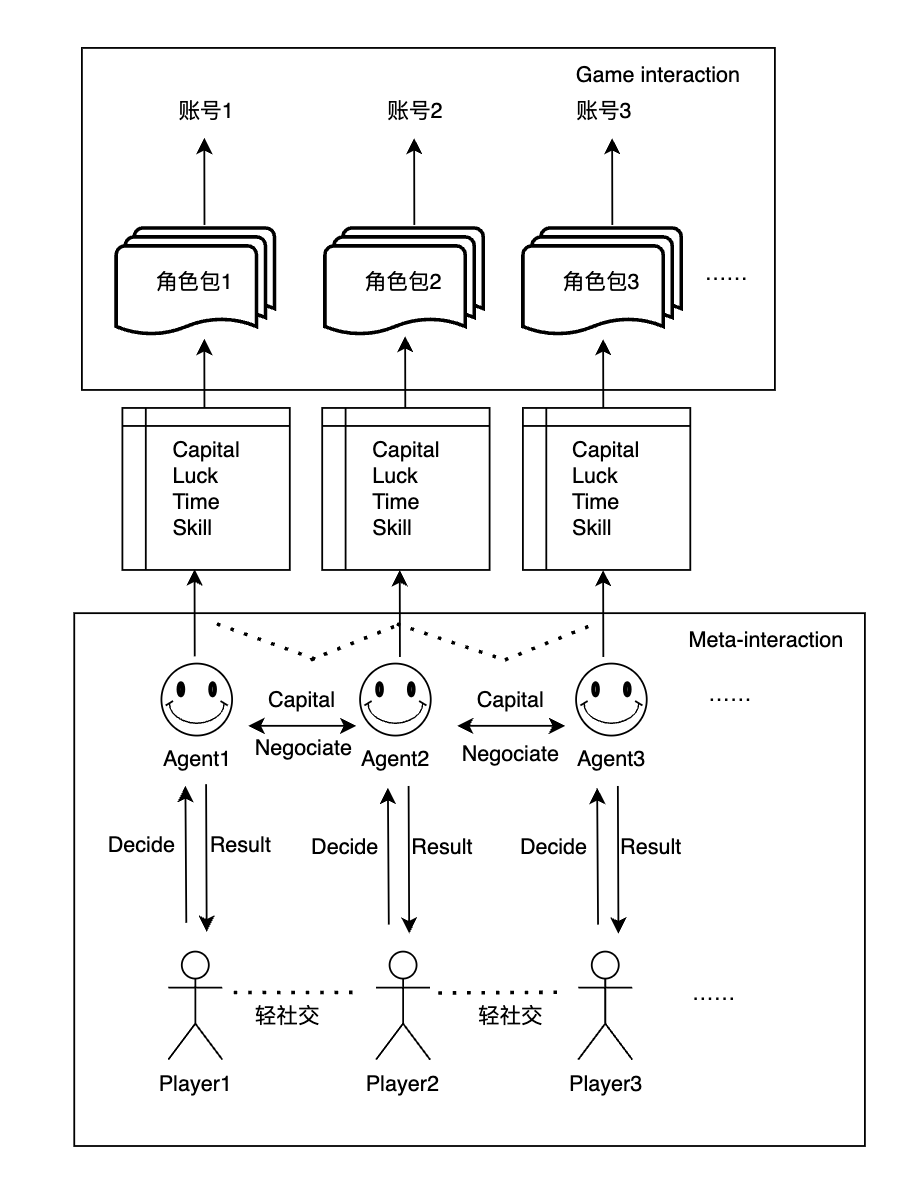
Imagine these scenarios:
1) Each player starts with an agent possessing identical game and negotiation strategies;
2) Players allocate funds to agents for actions like bribing or buying out other agents;
3) Agents return optional strategies every 6 hours; players choose the best one for execution;
4) Agents learn from each decision, adapting to player risk preferences—optimizing future strategies (e.g., whether to raise bribes, commit reserves/army to attacks, etc.);
5) A player can own multiple agents, training them independently or collaboratively—e.g., diplomacy agent + tactical agent—potentially creating a “negotiator agent” that conquers empires without spending coins or troops;
6) Agents evolve into entities with “personas”—appearance, voice, personality. Players who train successful agents could earn revenue shares from their commercialization.
Thus, the intense, always-on, socially demanding experience of games like *Rules of Survival* could transform into a passive, light-social (almost single-player) mode. Agents could become primary interaction points—like “mascot girls” in bishojo games—and even serve as monetizable content themselves.
Finally, why find AI games involving meta-economic interaction compelling?
Perhaps I've studied incentive mechanisms in crypto too long. Maybe zkML influenced me to believe future AI natives will manage users’ assets financially. Or maybe after *Dwarf Fortress*, I’ve grown uninterested in generative/passive agent-human interactions. Or perhaps I stubbornly believe games are interactive art. Either way, I feel current AI+games lack sufficient interactivity.
Undeniably, nearly all current AI+game experiments merely test AI’s mimicry of human behavior: Dota trains micro-control, Minecraft tests physical understanding, Stanford Town simulates human emotions. So why hasn’t anyone tested AI using economic tactics in games?
Games must always align with human nature. Does watching AI behavior satisfy voyeurism? How long does that last? How entertaining is it? Can it match GPU/VR audiovisual thrills? The adrenaline rush from opening loot boxes? The ego boost from dominating a server? If not, how can we use AI to create games that better tap into human desires and pleasure centers? That’s what I find truly interesting.
Also, I continue exploring AI’s role in narrative games. After finishing *The Wandering Village Sisters* this week, I shared some thoughts. Narrative remains one of the areas where I believe AI can most enhance and differentiate user experience.
Conclusion
Writing this article served three purposes:
1) To review the interesting mechanisms in Treasure Pavilion. Teams designing marketplaces might find them useful. It also highlights feasibility and ceiling differences between Treasure Pavilion and vertical web3 game marketplaces.
2) To explain a new value dimension for game assets. With F2P evolved, player spending habits have changed. Sticking to subscription-era logic for game trading is outdated. Shift perspective—explore alternative forms, identify key value carriers and transaction models: trading game experiences (accounts with multiple valuable characters).
3) If you’re intrigued by the idea of “meta-economic interaction” in AI+games, and work in related research, feel free to reach out. We still have much to explore.
Join TechFlow official community to stay tuned
Telegram:https://t.me/TechFlowDaily
X (Twitter):https://x.com/TechFlowPost
X (Twitter) EN:https://x.com/BlockFlow_News
 @0xAikoDai











