








Bitget UEX Daily Report | Houthi Armed Forces Drawn into Middle East Conflict; Crude Oil Futures Surge Over 3%; Analysts Predict Tesla and SpaceX May Merge by 2027
TechFlow Selected TechFlow Selected
Bitget UEX Daily Report | Houthi Armed Forces Drawn into Middle East Conflict; Crude Oil Futures Surge Over 3%; Analysts Predict Tesla and SpaceX May Merge by 2027
Overall, the market is in “risk-averse + defensive” mode, and short-term volatility may remain elevated until substantive progress is made in diplomatic negotiations.
 Navigating Web3 tides with focused insights
Author: Bitget
I. Top News Highlights
Federal Reserve Updates
The Federal Reserve’s balance sheet could shrink by $1–2 trillion
- Federal Reserve Governor Michelle Bowman stated that the current ~$7 trillion balance sheet could be reduced by $1–2 trillion through measures such as relaxing liquidity regulations—without triggering significant market volatility. She emphasized that the process must proceed gradually over several years.
- U.S. consumer confidence in March fell 6% month-on-month—the lowest since December 2025. Short-term inflation expectations rose from 3.4% to 3.8%.
- Kevin Warsh, nominee for Federal Reserve Chair, is expected to hold his Senate confirmation hearing as early as the week of April 13. Escalating Middle East conflict has pushed up energy prices, intensifying fluctuations in consumer confidence. Rising short-term inflation expectations may constrain the Fed’s policy flexibility, potentially prompting a reassessment of market expectations for rate cuts.
International Commodities
Houthi forces officially join anti-Israel operations; oil prices open higher Monday
- Over the weekend, Houthi forces launched missiles and drones at Israel and announced continued operations until attacks against Iran cease. Both WTI and Brent crude opened ~1% higher on Monday, with futures surging over 3%.
- The front-month Brent crude contract trades at a premium of $7.58 per barrel versus the second-month contract—highlighting acute near-term supply tightness.
- The G7 is discussing the possibility of releasing strategic petroleum reserves to ease pressure on energy markets. Escalating conflict directly threatens shipping safety in the Strait of Hormuz and the Red Sea, amplifying short-term oil price volatility and further testing global energy supply chains.
Macroeconomic Policy
- The U.S. Department of Defense is preparing for potential ground operations in Iran; U.S. troop levels in the Middle East are set to increase to 50,000. The White House estimates the most intense phase of hostilities may last another 2–4 weeks.
- California Governor Gavin Newsom signed an executive order banning public officials from trading on nonpublic information to profit from predictive markets. Escalating U.S.-China trade tensions combined with Middle East geopolitical risks are jointly pushing up global inflation expectations and risk-aversion sentiment—making policy-level hedging measures a focal point for markets.
II. Market Recap
Commodities & FX Performance
- Spot gold: Down 0.77% at $4,460/oz, pressured by rising oil prices and improved risk sentiment.
- Spot silver: Down 1.17% at $68.90/oz, weighed down by softer industrial demand outlook.
- WTI crude: Up 1.83% at $101.52/bbl, driven by supply concerns amid escalating Middle East conflict.
- Brent crude: Up over 2% at $107.49/bbl; widening near-term spreads reflect tightening spot supply.
- U.S. Dollar Index: Slightly stronger at 100.165, supported by inflows into safe-haven assets.
Cryptocurrency Performance
- BTC: +0.31% over 24H to $66,593; consolidating near key support levels—its safe-haven appeal emerged amid geopolitical risk but remains constrained by macro headwinds.
- ETH: −0.7% over 24H to $2,007; moving broadly in line with broader market trends, with ETF outflows adding downward pressure.
- Total crypto market cap: +0.8% over 24H to ~$2.35 trillion; overall risk appetite remains cautious amid geopolitical developments.
- Liquidations: ~$307M liquidated over 24H—longs accounted for ~$235M, shorts ~$72M.
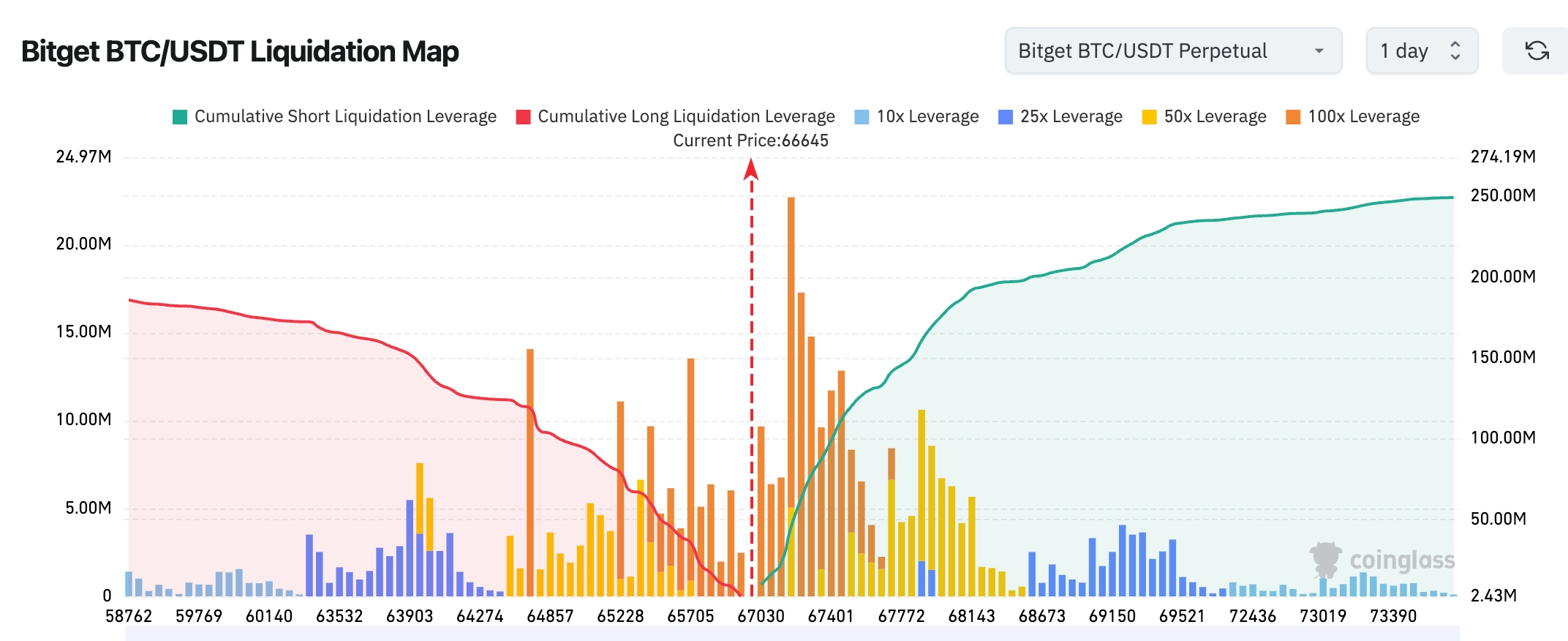
- Bitget BTC/USDT Liquidation Heatmap: Current price ~$66,645. A dense cluster of short positions exists between $66,500–$67,000; above $67,500–$68,200 lies a concentration of high-leverage longs—breakouts here could trigger cascading liquidations. Overall structure suggests stronger support below than resistance above; short-term consolidation of leverage is likely before directional clarity emerges. Key watchpoints: whether $67,000 can be reclaimed or if $68,000 breaks decisively.
U.S. Equity Index Performance
As of last Friday’s close

- Dow Jones Industrial Average: Down 1.73% to 45,166.64—down for five consecutive weeks, entering correction territory.
- S&P 500: Down 1.67% to 6,368.85—8.7% off its January high.
- Nasdaq Composite: Down 2.15% to 20,948.36—tech stocks weighed heavily; index now in correction.
Tech Giants’ Performance
- Apple (AAPL): Down 1.62% to $248.80—consumer electronics demand dampened by macro risk-aversion.
- Microsoft (MSFT): Down 2.51% to $356.77—multi-day pullback, notably off all-time highs.
- Nvidia (NVDA): Down 2.17% to $167.52—semiconductor sector broadly under pressure.
- Amazon (AMZN): Down 3.95% to $199.34—retail and cloud businesses impacted by rising energy costs and falling risk appetite.
- Meta (META): Down 3.99% to $525.72—ongoing litigation and regulatory scrutiny weighing on shares.
- Alphabet (GOOGL): Down 2.34% to $274.34—advertising business facing regulatory uncertainty.
- Tesla (TSLA): Down 2.76% to $361.83—despite oil price gains offering some tailwind, dominant risk-aversion sentiment outweighed it.
All “Magnificent Seven” stocks declined collectively, primarily driven by escalation in Middle East geopolitical tensions—including Houthi involvement and heightened Israel-Iran tensions—leading to a sharp drop in risk appetite and a rotation of capital from high-valuation tech/growth stocks into defensive sectors like energy.
Sector Rotation Observations
Energy sector up over 3%
- Key stock: Exxon Mobil up 3.5%.
- Catalyst: Surging oil prices directly benefit upstream producers; conflict escalation reinforces energy security themes.
Tech hardware sector down over 2%
- Key stocks: Micron, Western Digital—memory chip stocks sharply pulled back.
- Catalyst: AI model memory optimization news, combined with macro risk aversion, triggered outflows from high-valuation tech equities.
III. In-Depth Stock Analysis
1. Nvidia (NVDA) – Signs of AI Capex Pressure Emerging
Event Summary: As the undisputed leader in the global AI GPU market, Nvidia’s upcoming quarterly earnings guidance is highly anticipated. Investors are closely watching whether data center shipment volumes can sustain robust growth. Meanwhile, soaring oil prices—driven by Middle East conflict—are elevating supply chain transportation costs and magnifying overall energy consumption expenses for AI server deployments. Though Nvidia’s gross margin exceeds 75%, offering some cushion, questions around the sustainability of hyperscalers’ $650 billion AI capex plan for 2026 are mounting.
Market Interpretation: Analyst views are sharply divided. Raymond James upgraded its target price to $323 and maintained a Strong Buy rating, citing enduring AI demand anchored in real cost savings and revenue growth. However, Seeking Alpha and others note growing investor skepticism about growth durability—high oil prices have already contributed to six months of sideways price action, pressuring near-term target valuations. While rising supply chain costs have limited impact so far, they warrant ongoing monitoring.
Investment Takeaway: Near-term focus should center on how energy costs transmit to gross margins. Long-term leadership in AI technology remains intact. Investors are advised to dynamically adjust positions in light of oil price developments.
2. Microsoft (MSFT) – Cloud and AI Investment Under Scrutiny
Event Summary: As a leader in cloud and AI infrastructure, Microsoft’s upcoming quarterly report draws attention to Azure cloud service growth and the sustainability of AI infrastructure capex amid elevated oil prices. The company is reducing reliance on external GPUs via in-house Maia accelerators and Cobalt CPUs. Meanwhile, Copilot subscription users have reached 4.7 million—demonstrating tangible AI monetization potential.
Market Interpretation: Investment banks broadly view Azure demand as solid (39% YoY growth), though rising data center operating costs from high oil prices may compress margins. Guggenheim and Piper Sandler maintain Buy ratings and assign 12-month targets of $550–$600, highlighting Copilot’s potential for 30% revenue uplift. They also stress AI investment is shifting from “hype” to “ROI validation,” meaning valuation pressure persists in the near term.
Investment Takeaway: If results exceed expectations and underscore Azure’s defensive characteristics, a broader sector rebound may follow. Investors should prioritize tracking AI monetization progress as a key signal for valuation recovery.
3. Tesla (TSLA) – Indirect Impact of Rising Energy Prices
Event Summary: As a dual-driver enterprise in EVs and energy storage, Tesla faces scrutiny on quarterly delivery figures and energy segment performance. High oil prices offer short-term tailwinds for Megapack demand (2025 deployment reached 46.7 GWh, up 49% YoY), yet broad macro risk-aversion continues to weigh on auto business valuations. Tesla recently signed a $4.3 billion battery supply agreement with LG Energy Solution, further strengthening domestic supply chains.
Market Interpretation: Analysts note the energy segment now accounts for 13% of revenue and exhibits “exceptionally high growth” potential. Zacks and others see Megapack 3 and Megablock driving accelerated 2026 deployment. However, debate remains on how high oil prices affect EV demand. Amid prevailing risk-aversion, auto gross margins face pressure, increasing near-term share price volatility.
Investment Takeaway: Short-term volatility has significantly intensified, though the long-term energy transition thesis remains unchanged—making TSLA suitable as a defensive allocation within portfolios.
4. Exxon Mobil (XOM) – Benefiting from Elevated Oil Prices
Event Summary: As a global energy leader, Exxon Mobil’s earnings outlook has been substantially revised upward following Middle East conflict-driven oil prices breaching $100/bbl. Markets are closely watching profit elasticity in upstream exploration and production, as well as accelerated cost recovery from projects like Guyana—enhancing cash flow generation.
Market Interpretation: Investment banks unanimously raised target prices. Wells Fargo, Barclays, and Piper Sandler emphasize expanding oil supply-demand gaps amid geopolitical tension (projected 2026 tightness of 2.0 Mb/d), reinforcing energy security themes. Mizuho and BofA highlight that elevated oil prices will materially boost free cash flow and shareholder returns—pushing consensus target price from $144 to ~$151.
Investment Takeaway: Defensive attributes have strengthened markedly, positioning XOM as a core instrument for hedging geopolitical risk—ideal for allocation during elevated oil price regimes.
IV. Cryptocurrency Project Updates
1. Walmart-owned OnePay added SUI, Polygon, and Arbitrum tokens last Thursday. Over the prior few days, the platform had already launched 10 tokens including Solana, Cardano, Bitcoin Cash, and PAX Gold—bringing its total newly listed crypto assets to over a dozen.
2. According to Punchbowl News, two sources familiar with the matter indicated the Senate Banking Committee plans to hold Kevin Warsh’s nomination hearing for Federal Reserve Chair as early as the week of April 13. The exact date remains uncertain and depends on whether Warsh submits full documentation to the committee.
3. Ahead of major policy announcements during Trump’s second term, precisely timed trades may have generated multi-million-dollar profits for certain traders. Multiple legal experts argue these trades warrant investigation to uphold market fairness and determine whether insider information was leaked. Reuters analysis found suspicious pre-announcement activity ahead of key Trump administration decisions on tariffs, Venezuela, and Iran—across options, commodity futures, and prediction markets.
4. Data: SUI, EIGEN, OPN, and other tokens face large token unlocks this week—with SUI unlocking ~$37.2 million worth.
5. On-chain analyst “Aunt Ai” reported that the TRUMP team appears to have sold over $16.06 million worth of TRUMP tokens. Within the past two hours, a BitGo custodial address deposited 5.48 million TRUMP tokens to OKX. Tracing funds backward reveals the deposit originated from the TRUMP Team Allocation address (i.e., team allocation), which deposited 18.14 million tokens two months ago—valued then at $81.64 million.
6. According to CoinDesk, after Bitcoin hit an all-time high of $127,000 in October 2025, the market rapidly corrected in Q1 2026 to the ~$60,000 range. Though volatile, this correction reflects a normal cyclical “deleveraging + liquidity contraction” process.
From a cycle perspective, 2026 may unfold in “multiple phases of recovery”: early-year bottoming and deleveraging, mid-year partial rebounds, and later-stage consolidation before entering a more sustainable uptrend—mirroring patterns observed across prior crypto cycles. At present, investors should maintain defensive allocations and gradually increase risk exposure only upon signs of improving liquidity. 2026 is more likely a “transitional year”—neither a unidirectional bull nor bear market—but this “reset” may lay groundwork for the next upward cycle.
Analysis suggests current crypto market pressure stems from global liquidity tightening—including Fed balance sheet reduction, dollar strength, IPO funding diverting capital, and rising credit market stress. Against this backdrop, crypto asset prices often temporarily decouple from fundamentals, using price declines to cleanse the market and reset the cycle.
V. Today’s Market Calendar
Data Release Schedule
| 21:30 | USA | Chicago PMI (March) | ⭐⭐⭐ |
| 23:00 | USA | Consumer Confidence Index Final (March) | ⭐⭐⭐⭐ |
Key Event Forecasts
- Event: Follow-up discussions from the G7 Energy Ministers’ Meeting—monitor feasibility of strategic petroleum reserve releases.
- Event: Latest updates on indirect U.S.-Iran negotiations—watch for Trump administration comments impacting oil prices.
Institutional Views:
Top-tier investment bank analysts broadly agree that the Middle East conflict has entered a new phase. Houthi involvement and increased U.S. troop deployment suggest oil prices will remain volatile at elevated levels in the near term—supporting further re-rating of the energy sector. However, this will feed into inflation expectations, constraining the Fed’s ability to cut rates. Morgan Stanley warns that sustained Brent crude above $100/bbl raises global stagflation risks—recommending increased allocation to energy and defensive assets while trimming high-valuation tech stocks. Goldman Sachs analysts note that although crypto markets are near-term pressured by falling risk appetite, BTC ETF outflows have slowed, and long-term institutional demand remains intact. Should geopolitical tensions ease, risk assets may rebound. Overall, markets are in “risk-off + defensive” mode—volatility likely remains elevated until diplomatic progress materializes.
Disclaimer: The above content was compiled via AI search and verified manually for publication. It does not constitute any investment advice.
Join TechFlow official community to stay tuned
Telegram:https://t.me/TechFlowDaily
X (Twitter):https://x.com/TechFlowPost
X (Twitter) EN:https://x.com/BlockFlow_News










