








Two-level reversal, friend.tech has still agreed to be friends with you and the clone platform
TechFlow Selected TechFlow Selected
Two-level reversal, friend.tech has still agreed to be friends with you and the clone platform
There are no eternal friends, only eternal interests.
 Navigating Web3 tides with focused insights
A few weeks ago, friend.tech emerged out of nowhere, quickly dominating the feeds of crypto KOLs and media outlets alike.
A few weeks later, as we eagerly analyze friend.tech's viral mechanics and rise to fame, it’s natural to ask a broader question—what core technology is required to truly master social in web3?
Today, friend.tech has given us a lesson firsthand. The core tech behind making friends (friend) lies in: "You can't be friends with my competitors."
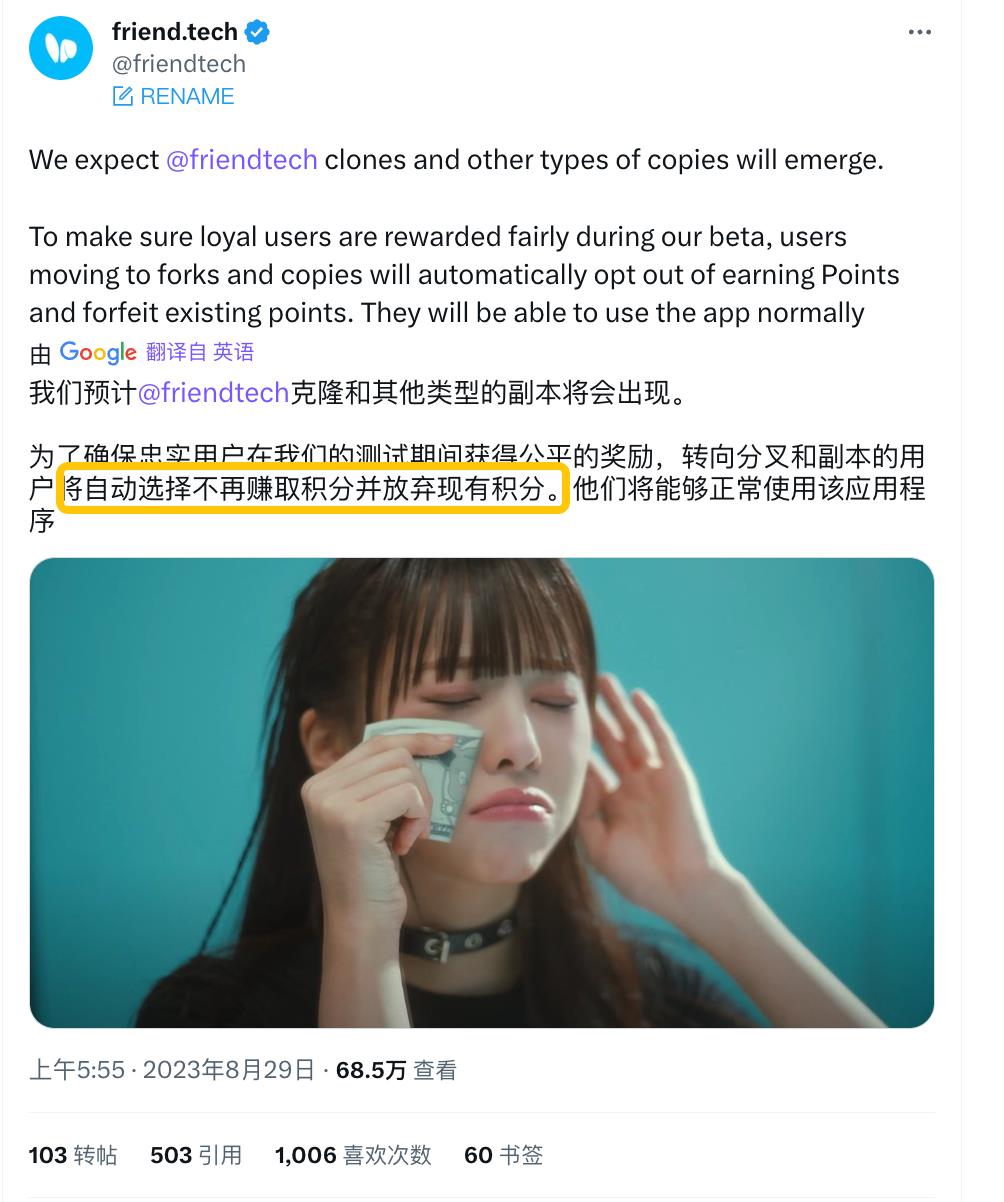
Just hours ago, friend.tech keenly sensed a familiar pattern in the crypto world: when a project becomes a phenomenon, countless clones quickly sprout up. Whether driven by fear or preemptive caution, its official Twitter posted the following statement:
“To ensure loyal users receive fair rewards during our test phase, users who switch to forks and clones will automatically stop earning points and lose all existing points. They will still be able to use the app normally.”
The accompanying image was especially painful—money and tears, the meaning clear without words.
The message was unambiguous: you're free to use other clones, but doing so means forfeiting all reward eligibility on friend.tech.
Since friend.tech builds on Twitter’s existing accounts and social graph, it can relatively easily detect when the same Twitter account links to competing platforms and disqualify those “disloyal users” from earning points.
In contrast to whitelist-based airdrops, this statement effectively functions as a blacklist—a non-airdrop list.
Disloyalty = No rewards. A direct, yet somewhat arbitrary logic.
Two-Stage Reversal
There are no eternal friends, only eternal interests.
After friend.tech issued this statement, influencer Cobie delivered a sharp and humorous follow-up comment, offering a satirical definition:
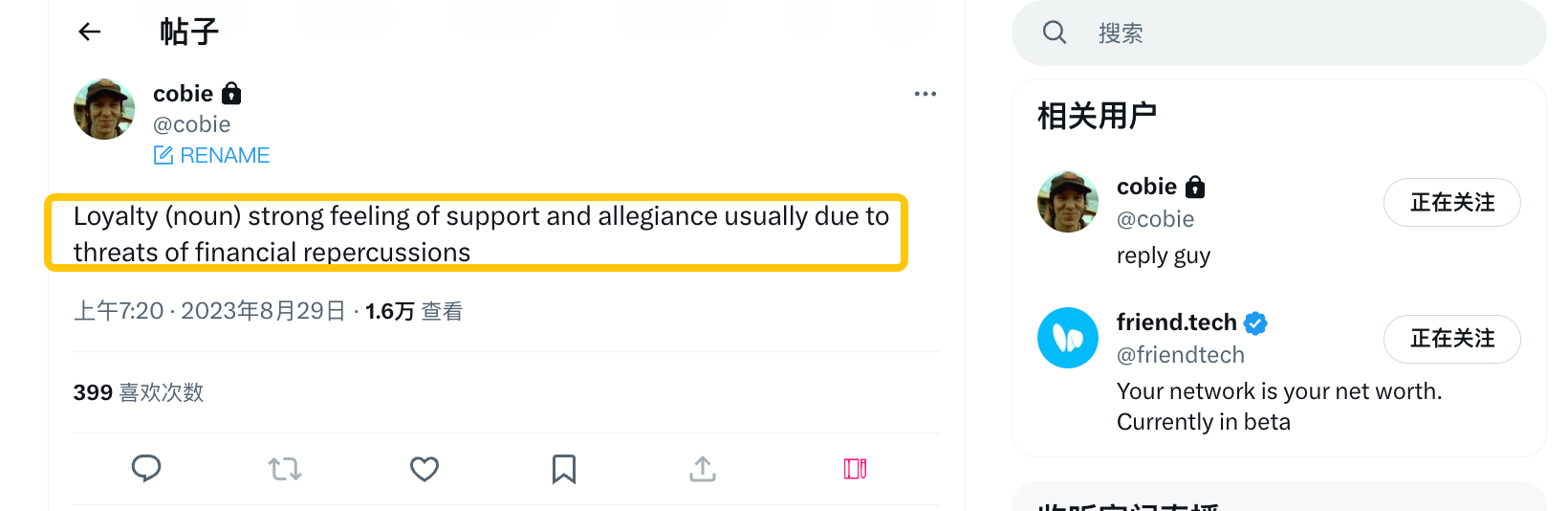 “Loyalty (noun): Typically refers to strong support and allegiance, usually enforced through the threat of economic consequences.”
In other words, Cobie implied that friend.tech is using economic incentives to pressure users into avoiding competing platforms and refraining from farming other projects’ rewards.
In crypto, first-movers often enjoy outsized expected returns.
As the first major SocialFi project in recent memory, friend.tech forces users to weigh: Is the combined yield from multiple clone projects greater than sticking solely with friend.tech?
Yet compelling users into an either-or choice feels inherently wrong.
Crypto values openness and decentralization (even if sometimes just in name). Assets, users, and protocols are meant to flow freely. Taking such a firm stance against competitors and revoking rewards is rare even within the ecosystem.
Moreover, the crypto community thrives on consensus. When something benefits everyone, people flock together—but when they’re angered, they scatter just as fast.
Unsurprisingly, friend.tech’s initial announcement invited widespread backlash. With major KOLs amplifying criticism, the negative social media impact could not be ignored.
Thus, just five hours after the initial post, an apology letter from founder Racer followed:
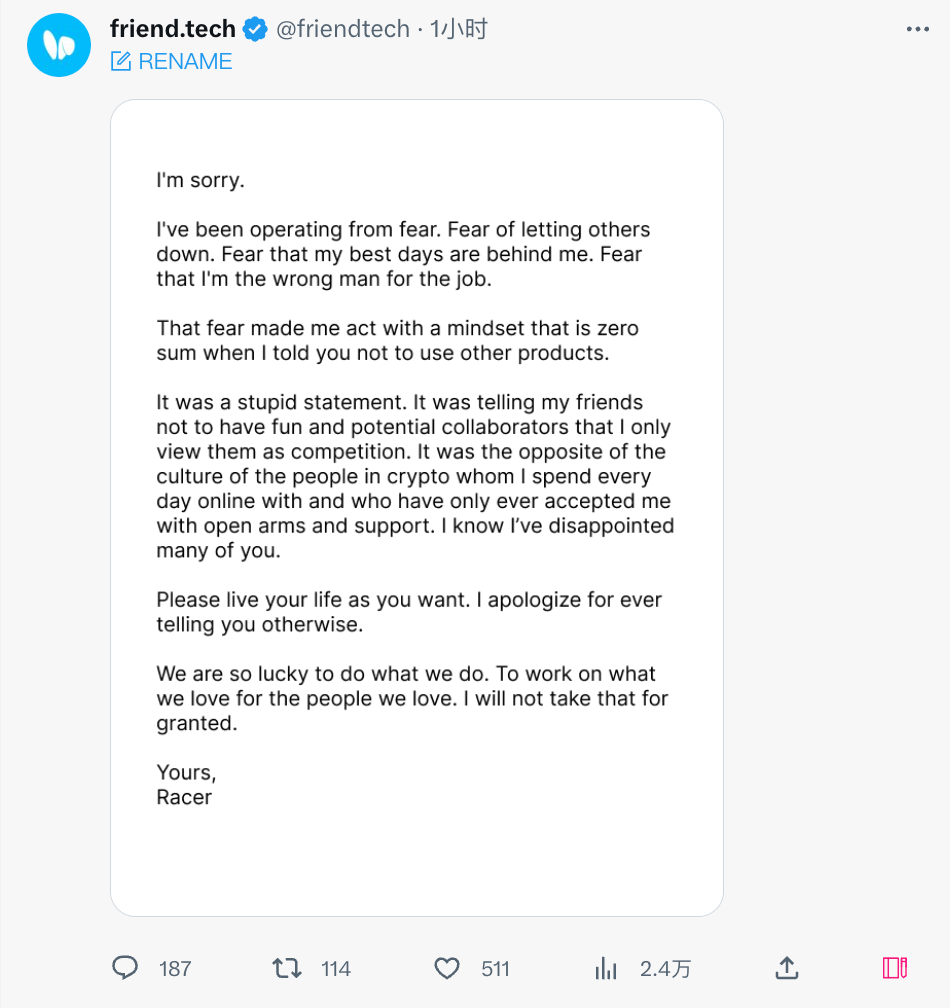
He admitted that his earlier remarks restricting users from using cloned or山寨 versions stemmed from fear and zero-sum thinking.
He confessed to fearing disappointment, fearing his golden era had passed, and doubting his own fitness for leadership. This fear led to zero-sum rhetoric urging users not to engage with competing products.
He called the statement foolish—telling friends not to have fun, making potential partners feel seen only as rivals. He acknowledged it contradicted crypto’s open culture and expressed deep regret.
This public apology revealed the team’s prior misjudgment—fear had overridden reason, prompting a desperate move.
But in my view, the fact that this letter was published at all shows that reason ultimately triumphed over fear. Though unstated, there was an implicit subtext:
“If we keep going like this, the project will collapse under public outrage—and our interests will suffer.”
Whether motivated by damage control or genuine remorse, this two-stage reversal highlights several issues:
-
The team or founder lacks deep crypto-native understanding, hence committing such a misstep;
-
Poor judgment in PR and marketing;
-
Governance and business mindset flaws—simply making a product web3-enabled doesn’t solve deeper structural problems.
All the world bustles for profit; all the world hustles for gain. To demonstrate sincerity and mend fractured consensus, perhaps a new round of inclusive airdrops would provide a fitting finale to this dramatic reversal.
Nothing New in Web3?
This monopolistic mindset seen in friend.tech isn’t novel—it has precedents throughout internet history.
Over 20 years ago, the infamous “3Q War” dominated headlines. Younger readers may barely remember the epic battle between 360 and QQ.
In 2010, two major Chinese software companies—Qihoo and Tencent—accused each other of unfair competition. In September, Qihoo launched the “360 Privacy Protector” and later the “360 Koubu Bao Biao,” claiming these tools protected QQ users' privacy and security. On November 3, Tencent responded by announcing QQ would no longer run on computers with 360 software installed.

“Use me or use them.” Two decades ago, internet giants forced users to choose between QQ and 360 by leveraging user habits and social necessities.
Twenty years later in web3, projects force similar choices using airdrop expectations and reward systems.
But in the greedier, more chaotic world of web3, kids make choices—farmers take everything. If a reward is publicly accessible, there’s no reason not to farm both A and B.
Hence, friend.tech pulling back at the last moment likely reflects a swift realization of web3’s unique nature:
Monopolies in web3 cannot be enforced through coercive rules—they must be built on shared value and consensus.
BTC, ETH, and others stand as proof. Ultimately, we must remain open and allow people to choose which interests and timelines to align with.
Join TechFlow official community to stay tuned
Telegram:https://t.me/TechFlowDaily
X (Twitter):https://x.com/TechFlowPost
X (Twitter) EN:https://x.com/BlockFlow_News
 深潮TechFlow


