Crypto-Trading Youth from County Town: Lost Money, Owe 130K, Back to Construction Site to Pay Debts
TechFlow Selected TechFlow Selected
Crypto-Trading Youth from County Town: Lost Money, Owe 130K, Back to Construction Site to Pay Debts
Addicted to this game of chasing big gains with small stakes, believing one can grasp the lever to wealth and social mobility, is in fact holding nothing but a scythe ready to reap them.
 Navigating Web3 tides with focused insights
Author: hachii

Overnight wealth is just a myth
Yang Yi, 24, is the most ordinary kind of youth from a small county town. After dropping out of high school, he followed his parents to construction sites in the city. Perhaps he would spend the next decade or so working on these sites, saving money to build a house back home, get married and have children, then return to the site—just like his father.
But then cryptocurrencies appeared—the biggest variable in Yang Yi’s life.
Yang Yi started following people online to trade Bitcoin using futures contracts, which allow leveraged "purchases" of coins by predicting price movements to earn returns. For someone with limited capital like Yang Yi, this was a lower-barrier entry point—but one carrying equally massive risks and rewards.
Searching “contracts” online always brings up warnings like “playing contracts leads to certain death.” Yet still, some remain fervently eager to strike gold in this financial game—like Yang Yi. The dream of sudden wealth acts like an endless vortex, pulling him repeatedly into the crypto world.
In the past, he lacked both the ability and luck to catch any of the era's fast-moving wealth trains. Now, he’s addicted to this high-stakes game, believing he finally holds the lever that can pry open fortune and enable social mobility—even though it’s actually a scythe poised to reap him.
The “New Continent”
Recalling the first time he clicked into a virtual currency exchange, Yang Yi thought of the Pandora’s box myth. Once opened, his life fell into a numb cycle: trading coins, accumulating online loans, returning to the construction site to repay debts.
Yet at the time, Yang Yi believed he had discovered a “new continent.” In derivative communities attached to exchanges, hundreds or thousands were active daily—posting profit screenshots, sharing trading tips, or offering paid courses. Like a novice adventurer stepping into a new game, Yang Yi absorbed these “beginner tutorials” from the community.
It was 2019. In February, Bitcoin was valued at $3,500. By June, when he entered, it had surged past $10,000. That intangible digital coin tripled in value within four months.
Hodlers—those who held onto their Bitcoin—saw their assets rise with this tailwind. Some contract traders also multiplied their stakes through accurate predictions of price trends. They posted envy-inducing asset screenshots in the community, exchanging flattery and advice in comments. Looking at those strings of zeros, Yang Yi felt for the first time that wealth was within reach.
Privately thrilled, he believed he’d found an easier shortcut to make money. More importantly, it gave him hope of leaving the construction site behind.
Yang Yi dropped out during winter break of his second year of high school and joined his father on a worksite. His hometown is a small town in Liupanshui, Guizhou Province—where many youths like him follow similar paths. Even in middle school, numerous classmates had already left school. Their options were few: idling around town; finding work in the county seat; or, going farther, donning hard hats to join infrastructure projects across cities large and small.
Construction work is extremely tough, often involving significant danger. During his first year on-site, his father fell from scaffolding two or three meters high, suffering a comminuted fracture in his knee and lying bedridden for two weeks. Without insurance, the contractor only offered 20,000 yuan for medical expenses before hastily closing the matter.
This made Yang Yi resent construction life. After encountering the crypto world, he dreamed of becoming like those community members—suddenly possessing multiplied assets. Then he could escape that dusty, noisy world and finally relieve the burden weighing on his parents.
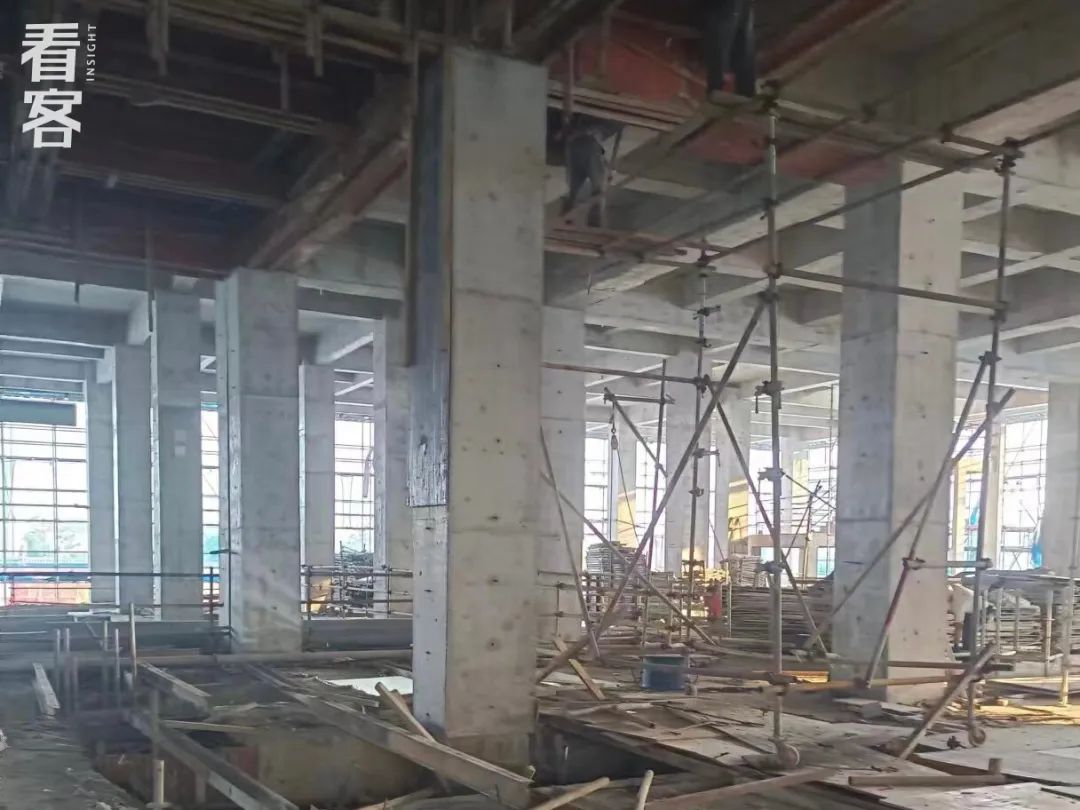
Scaffolding on the construction site with no safety barriers. Two men stand above; the one on the right is Yang Yi’s father.
He tried investing a hundred yuan as a test, playing with contracts.
Contract trading contrasts with spot trading. With sufficient capital, one could directly buy coins and wait patiently for appreciation—a safer approach. But for Yang Yi, earning via hodling was too slow and required upfront funds. Young people without money like him are effectively locked out of this method.
Contracts resemble stock market futures, generating returns based on predictions of price fluctuations. Crucially, with leverage, initial investments can be multiplied, thereby amplifying gains. For example, investing 10,000 yuan with 100x leverage on a Bitcoin price increase: if Bitcoin rises just 1%, the principal doubles instantly, yielding a 10,000 yuan profit.
But if the prediction is wrong, losses are equally total. If Bitcoin drops 1%, the entire 10,000 yuan disappears. Losing all invested capital this way is known as “liquidation.”
In the crypto world, many have been repeatedly liquidated due to market volatility, ending up completely broke. Yet others, relying on skill and courage under high leverage, have soared overnight to riches, becoming legends.
Dying Before Dawn
These tales of multiplying small sums in the contract market marked the beginning of Yang Yi’s obsession with crypto trading.
During the day, he worked alongside his supervisor on the site, studying price trend charts on his phone whenever possible, learning from experienced traders to predict future movements. At night, after washing up, instead of resting, he engaged in contract trading on exchanges: converting cash into stablecoins, setting leverage multiples, then deciding whether to go long or short. Each choice determined the fate of his money: doubling or liquidation?
The outcome was almost always “liquidation.” Beforehand, platforms issued early warnings—if additional margin wasn’t added promptly, the principal would be wiped out. And even after topping up margin, there was no guarantee against the next price swing, often leading to total loss.
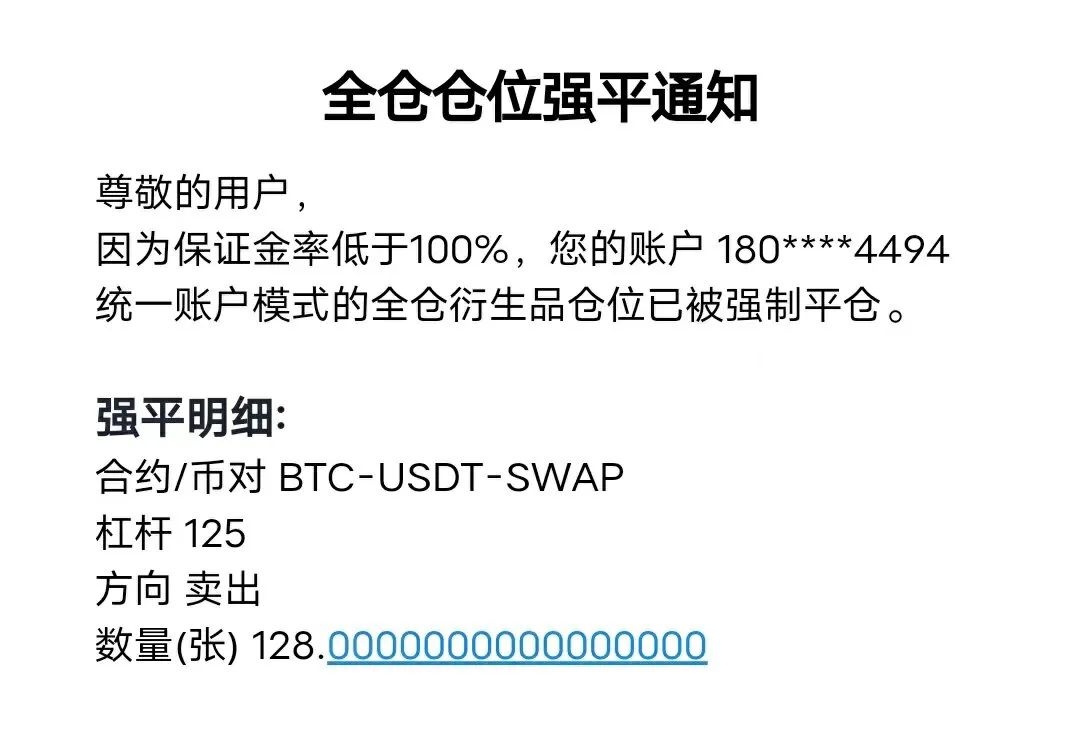
Email notification Yang Yi received after being liquidated (forcibly closed)
After losing his initial few hundred yuan, Yang Yi refused to accept defeat, thinking his technique simply wasn't good enough. He became more cautious but increasingly greedy, raising his stake from hundreds to 1,000 yuan, increasing leverage from 10x to 100x. Money in his bank account dwindled while numbers in trading apps appeared, grew, then vanished again.
He was nearly driven by contract trading itself. Every night, he felt like walking a tightrope in midair, his heart rising and falling with every curve on the chart. Real-time asset fluctuations kept him from sleeping soundly—he’d lie down for minutes, then get up again to check his phone.
Within less than a month of trading, he lost over 40,000 yuan saved from two years of labor, then accumulated 60,000 yuan in online loans before finally stopping—only because he had no more money to re-enter. By the end, Yang Yi felt numb. The only thing that frustrated him was losing the chance to play again, that possibility of “earning it back.”
Yang Yi finally understood what some contract players meant by “dying before dawn”—his money almost never lasted through a single night. Once, exhausted, he fell asleep holding his phone. When he woke the next morning, the money was gone, leaving only a text message: “You have been liquidated.”
He rarely profited. Even when he did, he always waited for further gains, only to see the trend reverse, wiping out both principal and profits.
Now Yang Yi realizes contracts are gambling arenas for grassroots traders. Wealthy individuals can afford thick cushions of idle cash, playing cautiously with low leverage. But people like him must use dangerous leverage levels, risking savings, living expenses, even borrowing, to chase a shot at “financial freedom.” This land isn’t the promised land of profit he imagined.
In various crypto communities, Yang Yi has seen many torn between survival and desire. Some ask for help after losses, wondering what to do next. Others write long reflections on how they arrived here. Some leave suicide messages and disappear. He doesn’t know if any of them ever saw their own dawn.
The Only Straw
Had he possessed money, stable employment, or a family of his own, Yang Yi believes he definitely wouldn’t touch the crypto world again. But having nothing, trading feels like the matchstick in a fairy tale—he can’t resist striking it again and again.
To his parents, this young man battling in the crypto world remains a well-behaved child: quiet, few words, steady in actions. The only time he disobeyed them was insisting on attending high school in the county town.
In his high school, about half went to university, mostly second- or third-tier institutions. He ranked below average. Had he persisted until college entrance exams, he might have made it into a third-tier university.
But after only half a semester, he wanted to drop out—not due to grades, but simply believing “education is useless.” He posted this thought on Baidu Zhidao, where a netizen persuaded him to continue, so he stayed another year. Eventually, he quit during his second year. “Many classmates who attended third-tier universities ended up no different anyway,” he said.
In small county towns, life trajectories seem predictable from birth.
The clearest example is his father. After junior high, his parents went to work on construction sites in Wenzhou, while he moved alone to the county high school, starting boarding life. A site job earns 70,000–80,000 yuan annually. To earn a living, countless families migrate to larger nearby cities—a common path locally. Many children in these towns separate early from parents, becoming “left-behind children.”
But Yang Yi longed for a warm, stable home, unwilling to repeat this pattern. After six months on-site, he began seeking ways back to the county. First, he underwent military recruitment体检, but failed due to “elbow hyperextension.” Then he found work at a karaoke bar in town, earning only 2,000 yuan monthly. Finally, he returned to the construction site.

Working at the county karaoke bar, Yang Yi described himself as “weary of this dark, sunless life.”
Life hit a dead end: staying on-site meant separation from family; returning to the county to start a family was unaffordable on 2,000 yuan per month; stable, well-paying jobs wouldn’t open doors to a young man without education or skills.
Scarcity, despair, and the absolute lack of alternatives bred immense desire. Despite repeated losses of capital and mounting debt, Yang Yi couldn’t stop fantasizing about sudden wealth.
That summer of 2021, Yang Yi traded crypto for the second time, losing over 20,000 yuan. Fear crept in—“felt like I’d lose no matter what.” He deleted all crypto contacts and trading apps, resolving never to trade again.
He didn’t expect that shortly after quitting, a legend would emerge.
In the crypto world, “Liangxi” is known to nearly everyone. The name is forever tied to three numbers: 519, 1000, 1000.
“519” refers to the cryptocurrency crash on May 19, 2021. Data shows total liquidations reached $6.28 billion (approximately 40.4 billion RMB). On that day, as countless investors fled, 17-year-old Liangxi turned 1,000 yuan into 10 million RMB using high-leverage rolling positions.
No one expected a teenager to seize this historic downturn. An initial stake of 1,000 yuan is practically the universal “entry threshold.” Starting with just 1,000 yuan and becoming a millionaire—Liangxi achieved a near-absurd possibility.
Though Liangxi’s paper gains have since turned into liabilities, at least for that year, he had it all: sudden wealth, fame. Founders of several trading platforms successively awarded Liangxi “dream funds,” rewarding his “never-give-up spirit.”
One thrilling story after another gradually weakened Yang Yi’s resolve.
Lever vs. Scythe
Last year, he came to Shanghai with a friend to deliver food, drawn by rumors of “earning 20,000 yuan a month.” It was the first big city he’d visited after leaving his hometown, where delivery riders buzzed like bees.

A photo taken by Yang Yi while delivering food in Shanghai. He felt the people in the picture resembled ants—each busy yet orderly.
He arrived in February but wasn’t fast enough to earn much. In early April, lockdown hit. Ten people crammed in one room, scrambling for groceries on Meituan all day. After riders were released early, he and his friend lived under bridges, delivering vegetables citywide. By May, he’d mastered the routes, rarely missing deadlines. By June, he had saved some money.
Desire likely surfaced then. “Being there exposed me to a richer lifestyle,” Yang Yi paused. “The gap felt too wide.” Shanghai sparked longing for a better life. Both food delivery and construction wore down the body—unsustainable long-term. Surveying his options, only crypto trading remained—a lever seemingly within his grasp.
Late June, Yang Yi embarked on his third crypto journey. He invested 5,000 yuan on day one—unsuccessful. He still had 20,000 yuan saved from deliveries, his entire savings.
For money, he hustled during lockdown, unable to return to his rental, sleeping in parks or under bridges with rider friends. For more money, Yang Yi gritted his teeth and threw it all in. The speed of loss exceeded expectations—within two days, only meal money remained.
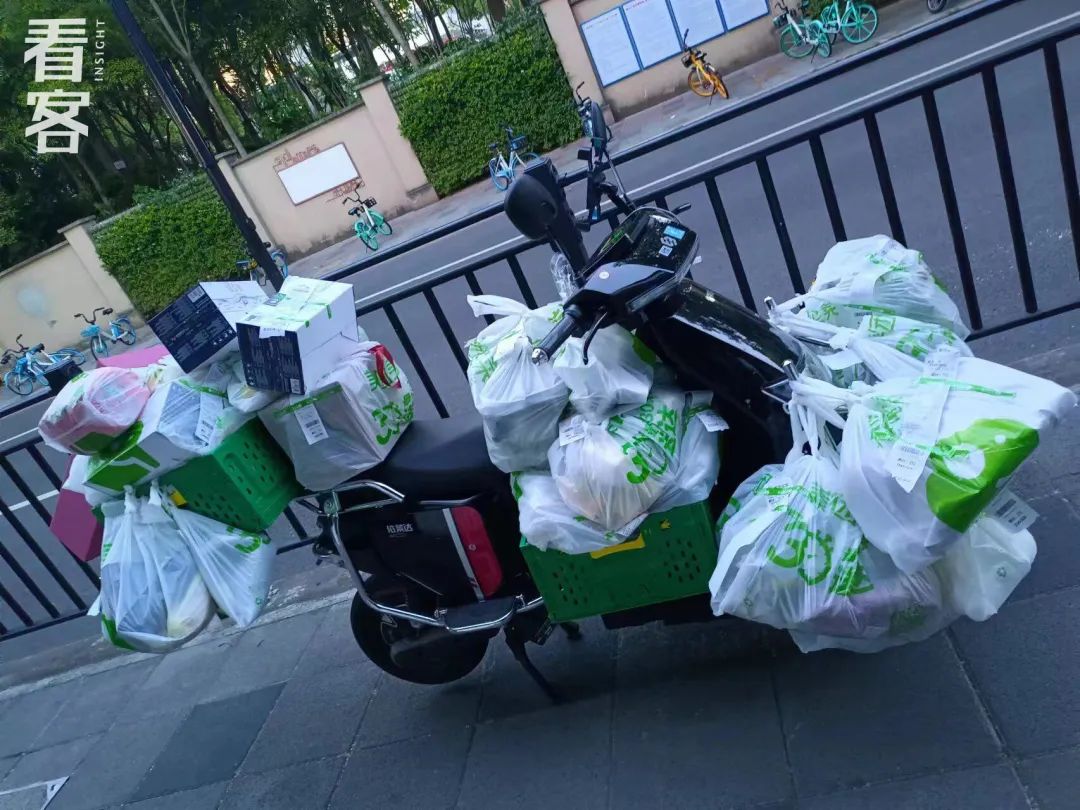
Supplies tied tightly to Yang Yi’s vehicle, awaiting delivery
He felt heartbroken, planning to stop, but then thought, “If I’m going to do it, I’ll go big,” turning sorrow into determination. Coincidentally, a loan app on his phone suddenly increased his credit limit. He borrowed 50,000 yuan, then another 30,000. Events spiraled beyond control—he downloaded more loan apps, eventually borrowing over 130,000 yuan.
On July 1, Yang Yi spent every last cent. At 10:30 a.m., he posted a single character “废 (waste)” on WeChat Moments, marking the end of this gamble.
He considered stopping midway but convinced himself he had no way back. He constantly feared a major market swing the moment he withdrew—regretting withdrawal, so he kept betting on the next trade, fighting to the very end. Even the 700 yuan left for meals—he put that in too.
“Precisely because I feel I have nothing, I want to take risks,” he said. “The less opportunity I have, the more desperately I try to create one.”
When crypto trading becomes a wealth game, most participants hope to get rich through it. They don’t know what the Lightning Network is, can’t explain Bitcoin forks, nor recall what ICO stands for. These ordinary investors, failing to understand blockchain’s essence, flood the market as the most primitive fighters in the crypto “arena,” yet simultaneously become anonymous victims fueling Bitcoin’s rise.
After multiple liquidations, Yang Yi now admits that ordinary people like him entering the market are just waiting-to-be-cut韭菜 (lettuce)—“We know we’re lettuce, but we still want to grab meat among lions,” he joked, making himself laugh. “If we can’t get meat, soup will do.”
Where Is the Way Out?
Last year, he owed 130,000 yuan in loans. Debt collectors called his home. Only then did his parents realize he had veered onto a different path unseen.
For this small-town family, 130,000 yuan in debt wasn’t light. His mother cried for the first time over him. Yang Yi felt terrible. He followed his parents’ advice, returned to work steadily on construction sites, and his family raised the money to clear his debt.
But Yang Yi doesn’t want to stay on-site forever. It’s been six or seven years since he dropped out—nearly five of his youth spent on construction.
“Construction sites are too dangerous,” he sighed. Last year, working on a site run by two brothers, the boss’s older brother was chatting with him one minute—and the next, a wooden board slipped from a crane and struck him dead. Towering cranes, accident-prone trucks, steel bars, and pits—all make him want to flee.
In his diary, Yang Yi wrote:
Is the construction site my lifelong destiny? No. Once I heal my injuries, I’ll come out again. Even if battered all over, I don’t want a life where I can see the end from the start.
He’s 24 this year, planning to work on-site until Chinese New Year. As for next year, Yang Yi counts off his options on fingers: construction, factory work, food delivery. “But none of these are what I truly want.”
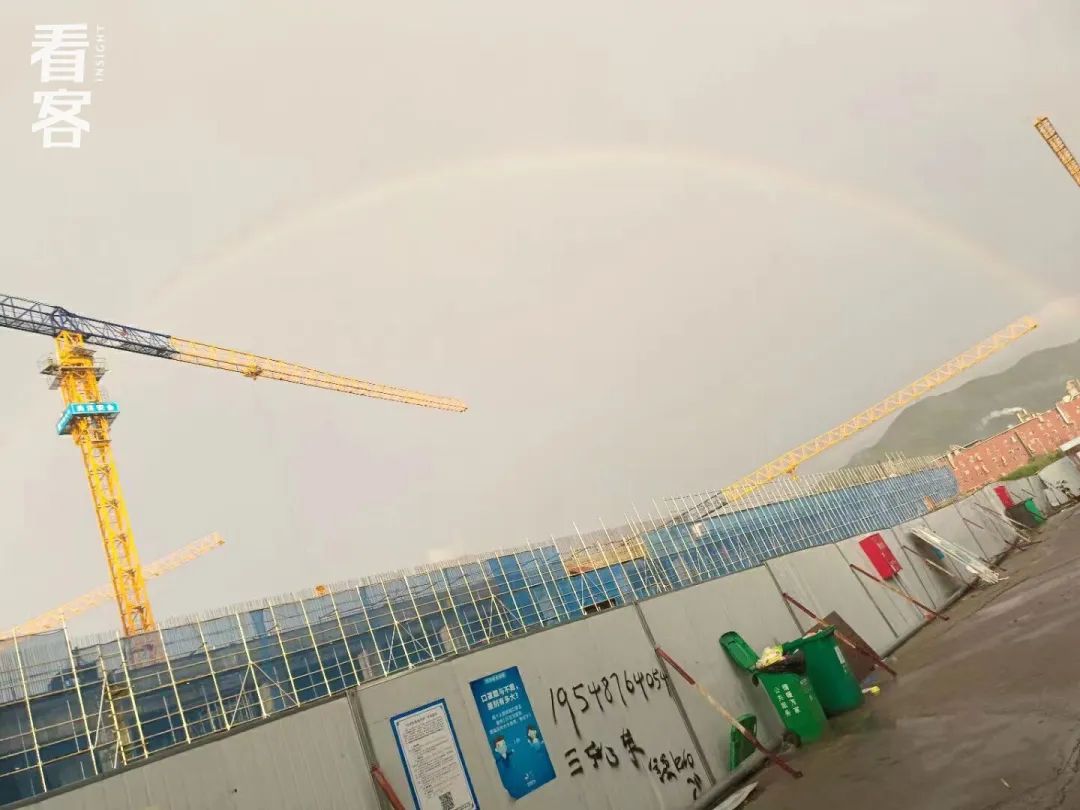
Recently, after finishing work on-site, Yang Yi looked up and saw a rainbow—the first time he’s “been this close to a rainbow”
Earlier this year, he paid 500 yuan tuition to join an online专科 (junior college) self-study group. Teachers uploaded video lectures, asking students to study in free time and check in daily in the group.
He persisted for half a month. Delivering food until 10 p.m., he studied until midnight, often falling asleep amid the teacher’s endless monologue. Eventually, he gave up, realizing he wasn’t someone with “free time.” He no longer remembers whether the unfinished political course was Marxist fundamentals or Maoist principles.
For him, perhaps the best days remain in student times. In high school, a friend lent him a tiny book about Bill Gates. Yang Yi kept it under his pillow, reading dozens of pages each night. On the eve of dropping out for the construction site, roommates joked: “Are you going to become Bill Gates too?”
Back then, he believed the future, like in business books, brimmed with opportunities. After stepping out, he realized a young man without education or skills faces a world full of hardships. Merely surviving is already everything many can manage.
While delivering food in Shanghai, a rider ten years older, hearing about his crypto involvement, sought him out for a talk. The elder had once traded stocks, lost 400,000 yuan, and was still repaying debts. “These things aren’t for us,” he told Yang Yi. “We only know how to throw money in.”
But Yang Yi isn’t someone who easily gives up. When asked if he’d trade crypto again, he hesitated, then said somewhat resignedly: if given the chance, he’d probably still play. On his current desktop, a dedicated folder for crypto apps remains, containing ten exchange and news apps. That tiny flicker of hope—he just can’t let go.
Join TechFlow official community to stay tuned
Telegram:https://t.me/TechFlowDaily
X (Twitter):https://x.com/TechFlowPost
X (Twitter) EN:https://x.com/BlockFlow_News