









Deep Dive into MEV: From Zero-Sum Game to Separation of Three Powers
TechFlow Selected TechFlow Selected
Deep Dive into MEV: From Zero-Sum Game to Separation of Three Powers
MEV is gradually evolving from its initial dark forest zero-sum game toward a checks-and-balances phase with separation of powers, and perhaps moving forward toward full privacy.
 Navigating Web3 tides with focused insights
TL;DR
-
What is MEV: MEV stands for Miner Extractable Value (also known as Maximal Extractable Value), referring to the additional profits miners can gain by manipulating transactions—such as adding, removing, or reordering them. MEV extraction strategies include DEX arbitrage, liquidations, front-running, back-running, and sandwich attacks.
-
Impact of MEV: Front-running and sandwich trades degrade user experience and cause significant losses. However, DEX arbitrage and lending liquidations help DeFi markets reach equilibrium faster and maintain stability.
-
How big is the MEV market: After The Merge on Ethereum, Block Proposers using Flashbots have received over 206,450 ETH in MEV revenue alone.
-
Flashbots: MEV-Geth enabled sharing of MEV profits between Miners and Searchers; MEV-Boost distributes MEV among Proposers, Builders, and Searchers while protecting users from front-running; MEV-Share aims to let users, wallets, and dApps capture MEV generated by their transactions; MEV-SGX leverages SGX trusted hardware to eliminate reliance on trusted MEV-Relays and achieve permissionless operation; SUAVE attempts to solve centralization risks from MEV. As a dedicated chain, it provides transaction ordering and block-building services for all existing chains.
-
Chainlink: As the largest oracle platform in the market, Chainlink seeks to mitigate MEV issues at the oracle network level through fair transaction sequencing.
What is MEV
MEV stands for Miner Extractable Value (also referred to as Maximal Extractable Value), which refers to the extra profit miners can obtain by manipulating transactions—adding, deleting, or reordering them. In typical public blockchains, all transactions are first submitted to the mempool, awaiting inclusion in a block. Miners/validators, responsible for producing blocks in the blockchain ecosystem, have substantial power in deciding which transactions are included and their order within a block.
Initially, miners ordered transactions solely based on gas fees, prioritizing higher-fee transactions. Later, it was discovered that by monitoring the mempool, miners could insert, remove, or reorder transactions to earn profits beyond block rewards—giving rise to MEV.
In practice, specialized searchers use complex algorithms to identify profitable opportunities. Due to competition among searchers scanning the public mempool, when an MEV opportunity is found, they increase their transaction fees to ensure inclusion. Thus, both miners and searchers share MEV profits. Depending on strategy, MEV extraction methods include DEX arbitrage, liquidations, front-running, back-running, sandwich attacks, etc. On blockchains using probabilistic finality consensus mechanisms (like Bitcoin and Ethereum 1.0 with PoW), Fee Sniping attacks may also occur.
-
DEX Arbitrage: Price discrepancies across different DEXs allow risk-free arbitrage via atomic transactions—buying low on one exchange and selling high on another.
-
Lending Liquidations: When collateral ratios fall below preset thresholds in lending protocols, anyone can liquidate the position and repay lenders immediately. Borrowers often pay large penalties during liquidation, part of which goes to the liquidator, creating MEV opportunities.
-
Front-Running: Also called "jumping the queue," this involves detecting a profitable transaction and submitting a similar one with a higher fee so it gets processed first. More broadly, it means inserting a transaction before another to capture profit.
-
Back-Running: On AMM-based DEXs, large trades create significant slippage. After such trades, markets become imbalanced. Back-running involves placing a trade right after to buy assets below fair market value.
-
Sandwich Trading: A combination of front-running and back-running—buying before a large trade pushes prices up, then selling afterward at a higher price for substantial profit.
-
Fee Sniping Attack: The recent surge in BRC-20 activity has congested Bitcoin's network and driven up fees, renewing concerns about Fee Sniping. On PoW blockchains, if potential gains are high enough, miners might roll back or reorganize recent blocks to reorder or include specific transactions for greater profit. Note: Pre-Merge Ethereum also used PoW but referred to such attacks as Time Bandit attacks.
Impact of MEV
MEV harms users and even the entire blockchain network, yet simultaneously enhances market efficiency.
1. Benefits
DEX arbitrage and lending liquidations help DeFi markets reach equilibrium faster and maintain stability. Similar to traditional finance, MEV searchers act as essential participants in efficient financial markets. For these types of MEV, the profits captured come directly from market inefficiencies.
2. Drawbacks
Front-running and sandwich trading lead to poor user experiences and severe losses. Competing MEV searchers drive up gas fees through bidding wars, causing network congestion. On PoW chains with probabilistic finality, Fee Sniping and Time-Bandit attacks violate blockchain immutability, threatening security and stability—raising concerns in the BTC community regarding the impact of Ordinals. On PoS chains like current Ethereum 2.0, MEV may lead to validator centralization. Larger staking pools earn more MEV, reinvesting into better MEV extraction tools, creating a Matthew effect that ultimately reduces decentralization and weakens security.
MEV harms users and the broader blockchain network, yet paradoxically improves market efficiency.
1. Benefits
DEX arbitrage and lending liquidations help DeFi markets reach equilibrium faster and maintain stability. Like traditional finance, MEV searchers underpin effective financial markets. For these forms of MEV, the profits earned originate from market inefficiencies.
2. Drawbacks
Front-running and sandwich trading degrade user experience and cause serious losses. Competitive MEV searchers create gas bidding wars, increasing network congestion and gas fees. On PoW chains with probabilistic finality, Fee Sniping and Time-Bandit attacks break blockchain immutability, undermining network security and stability—prompting concern in the BTC community over the implications of Ordinals. On PoS chains like Ethereum 2.0, MEV may promote validator centralization. Larger staking pools earn more MEV, fueling investment in stronger MEV extraction capabilities, triggering a Matthew effect that eventually leads to reduced decentralization and lower security.
Evolution of MEV
MEV evolves alongside system complexity.
Early萌芽 (2010–2017)
In 2015, Bitcoin core developer Peter Todd introduced the concept of “Replace By Fee (RBF)” on Twitter, a precursor to front-running, allowing users to replace a pending transaction by submitting another with the same input but a higher fee. Building on RBF, the Bitcoin community later explored Fee Sniping—where miners deliberately re-mine prior blocks to reclaim fees originally earned by other miners. Although the probability of successfully re-mining past blocks is low compared to extending the chain forward, it becomes profitable if those earlier blocks contain higher fees than what’s currently in the miner’s mempool. This concept was later extended to EVM-based systems and described in the paper *Flash Boys 2.0* as a “Time Bandit” attack.
Formal Emergence (2018–2019)
MEV arises only when there’s contention over unconfirmed state transitions—something nearly absent in Bitcoin due to its limited shared state and strictly defined state updates. Hence, Bitcoin’s MEV is largely confined to Fee Sniping and double-spend attempts. In contrast, Ethereum’s Turing-complete smart contracts vastly expand MEV opportunities.
In 2016, EtherDelta—the first DEX on Ethereum—launched with an off-chain order book design, offering abundant MEV opportunities, though few exploited it at the time. In 2017, DAI, Ethereum’s first algorithmic stablecoin, launched, introducing liquidation mechanics and sporadic but large-scale MEV events (Spike MEV). In 2018, Hayden Adams founded Uniswap—the first AMM-based DEX on Ethereum. The AMM model inherently relies on MEV extractors to maintain market efficiency, dramatically increasing MEV opportunities. In April 2019, the publication of *Flash Boys 2.0* brought MEV research into mainstream attention. By late 2019, a group of like-minded digital nomads formed Pirate Ship, later renamed Flashbots, adopting a robot emoji as their logo.

Early Flashbots logo ideas
In January 2021, Flashbots Auction (mev-geth and flashbots relay) officially launched, riding the DeFi Summer wave and leading to a sharp rise in extracted MEV.
Current State: MEV Proliferation, Flashbots Dominance
As the MEV market grows, many projects have entered the space. Currently, Flashbots supports only Ethereum Mainnet, so alternative Layer 1 and Layer 2 chains are studying Flashbots’ model to implement MEV auction functionality. Some projects pursue alternative paths, attempting to fully encrypt transaction pools to eliminate MEV. Flashbots itself continues innovating—after Flashbots Alpha in early 2021, it rolled out Flashbots Protect, MEV-Boost, MEV-Share, and is now developing SUAVE. How big is the MEV market? Theoretically, the MEV embedded in user transactions could be infinite. However, since we cannot compute exact MEV values, realized MEV (REV) serves as a lower bound estimate of total potential MEV.
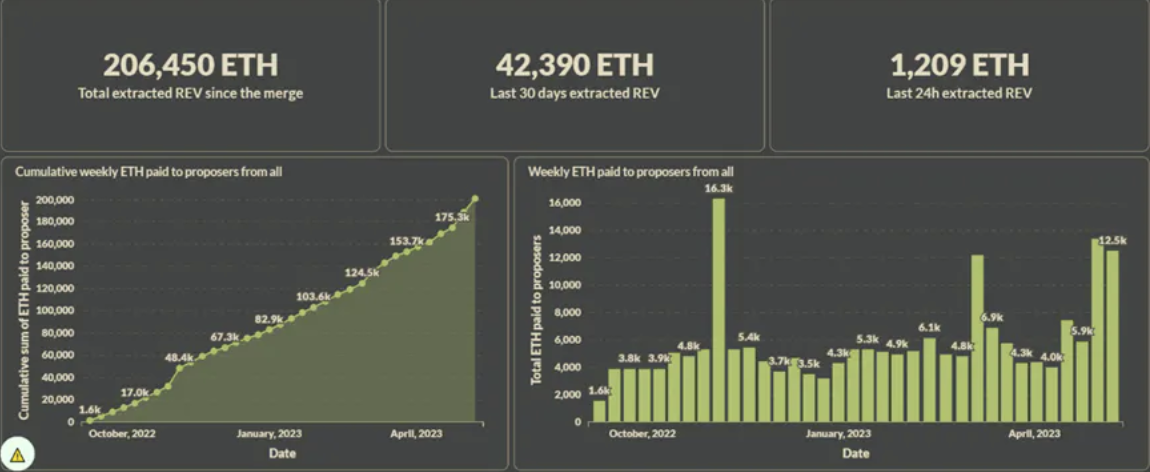
According to data provided by Flashbots, post-The Merge, over 206,450 ETH in REV has been extracted. But this figure only reflects MEV revenue received by Block Proposers—not including Searchers’ earnings.
Would Eliminating Market Competition Improve Things?
Historical experience suggests that the “invisible hand” usually works best. Yet few deny that market economics fail in certain domains, where abuse causes serious harm. The gas price inflation caused by front-running stems from Ethereum’s pricing mechanism. Could fixed gas prices prevent Priority Gas Auctions among searchers? But this would likely shift collusion off-chain—searchers with MEV opportunities bribing miners to prioritize their transactions, fostering small-scale private markets contrary to Ethereum’s open, permissionless ethos. Alternatively, we could require miners/validators to pass centralized certification to ensure honest behavior—but this introduces strong trust assumptions, effectively turning Ethereum into a permissioned chain. In short, preserving Ethereum’s current characteristics makes completely eliminating MEV extremely difficult.
Mitigating the Negative Impacts of MEV
Protocol-Level PBS – Ethereum Community’s Solution
Under PoS, validators take turns acting as block proposers and reach consensus on whether to accept a proposed block. Under PoW, miners perform both block production and consensus, functionally equivalent. PBS (Proposer-Builder Separation) primarily addresses validator centralization caused by MEV. In the default MEV workflow, block producers have two tasks: (1) constructing optimal blocks from available transactions (block building), and (2) proposing the block along with proof-of-stake/stake to the network (block proposing). Before MEV became prominent, step (1) simply involved sorting transactions by fee. As MEV profits grow, larger mining/validation pools capture disproportionate MEV revenue, reinforcing centralization. Moreover, actual block producers in decentralized pools benefit from MEV opportunities while others don’t, creating unfairness that discourages participation in decentralized pools—further increasing centralization. Roles potentially involved in MEV include:
-
Producer: Block producer (Miners, Validators)
-
Proposer: Block selector (chooses highest-MEV block built by a Builder)
-
Builder: Block constructor (decides block content)
-
Searcher: Identifies MEV opportunities in transactions
-
User: Submits transactions containing potential MEV. In practice, many roles are combined—for example, in standard Ethereum consensus, Producer, Proposer, and Builder are the same entity.
Vitalik’s Early Proposals
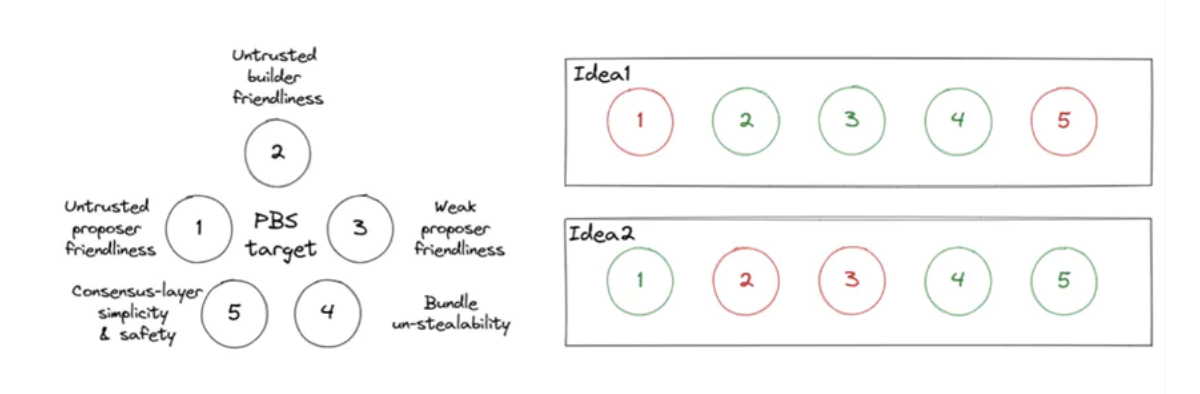
As early as 2021, Vitalik proposed two solutions with different emphases. Importantly, these are protocol-level changes enforced by Ethereum, unlike Flashbots’ off-protocol coordination. PBS aims to achieve five goals:
-
No need to trust proposer honesty: builders don’t need to trust proposers
-
No need to trust builder honesty: proposers don’t need to trust builders
-
Low proposer requirements: proposers shouldn’t need high computational resources or technical expertise
-
Bundle non-expropriation: proposers cannot steal profits from builders’ submitted blocks
-
Consensus simplicity and security: maintain consensus security without modifying current block proposal mechanisms
Proposal 1
-
Builders create bundles and send bundle headers to proposers, containing the hash of the full bundle body, payment to the proposer, and the builder’s signature
-
The proposer selects the highest-paying bundle header, signs it, and broadcasts a proposal containing that header
-
After seeing the signed proposal, the builder releases the full bundle
Analysis against the five goals:
-
The proposer could collect payment but delay publishing the proposal until the last moment, preventing the builder from releasing the full bundle—violating Goal 1
-
The builder pays upon submission of the header, so the proposer doesn’t need to trust the builder—satisfies Goal 2
-
Only basic networking and signing required—satisfies Goal 3
-
The proposer sees only the header, not the full content—cannot expropriate—satisfies Goal 4
-
Introduces new role (builder), requiring fork rule modifications and increasing fork choice complexity—potentially compromising security—fails Goal 5
Proposal 2
-
Builders create bundles and send headers to proposers, including the hash of the bundle body, payment to the proposer, and builder’s signature
-
The proposer collects received headers into a list and signs a commitment to that list
-
After seeing the signed commitment, builders release their corresponding bundle bodies
-
The proposer selects one header from the committed list and publishes a proposal containing it
Analysis against the five goals:
-
Payment occurs only if the full bundle is included—satisfies Goal 1
-
A builder could submit multiple high-payment headers but never release the body, making valid proposals impossible—fails Goal 2
-
If no limit on bundle count, proposers may face excessive bandwidth load—fails Goal 3
-
The proposer’s prior commitment restricts them to selecting from the announced list—cannot steal—satisfies Goal 4
-
Builders don’t participate in consensus; proposer behavior unchanged—no added fork scenarios—satisfies Goal 5
Two Evolving Paths – Two Slot PBS vs Single Slot PBS
These two approaches refine Vitalik’s initial proposals: Two Slot PBS corresponds to Proposal 1, and Single Slot PBS to Proposal 2.
In Two Slot PBS, a new block type called “Intermediate Block” will be introduced to store the winning builder’s content. At slot n, the Proposer submits a regular Beacon Block containing a commitment to the winning builder’s content. Then, at slot n+1, the winning Builder submits an Intermediate Block containing the actual block content. These two together form a complete block split across two slots—first the header-like Beacon Block, then the body-like Intermediate Block. Without a Beacon Block, no Intermediate Block follows.
Both blocks require attestation votes from committees. The Beacon Block is voted on by one committee, while the Intermediate Block is voted on by remaining committees in the slot. Votes for each block appear in the next slot’s block.
If a builder never sees the Beacon Block, it may mean the block wasn’t published timely, so the builder won’t release the Intermediate Block. To protect builders from delayed Beacon Blocks, well-defined fork choice rules reject late arrivals.
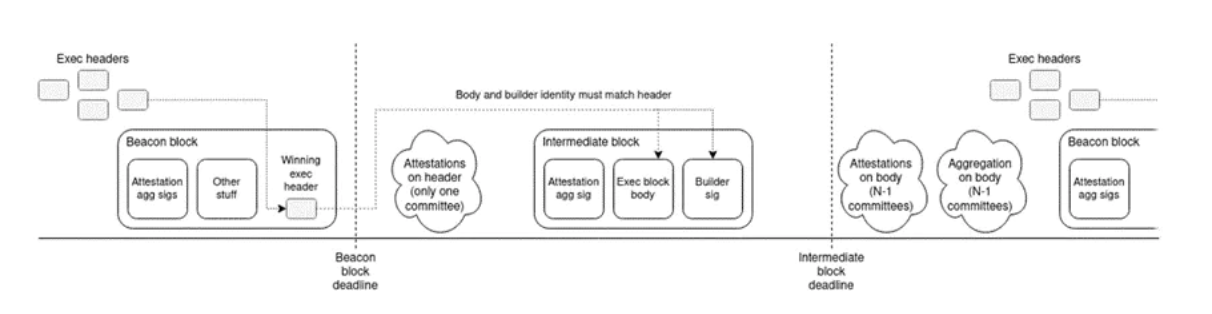
Design of Two Slot PBS
Single Slot PBS uses a decentralized committee as intermediary to hold block content. Builders send bundle headers to an auction subnet and encrypted bundle bodies to the committee. Once committee votes exceed threshold, the proposer sends a proposal. Upon receipt, the committee decrypts and broadcasts the bundle body—completing PBS within a single slot.
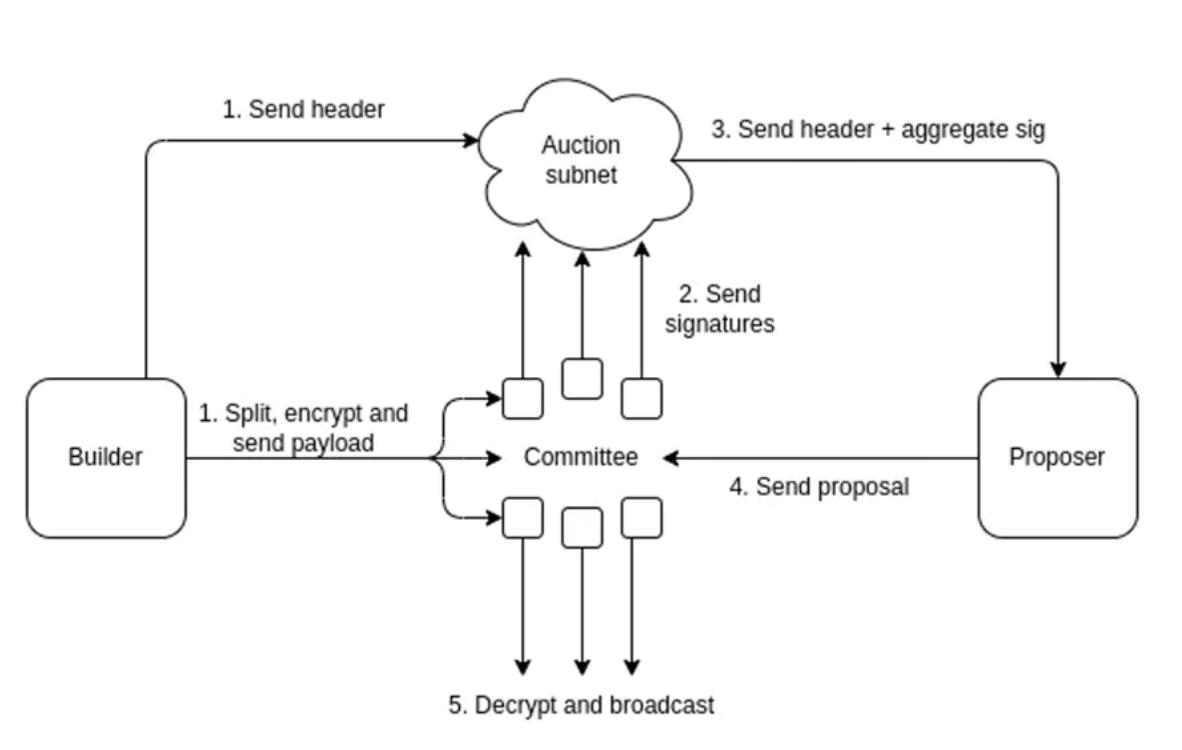
Design of Single Slot PBS
Why Ethereum Needs Protocol-Level PBS—It’s Not Just About MEV
Implementing PBS at the Ethereum protocol layer could destabilize consensus foundations and introduce new problems. Why modify the protocol instead of solving it above-protocol? The truth is, Ethereum’s motivation extends beyond MEV—PBS holds strategic importance for Ethereum’s long-term evolution.
With PBS, proposers no longer handle transaction ordering—they become stateless, needing only Merkle proofs to verify block validity rather than storing full Ethereum state. As Danksharding progresses, storage burdens will grow. Statelessness is crucial—it lowers proposer hardware requirements, enabling broader participation and enhancing decentralization.
Ethereum’s push for PBS mirrors the rationale behind EIP-1559. Miners/validators wield immense power in determining block contents. If they accumulate excessive profits, centralization intensifies, threatening overall network security. PBS aims to reduce their influence and redistribute power more equitably.
Additionally, Flashbots’ MEV-Boost implementation introduces trusted relays, raising censorship risks—a direct threat to Ethereum’s anti-censorship, permissionless ideals.
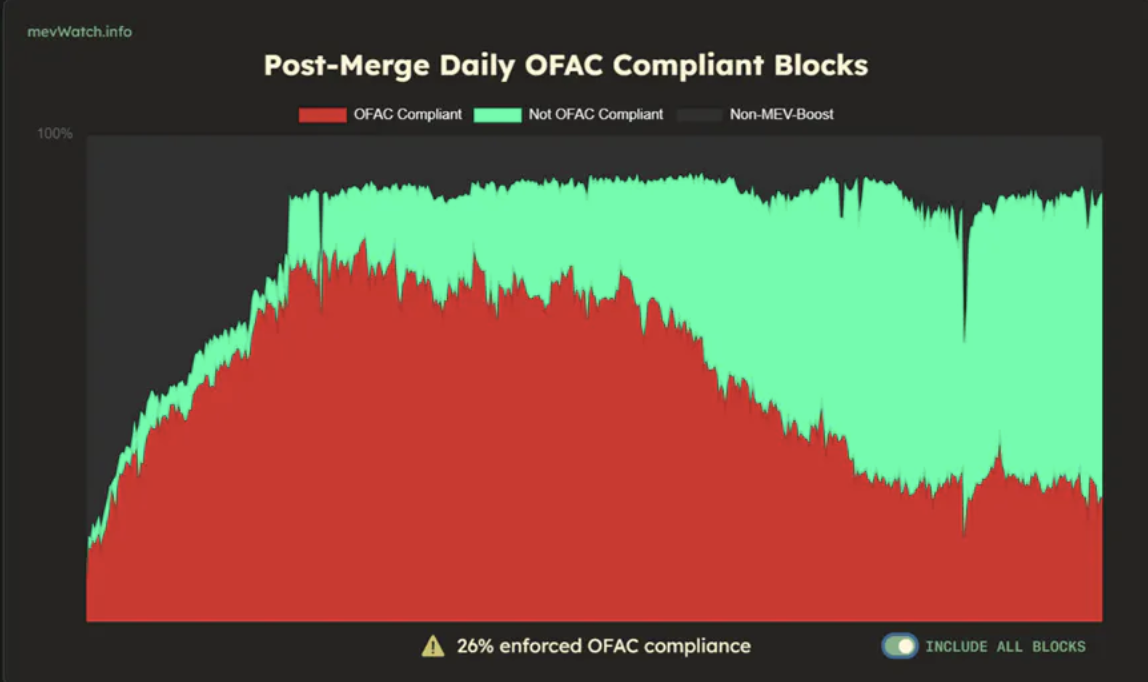
Censorship can affect up to 80% of transactions
Protocol-level PBS eliminates reliance on trusted relays. Proposers can enforce inclusion of censored transactions—or include them directly—enhancing Ethereum’s censorship resistance.
Summary: Ethereum’s protocol-level PBS redistributes incentives between builders and proposers, lowers proposer barriers, increases decentralization, and strengthens censorship resistance—though it does little to improve ordinary user experience.
Flashbots – Absolute Leader in the MEV Space
Flashbots uses market auctions to mitigate MEV issues and generate returns for participants. According to Flashbots’ official documentation, developments are categorized as: 1) Flashbots Auction, 2) Flashbots Data, 3) Flashbots Protect, 4) Flashbots MEV-Boost, 5) Flashbots MEV-Share. However, MEV-Boost is actually a phase within Flashbots Auction. Here, I’ll present Flashbots’ evolution chronologically.
Flashbots Auction consists of two phases: MEV-Geth for Ethereum 1.0 (pre-Merge) and MEV-Boost for Ethereum 2.0 (post-Merge).
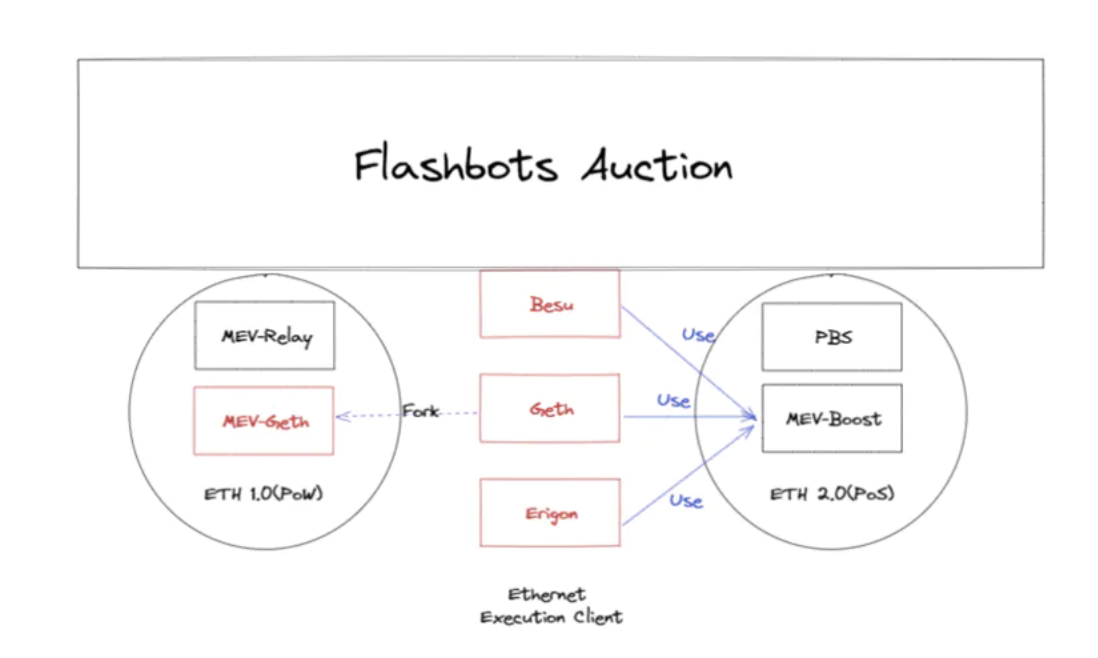
MEV-Geth
In early 2021, Flashbots launched MEV-Geth and MEV-Relay. MEV-Geth is a patch to the Go-Ethereum client, only about a hundred lines of code; MEV-Relay acts as a bundle forwarder between Searchers and Miners. Together, they offer a private transaction pool and sealed-bid block space auction, transforming MEV from a dark forest into a market economy. Bundles represent a new transaction type expressing order preferences. Flashbots Auction introduced a new RPC method, “eth_sendBundle,” standardizing bundle communication. A bundle includes a series of signed transactions and conditions for inclusion.
Flashbots also offers the Flashbots Protect RPC endpoint, allowing users to route transactions through it by simply changing their wallet’s RPC settings, shielding them from front-running in public mempools. Additionally, because Flashbots Protect uses an alternative block production path, reverted transactions do not occur—users aren’t charged for failed transactions. (However, this creates exclusive order flow—EOF.)
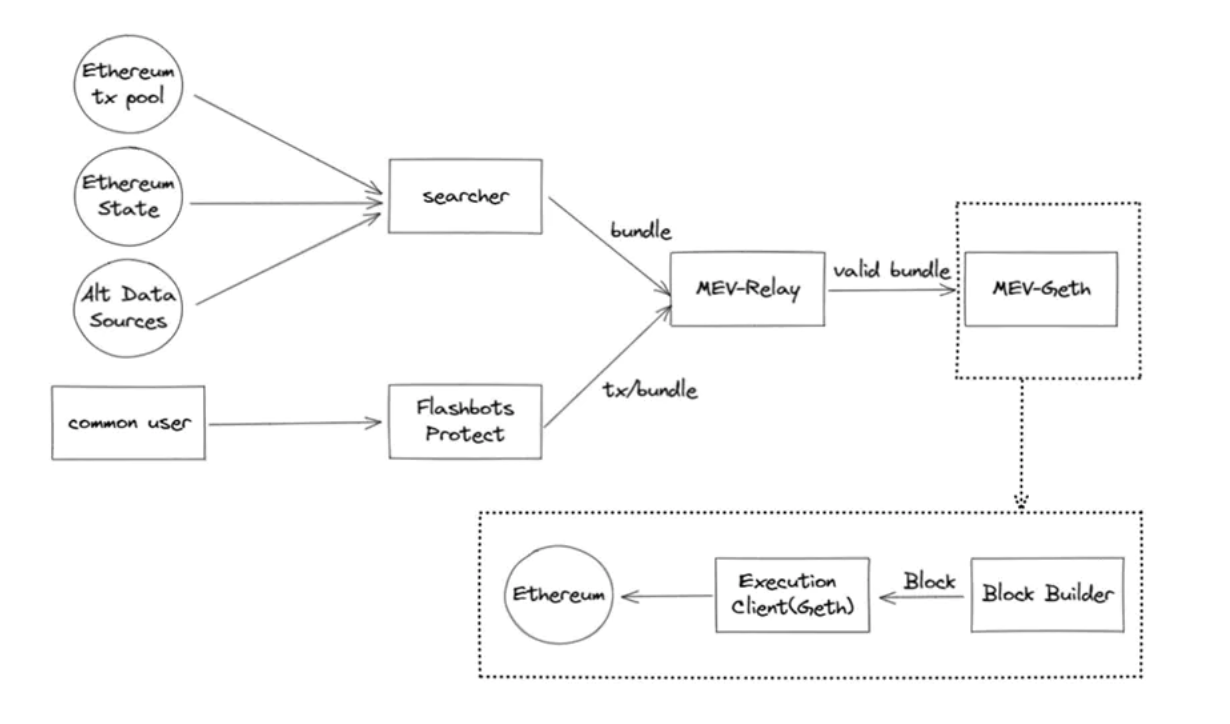
MEV-Geth quickly gained adoption by over 90% of Ethereum miners, significantly boosting their revenues. However, its simple auction design has notable flaws: 1) requires trusting miners, 2) only compatible with Geth, lacking diversity, 3) runs on centralized servers, posing single points of failure. Furthermore, intense competition among searchers funnels most profits to miners, increasing centralization risks for Ethereum.

MEV-Boost
After The Merge transitioned Ethereum to PoS, MEV-induced centralization became more pronounced. Flashbots designed MEV-Boost to address this. MEV-Boost resembles a variant of Single Slot PBS. Unlike protocol-enforced PBS, it operates as an optional middleware without altering consensus rules. Relays no longer mediate between Users/Searchers and Miners, but between Builders and Validators. Based on transaction flows from Users/Searchers, each party—Builder, Relay, Validator—selects downstream blocks to maximize profit.
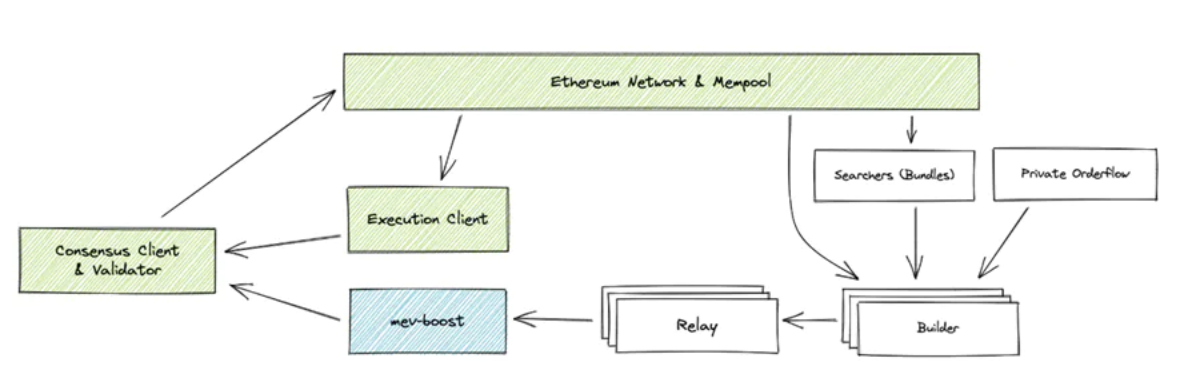
MEV-Boost adopts the commit-reveal scheme from Single Slot PBS: only after a Validator commits to a block header does the Builder reveal the full content. The detailed process is shown below: Before proposing, Validators must register with MEV-Boost and relays so block builders know which validator to build for.
-
Users/Searchers submit transactions to block builders via public/private mempools
-
Block builders construct execution payloads from incoming transactions. For revenue distribution, the builder sets their address as the payload’s coinbase and includes a final transfer to the proposer’s address. The block is sent to the relay
-
The relay validates the block’s validity and sends the ExecutionPayloadHeader to MEV-Boost. MEV-Boost selects the highest-profit header from various relays and forwards it to the Validator
-
The Validator signs the header, calls submitBlindedBlock, and returns it to MEV-Boost, which forwards it to the relay. The relay verifies the signature, then sends the full payload body to MEV-Boost and consensus layer, enabling the Validator to propose the SignedBeaconBlock to the network.
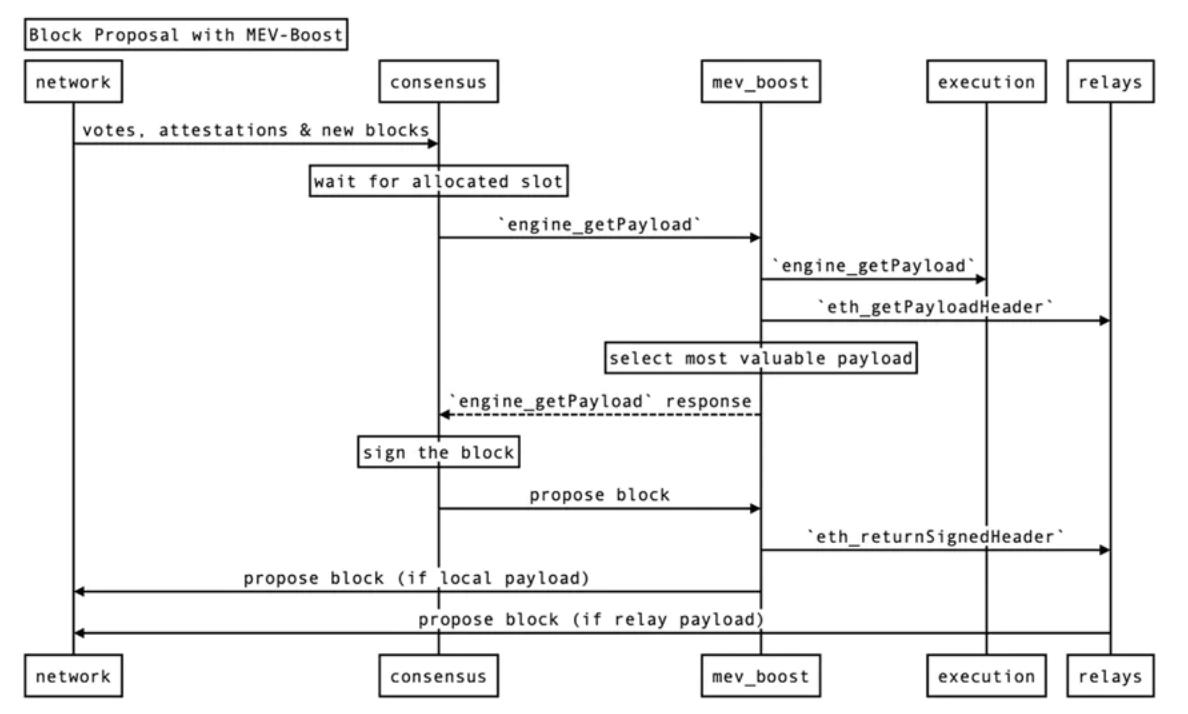
Compared to MEV-Geth, MEV-Boost is more versatile—operating as a plugin for Consensus Clients, supporting multiple clients—and mitigates previous miner centralization. However, post-PBS, Builders gain greater power. Dominant Builders in the market can censor transactions or monopolize order flow. Currently, competition among Builders is the main defense against centralization. Trust in Relays is further reduced, though they can still pose risks via fake bids to Builders and Proposers. Current mitigation involves monitoring relay honesty and letting Validators and Builders freely choose relays.
MEV-Share
MEV-Geth enabled MEV profit sharing between Miners and Searchers; MEV-Boost distributed MEV among Proposers, Builders, and Searchers while protecting users from front-running. Yet neither addressed user compensation. In Web3 philosophy, users who generate data should benefit from its value. MEV-Share embodies this principle—aiming to let users, wallets, and dApps capture MEV generated by their transactions.
MEV-Share introduces a Matchmaker role—an intermediary between Users, Searchers, and Builders—that protects user privacy by limiting how much transaction data is exposed to Searchers. It also restricts Searchers to inserting transactions only after user transactions (back-running), avoiding harm to users. Back-running doesn’t hurt users—its profits stem from temporary market imbalances.

Users can easily connect their wallets to the Flashbots Protect RPC to send transactions to the Matchmaker, or use the Matchmaker API to send private transactions, optionally specifying preferred Builders.
For Searchers, they listen via SSE Event Streams for partial transaction data selectively broadcast by the Matchmaker. SSE allows servers to push real-time updates to clients without polling, enabling Searchers to react instantly to blockchain state changes. They select transactions and append their own signed transaction to create a bundle.
Searchers may share partial information about their bundle with other Searchers to increase inclusion chances and earn shared MEV rewards. They can also specify preferred Builders in the bundle’s privacy field, ensuring delivery to mutually agreed-upon Builders.
SGX Encryption – Trusted Hardware to Eliminate Trust Assumptions
Exploration of SGX for mitigating MEV began with Flashbots.
The MEV-SGX proposal was systematically outlined on the Ethereum forum in June 2021, addressing trust issues in the initial Flashbots Alpha (early version of Flashbots MEV-Auction), aiming to build a fully private, permissionless MEV auction. The paper discussed options: 1) sending only block headers, hiding transaction tries; 2) bonded headers; 3) time-lock encryption; 4) secure enclaves—with Intel’s SGX being the most widely adopted solution for full privacy and permissionless access.
In the MEV-SGX design, SGX serves as a Trusted Execution Environment (TEE), replacing the single-trust-relay model of MEV-Relay. Both Searchers and Miners run code inside SGX instances. SGX’s tamper-proof nature ensures each party executes code in a secure, isolated environment. The searcher’s SGX verifies block validity and profitability for the proposer (proposers don’t need to trust builders); the miner’s SGX handles decryption and broadcasting of block content (builders don’t need to trust proposers, and proposers can’t steal profits).
Note: At the time, Ethereum was still PoW, hence the term “miner” rather than “validator”—but their consensus role (packaging and proposing blocks) is functionally identical.
After The Merge transitioned Ethereum to PoS, the prominence of MEV-SGX as a holistic solution declined, replaced by MEV-Boost and MEV-Share. However, SGX hasn’t been abandoned—due to high implementation difficulty, the community opted for the more practical MEV-Boost and MEV-Share, planning to integrate SGX later to fix shortcomings.
On December 20, 2022, the Flashbots community announced the first successful run of Geth inside SGX, proving technical feasibility. On March 3, 2023, they announced running a block builder inside SGX, advancing toward private transactions and decentralized builders.
Executing block-building logic inside secure enclaves ensures no participant except the user can see transaction content, preserving privacy. Running verifiable execution algorithms enables proof of economic efficiency without sacrificing privacy. Long-term, running builders in SGX could provide proposers with provably valid blocks and truthful bids, potentially eliminating trusted MEV-Relays entirely and achieving permissionless operation.
SUAVE – The Future of MEV
MEV-Share addresses MEV profit distribution but fails to eliminate centralization risks from block-building power. In Flashbots’ current setup, exclusive order flow and cross-domain MEV give Builder markets a positive feedback loop, increasing centralization risks.
SUAVE (Single Unified Auction for Value Expression) aims to solve MEV-driven centralization. Another modular blockchain experiment, SUAVE seeks to provide a plug-and-play mempool and decentralized block builder for all blockchains—as a dedicated chain offering transaction ordering and block-building services to all existing chains.

Multi-chain support greatly improves cross-domain MEV extraction efficiency; as a blockchain, its decentralized nature resolves past centralization risks in block builders.
SUAVE consists
Join TechFlow official community to stay tuned
Telegram:https://t.me/TechFlowDaily
X (Twitter):https://x.com/TechFlowPost
X (Twitter) EN:https://x.com/BlockFlow_News
 @CynicSong






