








Web3 Wallet "iPhone Moment"! A Complete Guide to OKX's AA Smart Contract Wallet
TechFlow Selected TechFlow Selected
Web3 Wallet "iPhone Moment"! A Complete Guide to OKX's AA Smart Contract Wallet
OKX announces the launch of its AA smart contract wallet, potentially revolutionizing the blockchain industry and lowering the barrier for internet users to enter Web3.
 Navigating Web3 tides with focused insights
Preface
"This article aims to help new users understand and start using Web3 wallets in the most accessible way possible, enabling them to join the new wave early."
Currently, there are nearly 5 billion Web2 users globally, while Web3 users number only around 400 million—making Web3 still a niche industry. As gateway applications, the widespread adoption of Web3 wallets is key to achieving mass-scale application of Web3.
On August 2, OKX announced the launch of its AA smart contract wallet—the first in the industry—which could permanently transform the blockchain landscape by lowering the barrier for internet users entering Web3.
Ethereum co-founder Vitalik Buterin has repeatedly emphasized that smart contract wallets represent the future of Web3 wallets. In his summary speech at EthCC, Buterin stressed that account abstraction (AA) will make crypto wallets as simple as email in the future. On Ethereum's roadmap for Ethereum 2.0, account abstraction is positioned alongside The Merge and sharding, underscoring its critical importance within the Ethereum ecosystem.
Getting Started with Web3 Wallets
Setting aside all Web3 jargon, a Web3 wallet is essentially no different from WeChat or Alipay—a payment tool. With this basic analogy, understanding Web3 wallets becomes much easier. Web3 wallets are primarily used to receive, store, manage, and transfer digital assets, as well as explore DApps.
When we reintroduce concepts like decentralization, the biggest difference between Web3 wallets and traditional payment tools becomes clear: Web3 wallets allow users to hold their own private keys and fully control their assets, eliminating reliance on third-party intermediaries such as banks and financial institutions. This means your assets remain secure in your Web3 wallet even during black swan events like the Silicon Valley Bank collapse—or even in apocalyptic scenarios—as long as you possess the private key.
Each Web3 wallet corresponds to one unique private key that cannot be changed. The private key is a 64-character hexadecimal string composed of letters and numbers. To make it easier for users to remember and record, it is typically converted into a 12-word mnemonic phrase. Therefore, the private key is paramount—whoever controls the private key controls the assets. Based on who holds the private key, three types of wallets have emerged: custodial wallets, hybrid-custody wallets, and non-custodial wallets—where private keys are held solely by the user, shared between user and custodian, respectively. Mainstream wallets like MetaMask and the OKX Web3 Wallet fall into the non-custodial (or self-custodial) category.
Although non-custodial wallets return asset control to users, they face significant pain points such as difficulty remembering and securely storing mnemonics, limited options for paying gas fees, and complex operational procedures—all of which present major barriers for new users. To address these issues, wallets like the OKX Web3 Wallet continuously explore new technologies and methods, accelerating product iteration to build leading, user-friendly, and secure digital wallets. The introduction of the OKX AA smart contract wallet ensures asset security while offering enhanced customizable and extensible features such as batch transactions, gas fee sponsorship, and private key recovery. It frees users from the burden of managing mnemonics/private keys, enhances security, simplifies on-chain interactions, and enables automated gas subsidies—dramatically lowering the barrier to using Web3 wallets. This could mark the "iPhone moment" for Web3 wallets, paving the way for mass adoption and unlocking vast potential.
Although non-custodial wallets return asset control to users, they face significant pain points such as difficulty remembering and securely storing mnemonics, limited options for paying gas fees, and complex operational procedures—all of which present major barriers for new users. To address these issues, wallets like the OKX Web3 Wallet continuously explore new technologies and methods, accelerating product iteration to build leading, user-friendly, and secure digital wallets. The introduction of the OKX AA smart contract wallet ensures asset security while offering enhanced customizable and extensible features such as batch transactions, gas fee sponsorship, and private key recovery. It frees users from the burden of managing mnemonics/private keys, enhances security, simplifies on-chain interactions, and enables automated gas subsidies—dramatically lowering the barrier to using Web3 wallets. This could mark the "iPhone moment" for Web3 wallets, paving the way for mass adoption and unlocking vast potential.
Opportunity
Why did OKX launch an AA smart contract wallet?
"AA" stands for Account Abstraction, so AA smart contract wallets are also known as smart accounts or account-abstraction wallets.
To understand account abstraction, we can break it down into two parts—"account" and "abstraction"—and first examine some background about Ethereum accounts.
Today, almost everyone has an account on a financial platform. Like bank cards, Alipay, or WeChat, Ethereum accounts display a visible balance. But what makes Ethereum accounts special?
Unlike Bitcoin, Ethereum accounts support not only simple token transfers but also complex smart contracts. Therefore, Ethereum has two types of accounts: Externally Owned Accounts (EOAs) and Contract Accounts (CAs). All existing wallets are built upon these two account types. The diagram below illustrates their differences directly.
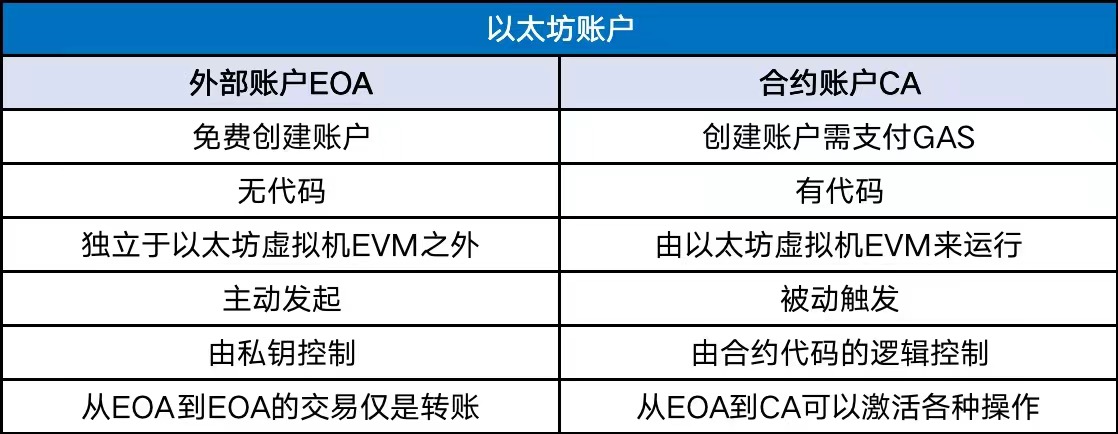
How do Ethereum accounts work? For example, suppose Xiao Ming creates EOA account A, and Xiao Li creates EOA account B. Now Xiao Ming wants to buy an apple worth 1 ETH from Xiao Li. Can he simply transfer funds from account A to account B? No—he must use CA account C.
Why? What if Xiao Li refuses to pay after receiving the apple, or Xiao Ming refuses to pay after delivery? A solution would be deploying a smart contract to create CA account C. Both account A and account B deposit 2 ETH into account C. After Xiao Li ships the apple, account C is triggered: sending 1 ETH back to account A and 3 ETH to account B.
The above explains the basics of Ethereum accounts. Next, let’s discuss "abstraction." To help explain account abstraction simply, consider this analogy: In summer, we don’t need to understand how an air conditioner works internally—we just use a remote to adjust temperature and fan speed. The remote "abstracts" the internal operations to a surface level. With this concept, understanding "abstraction" in accounts becomes easier.
Currently, EOAs serve as wallets, while CAs handle smart contract logic—each with pros and cons.
Unlike traditional bank accounts, EOA accounts combine "ownership" and "signing rights" under a single private key, leading to various problems. Why? "Ownership" refers to who owns the account, while "signing rights" refer to who can operate it. In traditional banking, even if a thief steals your password ("signing rights") or you lose it, others still cannot withdraw your assets ("ownership"). However, in Ethereum EOA accounts, holding the private key grants full control over all assets. Thus, current EOA accounts suffer from difficult private key storage, high signing privileges, and irreversible loss of assets if the key is lost—imagine having money in your wallet but being unable to retrieve it because you lost the private key. Almost no one could bear such a scenario. Additionally, EOAs lack programmability and require ETH as gas fees for any operation—more significant drawbacks.
CA accounts also have issues. Although they allow custom logic and expanded functionality, they cannot initiate transactions independently—they must be called by an EOA. Moreover, being deployed on-chain requires additional gas and waiting time.

Clearly, neither account type currently resolves the complexity of wallet user experience—both are high-barrier and insecure. Therefore, the AA smart account "abstracts" the complex underlying logic of CAs and EOAs, merging the two Ethereum account types into one. This unified account supports both cryptocurrency transactions and smart contracts, combining the programmability of CAs with independence from EOA-initiated transactions. It separates "ownership" from "signing rights," integrating the best features of both—enabling multi-sig, batch transactions, gas sponsorship, social recovery, and more, without needing to distinguish account types.
In other words, the wallet becomes the contract, allowing AA smart contract wallets to expand into diverse functionalities.
Account abstraction development relies heavily on Ethereum's broader ecosystem. It was proposed shortly after Ethereum launched but was shelved due to immature or impractical solutions. Multiple iterations—from early EIP-101 to EIP-3074—have occurred. The foundation for practical implementation came with ERC-4337, which enables wallet flexibility and upgradability—including multisig and social recovery—without modifying the base protocol, along with more efficient and streamlined signature algorithms.

Image: ERC-4337 official account shares and likes OKX AA Smart Contract Wallet
EIPs (Ethereum Improvement Proposals) are public channels for proposing and discussing improvements to Ethereum, enabling close community collaboration to enhance efficiency. Every Ethereum upgrade stems from an EIP. Anyone can submit an EIP, but it undergoes rigorous review involving discussion, feedback, and revision phases. ERCs are formal standards—for example, well-known ones like ERC-20, ERC-721, and ERC-1155. Vitalik Buterin stated that implementing ERC-4337 will “open the doors of creativity for wallet design,” reshaping how Ethereum wallets are built. If successfully implemented, it could be the key to realizing the dreams of “account abstraction” and “social recovery.”
Notably, Layer 2 blockchains like StarkNet and zkSync Era natively support abstracted accounts at the protocol layer, meaning they can build abstracted accounts without relying on the 4337 standard—wallets like Argent and Braavos already do this.
In short, account abstraction excels in signature algorithms, feature implementation, and user experience, making it a “must-have” for achieving mass adoption of Web3 wallets—something worth anticipating. Against this backdrop, OKX took the lead in researching and launching its AA smart contract wallet. Given that AA smart contract wallets involve extensive smart contracts and demand rigorous stress testing—with no unified security standards—the effort required behind the scenes is immense, though we won't elaborate here.
Use Cases
After covering theory and background, let’s now explore real-world use cases of the OKX AA smart contract wallet to illustrate its innovations and novel user experiences.
Stablecoin Gas Payments. When using ordinary Web3 wallets, transactions require native chain tokens (e.g., ETH) as gas fees. Without ETH, users cannot transact. The OKX AA smart contract wallet now supports stablecoins like USDT/USDC for gas payments—in addition to ETH—and plans to extend support to other ERC-20 tokens. This removes dependency on mainnet tokens, making usage more friendly and convenient.
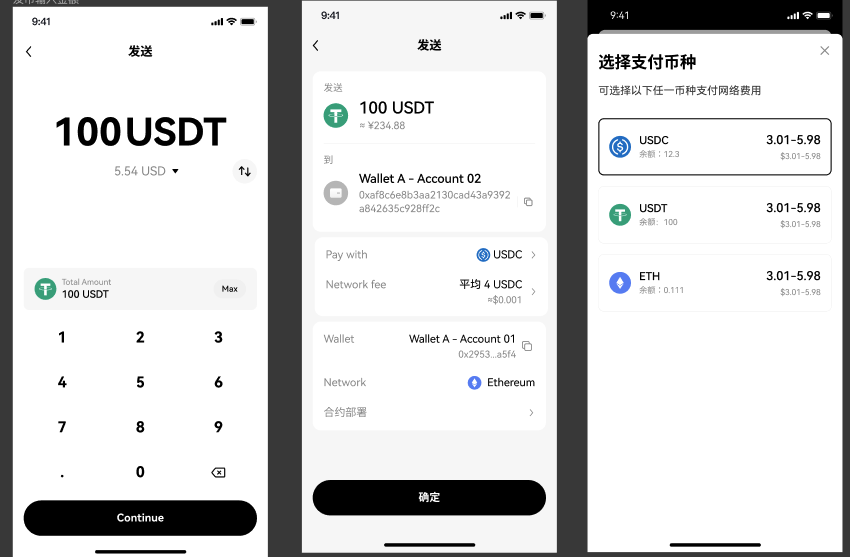
Multi-chain Support. Users can now create AA smart contract wallets on seven major blockchains via OKX: Ethereum, OKTC, Arbitrum, Polygon, Optimism, BNB Chain, and Avalanche.
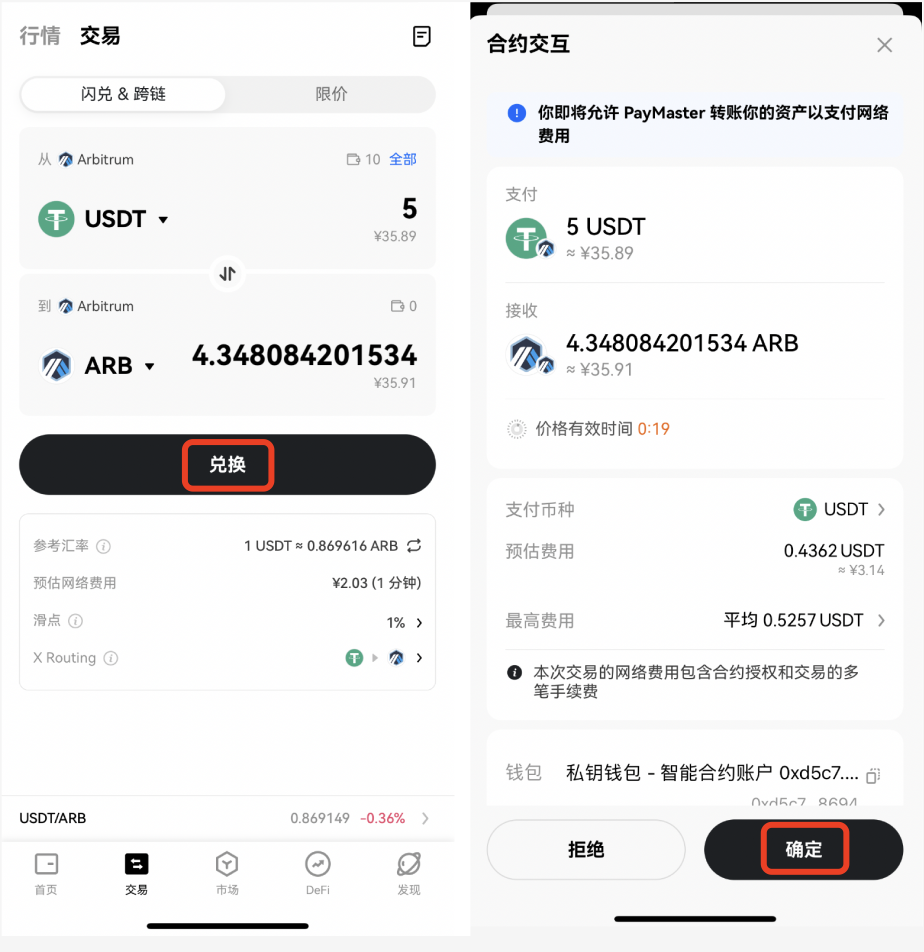
One-click DEX Swaps. The OKX AA smart contract wallet consolidates multiple steps previously required by regular accounts into a single action. For instance, it combines DEX "Approve" and "Swap" into one calldata call, enabling true one-click trading on decentralized exchanges (DEXs).
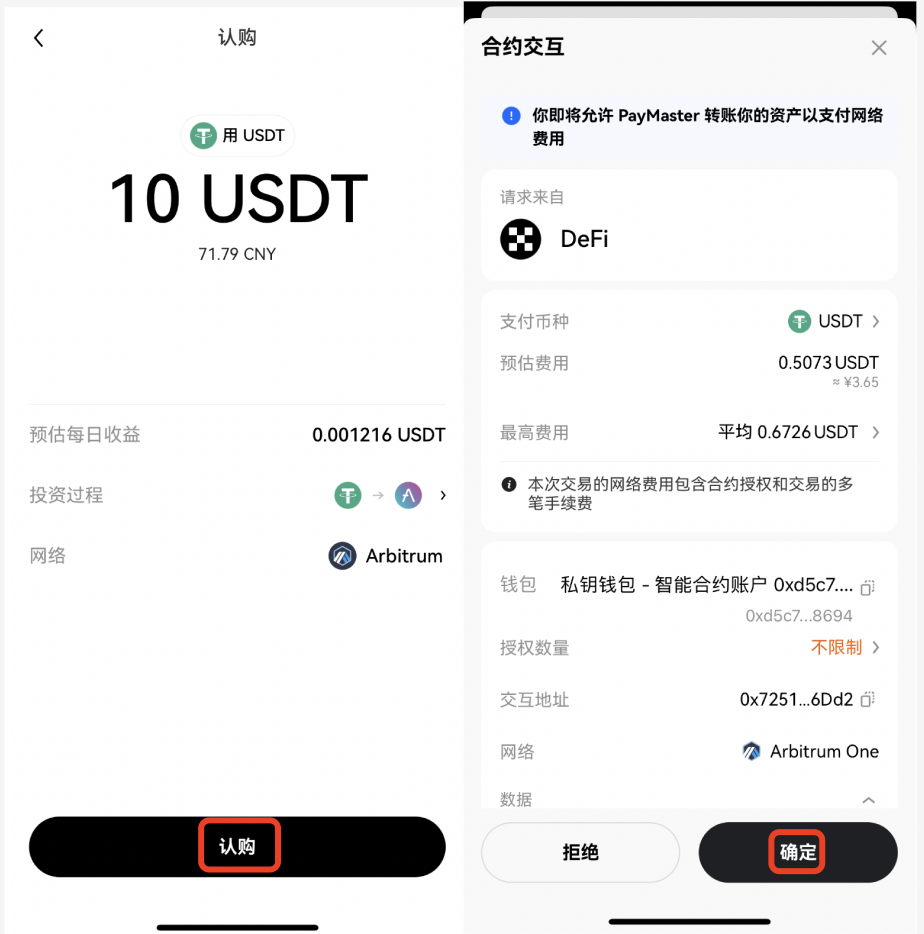
One-click DeFi Mining. Similar to the DEX one-click swap, AA smart contract accounts can bundle investment actions—such as yield farming or portfolio rebalancing—into a single click, greatly improving efficiency.
Beyond these initial flagship features, OKX AA smart contract wallet also runs a gas subsidy campaign—users enjoy one seamless gas rebate per day during transfers or trades, up to 5 USDT. Future updates will include social recovery, wallet mini-program components,亲友 gas sponsorship, multi-sig copy-trading, composable operations, and advanced on-chain wealth management strategies.
Imagine once social recovery launches—we’ll leave behind the era where losing your mnemonic means losing your account. Users won’t need to write down 12 words or private keys anymore. Even if mnemonics are lost, assets remain safe, and account access can be restored through multi-factor verification—delivering a smooth, Web2-like experience. Once automated execution rolls out, transactions will trigger automatically when preset conditions are met—similar to Alipay’s password-free payments. In future blockchain gaming, Web3 social apps, or high-frequency on-chain trading, automatic authorization and signing will dramatically improve usability.
However, account-abstraction wallets aren't "perfect" and still face areas needing improvement. For example, since all logic runs on-chain, gas costs increase; dependence on smart contracts introduces compatibility issues across chains; and potential contract vulnerabilities may rise.
Setup
How to Create an OKX AA Smart Contract Wallet?
Users can add an AA smart contract account to their existing wallet through OKX Web3 Wallet’s available wallet types: mnemonic-based, private-key, keyless, or hardware wallets. Each AA smart contract account is generated from a standard account, used to control on-chain behavior and enable account recovery.
For first-time wallet users, OKX Web3 Wallet offers two creation methods: keyless wallet or mnemonic-based wallet. Existing wallet users can import via four methods: restoring a keyless wallet, cloud restore (iCloud, Google Drive, Huawei Cloud), mnemonic phrase, or private key.
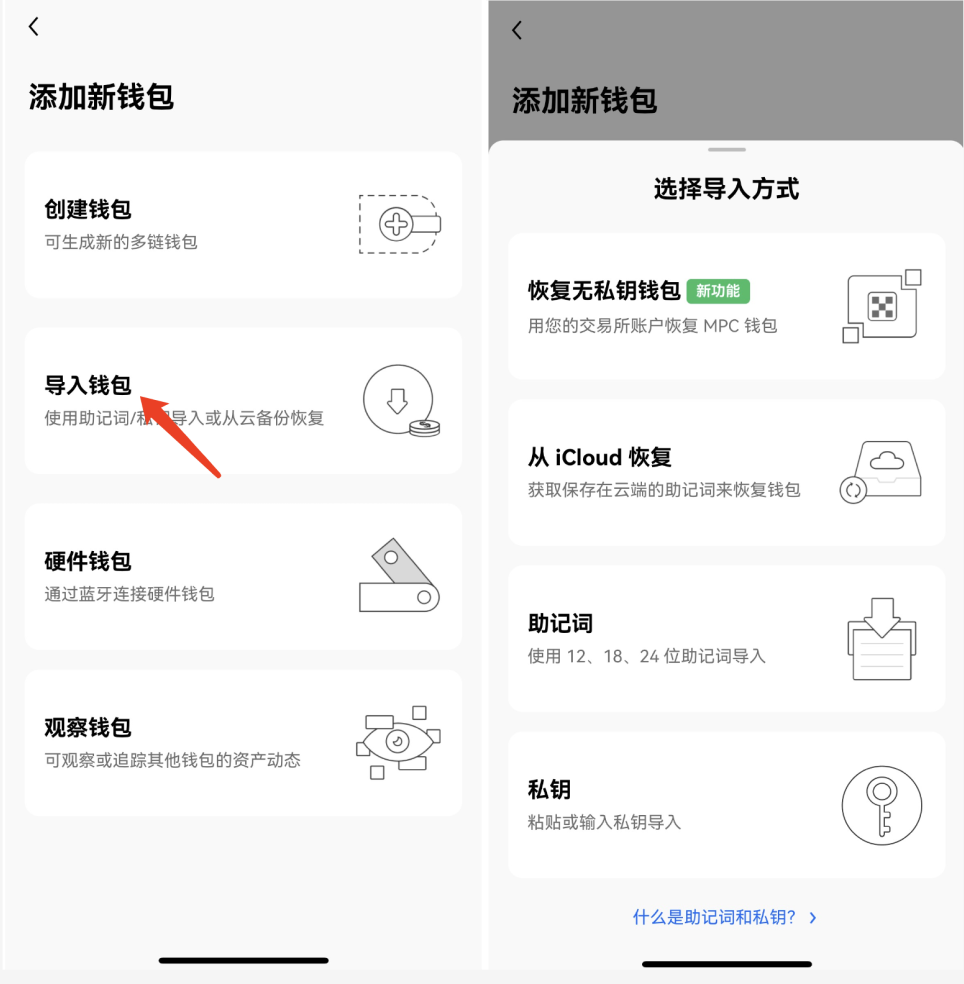
After creating or importing a wallet, go to the wallet homepage and click ▼ > Add Account > Smart Contract Account to successfully create an AA smart contract account.
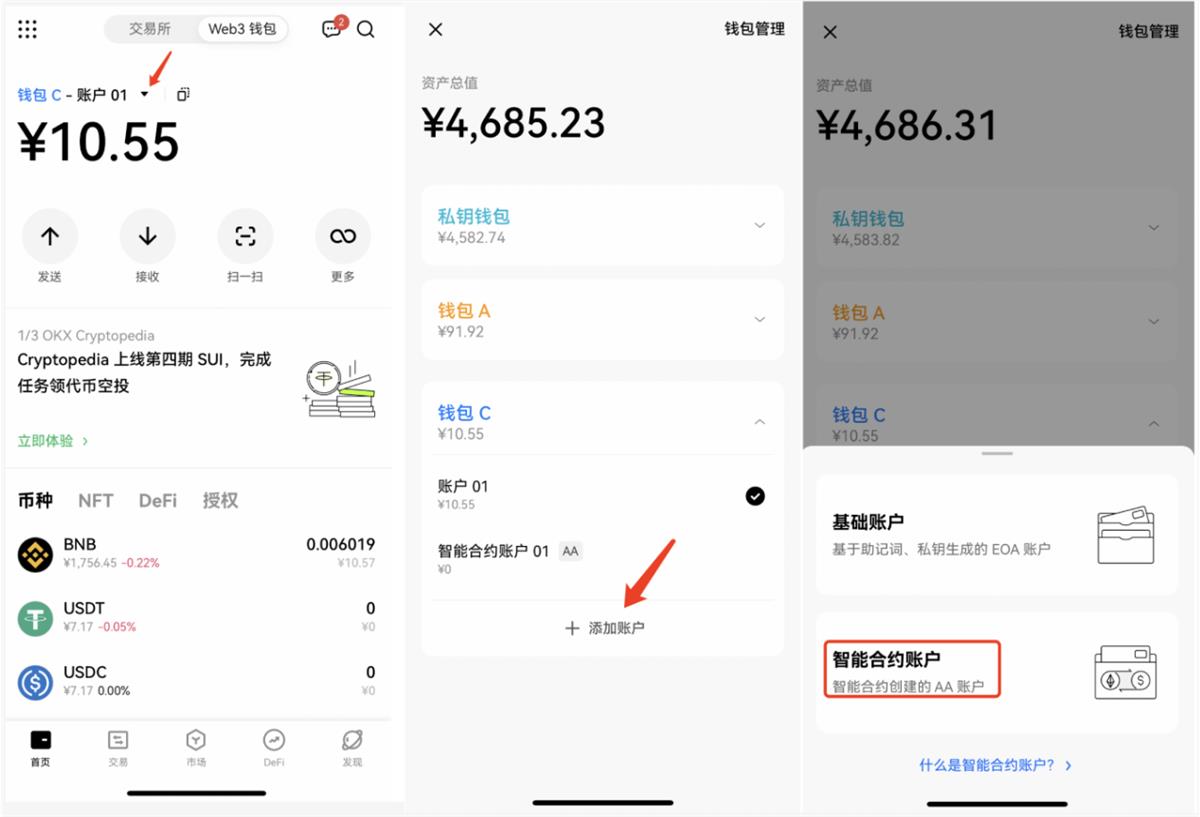
Within OKX Web3 Wallet, each keyless or private-key wallet can create only one AA smart contract account. However, under a mnemonic-based wallet, each individual account can have its corresponding AA smart contract account—for example, Wallet A - Account 01 corresponds to Wallet A - Smart 01.
Future Outlook
The past shapes our understanding, but the future defines trends—companies’ ability to sense and seize future trends is crucial.
Although EIP-4337 is still evolving and building account-abstraction wallets based on it remains challenging, Ethereum’s ultimate goal is to remove EOA accounts entirely from the network. AA smart accounts are clearly the future—offering developers unprecedented freedom, lowering user entry barriers, introducing new possibilities for Web3 wallets, and opening vast new horizons.
Only a few tech companies like OKX—with deep prior expertise in crypto wallets—have sensed and acted on this trend early, now leading the advancement of AA smart contract wallets, continuously enhancing everyday utility and user experience.
In recent years, OKX—the world’s second-largest crypto exchange—hasn’t rushed to claim the top spot. Instead, it returned to first principles, rethinking its original mission and future direction. Accurately identifying user needs, OKX continues strengthening its centralized services while actively exploring decentralized offerings—particularly advancing in Web3 wallets.
Just as the iPhone didn’t invent smartphones but made them mainstream, OKX now thinks like a "beginner" user when designing Web3 wallets, relentlessly lowering the barrier to entry. As Steve Jobs said, “Simple can be harder than complex—you have to work hard to make it simple.” The OKX AA smart contract wallet embodies this philosophy—stripping away complexity to deliver an极致 user-friendly experience. While it may not instantly convert all EOA users to AA wallet users, it brings mass adoption of Web3 wallets within reach.
According to a 2022 survey, as many as 1.7 billion people worldwide remain unbanked, excluded from the modern financial system. Web3 tools built by platforms like OKX can offer these individuals permissionless, equal access to financial services—bringing deeper liquidity and more users into Web3.
Indeed, "The bigger the vision, the bigger the world."
Join TechFlow official community to stay tuned
Telegram:https://t.me/TechFlowDaily
X (Twitter):https://x.com/TechFlowPost
X (Twitter) EN:https://x.com/BlockFlow_News






