How Katie Haun, the Queen of Crypto, Survived Crypto's Darkest Hour?
TechFlow Selected TechFlow Selected
How Katie Haun, the Queen of Crypto, Survived Crypto's Darkest Hour?
The trough of the cycle is truly the time for building.
 Navigating Web3 tides with focused insights
By Fortune Magazine
Translated by 0x26, BlockBeats
On a sunny April morning, Katie Haun trudged up a winding trail around the Stanford Dish, a massive radio telescope near Palo Alto. The three-and-a-half-mile loop is a favorite of the former prosecutor turned venture capitalist, but Haun wasn’t hiking for leisure. Instead, she and her small team of 11 needed to rally before delivering a high-stakes pitch to the wealthy limited partners (LPs) of her $1.5 billion fund—assuring them that despite the shattered state of the crypto industry, everything was still on track.
After the hike, Haun, her team, and several accompanying LPs returned to Haun Ventures’ office in Menlo Park, where they settled in among more than 70 attendees—including LPs and founders of companies Haun had backed. Veteran dealmaker Wat presented the long-standing Gartner Hype Cycle chart used to assess tech trends, reassuring the audience. The message was clear: the trough of disillusionment is when real building happens.
Crypto may be cyclical, but this downturn has been far steeper than investors anticipated, worsened by the collapse of many leading projects in the space. For Haun, whose career ascended from Supreme Court clerk to top roles at the Department of Justice and now to the pinnacle of VC, crypto’s Waterloo marks the first major setback to her rapid rise and carefully cultivated reputation.
Threading the Needle
The timing couldn’t have been worse. Launching a new crypto fund in spring 2022 was akin to opening a chain of movie theaters just before a pandemic. Within months, the raging bull market—where Bitcoin briefly hit $69,000—turned sour; high-profile projects like Terra imploded; and the VC industry was rocked by rising interest rates. Then in November, industry leader FTX collapsed amid a massive fraud scandal, triggering the most aggressive regulatory crackdown in crypto history.
As a result, Haun raised $1.5 billion—a substantial sum even by Silicon Valley VC standards—but many of the best opportunities had already vanished. During fundraising, according to a pitch document, the capital was split across two funds, with Haun originally projecting an investment timeline of roughly two years. That schedule no longer applies.
In Q2 2023, venture funding for crypto projects plummeted to $2.3 billion, down more than 70% year-on-year, as many investors pivoted to hotter sectors like artificial intelligence. The playbook for crypto venture capital is being rewritten.
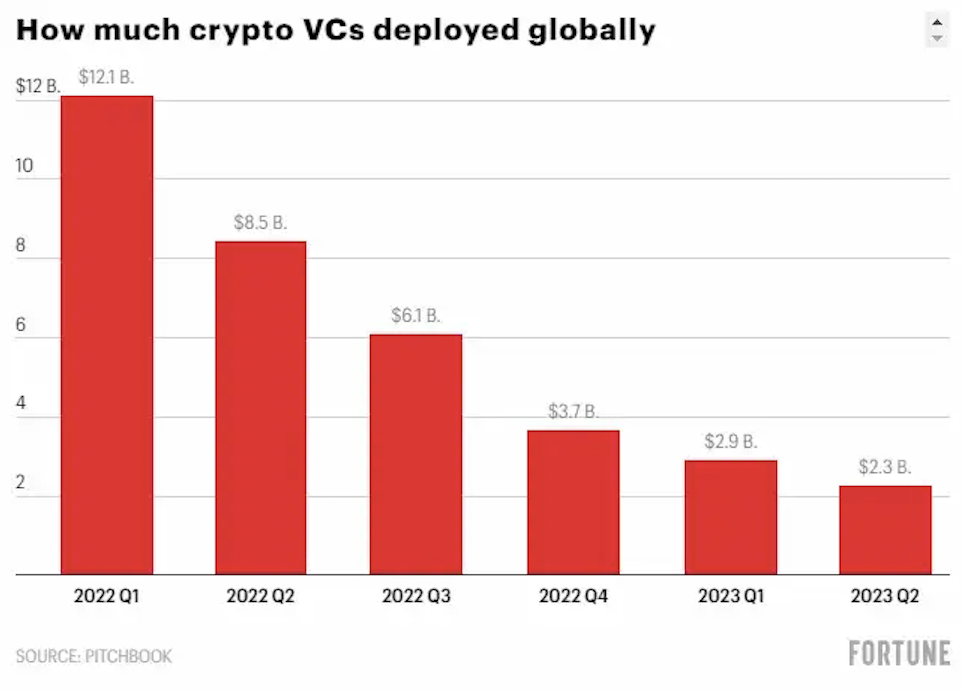
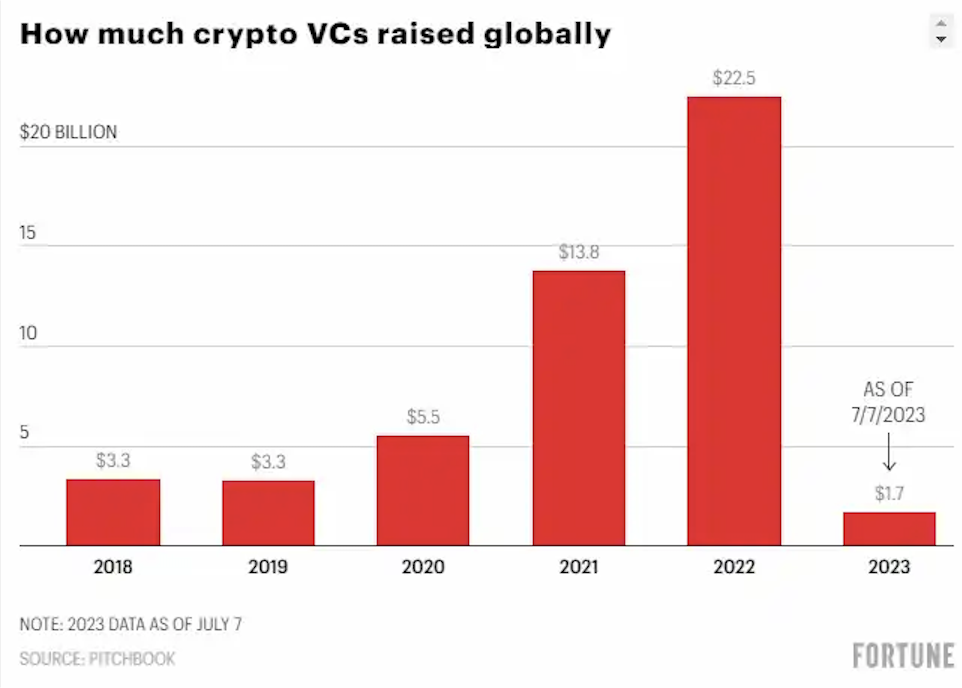
Still, some crypto VCs are burning through their reserves. Polychain Capital, for example, has already deployed most of its third fund, raised in 2022 and 2023. While it successfully raised $200 million for a fourth fund, other crypto VCs haven’t been so lucky. By mid-2023, crypto VCs had raised only about $2 billion—compared to over $22 billion for all of 2022.
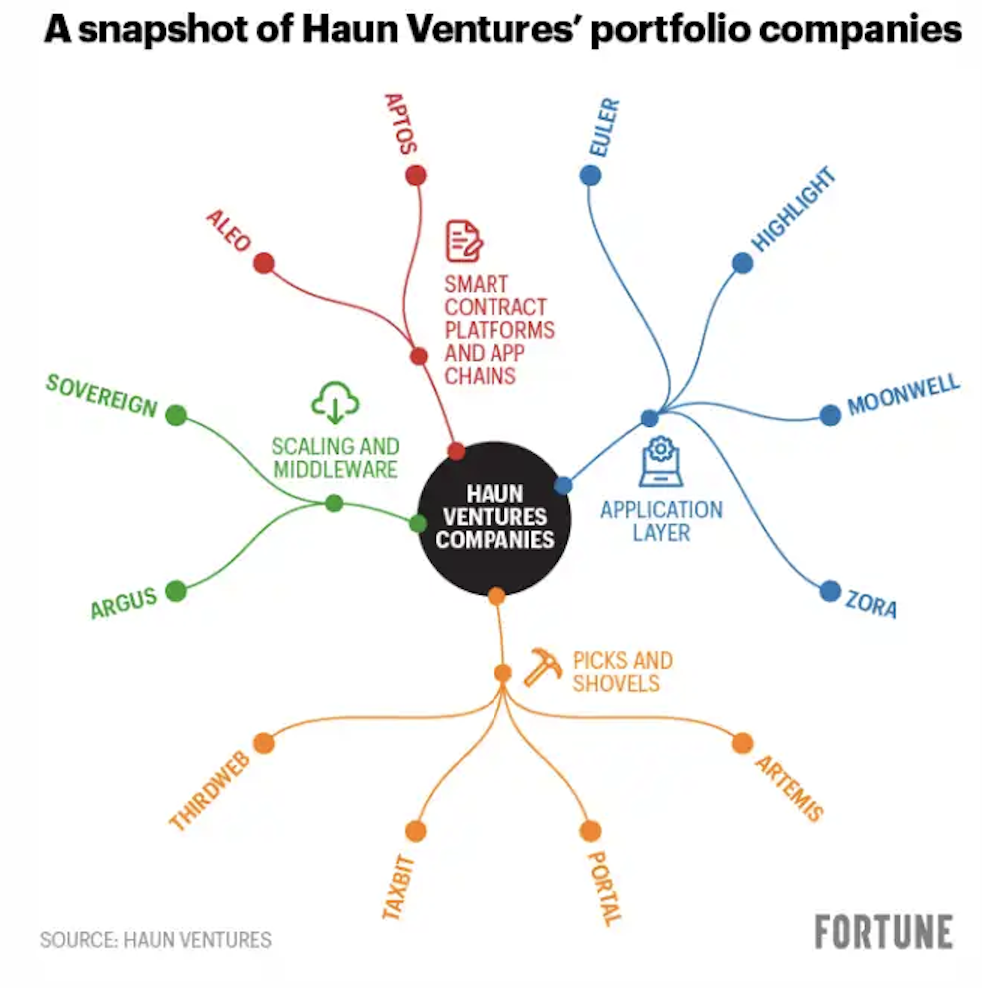
Haun Ventures is moving more cautiously, planning to deploy its cash over about three years. As of mid-June, the firm had invested roughly 30% of its capital into around two dozen projects, including publicly traded, liquid tokens. These include well-known cryptocurrencies such as Bitcoin and Ethereum, as well as smaller-cap project-related tokens often received alongside traditional equity in venture deals. Haun Ventures declined to disclose specific token holdings.
Partner Rosenblum said the firm’s investments during this period were nearly evenly split between digital tokens and traditional equity, though emphasis has shifted toward startup investments so far in 2023.
Haun Ventures has backed companies like NFT creation platform Zora and Web3 infrastructure platform thirdweb. It also participated in Aleo’s $32 million Series B round—a privacy-focused blockchain network—and supported crypto data analytics platform Artemis. More deals are expected to be announced soon.
Like other VCs, Haun Ventures leverages its influence to support portfolio startups. When Aleo nearly lost banking services after the collapse of Silicon Valley Bank and First Republic, Haun stepped in behind the scenes, introducing the company to alternative banks and sending staff to help answer compliance questions.
Amid U.S. regulatory turmoil, Haun has also been exploring international opportunities. She recently returned from a trip to Japan, where she met with a member of parliament promoting Web3 adoption.
It’s too early to evaluate returns from Haun Ventures, as even the firm’s own LPs acknowledge that it’s premature to assess startup performance. Moreover, many LPs are giant institutions—including Saudi Arabia’s sovereign wealth fund—that can afford the risk. One investor in Haun’s fund said, “If it goes to zero, it won’t break our portfolio.”
While some may appreciate the firm’s relative caution, there remains pressure—like with any VC—to put capital to work, especially since funds charge management fees. The industry standard is around 2%. Haun Ventures declined to comment on its fee structure.
Rosenblum acknowledged the firm is navigating a shifting landscape: “There are two ways you can go wrong,” he told Fortune. “One is moving too fast. The other is moving too slow.”
An Unconventional VC
Like other VCs, Haun faces the challenge of refining her investment strategy amid black swan events. But as a woman in a male-dominated field who raised the largest fund ever led solely by a female founding partner, she faces additional—and perhaps unfair—scrutiny.
At a venture dinner this past spring, conversation turned to Haun’s background. One attendee suggested she might be a regulatory expert, but lacked deep technical or transactional experience. Yet Haun’s supporters argue that doesn’t matter.
“She’s not an engineer, tinkerer, or builder,” said Fred Wilson, co-founder of Union Square Ventures, who has co-invested with Haun. “Instead, Haun brings extensive government experience and connections.”
“She’s one of the best networkers I’ve ever worked with,” Wilson said. “She can meet anyone.”
Haun’s networking prowess helped propel her to the top of the VC world—and so did the narrative she’s crafted about herself. While she’s now known as one of the first federal prosecutors to handle crypto cases, she wasn’t involved in the earliest ones, including the landmark takedown of the dark web marketplace Silk Road. Instead, she led a follow-up case targeting former law enforcement officials who stole cryptocurrency from Silk Road, and later worked on investigations into major hacks involving crypto giant Ripple and early exchange Mt. Gox.
Those experiences earned her a board seat at Coinbase and eventually a general partner (GP) role at venture heavyweight Andreessen Horowitz, where she spent four years investing in top firms like NFT marketplace OpenSea.
“Many successful investors with compelling stories transitioned from legal backgrounds into VC,” said Rachael Horwitz, spokesperson for Haun Ventures. “We believe Katie is undoubtedly one of the most experienced leaders and dealmakers in crypto.”
Some in law enforcement resent how Haun’s brief tenure in digital asset law propelled her to wealth and fame, while others with deeper roots in the field gained less recognition. Particularly galling to some is a media article dubbing Haun the “top crypto cop in Washington”—a title she never held nor claimed.
“She didn’t spend ten, twenty, thirty years grinding in government—she worked a few crypto cases,” said one insider. “I’ll give her credit for playing smarter, not harder.”
A former law enforcement official recalled an incident where a former DOJ prosecutor criticized media coverage on LinkedIn, arguing it misrepresented Haun’s government role. According to the unnamed official, drama ensued, and Haun’s allies reportedly pushed to have the post taken down. Soon after, it disappeared.
Regardless of whether reporting exaggerated her achievements, the former official said Haun clearly benefited from her rising profile. “In terms of her career trajectory in government, she positioned herself at the very top—and that became the launchpad for everything.”
Law enforcement is a world full of egos and discretion, where agents can only discuss cases under certain conditions, so professional disputes should be taken with caution. Other officials defended Haun, noting she never misrepresented her record.
“There are definitely people who dislike her,” said Grant Rabenn, former DOJ prosecutor and now head of financial crime at Coinbase. He asserted that 99% of her critics “don’t have her vision or her success.”
The VC world has a famously fraught relationship with the media. While many see themselves as independent thinkers, some are thin-skinned and lash out at negative coverage.
But unlike her former Andreessen Horowitz colleagues Marc Andreessen, who enjoys sparring with journalists on social media, or Chris Dixon, who prefers staying behind the scenes, Haun leans into mainstream media engagement. She debated Paul Krugman, sat with Ezra Klein, and graced the cover of Fortune, arguing that crypto and compliance can coexist. In May 2022, two months after launching her fund, she shared the stage with Sam Bankman-Fried and Michael Lewis at the now-infamous FTX founder’s conference in the Bahamas.
Yet after FTX collapsed in November, Haun largely stepped back from the media spotlight she once embraced—except for a Wall Street Journal op-ed in March 2023 and a brief Bloomberg interview in December. Her team attributed the shift to focusing on deals and regulatory work. Though she granted Fortune a cover feature last year, Haun declined multiple interview requests for this story.
Horwitz told Fortune the best use of company time is prioritizing investments.
They’ll Want a Tight Story
When VCs host “LP Days,” they’re typically lavish affairs. Given crypto’s dour mood, Haun Ventures’ April gathering had a frugal air: large dispensers of Peet’s Coffee and picnic-style lunch boxes from La Fromagerie. LPs, founders, and Haun’s team mingled on outdoor patios.
Brian Armstrong—Coinbase co-founder and the executive who gave Haun her start in crypto when she joined the board in 2017—delivered his usual speech, reiterating his hope that his company will remain a U.S.-based entity despite its existential battle with American regulators.
The LP Day presentation seemed to temporarily reassure investors; no one publicly complained or demanded redemptions. Part of the reason may be that Haun chose not to invest in FTX—the notorious exchange run by Sam Bankman-Fried, whose parents once taught Haun at Stanford Law School. Other top-tier funds, including prominent names and crypto experts, backed the fraudster, resulting in staggering losses: Sequoia wrote off $200 million for its investors, while Paradigm reportedly marked down its $290 million stake in FTX to zero last year.
Having stepped back from the media limelight she once embraced, Haun’s crypto advocacy is now almost entirely behind closed doors. She hosts lawmakers, organizes fundraising and educational sessions for key politicians like New York Democratic Senator Kirsten Gillibrand, and invites founders like thirdweb’s Furqan Rydhan to extol the benefits of blockchain.
With deals scarce (“Haun Ventures hasn’t entered the game yet,” as one LP put it), much of the firm’s energy appears focused on policy advocacy. Chris Lehane, who led Airbnb’s policy battles and Democratic political efforts, said he spends about a third of his time on crypto advocacy, including with Coinbase’s newly formed Global Advisory Council—an initiative with a vague mandate to “strengthen our stakeholder engagement” and “deploy crypto responsibly.”
Katie Haun’s entrepreneurial journey is still in its early stages, and the life cycle of her first fund remains short. Still, as crypto fights for survival, the former prosecutor has chosen to operate mostly behind the scenes, stepping away from the public advocate role. And even if her firm survives the storm, it remains uncertain whether investors will continue betting on such a turbulent industry.
USV’s Wilson told Fortune: “When they go raise their second fund, they’ll want a very tight story about what they’ve done and how they navigated market shifts. Hopefully, they’ll also have some wins to talk about.”
Join TechFlow official community to stay tuned
Telegram:https://t.me/TechFlowDaily
X (Twitter):https://x.com/TechFlowPost
X (Twitter) EN:https://x.com/BlockFlow_News
 @FortuneMagazine