








Will Financialization Destroy NFTs? Uncovering the Reality Where Risks Outweigh Benefits
TechFlow Selected TechFlow Selected
Will Financialization Destroy NFTs? Uncovering the Reality Where Risks Outweigh Benefits
Most financial innovations have eroded the non-fungibility of NFTs, negatively affecting collectors' desire to hold these assets.
 Navigating Web3 tides with focused insights
Written by: TylerD
Translated by: TechFlow
Back in 2021, everything was so simple. People genuinely bought NFTs—pieces they liked, NFTs with rare traits.
We joined Discord groups to connect with other holders. Communities formed, conversations grew, and holder counts increased. Then finance started seeping into this maturing market, and things began to change.
Many saw the financialization of NFTs as a sign of market maturity. Some believed it would open doors for larger players and broader mainstream adoption.
But is that really the case?
At least for one major segment of the NFT market—the PFP space—financialization appears to have undermined the NFTs we once knew. In this article, TylerD shares his perspective on the financialization of NFTs, examining innovations in markets and trading, token incentives, lending, and NFT perpetual contracts/futures, along with their impacts on the market.
Advanced Trading Features
Overall Impact: Negative
In the early days of the last cycle (late 2020 to early 2021), the NFT market resembled a chaotic Wild West—and OpenSea reigned supreme.
True to its name, it was an open sea of JPEGs. It was arguably the biggest winner during the 2021 bull run, earning millions in fees from billions in monthly volume.
Its success sparked competition—first LooksRare, then X2Y2, Gem, and Sudoswap, and finally Blur.
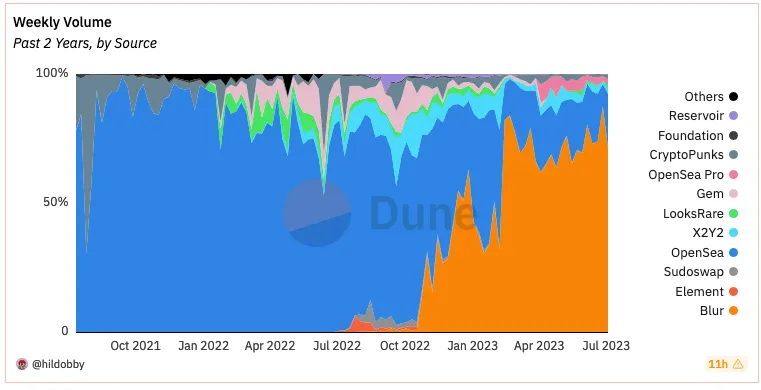
This competition led to new features in NFT marketplaces, enhancing the trading experience. There are too many to list exhaustively, but some impactful ones include:
-
Analytical charts and better data access;
-
Bulk buying and listing of NFTs;
-
Bulk selling of NFTs via accepting offers;
-
Real-time bidding and bid depth analytics.
At the time, these features were welcomed and remain popular today. But they were the first to begin shifting how NFT traders and collectors viewed their JPEGs.
Once unique digital collectibles with traits and characteristics that holders connected with and valued holding, these assets are now losing their non-fungibility—tokens are becoming fungible.
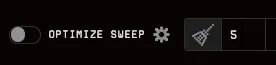
Bulk buying was arguably the first feature that set NFTs down this path. The ability to buy NFTs in bulk changed the shopping experience; the ability to sell in bulk via offers transformed the selling experience.
While floor sweeps are often celebrated in NFT Discord groups, sharper holders quickly realized the problem—most sweepers are more likely to be sellers. They don’t care which NFTs they own; they’re just tokens to flip.
Thus, while these features improved the trading experience, the experience of collecting and holding the underlying assets began to deteriorate. The impact of these trading advancements was negative—even if not fully recognized at the time.
But compared to the next phase of competitive warfare—the impact of token incentives—advanced trading features pale in comparison.
Token Incentives
Overall Impact: Negative
By late 2022, most PFP projects had died out. The survivors appeared poised for long-term success.
A new generation of projects, led by Bored Ape Yacht Club (BAYC), followed by Azuki, Doodles, Moonbirds, and Clone X, each seemed to possess unique and strong communities.
However, in February 2023, everything changed. Blur announced its airdrop and Season 2 mining. Early users received $BLUR tokens, injecting over $275 million in liquidity into the marketplace.
With this stimulus, liquidity flooded back into the PFP market, pushing prices upward for several weeks. Another ~$300 million in promised airdrops attracted new (apparently DeFi-native) traders into the space.
Miners could earn points by listing and bidding on NFTs. Naturally, savvy players figured out how to game the system. These speculators weren't buying NFTs to earn rewards, nor did they accumulate points once their bids were accepted. Instead, the game became: keep your bids high enough to earn points, but low enough not to get filled.
This revealed a truth: these farmers didn’t actually want the NFTs—they only wanted $BLUR points.
The issue became especially apparent when well-known traders/founders OSF and Mando executed a Bored Ape trade—selling 71 BAYCs in one transaction for 5,545 ETH (~$9 million at the time) within seconds.
Speculators on Blur who placed bids absorbed these 71 unwanted BAYCs, triggering a chain reaction. A group of participants began trading these NFTs among themselves purely to farm points.
As a result, two things occurred:
-
The same NFTs were traded dozens of times repeatedly;
-
Prices began to fall.
Speculators calculated their acceptable loss per trade, as long as point farming offset Blur’s costs. Starting in February 2023, this dynamic has led to a steady decline in asset prices—one that continues to this day.
One might argue why new buyers haven’t entered these ecosystems. Many point to shortcomings in execution and vision by teams and founders. That holds some truth.
But another driving factor—perhaps even more significant—is that these NFTs (especially PFPs) have lost their mystique. Buying a Bored Ape that’s been flipped dozens of times isn’t as appealing.
As prominent NFT trader Cirrus put it: imagine walking into a Rolex store and seeing several luxury collectors tossing Rolexes back and forth all morning. Would you still want to buy one?
As this process unfolded, the very qualities that initially attracted people to the PFP space—the connection to traits, owning a profile-worthy NFT, accessing communities—began to fade.
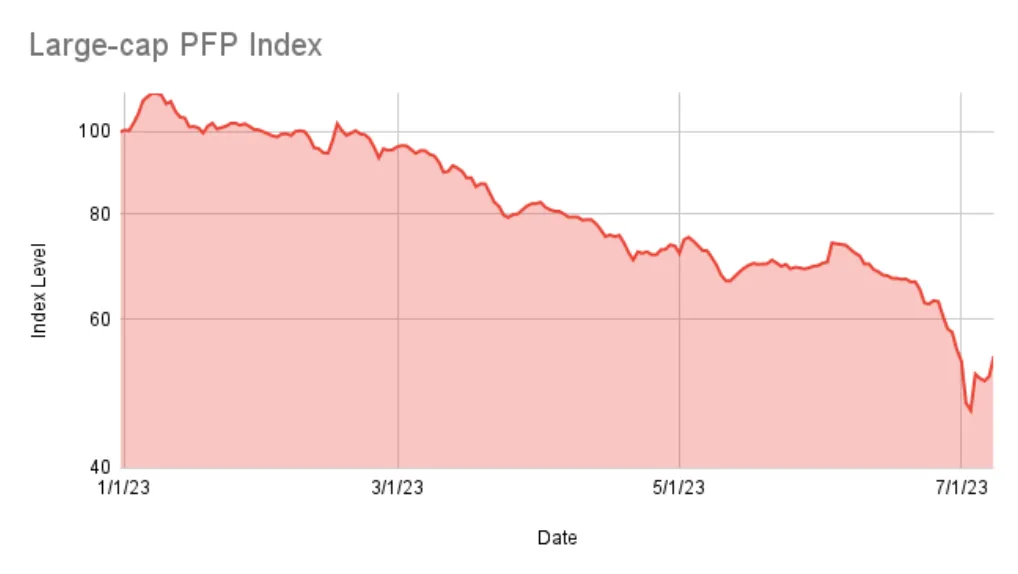
These PFPs became mere tokens to trade for accumulating $BLUR. Their non-fungibility diminished further—this is why I view the impact of token incentives on the market as negative.
NFT Lending
Overall Impact: Positive
While the marketplace wars raged on, a new financial frontier began to take off: NFT lending.
In April, cumulative volume in the NFT lending market surpassed $1 billion, recently crossing the $2 billion threshold in June following Blur’s launch of its Blend platform.
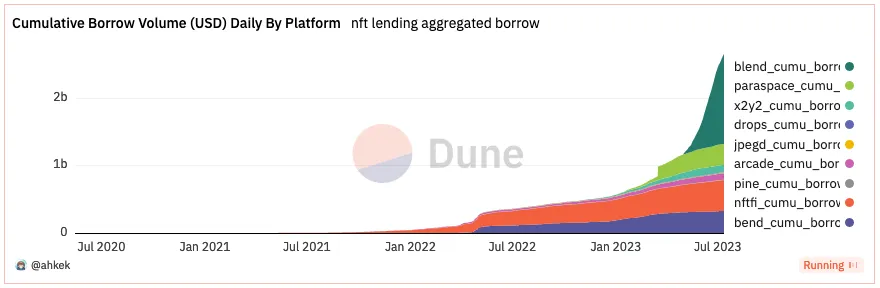
NFTfi was the first to market, launching in spring 2021 and reaching around $400 million in volume by the end of that year.
The product was straightforward: NFT holders use their assets as collateral, setting desired loan terms. Borrowers submit offers on these NFTs. If the holder accepts, the deal proceeds—the holder receives WETH, and the NFT goes into escrow. If the loan is repaid on time, the holder gets the NFT back; otherwise, the borrower claims it.
Soon, competitors emerged—including peer-to-peer lending protocols like Arcade.xyz and pool-based models like BendDAO and JPEG’d. Loan durations extended, and APRs dropped.
Quickly, NFT holders had options. New entrants like BendDAO promoted loans without repayment deadlines, as long as the asset value stays above a certain liquidation threshold.
Then in May 2023, Blur launched its Blend program, integrating lending with an option-like market (“Buy Now, Pay Later”) into its protocol, adding token incentives for loan offers.
Loan-to-value ratios (LTV) rose, and APRs dropped directly to 0%. More leverage entered the ecosystem—evident in recent events like the Azuki Vegas party, the Elementals disaster, and the subsequent chain reaction of PFP liquidations.
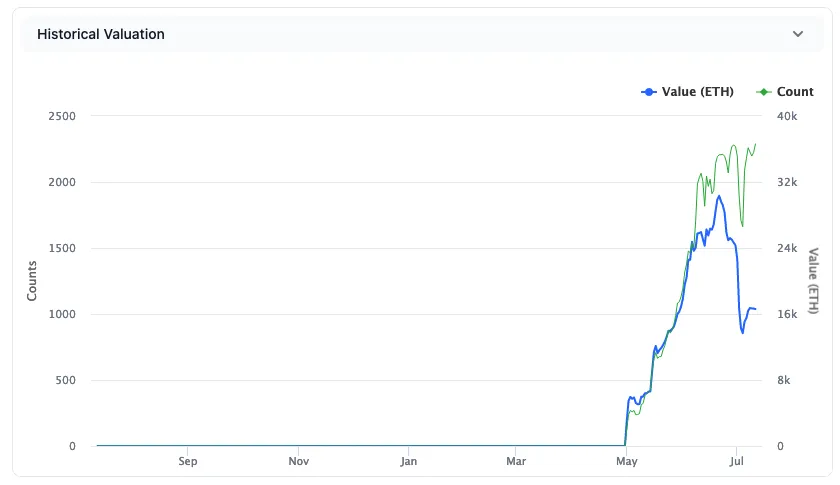
While some may argue NFT lending carries potential downsides—since leveraged trading often ends in disaster, especially for inexperienced, overexposed traders—for me, this functionality leans more positive.
The ability to gain liquidity using NFTs as collateral makes it easier to hold onto them for longer periods.
Moreover, protocols like NFTfi, Arcade, and even Zharta allow specific bids on specific NFTs, meaning traits, rarity, and uniqueness retain value in the lending process.
Non-fungibility is actually rewarded—so I rate NFT lending positively.
NFT Perpetuals, Options, and Futures
Overall Impact: Negative
Arguably one of the hottest financial trends in the NFT bear market has been the ability to go long or short on NFTs through perpetual contract platforms like NFTperp and Tribe, as well as Wasabi (peer-to-peer).
Perpetuals and futures allow traders to bet on future asset prices, often using leverage. For example, NFTperp allows users up to 10x leverage (meaning a 1 ETH bet controls exposure equivalent to 10 ETH). The difference between perpetuals and futures is that perpetuals can remain open indefinitely, while futures have fixed expiration dates.
A quick overview of how these protocols work: perpetual platforms use virtual automated market makers (vAMMs) to let traders take long positions (betting prices will rise) or short positions (betting prices will fall). As described by well-known crypto KOL 0xFoobar, vAMMs function similarly to Uniswap v2 pools—but without actual liquidity. They algorithmically simulate liquidity and adjust prices up or down based on the volume of long and short positions.
This product enables holders to hedge against NFT depreciation by opening short positions, lets those who can’t afford expensive NFTs (like a 35 ETH BAYC) bet on price increases with any amount via long positions, and allows skeptics to profit from expected price declines via shorts.
All three use cases make sense and fit into comprehensive trading strategies. Yet both the trades and the underlying models have limitations, vulnerable under extreme market conditions—and NFTperp just learned this the hard way.
Recently, NFTperp unexpectedly shut down, citing $518 million in bad debt accumulated from futures trading. They’ve shared some details, but likely causes include the Azuki Elementals mint and subsequent wave of liquidations, which triggered a sharp downturn in the NFT market, spiking shorting activity on NFTperp beyond what the system could absorb.
This leaves Wasabi and Tribe as the only remaining shorting protocols in the market.
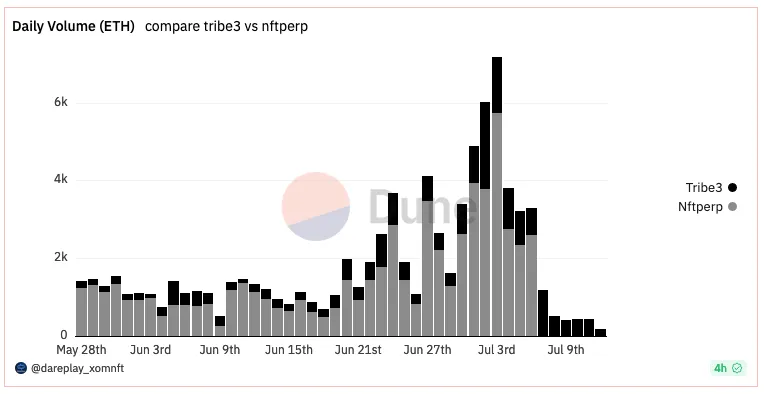
Overall, NFT perpetuals, options, and futures represent the newest and least mature segment of NFT financial markets. Some believe perpetuals are fundamentally flawed by design—a debate worth having separately.
But one thing is clear—among all the financial aspects discussed so far, perpetuals and futures likely have the most negative impact on preserving non-fungibility.
On the surface, only the floor price matters (more precisely, the vAMM oracle price). Entire communities and collections are reduced to numbers on a screen. Rare items no longer matter. All bets revolve around floor price volatility.
Therefore, I give NFT perpetuals, options, and futures a negative overall assessment.
Conclusion
The views expressed here focus primarily on the NFT PFP space, as Art Blocks and the broader digital art market, along with other sectors like gaming and metaverse, have largely remained unaffected by token incentives and farming mechanics.
Interestingly, the Art Blocks index has slightly increased over the past year, while the PFP index has dropped over 50%.
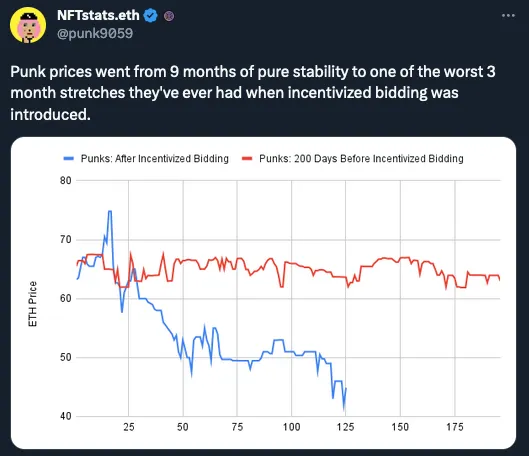
Perhaps the most damning evidence comes from the CryptoPunks market, which held a stable 10% range for 200 days before being added to Blur’s incentive bidding—then entered 120 days of extreme volatility, swinging +15% to -40%.
To summarize the evaluation of NFT financialization’s impact on the PFP space:
-
Advanced trading features — negative;
-
Token incentives — negative;
-
Lending — positive;
-
Futures, perpetuals, and options — negative.
As the non-fungible token market evolves, we’re beginning to see how various features and mechanisms affect this emerging space. Many have produced massive unintended consequences. But most of these financial innovations have eroded the non-fungibility of NFTs.
This erosion of non-fungibility negatively impacts collectors’ desire to hold these assets—and is reflected in the market. Sadly, the damage done to this market may be irreversible, with existing PFP collections possibly never seeing new all-time highs again.
Perhaps our early NFT market didn’t need so much financialization—or perhaps new innovations will rekindle non-fungibility.
Join TechFlow official community to stay tuned
Telegram:https://t.me/TechFlowDaily
X (Twitter):https://x.com/TechFlowPost
X (Twitter) EN:https://x.com/BlockFlow_News
 @overpricedjpegs






