Vitalik's EthCC Talk Summary: Account Abstraction Makes Crypto Wallets as Simple as Email
TechFlow Selected TechFlow Selected
Vitalik's EthCC Talk Summary: Account Abstraction Makes Crypto Wallets as Simple as Email
In Vitalik's view, account abstraction is "very elegant" because it doesn't require changes to the underlying protocol like previous upgrades did.
 Navigating Web3 tides with focused insights
By: TechFlow Intern
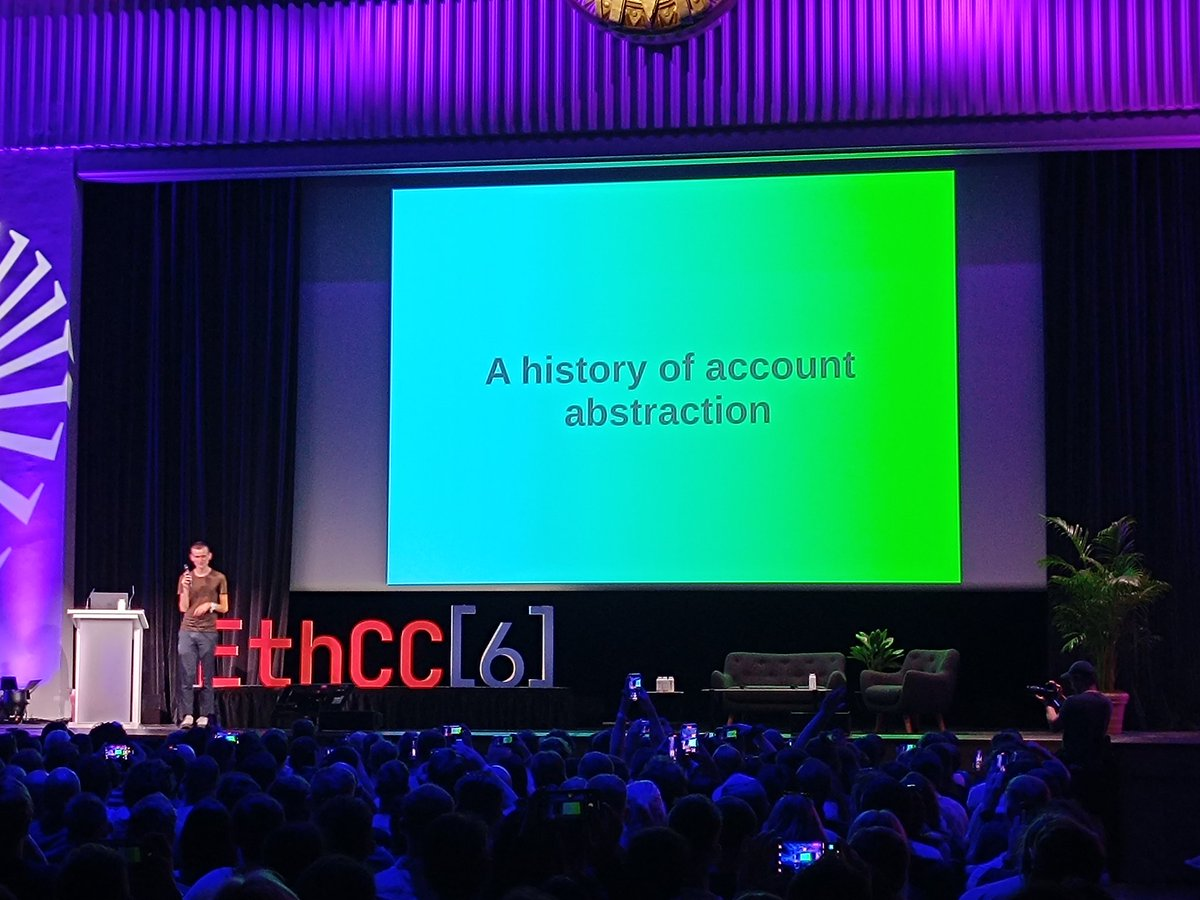
On July 17, the Ethereum community conference (EthCC) officially opened in Paris, where Ethereum co-founder Vitalik Buterin delivered a keynote speech endorsing smart contract wallets once again, focusing on the history and future of account abstraction.
This year, Vitalik has frequently voiced his support for account-abstracted smart contract wallets. For example, during a Twitter AMA in June, when asked about MPC-based (EOA) wallets versus smart contract wallets, he argued that MPC-based EOA wallets have fundamental flaws because they cannot revoke keys, making smart contract wallets the only viable option.
In Vitalik’s view, account abstraction is “very elegant” because it doesn’t require changes to the underlying protocol like previous upgrades did.
Account abstraction itself is a rather abstract concept.
Currently, Ethereum accounts are tightly coupled with key pairs—essentially one and the same. That is, if you control the private key, you control the account.
Account abstraction decouples the entity within the EVM (the account) from the entity owning assets (the key pair or signer). As long as a contract account (CA) supports certain functions (e.g., signature verification), it can serve as an account.
At its core, account abstraction allows users to define their own account security models, making Ethereum more adaptable to various use cases.
For instance, this feature enables users to set custom transaction validation rules, such as multi-signature requirements or spending limits, and also make their accounts compatible with future cryptographic algorithms.
Vitalik describes account abstraction as enabling Ethereum accounts to be controlled by smart contract code rather than private keys.
His vision is that everyone will eventually transition from current EOA wallets to smart contract-based wallets. If successful, managing crypto wallets could become as simple as managing email accounts.
Early Stages of Account Abstraction
Vitalik noted that the idea of allowing code—not just keys—to control accounts was present in Ethereum's design from the beginning.
The Ethereum Yellow Paper outlines two types of accounts: externally owned accounts (controlled by private keys) and contract accounts (managed by smart contract code). However, early attempts at implementing account abstraction faced challenges.
In the first Ethereum proof-of-concept version, there was optimism that users would widely adopt multi-signature wallets. But this didn't happen immediately, and multisig made deposit detection for exchanges more difficult. There were also complexities around paying gas fees from smart contract wallets. The original vision was that all transactions would be simple "calls," but issues like non-unique transaction hashes created obstacles.
The Evolution of Account Abstraction
Over the years, the Ethereum community iterated on many ideas for account abstraction. Proposals emerged around standardizing signatures, using "breakpoint" opcodes, and limiting access during transaction validation. Progress was slow, however, due to the complexity of changing the base protocol and the focus on transitioning to proof-of-stake. It wasn't until 2020 that concrete EIPs (Ethereum Improvement Proposals) for account abstraction were introduced.
Independent projects like Gas Station Network and Argent Wallet drove further innovation. They found creative ways to enable meta-transactions and abstracted accounts using only smart contracts. However, solutions relying on "wrappers" had drawbacks, such as higher overhead per transaction.
Later, EIP-4337 was proposed, offering a universal account abstraction standard using only smart contracts—without requiring changes to the base protocol.
The Ethereum (ETH) upgrade will allow users to create non-custodial wallets as programmable smart contracts.
This unlocks numerous features, including easy wallet recovery, signatureless transactions (meaning lower transaction fees), and team wallets (also known as multi-sig wallets).
According to Vitalik, this upgrade could be one of the major catalysts for global Web3 adoption. "One of the key properties we want blockchains to have is giving you money before you even sign up," he said.
He explained the idea is to let users receive any tokens—including stablecoins—in their smart contract wallets and pay gas fees without needing to convert holdings into ETH.
To enable these types of wallets and transactions to be broadcasted, the latest account abstraction upgrade introduces "paymasters," which allow users to pay gas fees using whatever token they're transacting with.
EIP-4337 also includes signature aggregators, allowing multiple signers to combine into a single signature used in a transaction.
"This is quite significant," Vitalik said, especially in rollups, where signatures on these types of Layer 2 solutions take up excessive space.
Ethereum Layer 2s, such as Arbitrum or Optimism, batch transactions together and validate them off the Ethereum mainnet.
Account abstraction will enable signature aggregation. Simply put, this allows greater data compression, translating into cheaper computation, and according to Vitalik, "could reduce costs by up to 86 times."
Moreover, this isn't the only Ethereum upgrade currently underway. Proto-danksharding, or EIP-4844, is also in progress. It has quickly become a primary focus for network development, laying the foundation for a new type of data that will significantly reduce costs and improve data efficiency.
Finally, Vitalik emphasized growing interest in integrating parts of account abstraction—such as ERC-4337—directly into the protocol to improve efficiency and censorship resistance. He also highlighted the importance of ensuring a smooth transition for legacy EOA users and integrating innovations like biometric signers.
Join TechFlow official community to stay tuned
Telegram:https://t.me/TechFlowDaily
X (Twitter):https://x.com/TechFlowPost
X (Twitter) EN:https://x.com/BlockFlow_News
 深潮TechFlow