
Did Web3 effectively solve the problems in Web2 marketing?
TechFlow Selected TechFlow Selected
Did Web3 effectively solve the problems in Web2 marketing?
Web3 marketing is no longer focused solely on the mass market, but places users at the center.
 Navigating Web3 tides with focused insights
Written by: Lucian Urbach
Compiled by: TechFlow
The most common terms associated with Web3 include blockchain, Bitcoin, Ethereum, DeFi, and NFTs. For some, these terms remain uncharted territory; for others, they are standard vocabulary.
Over the past decade, an entire industry has emerged that is now challenging and reshaping many aspects of our daily lives. One thing that both newcomers and industry experts share in common is Web3 marketing.
Without going into technical details, marketing and advertising in Web3 have existed for a while but have recently reached a stage where they're pioneering a new industry beyond Web3 itself. In this article, we will explore why this shift is happening and how it can help founders boost user acquisition by driving the next wave of adoption.
Looking at the current state of marketing, Web2 marketing has become an indispensable part of today’s business landscape—so much so that it's hard to imagine commerce without it.
However, due to multiple factors such as intense competition, ad blindness, ad blocking, opaque algorithms, and closed ecosystems (i.e., data silos), traditional Web2 marketing models have lost their effectiveness. These challenges make it difficult for founders to attract and engage their target audiences.
In contrast, Web3 marketing offers a fundamentally different approach to solving the problems faced by Web2 marketing.
Rather than focusing solely on mass markets, Web3 marketing places users at the center. It leverages the entire ecosystem instead of isolated data silos, enables shared ownership and value creation, and delivers unique experiences.
Thanks to its underlying technology, companies, founders, and marketers can now gain deeper insights into their target audiences. Through two-way interactions, they can engage users more meaningfully, achieving cost-effective growth and improved customer retention.
What Is Web2 Marketing?
Web 2.0 marketing refers to using interactive web-based platforms and social media to promote products or services online. Common Web2 marketing strategies include creating engaging social media content, building online communities around brands, leveraging influencers, utilizing user-generated content, and running targeted digital ads.
Overall, Web2 marketing focuses on building a strong online presence, fostering customer engagement, and driving business growth through valuable interactions.
How Is Web3 Marketing Different?
A good way to understand the difference between Web2 and Web3 marketing is to compare their marketing frameworks.
-
Web2 marketing is not user-centric—it targets broad audiences and lacks incentives to drive meaningful user engagement.
-
Web3 marketing, by contrast, is user-centric, aiming to build customer relationships and interactions that create mutual value. These relationships are nurtured through shared ownership, uniqueness, culture, and incentive mechanisms.
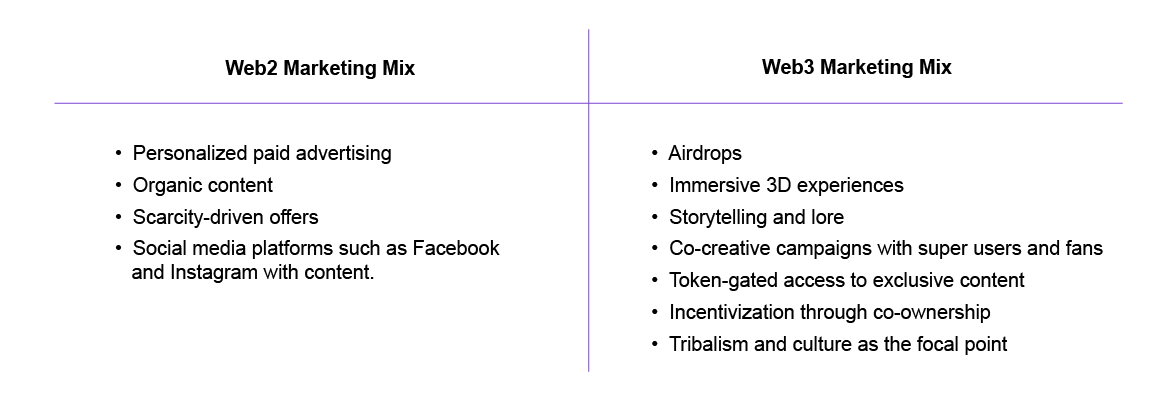
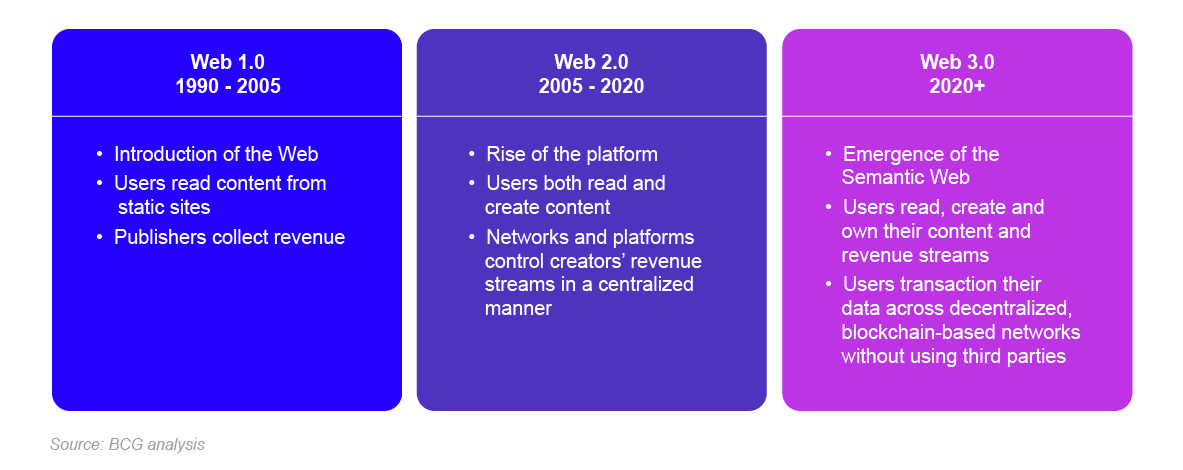
One reason for these differences lies in the technological limitations of Web2. Web2 can be categorized as one-way engagement, where customers are mostly limited to receiving information, whereas Web3 allows customers to actively interact with brands.
How Does Web3 Marketing Solve Web2 Marketing Problems?
Web3 marketing presents numerous exciting opportunities that differentiate businesses, founders, and marketers from traditional Web2 approaches. Here are some of the biggest opportunities:
-
Decentralization: Built on decentralized technologies, Web3 enables greater transparency and security in marketing activities. This is particularly important in areas like data privacy, ad fraud prevention, and consumer trust.
-
Immersive Experiences: Web3 technologies such as virtual and augmented reality offer more immersive and engaging experiences for consumers, enabling brands to run more memorable and impactful campaigns.
-
Microtransactions: Web3 facilitates microtransactions and revenue models based on them—such as pay-per-action or pay-per-view—giving businesses new monetization avenues while empowering users with greater control over what they consume and earn through micro-transactions.
-
User Ownership: Web3 enables true user ownership, allowing consumers to own their data, identity, and digital assets. This opens up new marketing opportunities for brands focused on user empowerment and incentivization.
-
Community Building: Decentralized social networks and other Web3 tools enable the creation of more active and engaged communities around products and brands, helping businesses build deeper relationships with customers.
-
Analytics: Thanks to blockchain’s transparency and data availability, analytics can be applied across the entire ecosystem. Marketers are no longer confined to internal data centers—they can access comprehensive, cross-platform data.
Overall, the greatest opportunities in Web3 marketing lie in the unique features and advantages of decentralized technologies—transparency, personalization, and user empowerment. Web3 marketing addresses key pain points of Web2 marketing, especially in customer engagement, loyalty, analytics, ownership, and data accessibility.
What Else Can Be Done?
As mentioned above, Web3 marketing solves various pain points of Web2 marketing. Below are additional use cases and examples of companies already applying this technology.
Loyalty Programs
-
Personalized rewards: In Web3, wallet-based logins allow brands to verify user identities via issued NFTs as proof of loyalty. Users then share information in exchange for perks like early access or event invitations.
-
Liquidity and value accumulation: A well-designed loyalty program gains intrinsic value and can be monetized or traded.
-
On-chain analytical insights: On-chain analytics provide detailed, real-time data. Marketers can access accurate metrics on campaign performance, conversion rates, user engagement, and behavior. Since data is immutably recorded on the blockchain, it is highly reliable. These insights enable marketers to optimize strategies and make data-driven decisions.
-
Measuring engagement over sales: Because Web3 loyalty members are non-fungible, each has unique behaviors, spending patterns, activity levels, and redemption histories. Research shows highly engaged members spend 25% more than inactive ones. Measuring granular engagement data provides deeper insights into active versus passive users, going beyond traditional metrics like spending or membership count.
Customer Engagement
-
CaaS (Community as a Service): An emerging service model focused on building and managing communities for other companies. For example, Tribally provides Axie Infinity with full community support—from roadmap planning to day-to-day operations on Discord and Telegram.
Physical Empowerment: Digital Twins of Physical Products
-
Vouchers redeemable for physical goods;
-
NFT-powered secondary markets for physical products.
Social Empowerment
-
NFTs as membership cards or event tickets.
Digital Empowerment
-
Single-brand wearable items;
-
Multi- or cross-brand collaborative wearables.
Conclusion
Web3 marketing effectively addresses many of the shortcomings of Web2 marketing. Centralization, closed ecosystems, data privacy concerns, generic advertising, cumbersome onboarding, data leakage, and poor user experience have rendered Web2 outdated in many areas. Many companies have recognized this issue and are beginning to integrate Web3 technologies into their offerings to maintain a competitive edge. As non-Web3 users can now easily access Web3 marketing tools, institutional demand is expected to grow. However, adoption won’t happen overnight—it will require time and support from those already embracing Web3.
This transition phase itself represents a market—often referred to as Web2.5—where marketing is just getting started and will play a crucial role in attracting the next billion users.
Join TechFlow official community to stay tuned
Telegram:https://t.me/TechFlowDaily
X (Twitter):https://x.com/TechFlowPost
X (Twitter) EN:https://x.com/BlockFlow_News
 Outlier Ventures