








Solana's Rebirth: A Resilient L1
TechFlow Selected TechFlow Selected
Solana's Rebirth: A Resilient L1
Solana remains one of the most popular chains for DeFi and NFTs in the crypto economy.
 Navigating Web3 tides with focused insights
Written by: Bankless
Compiled by: TechFlow

Solana has been through a lot. After struggling to recover from the collapse of FTX, the L1 has once again drawn scrutiny from regulators. Even Vitalik has expressed regret over how things have unfolded. Despite taking numerous hits, the network continues to show remarkable resilience.
Launched in 2017, Solana is a blockchain designed to deliver higher "base layer" throughput and scalability compared to other L1 blockchains like Ethereum and Bitcoin.
Currently, Bitcoin processes around 5 transactions per second (TPS), Ethereum about 30 TPS, while Solana handles approximately 4,000 TPS, with theoretical network capacity reaching 65k–75k TPS.
As a result, Solana supports near-instant transactions at extremely low costs, making it an attractive alternative to Ethereum for many Web3 developers and users.
However, the Solana ecosystem faces real competition from other L1 blockchains such as Avalanche and Fantom, as well as from Ethereum’s rapidly growing Layer 2 solutions like Arbitrum, Optimism, and Polygon zkEVM. Additionally, Solana has faced significant challenges including the collapse of FTX (a major backer of early Solana applications), recurring network outages, and recent regulatory headwinds following the designation of SOL as an unregistered security.
Nonetheless, Solana remains one of the most popular chains for DeFi and NFTs in the crypto economy, and its native token SOL continues to rank among the top 15 cryptocurrencies by market capitalization. While the network currently operates as a monolithic chain handling execution, security, and data availability on its own, it may gradually become more modular if Solana-based L2 solutions gain traction over time.
How Solana Works
Solana is a blockchain that uses a unique consensus mechanism called Proof-of-History (PoH), a variant of Proof-of-Stake (PoS).
PoH optimizes transaction processing by assigning timestamps to each transaction, allowing Solana to process them in the order they arrive rather than grouping them into blocks. This consensus method, combined with the blockchain’s Tower BFT algorithm, creates a blend of security, efficiency, and speed.
Unlike Ethereum, which uses the Ethereum Virtual Machine (EVM) to execute “smart contracts,” Solana employs a different model for executing “programs.” These programs are written in the Rust programming language and compiled into WebAssembly bytecode (WASM), enabling Solana to achieve high performance and parallel processing capabilities. This unique approach to smart contracts contributes significantly to Solana’s renowned high transaction throughput and low latency.
Moreover, while Ethereum wallets primarily support ERC20 tokens and Ethereum-based applications, Solana wallets like Phantom are specifically designed for SPL tokens and Solana-native dApps. However, several projects—such as Neon Labs—are currently working to bring EVM compatibility to the Solana network, enabling Ethereum-based transactions to be executed directly on this alternative L1.
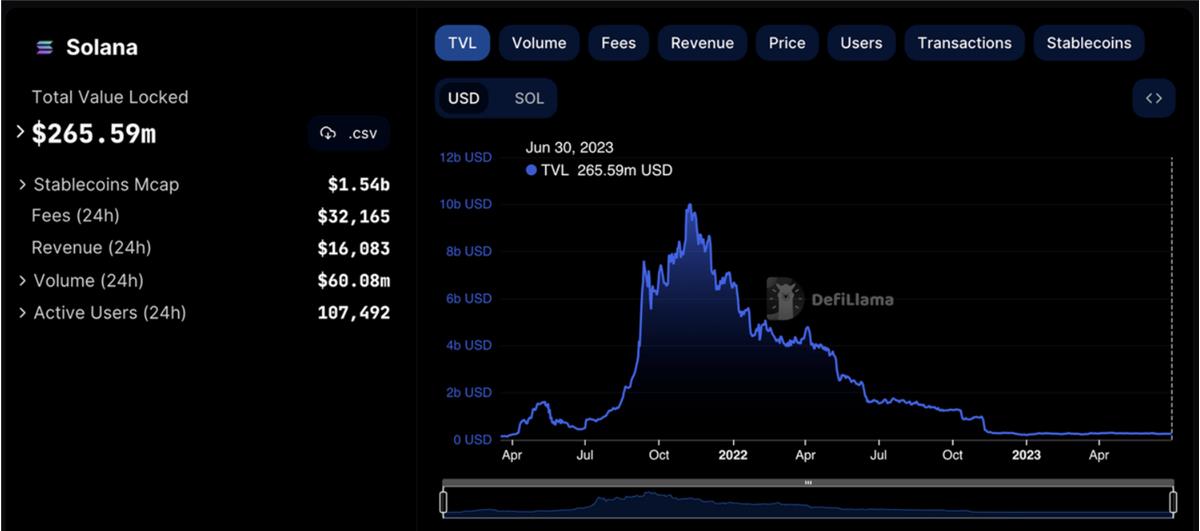
As of June 30, 2023, according to DefiLlama, the total value locked (TVL) in the Solana DeFi ecosystem was approximately $266 million. While significantly smaller than Solana’s previous TVL peak of around $10 billion, this still makes it the 11th largest DeFi network at the time of writing.
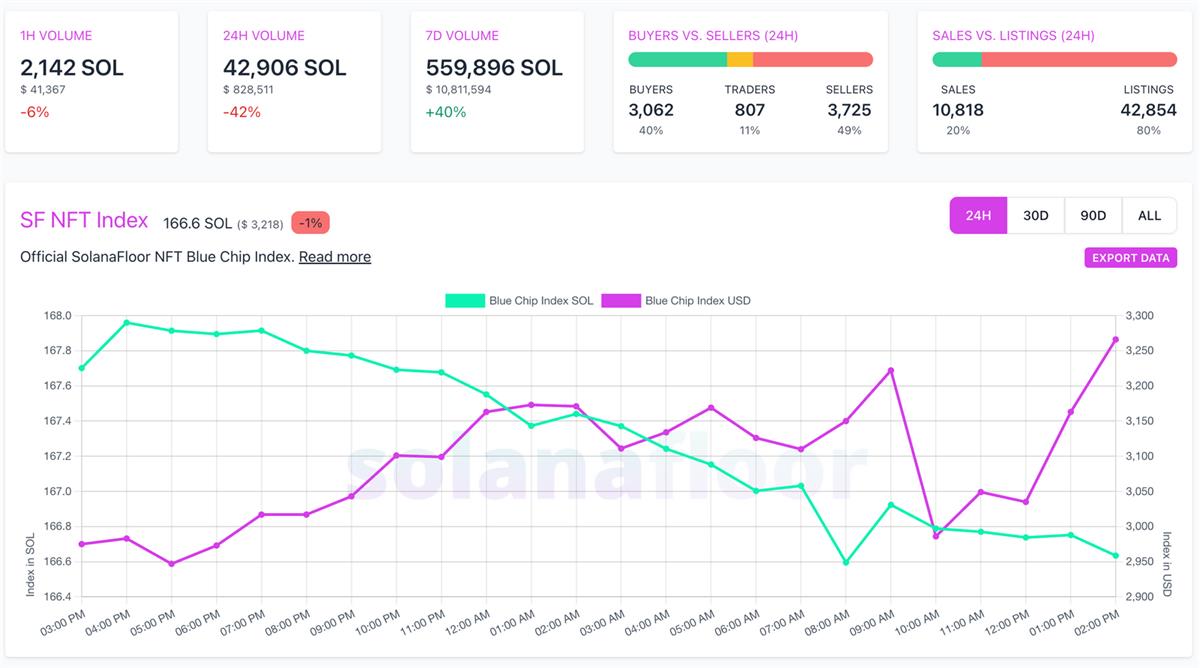
In addition, Solana remains quite active in the NFT space within the broader crypto economy, although its NFT ecosystem is notably smaller in both activity and breadth compared to Ethereum’s.
Token: SOL
SOL is Solana’s native token, used across the network’s ecosystem for various purposes such as paying transaction fees, participating in staking, and serving as a medium of exchange in DeFi applications.
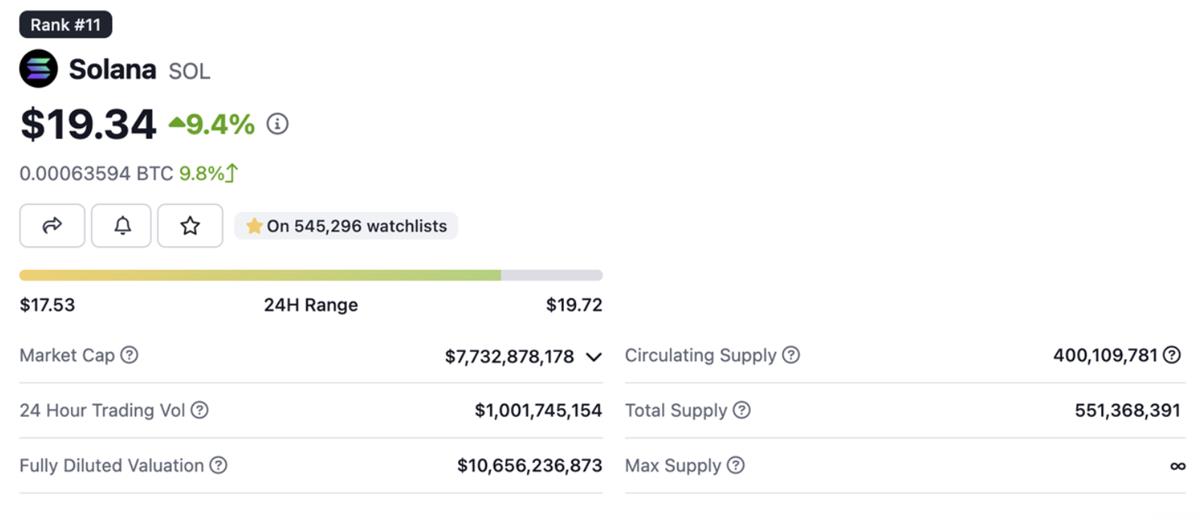
SOL trades at approximately $19.34, with a market cap of $7.73 billion, making it the 11th largest cryptocurrency in the crypto economy. At the time, the circulating supply of SOL slightly exceeded 400 million tokens, with a total supply surpassing 551 million and steadily increasing due to staking rewards.
What You Can Do on Solana
Here are some key activities available on Solana:
-
Liquid Staking SOL via Marinade Finance
As the largest application on Solana today, Marinade Finance is a liquid staking protocol built on the Solana network that enables users to stake SOL tokens using automated strategies. By staking on Marinade, users receive “staked SOL” tokens (mSOL), which can be used within DeFi or redeemed back to SOL at any time. As a non-custodial and permissionless protocol, Marinade ensures users always retain full ownership and access to their tokens.
Liquid staking offers an alternative to traditional staking, allowing users to stake any amount of SOL without waiting for the typical 1–3 day warm-up or cool-down periods. With Marinade, staking and unstaking can be completed instantly, eliminating the waiting times associated with conventional staking methods. However, immediate unstaking incurs a fee ranging from 0.3% to 9%. Users can also opt for delayed unstaking at no cost, though they must wait 1–2 epochs to reclaim their SOL and accrued rewards.
-
Trading Solana Tokens on Raydium
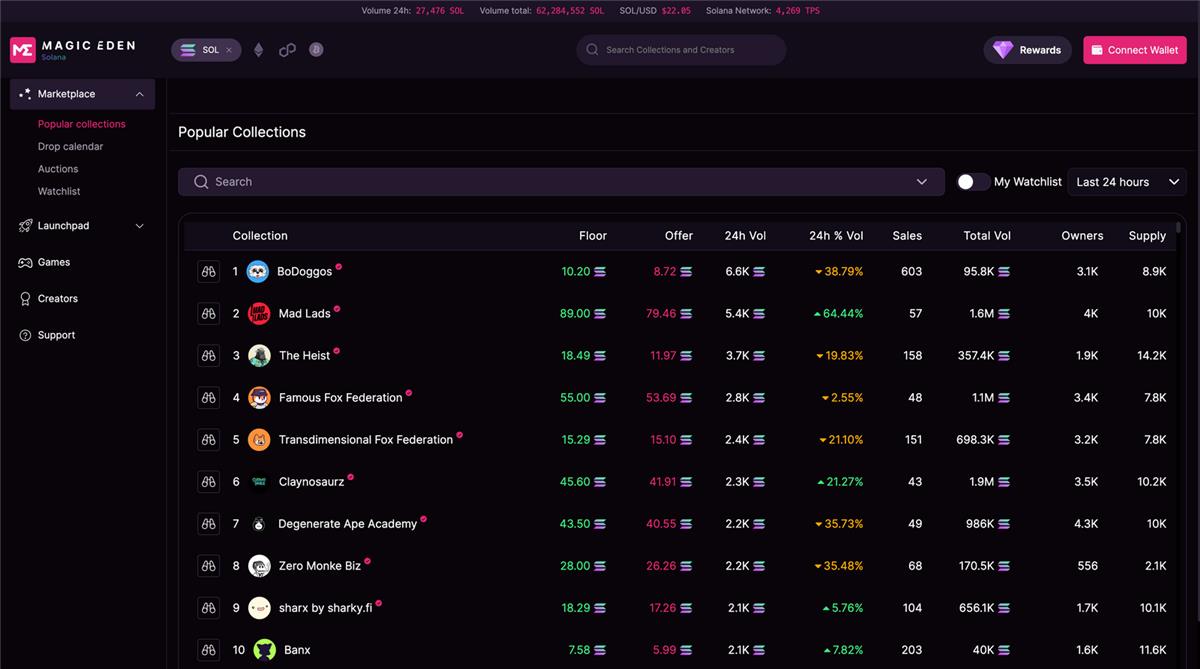
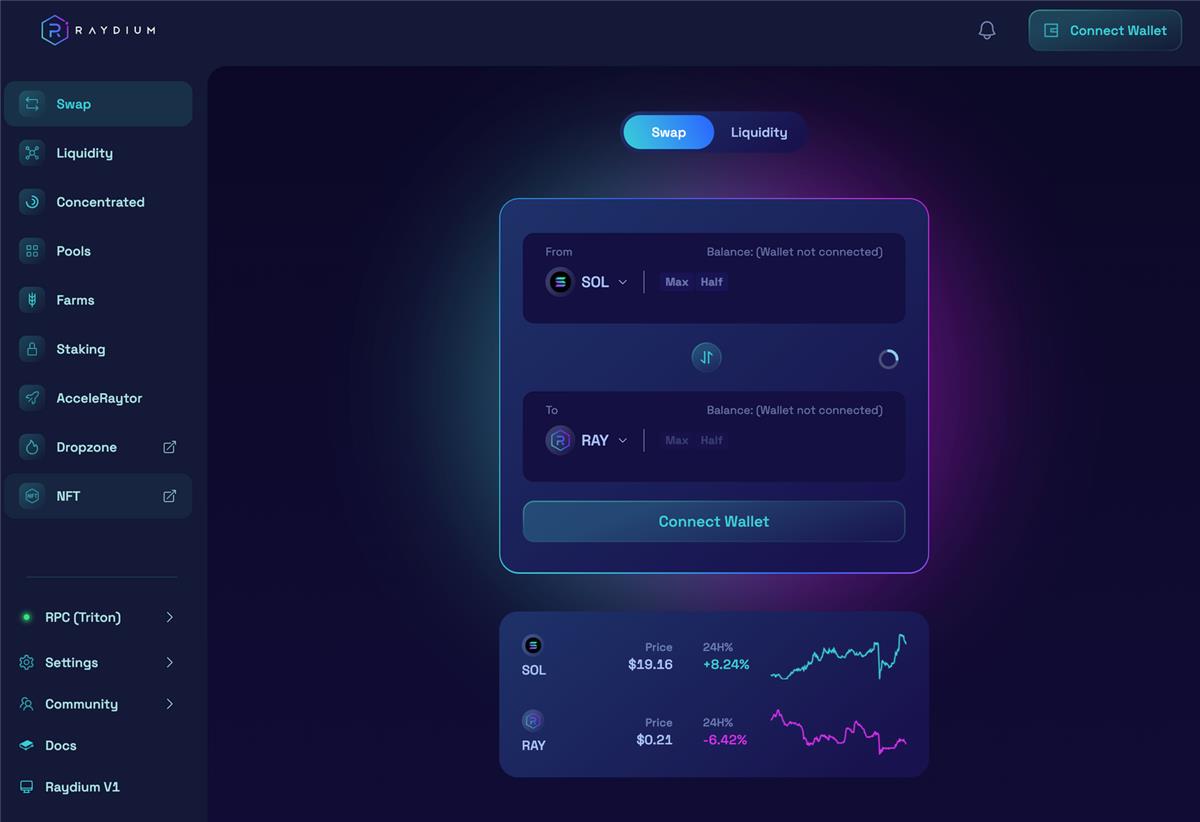
Raydium is a decentralized exchange (DEX) built on Solana that offers fast trading and liquidity mining. Users can leverage Raydium’s trading interface to swap SOL and SPL tokens via liquidity pools or use limit orders for more advanced trading. Additionally, the platform provides multiple ways to earn RAY tokens, such as providing liquidity to trading pools or staking, making Raydium an appealing choice for users looking to begin their DeFi journey on Solana.
-
Trading NFTs on Magic Eden
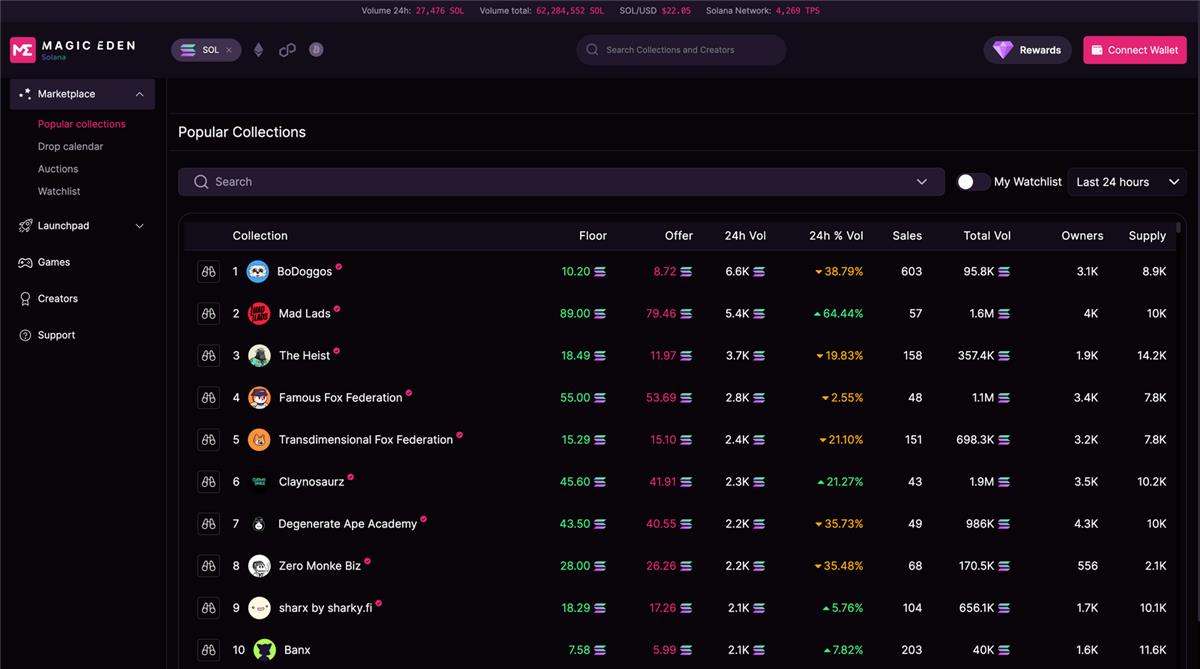
Magic Eden has emerged as the leading NFT marketplace on Solana, featuring over 8,000 listed NFT collections and offering users a one-stop platform to discover and trade Solana NFTs. Beyond its core secondary market, the platform provides a Launchpad for exclusive minting projects and collaborates with NFT brands. Users can also explore NFT gaming through Eden Games, which focuses on supporting game creators and their communities.
Other Solana Applications
If you're interested in exploring more of what the Solana application ecosystem has to offer, the following apps represent some of the most popular projects on Solana. These projects provide a wide range of features and use cases that can help you better understand Solana’s potential and practical applications:
-
Lido — Liquid Staking | $54M TVL;
-
Orca — Decentralized Exchange (DEX) | $36M TVL;
-
Solend — Lending | $37M TVL;
-
Atrix — Decentralized Exchange (DEX) | $15M TVL;
-
Francium — Leveraged Yield Farming | $12M TVL.
Join TechFlow official community to stay tuned
Telegram:https://t.me/TechFlowDaily
X (Twitter):https://x.com/TechFlowPost
X (Twitter) EN:https://x.com/BlockFlow_News
 Bankless


