Stader: Dissecting ETH Staking Products, How Can $SD Unlock Growth Potential?
TechFlow Selected TechFlow Selected
Stader: Dissecting ETH Staking Products, How Can $SD Unlock Growth Potential?
Entering ETH staking services will be a significant milestone for the Stader ecosystem development.
 Navigating Web3 tides with focused insights
Author: Yu Zhong Kuangshui

What is the future direction for LSD products?
From my perspective, the current LSD product structure is already quite mature, including centralized staking represented by Coinbase and Binance, and decentralized staking represented by Lido. The logic is simple and clear, with stable yield sources. Competitors entering later mostly focus on decentralization (even though Lido operates as an on-chain protocol, it still faces criticism for being overly centralized), low entry barriers, and yield rates.
This reminds me of a protocol I previously introduced—@staderlabs_eth. Their Ethereum staking functionality will soon launch. So today’s update will be based on the three aspects mentioned above.
1. Decentralization and Low Barriers to Entry
Stader divides validators into three groups: Stader Permissioned Stake Pool, Stader Permissionless Stake Pool, and Stader DVT Stake Pool.
Here's how I understand it: Stader aims to maximize decentralization while meeting Ethereum’s staking and validation demands by incorporating various types of validators.

The Stader Permissioned Stake Pool (permissioned pool) is managed by professional node operators. In contrast, the Stader Permissionless Stake Pool encourages home stakers and independent node operators to promote decentralization in Ethereum staking. The Stader DVT Stake Pool reflects Stader’s support for emerging decentralized technologies, ultimately aiming to further decentralize Ethereum staking.
Additionally, Stader actively promotes decentralization through $SD-powered DAO governance.
Moreover, the Stader team has committed to limiting its own ETH staking share to no more than 22% of the total staked amount, reducing centralization risks.
Stader works to lower the entry barrier for Ethereum staking in two ways:
1. Reduce the minimum staking requirement to just 4 ETH. Permissionless node operators only need to stake 4 ETH plus $SD worth 0.4 ETH to participate in node staking.
2. Cryptographic staking education. To attract node operators globally, Stader has established the ETHx Staking Academy, offering multilingual staking education and rewarding contributing community members with $SD.
Lowering barriers to entry is also one of the key paths toward achieving staking decentralization.
2. Yield
ETHx yields will come from two main sources:
1. Over years of operation, Stader’s liquid staking tokens on other chains have partnered with major DeFi protocols such as Aave, Balancer, QiDao, QuickswapDEX, Apeswap, and others. As a result, ETHx will also have opportunities to generate higher returns through these DeFi integrations.
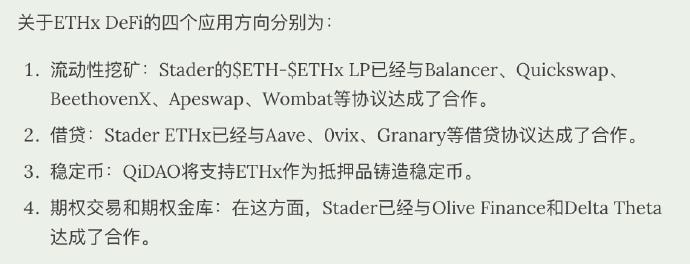
2. To incentivize more node operators to join, Stader will offer 1 million $SD tokens as rewards for active node operators.
Final Thoughts
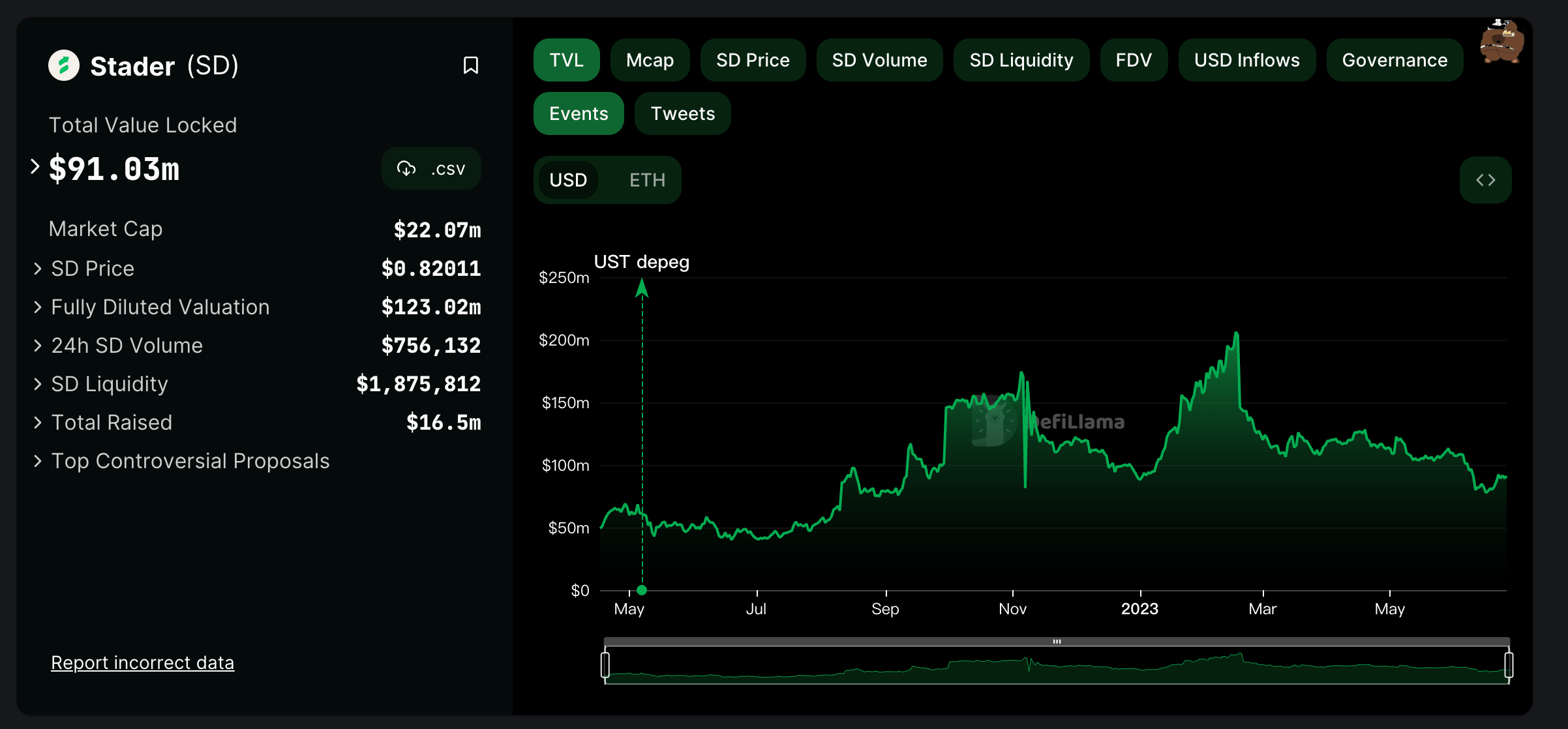
Stader currently has a TVL of $91 million and a $SD market cap of $22 million. It has been steadily and securely providing liquid staking services across six other blockchains. Entering the Ethereum staking space marks a significant milestone in Stader’s ecosystem development. What impresses me most is how well Stader understands the trends in Ethereum staking services and has made corresponding product optimizations. Another noteworthy point is that $SD is deeply integrated into the Ethereum staking ecosystem (as mentioned earlier, $SD stakers can also receive dividends from Stader’s ETH staking service). Therefore, I’ll be closely watching the price of $SD in July.
Join TechFlow official community to stay tuned
Telegram:https://t.me/TechFlowDaily
X (Twitter):https://x.com/TechFlowPost
X (Twitter) EN:https://x.com/BlockFlow_News
 雨中狂睡Sleeping in the Rain