opBNB: BNB Chain's Layer 2 Battle
TechFlow Selected TechFlow Selected
opBNB: BNB Chain's Layer 2 Battle
What exactly is opBNB, and what changes will it bring to the entire market?
 Navigating Web3 tides with focused insights
Previously, a question lingered: as OP and ZK Ethereum Layer 2 solutions flourished, would there still be opportunities for emerging public blockchains?
Today, BNBCHAIN has offered its answer—opBNB, a scaling solution built on the OP Stack.
Layer 2 is not exclusive to Ethereum; new public chains are now entering the L2 arena.
What exactly is opBNB? And what changes could it bring to the market?
What is opBNB?
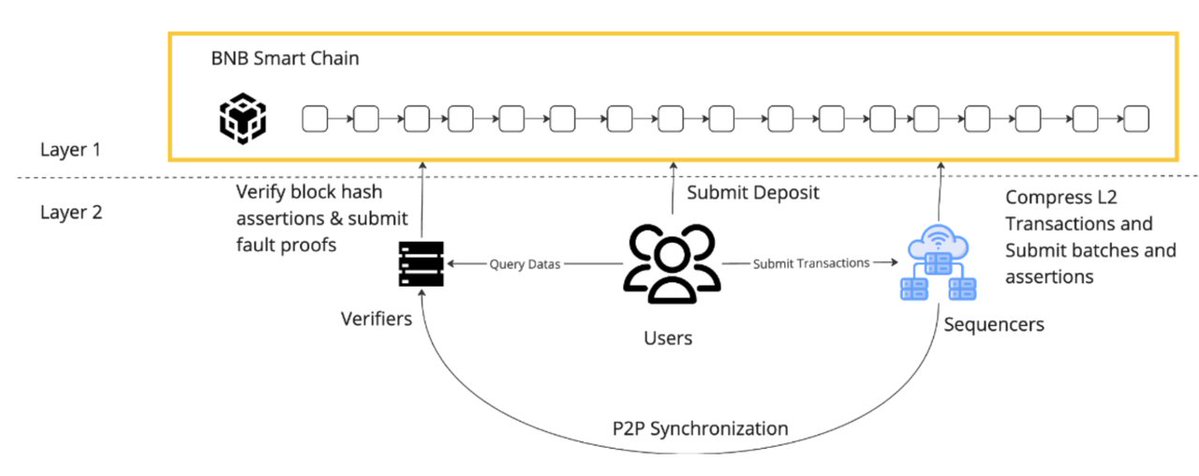
opBNB is a Layer 2 network built on BSC using OP Stack technology. Like Ethereum’s Optimism Rollup, opBNB enhances network performance by processing transaction data off-chain, then batching and submitting them to Layer 1. This enables high TPS, low gas fees, and security equivalent to that of Layer 1.
Quick fact:
Previously, Binance Chain (BC) and Binance Smart Chain (BSC) merged into a single entity renamed "BNB Chain."
BSC is a subset of BNB Chain. Since opBNB is built on BSC, it can also be referred to as an L2 of BNB Chain.
What are the features of opBNB?
1.Built on OP Stack: A standardized, open-source modular framework that allows customized chain development. For example, Coinbase's Base is also based on OP Stack. The difference lies in Base being an Ethereum L2, while opBNB serves as BSC's L2.
Why choose OP over the increasingly popular ZK?
Optimistic Rollups emphasize practicality, ease of use, high customizability, and true EVM compatibility, enabling rapid deployment for both developers and users. In contrast, ZK promises much but remains difficult to fully implement at scale today.
2.Even faster performance: While BSC is already considered fast compared to Ethereum, opBNB takes speed further.
Reportedly, opBNB will raise the gas limit to an “astonishing 100M,” surpassing Optimism’s 30M gas cap, supporting over 4,000 transactions per second with average transaction costs under $0.005.
3.BNB Greenfield as the DA layer: To reduce gas costs, OP Stack separates the Data Availability (DA) layer from execution, allowing selection of a custom DA layer. opBNB will adopt BNB Greenfield as its own storage layer.
What is the strategic significance of opBNB?
Theoretically, opBNB offers individual users a significantly improved on-chain experience: faster speeds and lower fees. Thanks to EVM compatibility, developers can quickly migrate projects from Ethereum or BSC L1. Not only DeFi, but also gaming and social applications will benefit from low-cost, high-speed infrastructure.
However, in reality, we are currently in a bear market. At present, BSC does not face clear bottlenecks in terms of TPS or gas fees. Therefore, in my view, opBNB is a forward-looking initiative—especially as OP and ZK-based chains race ahead, BSC naturally cannot afford to fall behind. This move prepares BSC for the upcoming L2 wars.
First, it awaits the return of a bull market. Second, it anticipates the widespread adoption of large-scale applications—particularly those demanding high performance, low latency, and frequent interactions. Which types of applications fit this profile?
I believe the main candidates include: games, especially fully on-chain games; on-chain social platforms with genuine scarcity use cases; metaverses hosting massive real user bases; and high-frequency trading...
Only when these conditions are met will opBNB truly come into its own.
L2 security relies on L1, and uses L1 tokens for gas. opBNB similarly uses BNB as its gas and payment token, which will greatly expand BNB’s utility in the future.
Moreover, opBNB can seamlessly integrate with the entire BNB ecosystem—the key advantage distinguishing it from other L2s. It gains immediate access to BNB’s vast user base, eliminating the need to build from scratch.
Finally, I look forward to seeing opBNB reach its full potential. When on-chain activity becomes bustling again, that day may signal the long-awaited return of the bull market.
Join TechFlow official community to stay tuned
Telegram:https://t.me/TechFlowDaily
X (Twitter):https://x.com/TechFlowPost
X (Twitter) EN:https://x.com/BlockFlow_News
 深潮TechFlow




![In-depth Analysis of Trade[XYZ]: How Were 92 Markets and 98% HIP-3 Trading Volume Established?](https://upload.techflowpost.com/upload/images/20260716/20260716061117965147.jpeg?x-oss-process=image/resize,p_50/quality,q_80)