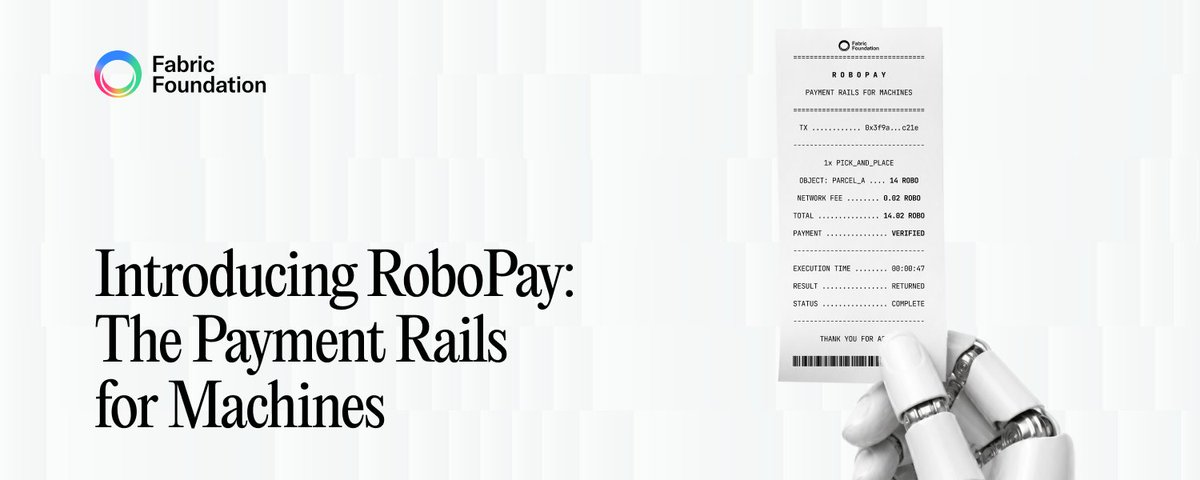
RoboPay Introduction: The Payment Rail for Machines
TechFlow Selected TechFlow Selected
RoboPay Introduction: The Payment Rail for Machines
RoboPay enables developers to publish bot features in the form of paid actions.
 Navigating Web3 tides with focused insights
Author:Fabric Foundation
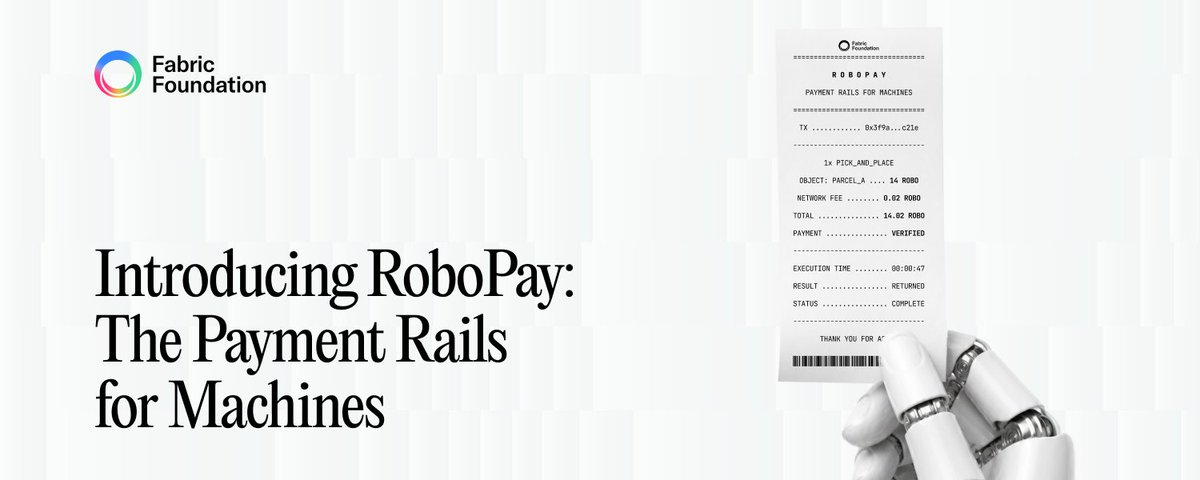
Turning Robot Capabilities into Programmable, Payable Services
Robots are becoming increasingly powerful, but most of their capabilities remain locked within their respective SDKs, local control systems, and one-off integration solutions.
A robot may be capable of item delivery, on-site inspection, image capture, object handling, and even executing various complex tasks, but developers still lack a standardized method to bind payment capabilities with these robot actions, thereby building applications truly oriented towards autonomous economic activities around them.
To truly realize the machine economy, robot capabilities cannot remain solely at the technical function level; they must also possess discoverability, invocability, payability, and verifiability.
Therefore, we announce the official launch of RoboPay: payment infrastructure for machines.
Official Website: https://robopay.fabric.foundation/
What is RoboPay?
RoboPay enables developers to expose robot functions as paid operations.
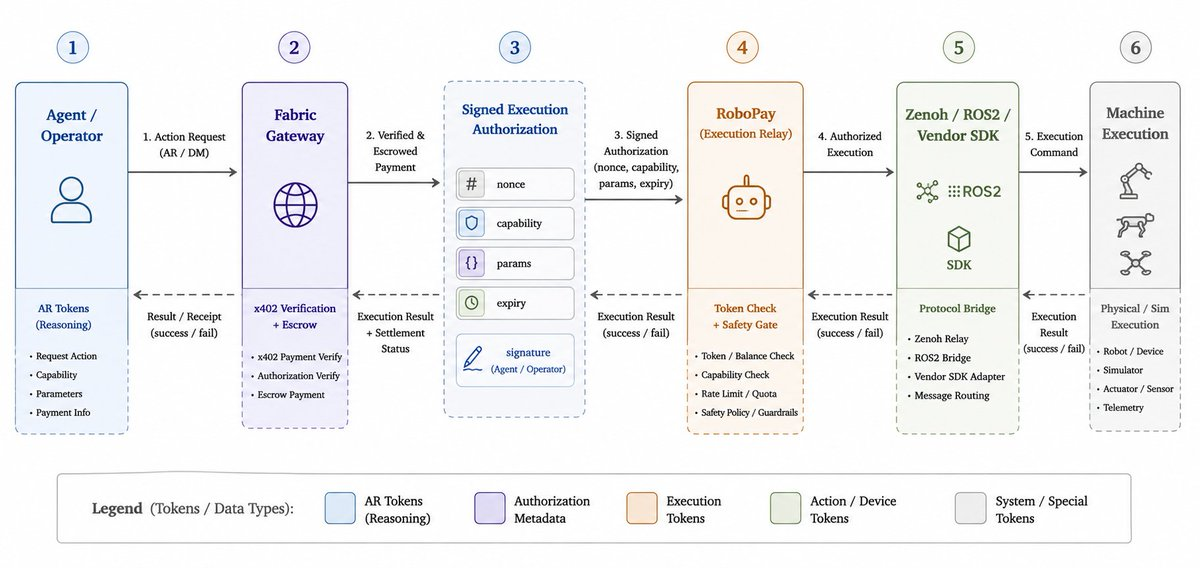
Developers can define robot skills, set prices and execution rules for them, receive authorized payment requests, and return structured results after the robot completes or rejects the operation.
The entire process is very simple:
Payment → Verify Payment → Execute Task → Return Result
We call this model Pay-to-Actuate, which can be applied to humanoid robots, robotic arms, mobile robots, drones, cameras, simulation systems, and other connected machine devices.
RoboPay is not limited to a single type of application or a single type of caller. Paid robot operations can be triggered by Web applications, marketplaces, enterprise workflows, other machines, or AI Agents.
Among them, capabilities oriented towards AI Agents are provided by RoboPay Agent Skill, which allows AI Agents to:
- Discover robot service interfaces
- Complete payments
- Initiate robot action requests
These components together constitute the infrastructure of a new economic system, in which AI Agents, humans, and machines jointly become economic participants.
Related introduction: https://x.com/FabricFND/status/2077176998368354568
Building Applications for the Machine Economy
The opportunities for RoboPay go far beyond letting AI assistants control robots.
For example:
- A logistics platform can pay mobile robots per delivery;
- A property management platform can pay robots per inspection;
- A robot marketplace can sell robotic arm usage rights per task or per hour;
- A data platform can pay to call cameras and robots to complete designated data collection;
- A robot operator can open up idle robot capabilities as on-demand services to generate revenue.
In these scenarios, robots are no longer just hardware devices, but can become true economic participants, capable of providing various functions, receiving requests, executing specific work, and creating revenue.
RoboPay provides developers with a unified infrastructure, allowing them to quickly build relevant applications without needing to redesign payment and execution processes for each type of robot.
RoboPay Integration Bounty Officially Launched
To accelerate ecosystem building, we are officially launching the RoboPay Integration Bounty program.
This is a one-month developer program with a total prize pool of 1,000,000 ROBO
Event Official Website: https://robopay.fabric.foundation/bounties
Prize Pool and Tasks
This bounty program covers 12 leading robot platforms, including humanoid robots, robotic arms, and robot dogs. Each platform offers four integration tasks with increasing difficulty, and developers can choose different levels of complexity to contribute based on their needs.
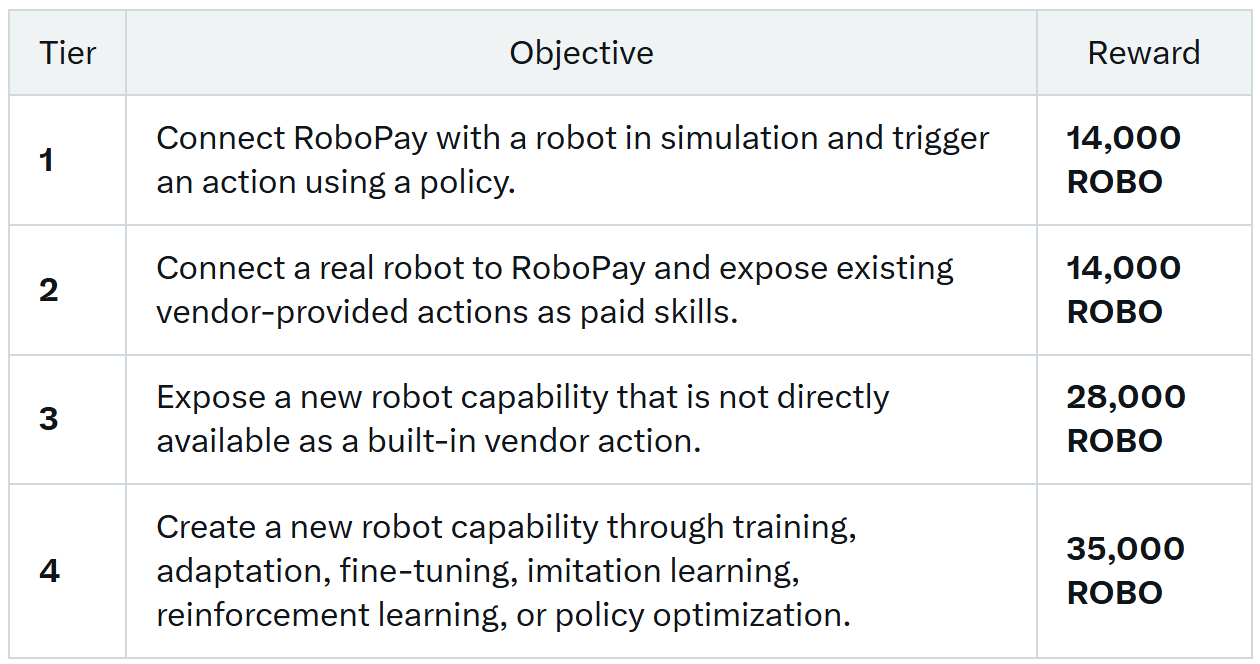
Each robot has its corresponding bounty tasks. All rewards follow a first-come, first-served principle, meaning: for a specific task, the first Pull Request (PR) that passes review and is successfully Merged will receive the corresponding reward.
Success Criteria
We are looking for integration solutions that can be deployed in production environments, not just simple Demos.
Each submission must fully demonstrate the entire Pay-to-Actuate workflow, including:
- Requests with completed payment authorization
- Transmitting requests via RoboPay and Zenoh
- Successfully driving the robot to execute tasks
- Asynchronously returning execution results
In addition, submissions must also publicly disclose discoverable robot skills and their pricing, ensure payment security, include reproducible documentation, and provide sufficient evidence for reviewers to verify the implementation.
Detailed requirements: https://github.com/fabricfoundation/RoboPay/wiki
How to Participate?
The participation process is very simple:
Step 1: Select a task in the Bounty Marketplace
Select the corresponding robot model and task level (Tier), and click Apply.
Step 2: Redirect to GitHub
The official website will automatically guide you to the GitHub page to submit a Pull Request (PR) in the corresponding repository.
Step 3: Please read the Success Criteria carefully before submitting
Ensure your implementation meets all review requirements.
Step 4: Official Review
The team will review submissions based on the publicly available Success Criteria.
If your Pull Request meets the requirements, you will receive the corresponding bounty reward.
Event Time
Submission Deadline: From now until August 21, 2026 00:00:00 (PT)
Join the Machine Economy
The reason the internet became programmable is because developers built upon open protocols. We believe robot technology will follow the same path.
Every robot integrated with RoboPay will become another programmable participant in the machine economy. Every contribution will expand developers' building capabilities, from AI Agents and robot marketplaces to logistics, automation, and more new applications yet to be born.
The bounty program is just the beginning, and we can't wait to see your work.
Join TechFlow official community to stay tuned
Telegram:https://t.me/TechFlowDaily
X (Twitter):https://x.com/TechFlowPost
X (Twitter) EN:https://x.com/BlockFlow_News
 @FabricFND
![In-depth Analysis of Trade[XYZ]: How Were 92 Markets and 98% HIP-3 Trading Volume Established?](https://upload.techflowpost.com/upload/images/20260716/20260716061117965147.jpeg?x-oss-process=image/resize,p_50/quality,q_80)